Tax Refunds When Leaving Germany: How to Claim and What to Know
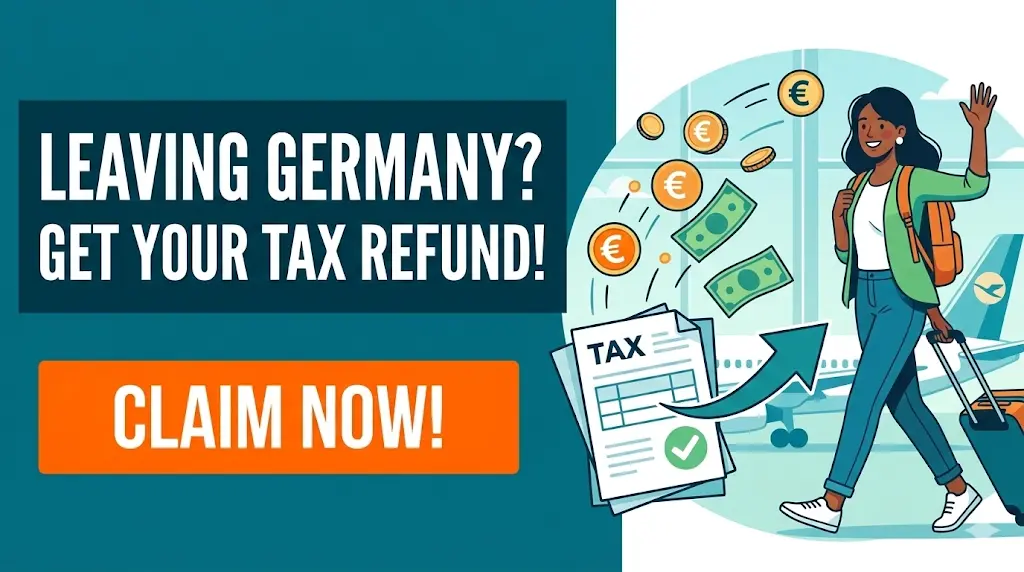
Leaving Germany often means leaving money on the table if you fail to claim your tax and pension refunds. This comprehensive guide explains how to navigate deregistration, file a fractional year return, and successfully retrieve your social security contributions from abroad.
Disclosure: This post may contain affiliate links. We may earn a commission at no extra cost to you if you make a purchase through these links. Read full disclosure.
Understanding Your Tax Status Upon Departure
How Deregistration Impacts Tax Residency
When you decide to leave Germany permanently, the most critical administrative step you must take is deregistering your address. This process, known as the Abmeldung, officially notifies the German government that you no longer reside within its borders. Without this vital piece of paper (the Abmeldebescheinigung), the local authorities, your health insurance provider, and the tax office (Finanzamt) will assume you are still living in the country and subject to unlimited tax liability. You can usually process your deregistration at the local citizens’ office (Bürgeramt) up to seven days before your departure or within 14 days after leaving.
Your exact deregistration date dictates the end of your unlimited tax liability in Germany. Up until the day you deregister, the German government retains the right to tax your worldwide income. After your deregistration date, provided you do not maintain another home in Germany or spend more than 183 days a year there, you transition to limited tax liability. This means Germany can only tax income that is strictly generated within its borders, such as rental income from a German property.
Failing to complete the Abmeldung properly can lead to a nightmare of phantom tax bills. The Finanzamt may estimate your income for the periods after you left, issuing massive tax demands that you must legally fight from your new home country. Furthermore, you cannot easily cancel your mandatory health insurance or mobile phone contracts without the official deregistration certificate.
The Fractional Tax Year Explained
The German tax system is designed around the assumption that you will earn your current monthly salary for the entire twelve-month calendar year. Your employer calculates your monthly income tax (Lohnsteuer) based on this annual projection. However, when you leave Germany in the middle of the year, you create a “fractional tax year.” This fractional year is the primary mechanism that generates massive tax refunds for departing expats.
For example, if you earn a high salary but leave Germany in June, your employer taxed your January through June paychecks assuming you would earn that high salary all year, pushing you into a higher progressive tax bracket. Because you left in June, your total actual German income for the year is only half of the projection. This means you were significantly overtaxed during those first six months because your true annual income bracket is much lower than the employer’s calculation.
When you file your tax return the following year, the Finanzamt reconciles this discrepancy. They recalculate your tax burden based on your actual, lower total earnings for the months you were a resident. The difference between the high taxes withheld by your employer and your true, lower tax liability is returned to you as a refund. To fully grasp how these brackets work, you can review our guide on German Income Tax Brackets: How Much Will You Pay?.
Mandatory versus Voluntary Filing When Leaving
A common misconception among departing expats is that leaving the country automatically triggers a mandatory tax return. In reality, the rules for mandatory filing remain largely the same whether you stay or leave. If you are a single employee in Tax Class I with no secondary income, filing a return is generally voluntary (Antragsveranlagung). However, as explained with the fractional tax year, choosing not to file a voluntary return when leaving mid-year is a terrible financial decision, as you will forfeit your overpaid taxes to the state.
There are scenarios where departing explicitly triggers a mandatory return (Pflichtveranlagung). If you received wage replacement benefits like short-time work allowance (Kurzarbeitergeld) or unemployment benefits before you left, you must file. More importantly, if you move to a new country and begin earning a salary there during the exact same calendar year you left Germany, you are subject to the progression clause (Progressionsvorbehalt). You must declare your new foreign salary to the Finanzamt. While Germany will not tax your new foreign salary, they will use it to determine the correct tax bracket for the income you did earn in Germany before leaving.
If you fall into the mandatory filing category, you are subject to strict deadlines, typically falling in the summer of the year following your departure. Missing these deadlines while living abroad will result in late penalties and interest charges accumulating in your name back in Germany. If you are unsure about your exact filing obligations, brushing up on Tax Deadlines in Germany is essential to avoid unwanted mail from the Finanzamt arriving at your new international address.
Claiming Your German Income Tax Refund
Gathering Essential Documentation Before You Move
Trying to retrieve missing German tax documents while sitting in an apartment in London or New York is an exercise in immense frustration. Before you board your flight out of Germany, you must meticulously gather your financial paperwork. The most critical document is your annual wage tax statement (Lohnsteuerbescheinigung). If you leave mid-year, your employer might not issue the official annual certificate until the end of February the following year, so you must ensure they have your correct foreign forwarding address and personal email.
Additionally, you must retain your permanent German Tax Identification Number (Steuer-Identifikationsnummer or Steuer-ID) and your local tax number (Steuernummer). Do not throw these away; they remain valid for your entire life, and you will need them to file your return from abroad. Keep digital copies of all your final payslips, your deregistration certificate (Abmeldebescheinigung), and any receipts for deductible expenses you incurred during your final year in Germany.
Because you will need to log into German government portals and banking apps from a foreign country to manage this process, you may encounter geo-blocking or trigger automated security freezes on your accounts. To prevent this, utilizing a high-quality Virtual Private Network is crucial. By running NordVPN on your laptop, you can route your internet connection through a German server, ensuring you maintain seamless, secure access to the ELSTER tax portal and your German banking infrastructure while navigating your cross-border move.
Deductible Relocation and Moving Expenses
The German tax system is surprisingly generous when it comes to professional relocation expenses, and this applies both when you move to Germany and when you move away from Germany. If your departure is primarily motivated by professional reasons—such as a corporate transfer to a foreign branch or accepting a new job offer in another country—a significant portion of your moving costs can be deducted as income-related expenses (Werbungskosten).
You can potentially deduct the cost of your international flights, the invoice from the international shipping or logistics company that moved your furniture, and even broker fees related to terminating your German lease early. By piling these massive relocation expenses onto your final German tax return, you drastically lower your taxable income base for that fractional year, dramatically increasing the size of the final refund you will receive from the Finanzamt.
However, you cannot deduct moving expenses if you are leaving Germany purely for private reasons, such as retiring abroad, returning home because you missed your family, or deciding to travel the world. The Finanzamt will require proof of your professional motivation, usually in the form of your new foreign employment contract dated around the time of your departure. To see how these professional deductions typically function, you can read our comprehensive overview of Filing a Tax Return in Germany.
Filing Methods and Digital Tools from Abroad
Filing a German tax return from another continent used to require expensive international postage and a deep understanding of German bureaucratic law. Today, the process is entirely digitized. You can use the government’s official online portal, ELSTER, to submit your return electronically from anywhere in the world. However, ELSTER remains exclusively in complex German and offers zero tax optimization advice, making it notoriously difficult for non-native speakers.
The far superior alternative for departing expats is utilizing third-party tax software specifically designed for the English-speaking market, such as Taxfix, Wundertax, or SteuerGo. These platforms guide you through a conversational English questionnaire, dynamically categorizing your fractional year income and international relocation expenses into the correct official German forms. They handle the complex backend ELSTER transmission on your behalf, usually for a modest flat fee, making them incredibly cost-effective.
If your financial situation is highly complex—for instance, if you are leaving behind German real estate that you will now rent out, or if you are dealing with complex corporate exit taxes—software will not suffice. In these scenarios, you must retain a certified German tax advisor (Steuerberater) before you leave. They will act as your legal representative in Germany, handling all correspondence with the Finanzamt and ensuring your global assets are shielded from double taxation. If you need help deciding, our guide on Hiring a Tax Advisor in Germany provides a detailed cost-benefit analysis.
The German Pension Refund Explained
Eligibility Criteria for Expat Pension Refunds
While income tax refunds grab most of the attention, the German pension refund is often vastly more lucrative. Every month you worked in Germany, nearly 10% of your gross salary was deducted and paid into the statutory German pension insurance system (Deutsche Rentenversicherung). For many expats leaving the country, these contributions are not lost forever; they can be refunded in full under very specific legal conditions.
To be eligible for a pension refund, you must generally be a non-EU citizen. Citizens of the European Union, the European Economic Area, and Switzerland are structurally prohibited from claiming a refund, as their German pension contributions are simply retained and combined with their home country’s pension calculations upon retirement. For non-EU citizens (such as Americans, Indians, or Australians), the primary rule is the “60-month threshold.” You must have contributed to the German pension system for fewer than 60 months (five years) in your entire lifetime.
If you contributed for 60 months or more, your contributions are permanently locked into the German system, and you will simply receive a monthly German pension payout when you reach the legal retirement age, regardless of where in the world you live. The second critical eligibility criteria is the waiting period: you must have officially moved out of the European Union and waited a minimum of 24 full calendar months after your last German pension contribution before you can even submit the refund application.
Calculating the Value of Your Pension Contributions
Understanding exactly how much money you will get back requires looking closely at your payslips. Your total monthly pension contribution (Rentenversicherung) was roughly 18.6% of your gross salary. However, you only paid half of that amount (9.3%), while your employer subsidized the other half (9.3%).
When you apply for a pension refund, you are only legally entitled to receive the employee portion—the 9.3% that was physically deducted from your own paycheck. The employer’s matching contributions remain in the German state coffers; they are never refunded to you or your company. Even so, 9.3% of your gross salary over two, three, or four years amounts to a staggering sum of money, often easily reaching tens of thousands of euros for highly skilled expats.
| Scenario | Leave the Money in Germany | Claim the Pension Refund |
| Years Worked | 1 to 4 Years (< 60 months) | 1 to 4 Years (< 60 months) |
| Financial Outcome | Receive a tiny monthly pension at age 67. | Receive a massive lump sum payment 24 months after leaving. |
| Employer Match | Retained in calculation for future payout. | Forfeited to the German state. |
| Investment Potential | Zero growth (fixed state points system). | Can be invested immediately in global markets for compounding growth. |
Choosing whether to take the refund (if eligible) or leave it in the system is a major financial decision. Most financial advisors recommend that eligible expats take the lump sum refund. The logic is that retrieving tens of thousands of euros in your thirties and investing it into a globally diversified portfolio via a platform like Interactive Brokers will generate vastly more long-term compound wealth than waiting thirty years for a micro-pension of 150 euros a month from the German state.
Step-by-Step Pension Refund Application Process
The actual process of claiming your pension refund is famously bureaucratic and requires immense patience. Exactly 24 months after your final contribution (which usually aligns with your last German paycheck), you must complete the official application form known as the V0901, provided by the Deutsche Rentenversicherung (DRV).
The complexity lies in proving your identity and your current non-EU residency. You cannot simply email the form. You must take your completed application, your physical passport, and proof of your current residency in your new country to a certified authority. This usually means booking an appointment at the nearest German embassy or consulate in your new home country, where a consular official will officially stamp and notarize your signature and documents.
Once notarized, you must physically mail the massive stack of paperwork back to the DRV headquarters in Germany. Processing times vary wildly, but it is entirely normal to wait three to six months before the DRV approves the refund. When approved, they will wire the lump sum directly to the bank account you specified on your application. Because this sum is often massive, ensuring you optimize the international wire transfer to avoid devastating banking fees is your final administrative hurdle.
Managing Cross-Border Finances After Relocation
Keeping a German Bank Account Open
To receive your income tax refund and your eventual pension refund, you need a highly reliable banking infrastructure. The problem is that traditional German brick-and-mortar banks (like Sparkasse or Deutsche Bank) strictly require a registered German address. Once they realize you have deregistered and moved abroad, they will forcefully close your Girokonto, often giving you only a few weeks’ notice to move your funds.
If the Finanzamt tries to send your tax refund to a closed account, the money bounces back, leading to agonizing bureaucratic delays. To prevent this, you should transition your banking to an agile, borderless platform before you leave. A neo-bank like N26 is often far more accommodating to expats who are moving across borders. Depending on your new destination country, you may be able to simply update your address in the app while retaining your German IBAN.
Maintaining a functional European IBAN is critical not just for receiving refunds, but for paying any lingering German utility bills, settling final internet contracts, or managing deposits returned by your landlord months after you have left.
Optimizing International Currency Transfers
When your tax refund or massive pension payout finally clears, it will arrive in Euros. If you have moved to the United States, the UK, India, or anywhere outside the Eurozone, you face the challenge of repatriating that wealth without losing a massive percentage to legacy banking fees.
If you allow a traditional German bank to execute a standard SWIFT wire transfer to your new foreign bank account, you will be penalized twice. First, the bank will charge a flat international wire fee. Second, and far more destructively, they will apply a hidden markup to the exchange rate, often keeping 2% to 4% of your total transfer as pure profit. On a 20,000 euro pension refund, that hidden margin could cost you 800 euros.
To protect your wealth, you must execute these transfers using a dedicated peer-to-peer currency exchange network. Utilizing Wise is practically mandatory for expats repatriating large sums. By providing you with local account details in multiple currencies, they allow you to move your German refunds at the true mid-market exchange rate, charging only a tiny, completely transparent upfront fee. This ensures that the maximum possible amount of your hard-earned refund actually arrives in your new home country.
Handling Capital Gains and Exit Taxes
For expats who built significant wealth while living in Germany, leaving the country triggers complex capital gains evaluations. If you hold a standard retail portfolio of ETFs or stocks, you generally do not owe the German government any taxes on unrealized gains when you move. You simply update your residency status with your brokerage, and your future capital gains will be taxed by your new home country.
However, if you own more than 1% of the shares in a corporation, or if you hold significant cryptocurrency assets that you bought less than a year ago, leaving Germany can trigger an exit tax (Wegzugsbesteuerung). The government effectively pretends that you sold all your highly valuable assets on the day you deregistered, forcing you to pay capital gains tax on the theoretical profit before you are allowed to leave the tax system.
Conclusion
To navigate these global asset shifts without triggering unnecessary liquidations or violating Double Taxation Agreements, expats must utilize internationally portable brokerages. Consolidating your assets into a unified platform like Interactive Brokers allows you to maintain your investment portfolio regardless of your global residency status.
Instead of selling everything, triggering a massive tax event, and closing a local German depot, you simply update your tax residency within the platform and continue growing your wealth in your new country seamlessly.
References
Primary sources (official)
- Federal Ministry of Finance (BMF): Official information on income tax, the saver’s allowance, and recent changes to the commuter allowance (Pendlerpauschale). https://www.bundesfinanzministerium.de/
- ELSTER: The official portal of the German tax administration for secure electronic tax return submissions. https://www.elster.de/eportal/start
Other helpful sources
- Make it in Germany: The official government portal detailing taxation structures, allowances, and social security for qualified international professionals. https://www.make-it-in-germany.com/en/living-in-germany/money-insurance/taxes
Disclaimer
The information provided in this article is for educational and informational purposes only and does not constitute financial, investment, legal, or tax advice. German tax laws, deregistration procedures, and the strict eligibility requirements for pension refunds are highly complex and subject to change by the respective federal authorities. Always conduct your own independent research and strongly consider consulting a certified Steuerberater (tax advisor) specializing in international law before making cross-border financial decisions or submitting official refund applications. We assume no liability for any financial losses or administrative penalties resulting from actions taken based on the contents of this guide.