Banking and Insurance in Germany: Guide to Financial Services for Foreigners
Setting up your financial life in Germany involves navigating a complex ecosystem of mandatory insurances, deeply ingrained cash cultures, and meticulous tax regulations. This comprehensive guide provides expats with the strategies needed to master German banking, secure vital insurance, and protect their wealth.
Disclosure: This post may contain affiliate links. We may earn a commission at no extra cost to you if you make a purchase through these links. Read full disclosure.
Navigating the German Banking Landscape
Traditional Banks Versus Digital Banks
When you first arrive in Germany, securing a reliable place to store your money is paramount. The banking landscape is broadly divided into two major categories: traditional branch-based banks and modern digital-first neobanks. Traditional institutions, known as Filialbanken, include massive private banks like Deutsche Bank and Commerzbank, as well as local cooperative banks like the Sparkasse or Volksbank. These established entities offer profound security and a wide array of sophisticated financial products, including mortgage lending and business loans. For expats looking to permanently settle and eventually buy property, establishing a long-term relationship with a traditional bank manager can be an invaluable asset down the line.
However, traditional German banks are notorious for their bureaucratic hurdles. Opening an account usually requires scheduling an in-person appointment, presenting a physical registration certificate (Meldebescheinigung), and navigating reams of paperwork that are almost exclusively printed in complex legal German. Furthermore, many traditional accounts come with monthly maintenance fees (Kontoführungsgebühren) ranging from €5 to €15, unless you can guarantee a high minimum monthly deposit. For newly arrived foreigners who might still be searching for a permanent apartment or waiting for their first paycheck, these requirements can pose a significant roadblock.
To bypass these initial frustrations, a massive percentage of the expat community turns to modern neobanks like N26. These digital-first institutions have fundamentally disrupted the German market by offering an entirely app-based onboarding process. You can typically open an N26 account from your smartphone in minutes using a simple VideoIdent verification process, often before you even officially register your German address. With their user interfaces completely available in English, zero monthly fees for basic accounts, and instant push notifications for every transaction, these digital alternatives provide a frictionless, immediate solution for securing a German IBAN.
Essential Account Types for Expats
The absolute cornerstone of your financial existence in Germany is the Girokonto, or current account. This is the account where your employer will deposit your monthly salary and from which you will pay your rent, health insurance, and utility bills. Almost all domestic financial transactions in Germany operate via SEPA (Single Euro Payments Area) direct debits (Lastschrift), making a functional Girokonto absolutely non-negotiable. Without one, you will find it nearly impossible to secure a long-term mobile phone contract or even register for a local gym membership.
Once your basic liquidity is established, you should look into opening a Tagesgeldkonto. This is an instant-access savings account designed to hold your emergency fund. In Germany, it is highly recommended to keep three to six months’ worth of living expenses readily available. A Tagesgeldkonto keeps your savings entirely separate from your daily spending account, reducing the temptation to overspend while still allowing you to withdraw the funds within 24 hours if an unexpected expense, like a sudden car repair or a medical co-pay, arises. While interest rates fluctuate, these accounts offer a safe harbor protected by the robust German Deposit Guarantee Scheme.
For international students or job seekers arriving on specific visas, a third type of account is often mandatory: the Sperrkonto, or blocked account. German immigration law dictates that individuals from outside the European Union must prove they have sufficient financial resources to sustain themselves for a year without relying on state welfare. A Sperrkonto holds these required funds in escrow, automatically releasing only a strict monthly allowance into your standard Girokonto. Setting up this specialized account correctly is a vital step in your immigration process, often running parallel to securing your mandatory health coverage, as discussed in our Moving to Germany Checklist.
Overcoming Language Barriers in Financial Institutions
One of the most daunting aspects of managing money in a foreign country is the language barrier. German financial and legal terminology is exceptionally dense. Words like Dispositionskredit (overdraft facility) or Freistellungsauftrag (tax exemption order) can easily confuse even intermediate German speakers. When dealing with traditional banks, you will quickly discover that many clerks, especially in smaller towns, are either unable or legally hesitant to provide binding financial advice in English due to strict compliance regulations.
To overcome this, expats must be proactive. If you absolutely must use a traditional bank, consider bringing a bilingual friend or hiring a relocation consultant to accompany you to your initial account-opening appointment. Before signing any contract, ask for a copy to take home. You can then use digital translation tools to thoroughly review the fee structures, penalty clauses, and cancellation notice periods. Never sign a German financial document that you do not fully comprehend, as verbal assurances hold very little weight against a signed physical contract in German court.
Alternatively, choosing financial service providers that explicitly cater to the international community eliminates this stress entirely. Neobanks and modern insurance brokers have built their entire business models around providing comprehensive English-language support. From the initial terms of service to live chat support when a card is lost, utilizing English-first platforms ensures you remain in complete control of your assets. For a deeper understanding of how language impacts your overall transition, exploring Living in Germany as an Expat can provide broader cultural context.
Day to Day Financial Transactions in Germany
The Girocard and Cash Culture Explained
Despite its status as a global economic powerhouse, Germany retains a famously stubborn attachment to physical cash (Bargeld). While the global pandemic slightly accelerated the adoption of contactless payments, you will still routinely encounter bakeries, independent cafes, flea markets, and rural restaurants that proudly display signs reading “Nur Bargeld.” For expats accustomed to paying for a single coffee with a tap of their smartwatch, this reliance on coins and banknotes requires a significant daily adjustment. Always keeping €20 to €50 in cash in your wallet is a practical necessity to avoid awkward situations at the checkout counter.
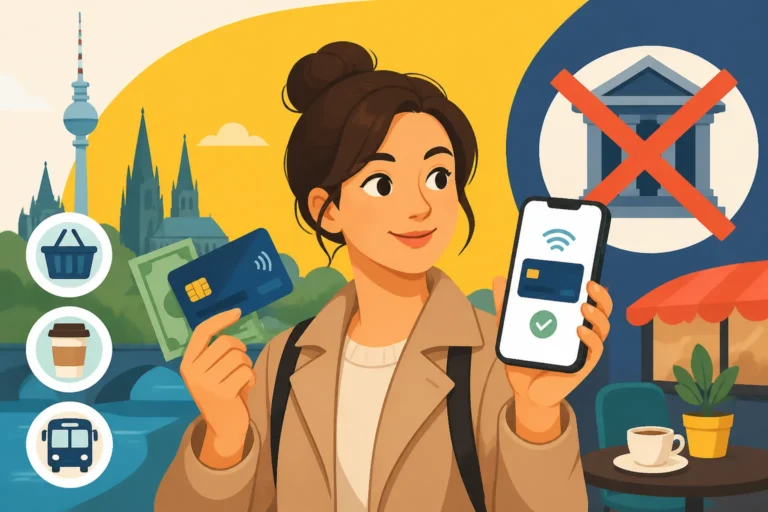
When Germans do use plastic, they overwhelmingly prefer the Girocard (historically referred to as the EC-Karte). The Girocard is a proprietary German debit card system directly linked to your Girokonto. It is crucial to understand that a Girocard is not a Visa or Mastercard debit card. Many large German grocery chains, post offices, and government civic centers (Bürgerämter) will accept a Girocard but will instantly reject an international Visa or Mastercard due to the higher merchant processing fees associated with international networks.
When you open a bank account, you must ensure that a physical Girocard is included in your package. Some modern digital banks have stopped issuing Girocards as their default, opting instead to provide a standard Mastercard debit card. While the Mastercard works perfectly for online shopping and large international retailers, relying on it exclusively will leave you unable to pay at smaller local vendors. Navigating these payment quirks is an essential part of mastering the true Cost of Living in Germany.
Managing International Money Transfers
For expats, financial life is rarely confined to a single country. You may need to send portions of your salary back home to support family, pay off a lingering student loan, or transfer massive sums of capital to Germany to secure a deposit for renting an apartment. If you attempt to execute these cross-border transfers using your traditional German bank, you will likely encounter exceptionally poor currency exchange rates and hidden correspondent banking fees that can siphon hundreds of euros from your hard-earned money.
To circumvent these punitive costs, international residents lean heavily on specialized currency exchange platforms like Wise. By utilizing Wise, you can transfer funds between your home country and Germany at the real mid-market exchange rate—the exact rate you see on Google—while paying only a small, transparent upfront fee. This mechanism fundamentally bypasses the archaic SWIFT network fees that traditional banks rely upon to generate profit from international clients.
Furthermore, Wise offers a highly versatile multi-currency account. This allows you to hold balances in Euros, US Dollars, British Pounds, and dozens of other currencies simultaneously. If the exchange rate is currently unfavorable, you can hold your funds in their native currency until the market shifts in your favor. This level of granular control over your international liquidity is indispensable for anyone living a truly global lifestyle and dealing with cross-border tax liabilities.
Credit Cards and Consumer Debt Practices
The German attitude toward consumer debt is highly conservative. The very word for debt in German, Schulden, shares its linguistic root with the word for guilt, Schuld. Consequently, the aggressive credit card culture prevalent in North America—where consumers routinely carry revolving balances and pay exorbitant monthly interest rates—simply does not exist in mainstream German society.
When you apply for a credit card (Kreditkarte) through a German bank, you will most likely be issued a “charge card.” With a charge card, your credit limit is tied strictly to your monthly income, and the entire balance of the card is automatically deducted from your linked Girokonto at the end of every single billing cycle. You cannot choose to pay only a “minimum balance” and roll the debt over to the next month. This rigid structure forces consumers to live within their means and prevents the spiraling debt traps common elsewhere.
Real revolving credit cards do exist, usually offered by specialized international issuers or airlines, but they are viewed with caution. If you are an expat attempting to build a credit score, you should know that in Germany, credit scores are not built by actively taking on debt and paying it off. In fact, having too many credit cards or frequently utilizing your bank account’s overdraft facility (Dispokredit) can negatively impact your perceived financial stability. Managing your monthly budget strictly with available funds is the safest path forward.
Building Wealth and Investing Locally
Brokerage Accounts and Stock Market Access
Once you have established your emergency savings, protecting your wealth from inflation requires entering the investment market. To buy stocks, bonds, or funds in Germany, you need to open a Depot (brokerage account). While every major traditional bank will gladly open a Depot for you, their trading commissions and custodial fees are often prohibitively high, frequently eating into your long-term returns.
Savvy expats and younger German investors generally prefer utilizing modern “neobrokers” or sophisticated international platforms. For expats who desire a highly professional, globally integrated trading environment, Interactive Brokers is a premier choice. Interactive Brokers provides unparalleled access to global financial markets, allowing you to trade equities, options, and futures across European, American, and Asian exchanges from a single interface. Their exceptionally low commission structure makes them ideal for both active traders and long-term passive investors.
Operating a brokerage account requires a basic understanding of your risk tolerance and investment horizon. The German stock market, symbolized by the DAX index, features many world-leading industrial, automotive, and chemical companies. However, most financial advisors recommend profound diversification rather than betting on single local equities. Using platforms that allow you to invest globally ensures your portfolio is not overly exposed to the regional economic fluctuations of Central Europe.
Understanding Capital Gains Tax
Investing in Germany introduces you to the Abgeltungsteuer, the flat-rate withholding tax on capital gains. Whether you earn dividends from your stock portfolio, realize a profit from selling shares, or simply earn interest on a high-yield savings account, the German tax authority (Finanzamt) claims a flat 25% of those profits. On top of this 25%, you must also pay the solidarity surcharge (Solidaritätszuschlag) and, if you are a registered member, church tax (Kirchensteuer), bringing the total tax rate closer to 26.375% or 28%.
Fortunately, the government provides a buffer for smaller investors known as the Sparerpauschbetrag (saver’s tax-free allowance). For the 2026 tax year, the first €1,000 of your capital gains is completely tax-free for single individuals, and €2,000 for married couples filing jointly. To automatically utilize this allowance, you must file a Freistellungsauftrag (exemption order) with your German bank or broker. If you fail to submit this form, the broker will automatically deduct the 25% tax from your very first euro of profit, forcing you to reclaim it later on your annual tax return.
If you are using an international brokerage platform like Interactive Brokers, they generally will not withhold German taxes on your behalf. This places the legal onus entirely on you to meticulously track your realized gains, dividends, and losses throughout the year, and accurately report them on the Anlage KAP form during your annual tax declaration.
Safe Investment Vehicles and Savings Plans
For expats who prefer a highly automated, “set it and forget it” approach to building wealth, the ETF-Sparplan (ETF savings plan) is the most popular investment vehicle in Germany. An ETF savings plan allows you to automatically invest a fixed amount of money—often as little as €25 or €50—on a specific day every single month into a broadly diversified index fund, such as the MSCI World or the FTSE All-World.
This strategy utilizes the concept of euro-cost averaging, smoothing out the extreme volatility of the stock market by consistently buying shares regardless of whether the market is up or down. Almost all modern German brokers offer hundreds of ETFs eligible for these savings plans, frequently executing the monthly trades completely free of commission charges. It is an incredibly powerful, low-effort tool for building a retirement nest egg over several decades.
For ultra-conservative savers, Germany also offers the Bausparvertrag (building society savings contract). This is a highly specialized, closed-loop financial product designed specifically for people planning to buy real estate. You save a fixed amount for several years at a low interest rate, and in return, you are guaranteed a mortgage loan at a similarly low, pre-determined interest rate in the future. While less lucrative than the stock market, it provides absolute certainty for risk-averse expats dreaming of homeownership.
The Mandatory Health Insurance System
Statutory Public Health Insurance Framework
In Germany, health insurance is not a luxury or an optional perk; it is a strict, legally mandated requirement for every single resident from the day they cross the border. The system is split into two massive pillars, the largest of which is the statutory public health insurance system, known as the Gesetzliche Krankenversicherung (GKV). If you are a salaried employee earning below a specific income threshold, you are legally obligated to enroll in the GKV.
The public system operates on a powerful solidarity principle. Your monthly premium is not calculated based on your age, your medical history, or your personal risk factors. Instead, it is strictly tied to your income. As of 2026, the general contribution rate is fixed at 14.6% of your gross salary, plus a small supplemental rate determined by your specific sickness fund (such as TK, AOK, or Barmer). Crucially, this financial burden is shared perfectly equally; your employer pays half, and the other half is automatically deducted from your gross paycheck.
This system provides profound peace of mind. It covers all medically necessary doctor visits, hospitalizations, prescription medications, and basic dental work. Furthermore, the GKV features non-contributory family insurance (Familienversicherung). If your spouse does not have an income of their own, and if you have children, they can all be fully insured under your single monthly premium at absolutely no additional cost. To grasp the full scope of these benefits, please refer to our comprehensive breakdown in How to Get Health Insurance in Germany.
Eligibility for Private Health Coverage
The second pillar is Private Health Insurance, or Private Krankenversicherung (PKV). Access to this tier is heavily restricted. To be eligible to opt out of the public system and join a private insurer, you must be a civil servant, a self-employed freelancer, or a salaried employee whose gross annual income exceeds the Jahresarbeitsentgeltgrenze (compulsory insurance threshold), which is set at roughly €77,400 for the 2026 fiscal year.
If you qualify, private insurance offers an entirely different paradigm. Premiums in the PKV are calculated based on the equivalence principle: they evaluate your age and strict medical history at the time of entry. For a young, highly paid, and perfectly healthy expat, a private premium can actually be significantly cheaper than the maximum capped rate of the public system, while simultaneously offering premium clinical upgrades like single-bed hospital rooms, priority specialist access, and comprehensive dental implant coverage.
However, choosing private insurance is a massive, long-term strategic decision. As you age, private premiums generally increase, and unlike the public system, you must pay a separate premium for every single family member; there is no free family co-insurance. Furthermore, legally returning to the public system if your income drops or if you decide to retire in Germany can be incredibly difficult, if not impossible, after the age of 55. Careful consideration of these rules is vital before leaving the statutory system.
Navigating Co Payments and Medical Billing
If you are publicly insured, your daily interaction with the medical billing system is practically non-existent. You simply present your electronic health card (eGK) to the receptionist at the clinic, and the doctor bills the state sickness fund directly behind the scenes. Your only out-of-pocket costs will be minor statutory co-payments (Zuzahlungen), such as a flat €10 per day fee for hospital stays, or a 10% co-pay for prescription medications at the pharmacy (capped strictly between €5 and €10 per item).
For expats who choose private health insurance, the financial mechanics require significantly more active management. Private patients operate on the “cost reimbursement” principle. When you visit a doctor, you are treated as a direct cash client. The clinic will mail a complex, highly itemized invoice to your home address detailing every specific medical service performed based on the official fee schedule for physicians (GOÄ).
You are legally responsible for transferring the funds to the doctor’s bank account, usually within 14 to 30 days. You must then scan and submit this invoice to your private insurance provider for reimbursement. Because complex diagnostic procedures or minor surgeries can easily generate invoices in the thousands of euros, maintaining a healthy cash buffer is essential to float these costs while waiting for the insurance payout. For a masterclass on reading these complex documents, see our guide on Doctor Appointments in Germany.
Essential Personal Liability and Protection
Private Liability Insurance Fundamentals
If there is one cultural quirk regarding insurance that every expat must immediately adopt, it is the absolute necessity of Privathaftpflichtversicherung (private liability insurance). While it is technically not mandated by law like health or car insurance, it is universally considered mandatory by German society. Under paragraph 823 of the German Civil Code, you are held personally liable with all your current and future assets for any damage you accidentally cause to a third party.
This liability extends to incredibly mundane, everyday scenarios. If you are riding your bicycle and accidentally scratch the paint of a parked Mercedes, if you spill a cup of coffee over your colleague’s brand-new MacBook, or if you jaywalk and cause a severe multi-car traffic accident, you are financially responsible for the repairs and the associated medical costs, which can quickly spiral into the millions of euros.
Private liability insurance shields you from this catastrophic financial ruin. Remarkably, it is incredibly cheap. A comprehensive policy offering €50 million in global coverage typically costs between €40 and €70 for an entire year. Furthermore, almost all German landlords will aggressively demand proof that you hold this insurance before handing over the keys to a new apartment, as the policy also covers accidental damage to rented property, such as ruining a parquet floor.
Household Contents Insurance Details
Once you secure an apartment and begin filling it with your personal belongings, you should strongly consider purchasing Hausratversicherung (household contents insurance). This policy protects all the movable items inside your home—furniture, electronics, clothing, and appliances—against devastating external events. Standard policies cover damages caused by fires, burst water pipes, severe storms, and burglaries.
For expats, one of the most valuable add-ons to a household contents policy is bicycle theft protection. Germany is a highly cycling-centric country, and unfortunately, bicycle theft is rampant in major metropolitan areas like Berlin, Leipzig, and Munich. By adding a specific bicycle clause to your Hausratversicherung, you can ensure that your expensive e-bike or gravel bike is fully replaced if it is stolen, provided it was locked correctly according to the insurer’s terms.
When setting up your policy, you must accurately estimate the total replacement value of your belongings to avoid being underinsured. A common rule of thumb suggested by German insurers is estimating €650 of value per square meter of your living space. Managing these localized housing risks successfully is a vital component of seamlessly Renting an Apartment in Germany.
Legal Protection Insurance for Renters and Employees
Germany is a highly regulated and, relatively speaking, litigious society. Knowing your rights is important, but being able to afford to defend them in court is entirely different. This is where Rechtsschutzversicherung (legal protection insurance) comes into play. This insurance covers the exorbitant costs of hiring lawyers, paying court fees, and funding expert witness testimonies.
For expats, the two most critical modules to include in a legal protection policy are employment law and tenancy law. If you suddenly face unfair dismissal, workplace discrimination, or an employer refusing to pay out your remaining vacation days, your employment legal protection ensures you can hire a specialized labor lawyer without fear of bankruptcy.
Similarly, tenancy law protection is invaluable. Disputes with German landlords over withheld security deposits (Kaution), unjustified rent increases, or disagreements over cosmetic repair obligations upon moving out are incredibly common. Having legal insurance signals to an aggressive landlord that you have the financial backing to fight illegitimate claims in court, often leading to a rapid out-of-court settlement.
Securing Your Income and Retirement
Occupational Disability Insurance Basics
While health insurance covers the immediate medical costs of getting sick, what happens if a severe illness or a catastrophic accident permanently prevents you from doing your job? In Germany, state support for occupational disability is notoriously meager and incredibly difficult to qualify for. To protect their livelihood, financially savvy residents purchase Berufsunfähigkeitsversicherung, commonly abbreviated as BU insurance.
BU insurance guarantees that you receive an agreed-upon monthly pension if you become unable to perform your specific profession for an extended period, typically more than six months. For instance, if a surgeon develops severe arthritis in their hands, or a software engineer suffers a massive stroke leading to cognitive decline, the BU policy steps in to replace their lost income, ensuring they can continue to pay their mortgage and support their family.
Securing a BU policy is highly complex. The premiums are rigorously calculated based on your current age, the statistical risk of your specific profession (roofers pay significantly more than desk clerks), and a brutally thorough medical history questionnaire. Because a single incorrect answer regarding a past doctor’s visit can void the policy years later, expats are strongly advised to utilize independent, specialized insurance brokers who can navigate the medical underwriting process safely.
The German Public Pension System
The cornerstone of retirement planning in the country is the Gesetzliche Rentenversicherung (statutory public pension system). As a regular employee, you are automatically enrolled in this system. Exactly 18.6% of your gross salary (shared equally between you and your employer) is deducted every month and funneled directly into the pension fund.
The German system operates on a “pay-as-you-go” basis. Your current contributions do not sit in a personal vault accumulating interest; they are immediately used to pay the pensions of current retirees. In exchange for your contributions, you earn “pension points.” The more you earn (up to the contribution ceiling) and the longer you work, the more points you collect. When you eventually reach the legal retirement age—which is currently scaling up to 67 years old—these points are converted into a monthly payout.
For expats, a critical rule to remember is the five-year vesting period. You must contribute to the German pension system for a minimum of 60 months to earn the right to a future payout. If you work in Germany for only three years and then move back to a non-EU country (like the US or Australia), you can usually apply to have your personal share of the contributions refunded to you after a 24-month waiting period, allowing you to reclaim thousands of euros.
Private and Company Pension Supplements
Because demographic shifts and an aging population are placing immense strain on the statutory pension system, relying solely on the state payout will likely result in a severe drop in your standard of living during retirement. To bridge this “pension gap,” expats must actively pursue supplementary retirement strategies.
The primary supplement is the Betriebliche Altersvorsorge (bAV), or company pension scheme. By law, every employee has the right to divert a portion of their pre-tax salary directly into a company-sponsored pension fund. If this saves the employer money on social security contributions, the employer is legally mandated to pass a 15% subsidy onto your pension plan. For high earners, this tax-deferred growth is a highly efficient way to accumulate wealth.
Additionally, the state highly incentivizes private pension plans through tax deductions. The Rürup-Rente (Basic Pension) is tailored specifically for freelancers and high-income earners, offering massive upfront tax write-offs during the contribution phase, though the funds are strictly locked until retirement and cannot be paid out as a lump sum. Diversifying across these three pillars—state, company, and private—is the safest way to guarantee financial peace of mind.
| Retirement Pillar | Source of Funds | Tax Advantage | Best Suited For |
| Pillar 1: Statutory | Mandatory Payroll Deduction | Tax-free contributions | All Employees |
| Pillar 2: Company (bAV) | Employer & Employee | Pre-tax salary conversion | Long-term Employees |
| Pillar 3: Private (Rürup) | Personal Savings | Massive income tax deductions | Freelancers & High Earners |
| Pillar 3: ETF Savings | Personal Savings | High flexibility, lower fees | Young Expats & Investors |
Digital Security and Expat Financial Administration
Protecting Your Financial Data Online
As you build your financial life in Germany, utilizing digital neobanks, online brokerage platforms, and digital tax portals becomes second nature. However, the convenience of digital banking introduces significant cybersecurity risks. Expats frequently travel across European borders, work remotely from bustling coffee shops in Berlin, or manage their finances while connected to unsecured public Wi-Fi networks in airports.
To protect your sensitive financial credentials and personal data from interception, utilizing a robust Virtual Private Network (VPN) is a non-negotiable security measure. By running a premium service like NordVPN on your laptop and smartphone, you encrypt all of your internet traffic. This military-grade encryption ensures that even if a local network is compromised, your banking passwords and investment portfolios remain completely invisible to malicious actors.
Furthermore, NordVPN serves a highly practical administrative function for the international expat. Many traditional banking apps and government tax portals back in your home country utilize strict regional geofencing, automatically blocking login attempts originating from German IP addresses to prevent fraud. By connecting to a server in your home country via the VPN, you can seamlessly access your foreign financial accounts without triggering frustrating security lockouts, ensuring your global assets remain at your fingertips.
The Schufa Credit Scoring System
In Germany, your financial reputation is tracked and calculated by a powerful private credit bureau known as the SCHUFA. Unlike the credit bureaus in the US or the UK, the SCHUFA does not know how much money you earn or how much wealth you have in the stock market. It solely tracks your reliability in fulfilling legal and financial contracts.
Every time you open a German bank account, sign a post-paid mobile phone contract, set up a utility bill, or take out a loan, the provider registers that interaction with the SCHUFA. If you pay your bills on time, your “Basisscore” remains high (ideally above 95%). If you miss payments, default on loans, or frequently utilize your bank overdraft facility, your score will plummet rapidly. A poor SCHUFA score is a massive liability; it can prevent you from securing internet contracts, obtaining credit cards, or passing the background checks required to rent a new apartment.
As a new expat, you start with a “blank” file, which landlords often view suspiciously. To actively manage your reputation, you have the legal right under European GDPR laws to request a free copy of your data (Datenkopie) from the SCHUFA once a year. Monitoring this report allows you to identify and dispute any erroneous entries—such as a canceled phone contract that still appears active—before they negatively impact your ability to navigate the German economy.
Navigating Tax Returns and Financial Bureaucracy
The culmination of your annual financial administration in Germany is the Steuererklärung (tax return). While the German tax code is famously complex, engaging with it is highly lucrative. Employees who voluntarily file a tax return in Germany receive, on average, a refund exceeding €1,000. This is because you can aggressively deduct work-related expenses (Werbungskosten) from your taxable income.
Expats can claim deductions for the costs of relocating to Germany, purchasing laptops or office furniture for remote work, daily commuting costs, and even the fees paid for professional German language courses required for their jobs. The official government tax portal, ELSTER, allows you to file for free, but its archaic interface and dense bureaucratic German make it incredibly difficult for non-native speakers to navigate successfully.
To bypass this frustration, the majority of the expat community utilizes specialized, English-language tax software (like Wundertax or Taxfix) or hires a professional tax advisor (Steuerberater). Once your return is processed, the Finanzamt (tax office) will deposit your refund directly into your linked checking account. Utilizing a streamlined neobank like N26 or a flexible multi-currency account like Wise ensures that these sudden influxes of capital are securely received and ready to be deployed toward your broader wealth-building goals.
Conclusion
Mastering the financial and insurance landscape in Germany transforms a daunting expat experience into a secure, predictable, and highly rewarding journey. By strategically selecting the right digital banking tools like N26 and optimizing cross-border money movement with Wise, you establish a solid foundation for your daily life. Acknowledging the mandatory nature of the statutory health system and fiercely protecting your livelihood with private liability and disability insurance shields you from unexpected catastrophic events.
As you build your wealth through accessible brokerage accounts like Interactive Brokers and safeguard your digital presence with NordVPN, you align yourself with the robust, long-term financial philosophies of your host country. Engage proactively with the bureaucracy, respect the rules of the system, and Germany will provide an exceptionally stable environment for you and your assets to thrive.
References
Primary sources official
- Federal Financial Supervisory Authority (BaFin) – Official English Portal: https://www.bafin.de/EN/
- Federal Ministry of Finance (BMF) – Tax Regulations and Policies: https://www.bundesfinanzministerium.de/Web/EN/Home/home.html
Other helpful sources
- Make it in Germany – Money and Insurance Guide for Expats: https://www.make-it-in-germany.com/en/living-in-germany/money-insurance
Disclaimer
The information provided in this article is for general informational and educational purposes only and does not constitute professional financial, tax, legal, or investment advice. The German banking system, tax brackets, insurance regulations, and investment laws are highly complex and subject to continuous legislative updates. Always consult directly with a certified financial advisor, a registered Steuerberater (tax consultant), or an independent insurance broker regarding your unique financial circumstances, specific tax liabilities, and legal obligations in Germany.