Public Safety and Emergency Services: Who to Call (Police, Fire, Medical)
Dialing the wrong number during a medical panic because you assumed “911” works everywhere is a terrifying expat mistake. I remember standing over a burned hand in my kitchen, completely blanking on whether to call the police or an ambulance. This guide demystifies Germany’s emergency numbers, healthcare hotlines, and public safety rules to keep you safe and prepared.
Disclosure: This post may contain affiliate links. We may earn a commission at no extra cost to you if you make a purchase through these links. Read full disclosure.
The Core Emergency Numbers in Germany
Dialing 112 for Fire and Medical Emergencies
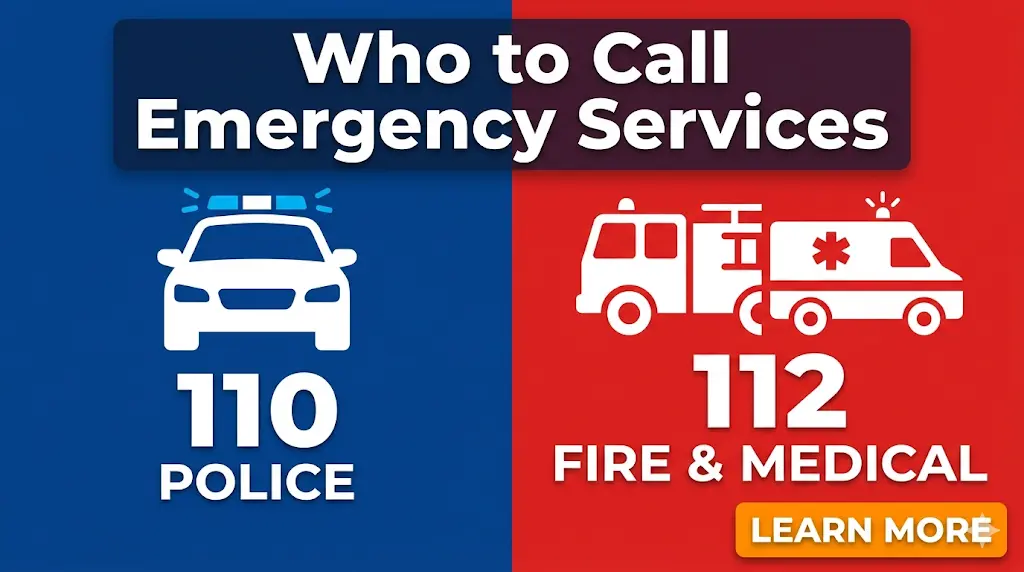
If there is one number you memorize before stepping off the plane, it must be 112. This is the standard European emergency number, but in Germany, it is strictly dedicated to the fire brigade (Feuerwehr) and emergency medical services (Rettungsdienst). You should dial 112 if you are facing a life-threatening medical emergency (such as a suspected heart attack, severe bleeding, or unconsciousness) or if there is a fire.
Dialing 112 is completely free of charge from any landline, payphone, or mobile phone. Crucially, a 112 call will connect even if your phone does not have an active SIM card or is locked, utilizing any available network tower. When the operator answers, they will usually say “Notruf Feuerwehr und Rettungsdienst” (Emergency call, fire and rescue service). The operators are highly trained and act rapidly.
However, Germans treat 112 with extreme reverence. It is strictly reserved for acute, life-and-death situations. If you call 112 because you have a mild flu, a sprained ankle, or because you simply cannot get a regular doctor’s appointment, the dispatcher will sternly reprimand you and end the call. In extreme cases of intentional misuse, the authorities can issue massive fines. Knowing exactly what constitutes a medical emergency versus a routine illness is a vital part of navigating your new home.
Dialing 110 for Police and Security Threats
If you are witnessing a crime in progress, facing immediate physical danger, or have been involved in a severe traffic accident, you must dial 110. This is the direct line to the local police dispatch (Polizei).
It is a common expat mistake to assume that calling 112 will bring the police. While the 112 and 110 dispatch centers can and do communicate with each other, dialing 112 to report an active burglary wastes precious seconds, as the fire dispatcher must manually transfer your call to the police. Always separate your emergencies: 112 for fire and health, 110 for crime and security.
When you dial 110, you are connected to the regional state police command center. The operator will prioritize the dispatch based on the active threat level. If you are reporting a stolen bicycle that you noticed missing three hours ago, 110 is not the correct avenue. The emergency line is for immediate intervention. For past crimes or non-urgent matters, you are expected to visit the local police station in person or file an online report (Online-Wache).
The English Language Barrier in Crisis Situations
A terrifying realization for non-German speakers is that emergency operators are not legally guaranteed to speak English. If you call 112 or 110 in massive metropolitan hubs like Berlin, Frankfurt, or Munich, the operator will almost certainly speak proficient English or be able to instantly transfer you to a bilingual colleague. However, if you are in rural Bavaria or a smaller town in Saxony, you might encounter an operator whose English is limited.
Do not panic. Operators are trained to handle extreme stress and language barriers. You must remain calm and utilize the German “5 Ws” framework, even if you can only speak basic vocabulary. Tell them:
- Wo (Where is it happening?) – Be specific about your city and street.
- Was (What happened?) – E.g., “Feuer” (Fire), “Herzinfarkt” (Heart attack), “Unfall” (Accident).
- Wie viele (How many people are hurt?)
- Welche (What kind of injuries?)
- Warten (Wait!) – Never hang up until the operator tells you to.
Practicing these basic phrases is just as important as mastering the local transport systems, which you can learn about in Public Transport Tickets and Passes: Navigating German Transit Systems.
| Number | Service Addressed | Best Used For | Key Considerations |
| 112 | Fire (Feuerwehr) & Ambulance (Rettungsdienst) | Heart attacks, severe bleeding, house fires, major accidents | Free, EU-wide, works without active SIM. For life-threatening emergencies only. |
| 110 | Police (Polizei) | Robbery, assault, active domestic violence, traffic accidents | Connects to local dispatch. Prioritizes active, immediate crimes in progress. |
| 116117 | On-Call Medical Service (Ärztlicher Bereitschaftsdienst) | High fever on a Sunday, severe stomach bugs, urgent but not life-threatening illnesses | Can involve long wait times on the phone. Replaces your GP during weekends/nights. |
Non-Life-Threatening Medical Services
When to Call 116117 On Call Doctors
If you wake up on a Saturday morning with a soaring fever, a severe urinary tract infection, or crippling back pain, you cannot wait until Monday to see a doctor. But because these issues are not immediately life-threatening, calling 112 is inappropriate. Your lifeline in this scenario is 116117, the Medical On-Call Service (Ärztlicher Bereitschaftsdienst).
This nationwide, toll-free number connects you to a dispatch center that organizes medical care outside of regular office hours (evenings, weekends, and public holidays). Depending on your symptoms, the 116117 operator will either direct you to the nearest open on-call clinic (Bereitschaftspraxis) or, if you are too sick to move, dispatch an on-call doctor to visit your apartment.
Be warned: this is not an emergency response service. If they dispatch a doctor to your home, you might wait several hours for them to arrive. The service is highly effective but demands patience. If you are struggling to navigate this two-tiered emergency system, dive deeper into our guide on What to Do When You’re Sick in Germany and Don’t Have a Doctor Yet.
Navigating Emergency Rooms Notaufnahmen
If your situation is urgent but you can physically transport yourself, going straight to the hospital emergency room (Notaufnahme or Rettungsstelle) is an option. However, German emergency rooms operate on a strict triage system.
When you walk in, a triage nurse will evaluate your condition based on clinical severity, not your time of arrival. If you arrive with a deeply cut finger that requires stitches, you will be treated, but you will be pushed down the queue every time an ambulance arrives with a critical heart patient. It is not uncommon for expats with minor injuries to wait four to six hours in a German Notaufnahme.
Many expats avoid the ER out of fear that they will be hit with a massive, American-style medical bill. This is a misconception. If you have statutory public health insurance or compliant private expat insurance, emergency care is fully covered. If an ambulance (via 112) is deemed medically necessary by the paramedics, the health fund pays for the ride, and you are only billed a nominal statutory co-pay (Zuzahlung) of 10 euros. To understand exactly how your specific insurance policy dictates your hospital access, review Healthcare in Germany: A Comprehensive Guide for Expats.
Finding an After Hours Pharmacy Apotheke
In Germany, you cannot buy paracetamol, ibuprofen, or cold medicine at a supermarket or a drugstore like dm or Rossmann. All medications, even basic painkillers, are exclusively sold in licensed pharmacies (Apotheken). Because standard retail laws force almost all shops to close on Sundays and late evenings, getting medicine during a weekend flu can be a nightmare.
To solve this, pharmacies operate on a rotating emergency duty roster known as the Apotheken-Notdienst. At any given time of the night or weekend, at least one pharmacy in your district is legally required to remain open. If you walk up to your closed local pharmacy, there will always be a printed schedule or digital screen on the front door listing the exact address of the pharmacy currently on duty.
You usually have to ring a night bell (Nachtglocke) at the duty pharmacy, and the pharmacist will serve you through a small glass window. There is a small, legal emergency surcharge (usually around €2.50) added to your purchase. To avoid wandering the streets at 2:00 AM with a fever, I highly recommend ordering a digital thermometer and a stockpile of basic cold and flu teas on Amazon Germany before the winter season begins. Utilizing Amazon Germany to build a basic non-prescription care kit allows you to weather minor illnesses without braving the confusing weekend pharmacy rotation.
Public Safety and Everyday Security Concerns
General Crime Rates and Street Safety
Germany consistently ranks as one of the safest countries in the world. Violent crime is statistically low, and strict gun control laws mean that weapons-related offenses are incredibly rare. You can generally walk alone at night in almost any major German city without fearing for your physical safety.
However, this baseline of safety often lulls expats into a false sense of absolute security. While violent crime is low, petty crime—specifically bicycle theft and pickpocketing—is rampant. Major transit hubs like Frankfurt Hauptbahnhof, Berlin Alexanderplatz, and Munich Hauptbahnhof are notorious for organized pickpocket rings. Do not leave your phone sitting on a cafe table, and always use a heavy-duty U-lock for your bicycle. Replacing a stolen bike is an annoying expense that can quickly derail your budget, a reality we address in Cost of Living in Germany: A Realistic Budget for Expats.
Dealing with Thefts and Filing Police Reports
If you are the victim of a non-violent crime, such as a stolen laptop or a smashed car window, you must file a formal police report (Anzeige). You cannot simply walk away from a theft if you ever want your insurance to cover the loss. German insurance companies are notoriously bureaucratic and will automatically deny any theft claim unless it is accompanied by an official police file number (Aktenzeichen).
You do not need to dial 110 for this. You can visit the nearest local police precinct (Polizeirevier) during standard hours to file the report in person. The police officers are usually highly professional and will provide you with a printed copy of your statement. In many federal states, you can now file an Anzeige for minor property crimes entirely online via the regional Internetwache portal, which saves you the stress of explaining a stolen wallet in broken German at the front desk. For tips on navigating these kinds of linguistic hurdles, read Living in Germany Without Speaking German (Yet): Tips to Get By.
Home Security and Tenant Protection
Home invasions and burglaries are relatively uncommon, largely due to the robust construction of German apartments. You will quickly notice that German front doors are massively heavy, feature complex multi-point locking mechanisms, and almost never lock with a simple push-button. You must use a key to lock them from the outside, and if you pull the door shut with the key inside, you are locked out immediately.
If you are concerned about building security during your first year, choosing the right temporary housing is an excellent defense. Utilizing Wunderflats to secure a furnished apartment ensures you are moving into a legally verified residential building that meets strict local safety and fire codes. Wunderflats landlords are vetted, meaning you completely bypass the risk of housing scams or moving into a compromised building with faulty locks.
If you want to upgrade your temporary flat’s security for peace of mind, you can easily order non-drilling smart indoor cameras or secure digital lockboxes on Amazon Germany. Because these security items from Amazon Germany can be installed without altering the landlord’s walls, you remain perfectly compliant with your lease while boosting your personal safety.
Specialized Helplines and Non-Emergency Contacts
Poison Control and Domestic Crisis Hotlines
Unlike the centralized 112 system, poison control (Giftnotruf) in Germany is operated regionally by different university hospitals. There are multiple regional numbers depending on your federal state (for example, the Charité in Berlin or the University Hospital in Munich). These hotlines provide immediate, life-saving advice if a child ingests cleaning chemicals or if you suspect mushroom poisoning. It is absolutely vital that you look up the specific Giftnotruf number for your region and save it in your phone on day one.
Beyond medical issues, Germany provides robust, anonymous support for mental health and domestic crises. The Telefonseelsorge (Telephone Counseling Service) can be reached at 0800 111 0 111 for severe mental health distress. There is also a dedicated, multilingual nationwide hotline for women experiencing domestic violence (Hilfetelefon Gewalt gegen Frauen) at 116 016. Understanding these mental health resources is a critical part of your overall well-being, which you can explore in Healthy Living in Germany: Wellness, Fitness, and Mental Health Guide.
Roadside Assistance and Traffic Accidents
If your car breaks down on the Autobahn, do not call 112 unless someone is injured or the car is actively on fire. For mechanical breakdowns, the absolute king of German roadside assistance is the ADAC (Allgemeiner Deutscher Automobil-Club). Often referred to as the “Yellow Angels” (Gelbe Engel) due to their bright yellow trucks, an ADAC membership is widely considered mandatory for anyone driving in Germany.
If you get into a minor fender bender, German law requires you to secure the scene immediately. You must put on your high-visibility safety vest, set up your warning triangle at an appropriate distance, and exchange insurance information. If the accident is minor and no one is hurt, you do not necessarily have to call the police (110), though many Germans do to ensure an official record is created for insurance disputes. To understand the strict rules of the road and how to survive the Autobahn safely, read Driving in Germany: Rules of the Road and Autobahn Etiquette.
Preparing an Expat Emergency Kit
You cannot rely entirely on the state to save you the moment disaster strikes; personal preparation is expected. German law explicitly mandates that every vehicle must carry a standardized first-aid kit (DIN 13164). Even if you do not own a car, purchasing one of these heavily regulated kits for your apartment is the smartest safety move you can make.
You can order a fully compliant DIN-13164 first aid kit and a high-quality fire blanket directly from Amazon Germany for under €25. Having these items from Amazon Germany sitting in your kitchen cabinet guarantees you have the exact sterile bandages, thermal rescue blankets, and scissors needed to stabilize a burn or a deep cut before the 112 paramedics arrive.
Finally, remember that an ambulance cannot save you if they cannot find you. In Germany, your name must be clearly printed on your mailbox and doorbell so paramedics can locate your specific apartment in a massive building. When you use Wunderflats, your housing is formalized and legal, meaning you can register your address properly and ensure your name is officially on the buzzer. Knowing that emergency responders can locate your Wunderflats apartment instantly brings massive peace of mind. For a step-by-step guide on securing this vital registration, review Registering Your Address (Anmeldung): Step-by-Step Guide.
References
Primary sources (official)
- Federal Office for Migration and Refugees (BAMF) – Emergency Numbers in Germany: https://www.bamf.de/EN/Themen/MigrationAufenthalt/ZuwandererDrittstaaten/Migrathek/ErsteSchritte/ersteschritte-node.html
- Bundesportal (Federal Portal) – Medical on-call service 116 117: https://verwaltung.bund.de/leistungsverzeichnis/EN/leistung/99146001153003/herausgeber/RP-8958974/region/07
- BVL – List of Poison Control Centers (Giftnotrufzentralen): https://www.bvl.bund.de/DE/Arbeitsbereiche/01_Lebensmittel/03_Verbraucher/09_InfektionenIntoxikationen/02_Giftnotrufzentralen/lm_LMVergiftung_giftnotrufzentralen_node.html
Other helpful sources
- 116117.de (Official Patient Portal of the KBV): https://www.116117.de/
- Polizei.de (Official portal of the German state and federal police forces): https://www.polizei.de/
Disclaimer
The information provided in this guide is for general informational purposes only and is based on the real-world experiences of expats navigating the German emergency and public safety systems. Emergency protocols, non-life-threatening medical hotline procedures (such as 116117), and specific regional poison control numbers (Giftnotruf) are subject to change by federal and state authorities. This article does not constitute medical, legal, or professional emergency advice. In a genuine, life-threatening crisis, always dial 112 for the fire and rescue services, or 110 for the police, and follow the exact instructions of the official dispatch operator.