Driving in Germany: Rules, Road Signs, and Getting Your License Converted
Receiving a hefty fine because you unknowingly violated the invisible “right before left” rule at a quiet suburban intersection is a brutal welcome to German roads. I once nearly caused a highway pile-up trying to merge onto the Autobahn at the wrong speed. This guide demystifies Germany’s strict driving laws, essential road signs, and the complex process of converting your foreign license.
Disclosure: This post may contain affiliate links. We may earn a commission at no extra cost to you if you make a purchase through these links. Read full disclosure.
The Reality of Driving in Germany
To drive successfully in Germany, you must completely discard the casual driving habits of your home country. The German driving ecosystem is built on a foundation of absolute predictability, rigid adherence to the law, and zero tolerance for driver negligence.
The Autobahn Myth versus Reality
The most pervasive myth about Germany is that the Autobahn is a lawless, free-for-all race track with no speed limits. While it is true that roughly 70 percent of the Autobahn network lacks a permanent, legally enforced speed limit, it is highly regulated. There is an advisory speed limit (Richtgeschwindigkeit) of 130 km/h. If you choose to drive 180 km/h and are involved in an accident, German courts will automatically assign you a percentage of the financial and criminal liability—even if the accident was entirely the other driver’s fault—simply because you exceeded the advisory limit.
Furthermore, the structure of the lanes is sacrosanct. The left lane is exclusively for passing (Überholspur). The Rechtsfahrgebot (keep right rule) legally mandates that you must drive in the rightmost lane unless you are actively overtaking another vehicle. If you cruise casually in the left lane, you will quickly find a German luxury sedan inches from your rear bumper, aggressively flashing its high beams. While terrifying, this flashing is technically legal as a warning signal outside of city limits. However, passing a slower car on the right side is strictly illegal and will result in massive fines and points on your license.
Finally, you must be hyper-vigilant for construction zones (Baustellen). The Autobahn is under constant repair. When you enter a Baustelle, the lanes become incredibly narrow, and the speed limit instantly drops to 80 km/h or 60 km/h. These zones are heavily monitored by automated speed cameras, and failing to brake in time is a guaranteed fine.
Unwritten Rules and Driving Culture
German driving culture relies heavily on efficiency and asserting your legal right of way. In many countries, it is considered polite to wave another driver out of a side street or yield your priority to be courteous. In Germany, doing this is incredibly dangerous. The system relies on you doing exactly what the law dictates you should do. By trying to be “polite,” you act unpredictably, which causes accidents.
You must also master the Reißverschlussverfahren (zipper merge). When two lanes merge into one due to an obstruction or construction, German law dictates that you must drive all the way to the very end of the closing lane before merging. You then take turns merging one-by-one, like the teeth of a zipper. Expats often merge early out of politeness and then get furiously honked at by German drivers who understand that merging early causes massive traffic jams.
Speaking of honking, the horn is almost exclusively used as an emergency warning tool to prevent immediate accidents. Using your horn simply because you are annoyed that the person in front of you missed a green light is considered a highly aggressive social taboo and can technically result in a fine for noise pollution.
The Hidden Costs of Car Ownership
Owning a vehicle in Germany is a massive, ongoing financial burden. Fuel prices are heavily taxed and drastically more expensive than in North America or the Middle East. Furthermore, you must pay an annual vehicle tax (Kfz-Steuer) which is calculated based on your car’s engine size and CO2 emissions.
The most painful cost for newcomers is the mandatory third-party liability auto insurance (Kfz-Haftpflichtversicherung). German insurance providers operate on a strict “no-claims bonus” system (Schadenfreiheitsklasse). Because you are a newly arrived expat, most German insurers will completely ignore your twenty years of flawless driving history in your home country. They will classify you as a high-risk beginner, resulting in staggering monthly premiums.
Because the initial costs of buying, registering, and insuring a car are so high, veteran expats often completely avoid driving during their first year. By booking a centrally located, furnished apartment via Wunderflats, you can easily commute via the local U-Bahn and S-Bahn networks, completely delaying the expense of a car until your budget stabilizes. Utilizing a Wunderflats apartment near a transit hub buys you the critical time needed to sort out your finances, a strategy detailed further in Cost of Living in Germany: Budgeting for Your First Year as an Expat.
Decoding German Road Signs and Traffic Laws
Germany operates heavily on visual cues rather than written text. The road signs are standardized across Europe, but there are specific German nuances that, if ignored, will result in immediate police intervention.
The Infamous Rechts vor Links Rule
This is the single most important traffic rule in Germany, and it is the primary reason expats fail their driving tests or cause expensive fender benders. The rule is Rechts vor Links (Right before Left).
If you are driving in a residential area (typically marked as a Zone 30, meaning the speed limit is 30 km/h) and you arrive at an intersection that has absolutely no stop signs, no yield signs, and no traffic lights, the vehicle coming from the right-hand street has the absolute right of way. You must physically slow down at every single unmarked intersection and yield to the right. The terrifying part is that the driver coming from the right will rarely slow down to check if you are stopping; they assume you know the law and will pull directly into the intersection.
Essential Road Signs You Cannot Ignore
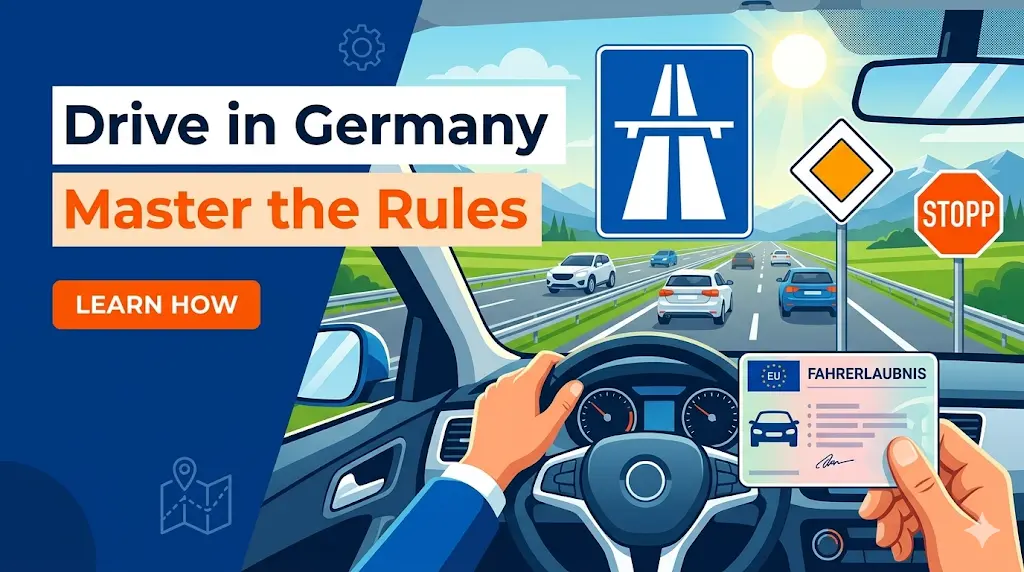
To survive unmarked intersections, you must look for the Yellow Diamond sign. This yellow diamond with a white border indicates a Vorfahrtstraße (priority road). If you are driving on a road with this sign, you have the right of way at all upcoming intersections, and you do not need to yield to traffic coming from the right. When you see this yellow diamond with a black diagonal line striking through it, your priority has ended, and the Rechts vor Links rule immediately resumes.
Another deeply confusing sign is the white circle with five diagonal black lines crossing it. This is the Ende aller Streckenverbote (End of all route-related restrictions). Whenever you see this sign, it means that any previous speed limits or overtaking bans have been lifted. On the Autobahn, passing this sign means the advisory 130 km/h limit is back in effect, and you can accelerate freely.
Finally, pay attention to the yellow town signs (Ortsschilder). When you pass a yellow sign bearing the name of a town, the speed limit instantly and automatically drops to 50 km/h. There is no separate speed limit sign; the town sign is the speed limit sign. When you pass the town sign with a red line through it on your way out, the speed limit automatically increases to 100 km/h for rural roads.
Speed Cameras Blitzer and Penalties
Germany heavily relies on automated traffic enforcement. You will rarely see police cars hiding behind billboards with radar guns. Instead, Germany uses highly camouflaged, automated speed cameras known as Blitzer.
These cameras are stationed on highways, hidden inside fake trash cans in residential areas, and attached to traffic lights. When you speed past one, you will see a blinding, bright red flash. You cannot talk your way out of it. A few weeks later, a letter will arrive at your registered home address containing a fine (Bußgeld) and a high-resolution photograph of your face behind the wheel.
For minor speeding (10 to 15 km/h over the limit), you simply pay the fine via bank transfer. However, severe speeding violations or running red lights will earn you penalty points in the national traffic register in Flensburg (Punkte in Flensburg). If you accumulate 8 points in Flensburg, your driving license is permanently revoked.
Converting Your Foreign Driving License (Umschreibung)
Your ability to drive legally in Germany is dictated entirely by which country issued your original passport and driving license. The bureaucracy surrounding license conversion (Umschreibung) is highly rigid and deeply frustrating.
The Six Month Grace Period Trap
From the exact date you complete your official address registration (Anmeldung), your non-EU foreign driving license is valid for exactly six months. You can rent cars, buy a vehicle, and drive freely using your home country’s license during this window (though an International Driving Permit or a sworn translation is often required to accompany it).
The trap closes on day 181. After six months, your foreign license is legally void in Germany. If you continue to drive, you are committing a severe criminal offense known as Fahren ohne Fahrerlaubnis (driving without a license). If you are caught, you face massive fines, potential jail time, and the immediate invalidation of your car insurance.
Because the bureaucratic backlog at the local driver licensing authority (Fahrerlaubnisbehörde) can stretch for months, you must initiate the conversion process the exact week you arrive. If you miss this window and lose your driving privileges, relying on public transit is your only legal option.
The Privileged Conversion Annex 11 Countries
If your driving license was issued by a country within the European Union (EU) or the European Economic Area (EEA), you are exempt from this entire process. Your license is fully valid in Germany until its printed expiration date, at which point you simply swap it for a German one.
If you are from a non-EU country, you must hope your nation is listed on “Annex 11” of the German Driving Licence Ordinance. Annex 11 includes countries that Germany deems to have equivalent driving testing standards, such as the United Kingdom, Canada, Australia, New Zealand, Japan, and certain individual states within the US (e.g., Texas and Massachusetts, but not New York or California).
If your jurisdiction is on Annex 11, you are privileged. You can apply for an Umschreibung by taking your original license, a recent eye test, a biometric photo, and a first-aid course certificate to the authorities. You pay a fee, surrender your home license, and they mail you a German one. You do not have to take any tests. The appointments required to execute this paperwork operate similarly to visa appointments, requiring extreme patience. You can map out strategies for dealing with these municipal offices in Navigating the Ausländerbehörde: Tips for Dealing with German Immigration Offices.
The Nightmare of Starting Over Third Country Nationals
If your home country or US state is not listed on Annex 11 (which includes India, Brazil, South Africa, and many others), you face a grueling, expensive nightmare. Your years of driving experience mean nothing to the German state. To convert your license, you must take and pass both the official theoretical and practical German driving tests.
You are legally required to register with a certified German driving school (Fahrschule). While you are exempt from the mandatory beginner practical driving hours (the expensive night and Autobahn drives), you must pass the brutal 30-question theoretical exam. This exam is famous for literal, highly confusing trick questions regarding physics and obscure load-bearing formulas.
After passing the theory, you must pass a 45-minute practical driving exam with a state inspector in the back seat, who will fail you instantly if you roll over a solid white line or forget to aggressively check your blind spot over your shoulder (Schulterblick). The total cost of registering with a school, utilizing their learning apps, paying the exam fees, and renting the instructor’s car for the final test usually ranges from 1,000 to 2,000 euros.
| License Origin | Valid After Arrival | Theory Test Required? | Practical Test Required? | Estimated Conversion Cost |
| EU / EEA | Until expiration | No | No | ~€35 (Admin fee upon renewal) |
| Annex 11 (e.g., UK, Canada) | 6 Months | No (Usually) | No | ~€50 – €100 |
| Non-Annex 11 (e.g., India) | 6 Months | Yes (Mandatory) | Yes (Mandatory) | €1,000 – €2,000 |
If the prospect of spending 2,000 euros to retake a driving test sounds absurd, you are not alone. Many expats completely rethink their location strategy upon learning this. By utilizing a mid-term rental on Wunderflats situated directly on an S-Bahn line, you can completely avoid the necessity of a car, saving your capital and bypassing the Fahrschule entirely.
Equipping and Maintaining Your Vehicle
If you manage to secure a license and buy a car, your administrative duties have only just begun. The German state enforces vehicle safety and seasonal readiness with absolute legal precision.
Navigating the TÜV and Vehicle Registration
Before you can drive a newly purchased car on public roads, you must register it at the Zulassungsstelle (vehicle registration office). To get your license plates, you must present an eVB number (electronic insurance confirmation), proving you have secured mandatory third-party liability insurance. While protecting your apartment’s contents is optional (a concept detailed in Home Insurance in Germany: Do You Need Haftpflicht and Hausrat?), driving without car insurance is a severe crime.
Furthermore, every two years, your vehicle must undergo the Hauptuntersuchung (HU), universally known as the TÜV. This is an incredibly rigorous, unforgiving mechanical inspection conducted by certified state engineers. They test your exhaust emissions, brake pad thickness, rust levels, and headlight alignment. If your car fails the TÜV, the inspector removes the validation sticker from your license plate, and the car is legally forbidden from driving on public roads until the mechanical defects are repaired by a certified workshop.
The Situative Winter Tire Law
Germany does not have a strict calendar date for changing your tires, but it strictly enforces the Situative Winterreifenpflicht (situational winter tire obligation). By law, if there is snow, slush, frost, or black ice on the road, your vehicle must be equipped with certified winter tires.
As of late 2024, standard “M+S” (Mud and Snow) all-season tires are no longer legally sufficient for winter driving. Your tires must physically bear the “Alpine” symbol (a mountain peak with a snowflake inside). If you are caught driving in snowy conditions with summer tires, you will be heavily fined and receive a point in Flensburg. If you cause an accident with summer tires in the winter, your insurance company can legally refuse to pay out your claims due to gross negligence.
To avoid the massive 100-euro fees charged by mechanics to swap your tires twice a year, many expats do it themselves. You can easily order a heavy-duty hydraulic floor jack, a high-quality torque wrench, and wheel chocks directly from Amazon Germany. Utilizing Amazon Germany for your automotive tools ensures you receive TÜV-certified, heavy-duty equipment delivered to your door, entirely avoiding the confusing German terminology at the local hardware store.
Mandatory Emergency Equipment
The German traffic code (StVO) dictates that specific emergency safety equipment must be physically inside your vehicle’s cabin or trunk at all times. This is not a recommendation; it is a legal mandate that the police will check during routine traffic stops.
You must carry a reflective warning triangle (Warndreieck). You must carry at least one high-visibility reflective vest (Warnweste) conforming to the EN 471 standard, although carrying one for every passenger in the car is highly recommended. Most critically, you must carry a comprehensive, DIN-13164 certified first aid kit (Verbandskasten). These first aid kits have strict expiration dates; if the police check yours and the sterile bandages expired two years ago, you will be fined.
Do not wait until you are pulled over to realize your used car is missing this gear. The moment you purchase a vehicle, log onto Amazon Germany and order a complete, pre-packaged German vehicle emergency kit. Additionally, order a blue parking disc (Parkscheibe) from Amazon Germany. You will need to place this blue disc on your dashboard to display your arrival time when parking in almost every free supermarket or municipal parking lot in the country; failing to display it results in an immediate 30-euro parking ticket. Preparing your car through Amazon Germany before you even drive off the lot is the ultimate expat survival tactic.
Mastering the German roadways requires immense patience, respect for the rule of law, and a willingness to relearn everything you thought you knew about driving. By strictly obeying the Rechts vor Links rule, navigating the bureaucratic maze of the license conversion, and properly equipping your car via Amazon Germany, you can safely conquer the Autobahn and explore the continent.
References
Primary sources (official)
- Federal Ministry for Digital and Transport (BMDV): The official government regulations detailing the exact legal validity of foreign driving licenses, the six-month grace period, and the translation requirements for non-EU citizens.https://bmdv.bund.de/SharedDocs/EN/Articles/StV/Roadtraffic/validity-foreign-driving-licences-in-germany.html
- Federal Ministry of Justice (Gesetze im Internet): The official English translation of the German Road Traffic Act (Straßenverkehrsgesetz), outlining the foundational laws of the road and liability.https://www.gesetze-im-internet.de/englisch_stvg/englisch_stvg.html
Other helpful sources
- Make it in Germany: The federal government’s comprehensive guide for expats explaining the process of converting a third-country license, registering a vehicle, and passing the TÜV inspection.https://www.make-it-in-germany.com/en/living-in-germany/housing-mobility/driving-licence-car
Disclaimer
The information provided in this article is for general informational and educational purposes only and does not constitute professional legal, financial, or driving advice. German traffic laws (Straßenverkehrsordnung), the strict guidelines surrounding the conversion of foreign driving licenses, and the specific lists of Annex 11 privileged countries are highly complex and subject to continuous legislative updates. The ultimate responsibility for road compliance rests solely with the driver. Always consult directly with your local driver licensing authority (Fahrerlaubnisbehörde) or a certified German driving school (Fahrschule) to verify your personal eligibility and testing requirements before getting behind the wheel.