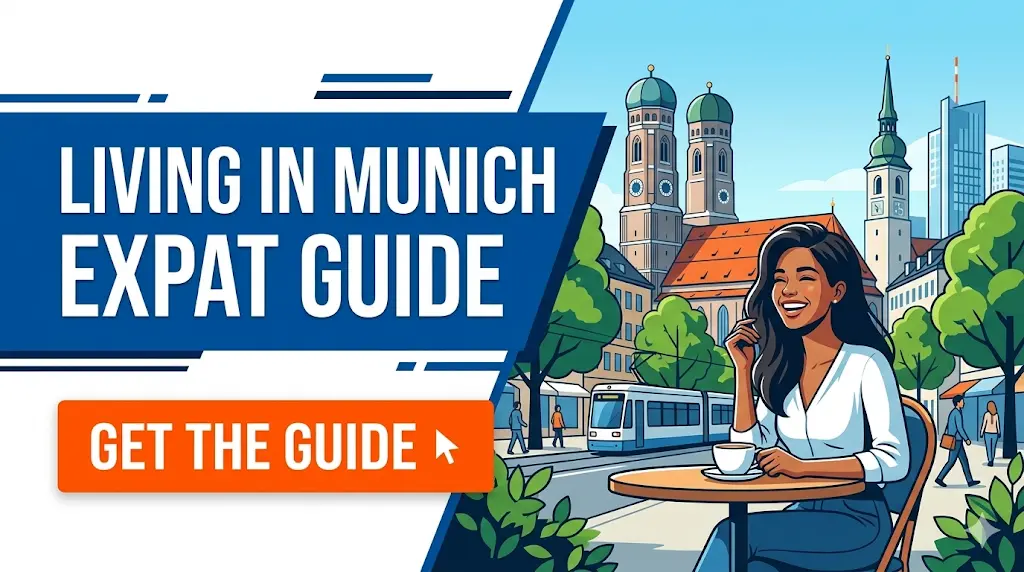
Living in Munich: Expat Guide to the Bavarian Capital
Looking at a €1,500 rental listing for a tiny studio on the outskirts of Munich while trying to figure out if your salary can cover the mandatory three-month deposit is utterly terrifying. I spent my first two months bleeding cash in a subpar hotel because I completely underestimated the Bavarian housing crisis. This guide demystifies Munich’s neighborhoods, extreme living costs, and unique cultural quirks.
Disclosure: This post may contain affiliate links. We may earn a commission at no extra cost to you if you make a purchase through these links. Read full disclosure.
The Reality of the Munich Housing Market
The Intense Competition and High Costs
Munich consistently ranks as the single most expensive city in Germany for real estate, and the sheer hostility of the rental market is the first massive hurdle every expat faces. When a reasonably priced, centrally located apartment is listed on popular housing portals, it is standard for the landlord to receive hundreds of applications within the first ten minutes. Attending an apartment viewing in Munich often feels like attending an open casting call; you will be standing in a stairwell with fifty other desperate, highly qualified professionals holding pristine application folders.
To even be considered by a Munich property manager (Hausverwaltung), you must arrive over-prepared. This means having your SCHUFA (credit score), your last three payslips, a copy of your passport, and a certificate from your previous landlord confirming you have no rent arrears (Mietschuldenfreiheitsbescheinigung). For a newly arrived expat without a local credit history, competing against double-income German couples is profoundly demoralizing. Landlords in Munich are risk-averse and generally prefer tenants who have already passed their six-month corporate probation period. If you are stepping off the plane and trying to dive straight into the permanent housing market, you must strategize heavily using the methods outlined in Finding an Apartment in Germany: Best Websites and Tips for Expats.
Navigating Furnished vs Unfurnished Options
A devastating shock for many expats moving to Munich is the German definition of an “unfurnished” apartment. If you manage to sign a standard, long-term lease, you are usually renting a bare concrete box. There are no light fixtures, no built-in closets, and, most crucially, no kitchen. You are expected to purchase, transport, and install your entire kitchen block, including the sink, oven, and cabinets, entirely at your own expense. If you lack the required tools, you will find yourself frantically ordering heavy-duty power drills and ceiling lights from Amazon Germany just to make the flat minimally livable.
For an international professional on a two-year work contract, investing five thousand euros into a custom-built kitchen that you might have to rip out when you leave makes zero financial sense. Because of this, the savviest expats bypass the permanent market initially. Booking a mid-term, fully equipped flat through Wunderflats has become the standard survival tactic. This allows you to walk into a ready-made home with high-speed internet and pots already in the cupboards. It buys you the essential time needed to pass your work probation and explore the city before committing to the massive financial undertaking detailed in Furnished vs Unfurnished Apartments in Germany.
Bureaucracy and the Anmeldung Process
The most frustrating administrative loop in Munich is the infamous Anmeldung (address registration). To legally exist in Germany, you must register your residential address at the local citizen’s office (Kreisverwaltungsreferat or KVR in Munich) within two weeks of moving in. You need this registration certificate (Meldebescheinigung) to open a standard bank account, get your tax ID number, and secure a mobile phone contract. However, traditional landlords will not rent you a permanent apartment without a German bank account and a German credit history.
Many newcomers attempt to solve this by sleeping on a friend’s couch or finding an informal sublet on social media. This is a dangerous game. To legally register at the KVR, you must present a Wohnungsgeberbestätigung (a confirmation form signed by the actual landlord). If an informal sublessor refuses to provide this document, the sublet is illegal, and you remain in bureaucratic limbo, unable to get paid correctly by your employer.
This administrative nightmare is another reason why corporate housing or managed platforms are so valuable for newcomers. Utilizing Wunderflats guarantees that you are entering a legally compliant rental agreement where the landlord will provide the mandatory paperwork on your move-in day.
Decoding Munich Neighborhoods
Schwabing and Maxvorstadt for Central Vibrancy
Schwabing and Maxvorstadt are the historical, beating hearts of Munich’s academic and bohemian life. Maxvorstadt is home to the city’s two massive universities (LMU and TUM) and the museum quarter, giving it a vibrant, youthful, and highly intellectual energy. The streets are lined with independent bookstores, third-wave coffee shops, and countless restaurants catering to the student population. It is loud, busy, and constantly moving.
Just to the north lies Schwabing, which was once the center of Munich’s counter-culture but has since gentrified into one of the most desirable and expensive residential areas in the country. It is famous for its gorgeous, renovated Art Nouveau architecture and its immediate proximity to the English Garden (Englischer Garten), one of the largest urban parks in the world. Living in Schwabing means you can walk out your front door and be surrounded by nature, beer gardens, and high-end boutiques within minutes.
However, the cost of living in these two neighborhoods is astronomical, and the competition for apartments borders on the absurd. Noise can also be a significant issue, as the bars and restaurants operate late into the night. If you want to be in the center of the action and have the budget to support it, this is the premier location, but you must heavily weigh these factors against the regional alternatives discussed in Best Cities in Germany for Expats: Pros and Cons of Each.
Bogenhausen and Haidhausen for Upscale Comfort
If you cross the Isar River to the east, the atmosphere shifts dramatically. Haidhausen, often referred to as the “French Quarter” due to its street names and architectural flair, offers an incredibly picturesque, village-like feel right in the middle of the city. It is characterized by beautifully preserved historic buildings, quiet cobblestone squares, and a dense concentration of high-quality dining. It is immensely popular with young professionals and expat families who want beauty and quiet without sacrificing urban convenience.
Further northeast sits Bogenhausen, which is Munich’s undisputed luxury district. This area is defined by massive, historic villas, wide, tree-lined avenues, and a deeply tranquil atmosphere. It is the neighborhood of choice for foreign diplomats, top-tier corporate executives, and generational Bavarian wealth. Bogenhausen offers excellent international schools and incredible safety, but it lacks the chaotic street life and late-night amenities of the inner city.
Because these eastern districts are heavily favored by affluent expats and corporate relocation agencies, the available rental stock is often handled exclusively by premium brokers. Many families transitioning to Munich use Wunderflats to secure upscale, family-sized interim housing in Haidhausen while they search for a permanent villa or large apartment.
Giesing and Sendling for Authentic Charm
For expats who want to escape the highly polished, wealthy sheen of central Munich and experience a more grounded, authentic Bavarian working-class vibe, Giesing and Sendling are the neighborhoods of choice. Located to the south, these areas were historically industrial but are rapidly transforming into the city’s most dynamic districts.
Giesing is fiercely proud of its roots. It is home to TSV 1860 Munich (the city’s “other” football team, deeply beloved by locals over the massive FC Bayern), and the neighborhood is dotted with authentic, unpretentious local pubs (Boazn) rather than high-end cocktail bars. The rent here, while still climbing, is significantly more approachable for mid-level professionals and artists than Schwabing or Bogenhausen.
Sendling offers a similar charm with the added benefit of housing the Grossmarkthalle (the massive wholesale market) and Flaucher, a stunning, wild stretch of the Isar River known for its pebble beaches and summer barbecue culture. These neighborhoods provide a strong sense of local community, making them excellent locations to practice your German and implement the integration strategies found in Making Friends in Germany: Social Tips for Expats.
| Neighborhood | Primary Vibe | Average Rent Cost | Target Expat Demographic |
| Schwabing | Classic, affluent, close to parks | Very High | High-earning singles, established professionals |
| Maxvorstadt | University hub, vibrant, artsy | High | Students, academics, young professionals |
| Haidhausen | Picturesque, village-like, trendy | Very High | Expat families, couples seeking charm |
| Bogenhausen | Elite, quiet, diplomatic | Astronomical | Corporate executives, diplomats |
| Giesing | Working-class roots, authentic, proud | Medium to High | Budget-conscious expats, creatives |
| Sendling | River access, community-focused, relaxed | Medium to High | Young families, outdoor enthusiasts |
Cost of Living and Career Opportunities
High Salaries Versus the Bavarian Premium
Munich is the economic powerhouse of Germany. The career opportunities here are staggering, and the salaries reflect the city’s elite status. If you are relocating for a senior role in tech, engineering, or finance, your compensation package will likely be significantly higher than what you would be offered for the exact same role in Berlin or Leipzig.
However, this high income is aggressively offset by what locals call the “Munich Premium.” Absolutely everything costs more here. A pint of beer in a pub, a monthly gym membership, and your basic grocery run will all demand a larger portion of your paycheck. The warm rent (Warmmiete)—which includes your base rent plus the estimated costs for heating, water, and building maintenance—can easily consume forty to fifty percent of a standard net salary.
You must conduct a ruthless audit of your finances before accepting a job offer in the Bavarian capital. A salary that seems luxurious on paper can quickly evaporate when faced with the local reality.
Thriving Tech and Automotive Industries
The primary magnet drawing international talent to Munich is its unparalleled corporate landscape. The city is the global headquarters for automotive titans like BMW and MAN, tech giants like Siemens and Infineon, and insurance behemoths like Allianz. Furthermore, Munich has successfully branded itself as the “Isar Valley,” attracting massive European hubs for Google, Apple, Microsoft, and Amazon.
This concentration of global corporations means that the professional environment in Munich is highly international, and the working language in many of these massive corporate campuses is entirely English. For a highly skilled expat, finding a job that does not strictly require fluent German is significantly easier here than in smaller German cities.
However, the corporate culture in Munich tends to be much more conservative and formal than the chaotic, hoodie-wearing startup scene of Berlin. You are expected to adhere to traditional business etiquette, strict punctuality, and clear hierarchical boundaries.
Budgeting for Daily Life and Groceries
Surviving the high costs of Munich requires adopting local budgeting habits quickly. The most fundamental lifestyle change for expats is abandoning the convenience of eating out multiple times a week. Dining at restaurants in Munich is a luxury. A standard dinner for two at a mid-range restaurant, including a couple of drinks, will easily exceed sixty or seventy euros. To protect your savings, you must embrace the German culture of cooking at home.
Groceries in Germany are notoriously cheap compared to the rest of Western Europe, largely due to the fierce price wars between discount supermarket giants like Aldi, Lidl, and Penny. Learning to do your primary shopping at these discounters, and supplementing with specialty items from premium markets like Edeka or Rewe, will drastically reduce your monthly expenditure. For heavy, non-perishable staples or specialized international ingredients that are impossible to find in standard Bavarian supermarkets, utilizing bulk delivery from Amazon Germany is a massive money and time saver.
You must also account for the hidden, mandatory costs of living in Germany, such as the Rundfunkbeitrag (the mandatory TV and radio tax charged to every household) and the complexities of your annual utility reconciliations.
Bavarian Culture and Expat Integration
The Coconut Culture and Making Friends
Bavaria operates on a distinctly different cultural frequency than the rest of Germany, and Munich sits squarely at the center of this traditional identity. The local mentality is famously encapsulated by the Bavarian motto “Mia san mia” (We are who we are). This denotes a deep, unshakeable pride in their regional culture, their history, and their way of life. They do not feel the need to conform to outside expectations.
For an expat, this can initially feel incredibly exclusionary. The social dynamic heavily features the classic German “Coconut” culture. Munich locals have a very hard, polite, but distant exterior. They do not engage in superficial small talk with strangers, and they do not hand out the title of “friend” lightly. You might work alongside a Bavarian colleague for two years before they invite you to their home.
However, once you crack that hard outer shell—usually through shared hobbies, joining a local sports club (Verein), or demonstrating consistent reliability—the interior is incredibly soft and loyal. A Bavarian friend is a friend for life. You cannot force this integration; you must be patient and participate actively in the community.
Beer Gardens and the Oktoberfest Phenomenon
You cannot discuss Munich without discussing beer. It is not just a beverage here; it is officially classified as a basic foodstuff in Bavaria, and it forms the absolute backbone of social life. As soon as the weather warms up in spring, the entire city migrates outdoors to the Biergarten (beer garden). Massive outdoor spaces like the Hirschgarten (which seats over 8,000 people) or the Chinesischer Turm in the English Garden become the city’s living rooms.
Beer garden culture has strict, beautiful rules. If tables have tablecloths, they are serviced by waiters and you must order food. If the tables are bare wood, it is a self-service area, and you are legally allowed (and highly encouraged) to bring your own picnic of radishes, cold cuts, and pretzels, provided you buy your beer from the vendor.
Then, there is Oktoberfest. Expats often dismiss it as a tourist trap, but for Munich locals, the “Wiesn” is a deeply serious, two-week-long cultural phenomenon. Major corporations close down for an afternoon to take their teams to the tents. Wearing traditional Tracht (Lederhosen for men, Dirndls for women) is not a costume; it is a sign of deep cultural respect.
Embracing the Language and Regional Dialect
While the massive corporate bubbles of Munich operate in English, attempting to build a long-term life in Bavaria without learning the language will leave you permanently isolated on the fringes of society. You must learn Hochdeutsch (Standard German) to deal with the immigration office, the tax authorities, and your landlord.
However, in Munich, you will also be bombarded by Bairisch (the Bavarian dialect). It is not merely an accent; it features entirely different vocabulary, grammar rules, and vowel shifts. A standard German “Guten Tag” (Good day) is replaced entirely by “Grüß Gott” or “Servus.” A bread roll is not a “Brötchen,” it is a “Semmel.”
You are not expected to speak Bavarian—in fact, attempting to fake the dialect as an expat is often viewed as highly embarrassing—but you must train your ear to understand it if you want to converse with local tradespeople or the older generation in the beer gardens.
Lifestyle and Getting Around the City
Mastering the MVV Public Transit System
Owning a car in central Munich is a deeply frustrating and expensive liability. Parking is virtually non-existent, and the city is aggressively designing infrastructure to favor pedestrians and cyclists. Fortunately, the Münchner Verkehrs- und Tarifverbund (MVV) operates a world-class, integrated public transit network comprising the U-Bahn (subway), S-Bahn (commuter trains), trams, and buses.
The system is highly efficient, but it has one massive, notorious bottleneck: the Stammstrecke (the main trunk line). Every single S-Bahn line in the city converges into one central tunnel running beneath the city center from Pasing to Ostbahnhof. If a train breaks down or a signal fails in this tunnel, the entire S-Bahn network instantly collapses, leaving tens of thousands of commuters stranded. When choosing an apartment, living near a U-Bahn line (which operates independently of the S-Bahn tunnel) is a massive quality-of-life upgrade.
The ticketing system is based on concentric rings radiating out from the city center (the M-Zone). Buying the correct ticket for your specific zones can be confusing initially, and plainclothes ticket inspectors are ruthless. If you are caught without a validated ticket, you will face an immediate, non-negotiable €60 fine.
Cycling Infrastructure and Isar River Life
Munich is remarkably flat, making it an absolute paradise for cyclists. Biking is not just a leisure activity; it is the primary mode of transport for hundreds of thousands of residents year-round. The city is crisscrossed with dedicated, protected bike lanes, and cycling along the tree-lined avenues of Schwabing or through the English Garden is one of the greatest joys of living here.
You will need a reliable city bike immediately upon arrival. However, bicycle theft is rampant, so spending a small fortune on a top-tier racing bike for daily commuting is unwise. Buy a sturdy, second-hand bike from a local flea market, and invest heavily in a massive, cut-proof U-lock. Furthermore, the weather in Bavaria is highly unpredictable. Sourcing high-quality, breathable waterproof rain pants and heavy-duty cycling gloves from Amazon Germany ensures you can commute comfortably through the brutal, freezing sleet of November.
In the summer, the cycling paths inevitably lead to the Isar River. The river cuts directly through the city and has been aggressively renaturalized. On a Friday afternoon in July, the pebble beaches of the Isar, particularly around the Flaucher area, are packed with thousands of young Munich residents grilling sausages, drinking cold beer, and swimming in the freezing, crystal-clear alpine water. It is a wildly communal, joyous atmosphere that perfectly captures the city’s outdoor spirit.
Escaping to the Alps and Bavarian Lakes
The single greatest lifestyle advantage of living in Munich is its geographic location. On a clear day, particularly during a Föhn wind event, the massive, jagged peaks of the Bavarian Alps are clearly visible from the city center, dominating the southern horizon. Munich is the ultimate basecamp for outdoor enthusiasts.
Within an hour via the regional train network (BOB or BRB), you can be standing at the base of the Alps in Garmisch-Partenkirchen, ready to ski the Zugspitze in the winter or hike the dramatic gorges in the summer. Similarly, the region is surrounded by stunning, massive alpine lakes, known locally as the Fünfseenland (Five Lakes Region). Taking the S-Bahn directly to Lake Starnberg (Starnberger See) or the Ammersee for a weekend sailing trip or a lazy afternoon at a lakeside beer garden is a standard weekend routine.
This immediate, effortless access to world-class nature provides a vital release valve for the high-pressure, corporate environment of the city. You work hard in Munich, but you are expected to play equally hard in the mountains on the weekends. Embracing this dual lifestyle is the ultimate key to thriving in the Bavarian capital.
References
Primary sources (official)
- Official Portal of the City of Munich – Living in Munich: https://www.muenchen.de/en/living
- Make it in Germany (Official Federal Government Portal) – Bavaria: https://www.make-it-in-germany.com/en/living-in-germany/discover-germany/german-states/bavaria
Other helpful sources
- MVV Munich – Fares and Tickets Guide: https://www.mvv-muenchen.de/en/tickets-and-fares/index.html
Disclaimer
The housing market conditions, living costs, and cultural observations detailed in this guide are based on widespread expat experiences and the current realities of residing in Munich. Rent prices and bureaucratic procedures are highly volatile and subject to constant change by local authorities. Always verify current transit zones, visa requirements, and rental laws directly through the official muenchen.de service portal before finalizing your relocation budget or signing legally binding lease agreements.