Furnished vs Unfurnished Apartments in Germany: Pros and Cons
Landing in Germany only to discover your “unfurnished” apartment is literally a concrete box with bare wires hanging from the ceiling is a uniquely traumatizing experience. I spent my first night in Berlin sleeping on a yoga mat because I didn’t realize “empty” meant no light bulbs or kitchen sink. This guide solves the confusion between furnished and unfurnished rentals, helping you navigate the steep costs and bureaucratic hurdles of setting up your brand new home.
Disclosure: This post may contain affiliate links. We may earn a commission at no extra cost to you if you make a purchase through these links. Read full disclosure.
Understanding the German Definition of Unfurnished
The Bare Shell Reality
When you see an apartment listed as “unfurnished” in most countries, you expect a fridge, a stove, and maybe some light fixtures. In Germany, the term unmöbliert is taken to an extreme that often shocks foreigners. Often, these apartments are handed over as a “bare shell.” This means no kitchen cabinets, no appliances, no wardrobes, and occasionally, no flooring or light sockets. It is a standard practice rooted in the idea that German tenants move for the long term—often decades— and want to customize every inch of their living space.
The most notorious aspect of this is the missing Einbauküche (EBK), or fitted kitchen. Unless the listing specifically mentions “EBK,” you are expected to buy, design, and install your own kitchen, including the sink and stove. I remember walking into my first long-term flat and seeing just a pipe sticking out of the wall where the dishwasher should be. If you are unprepared, this can turn your move into a logistical nightmare. For a deeper dive into the specific vocabulary you’ll encounter on listing sites, review German Immigration Terms Explained: A Glossary for Newcomers.
The Hidden Costs of an Empty Flat
While the “cold rent” (Kaltmiete) of an unfurnished apartment is significantly lower than a furnished one, the startup costs are astronomical. You aren’t just buying a bed; you are buying a lifestyle from scratch. Beyond the kitchen, which can cost anywhere from €2,000 to €10,000, you have to account for light fixtures, curtain rods, and wardrobes (closets are rarely built into German walls).
Many expats find themselves spending their first three weeks in a constant cycle of hardware store visits and delivery tracking. To mitigate these initial expenses, many of us rely on Amazon Germany for fast delivery of essential light fixtures, tools, and basic furniture components that can be assembled quickly. Without a strategic plan, you might find your initial savings evaporated before you’ve even paid your second month’s rent.
The Infrastructure Challenge: Electricity and Internet
In an unfurnished apartment, you are the manager of your own utilities. Unlike furnished apartments where utilities are often bundled into a “warm” rent, here you must register your own electricity and gas meters. If you don’t do this immediately, you will fall into the Grundversorgung (basic supply), which is the most expensive rate provided by the local utility company.
Internet is another major hurdle. German providers are notoriously slow with installations, sometimes taking four to six weeks to send a technician. In a furnished flat, the Wi-Fi is usually ready on day one. In an unfurnished one, you’ll be tethering from your phone until the “Telekom man” finally shows up. To stay connected during this gap, I’ve often ordered LTE routers or high-gain antennas from Amazon Germany to ensure I could actually work from my new, albeit empty, living room.
The Case for Furnished Living in Germany
Speed and Bureaucratic Ease
The biggest advantage of a furnished apartment, or möblierte Wohnung, is the speed of entry. In the competitive housing markets of Munich, Berlin, or Hamburg, finding a long-term unfurnished flat can take months. Furnished apartments, especially those found through professional platforms like Wunderflats, cater specifically to expats and professionals who need to move in immediately. You skip the “viewing marathons” where 50 people compete for one empty room.
More importantly, these apartments are often “ready to live.” This means the bed is made, the kitchen is fully stocked with utensils, and most importantly, the internet and electricity are already active and included in the price. For someone just landing, this eliminates at least five major administrative headaches. If your goal is to hit the ground running with your new job, using Wunderflats for your first few months is often the most logical choice to avoid burnout.
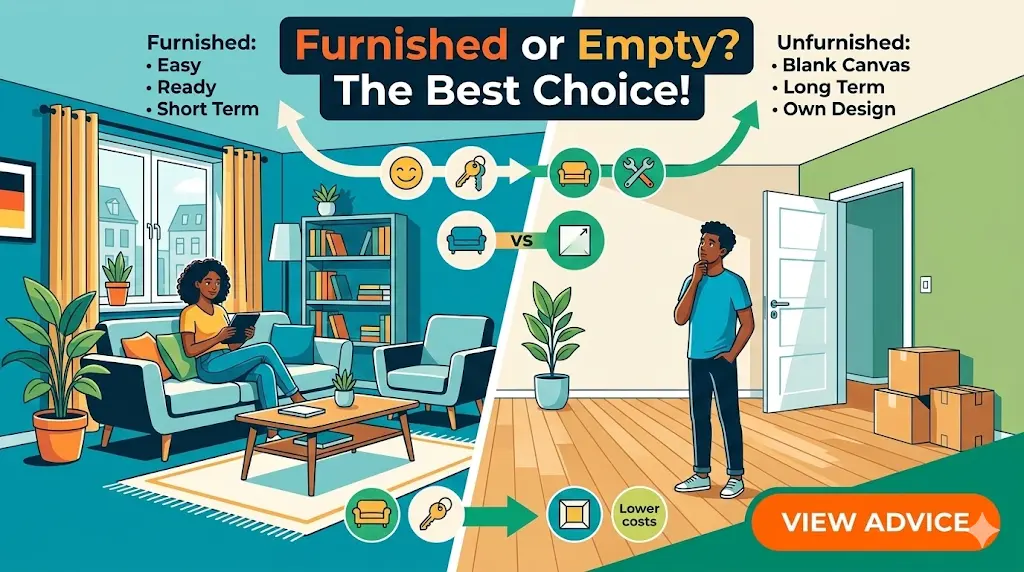
Choosing between furnished and unfurnished apartments in Germany depends on budget, duration of stay, and lifestyle needs. Furnished apartments come equipped with essential furniture, appliances, and sometimes kitchenware, making them ideal for short-term stays, students, or expats who want convenience. They allow quick move-in without upfront investment in furniture. However, they usually have higher monthly rent, limited personalization options, and sometimes stricter usage terms.
Unfurnished apartments, on the other hand, are more common in Germany and often more cost-effective in the long run. Rent is typically lower, but tenants must invest in furniture, lighting fixtures, and even kitchens in some cases. This option suits long-term residents who want to customize their living space. It also provides more stability, as leases are often longer and less flexible.
Another factor to consider is availability. Furnished apartments are easier to find in major cities and for temporary housing, while unfurnished units dominate the standard rental market. Bureaucratic processes, such as registration (Anmeldung), are possible with both, but landlords may have different requirements. Flexibility is another key difference. Furnished rentals usually offer shorter lease terms and easier exit options, making them suitable for temporary assignments. Unfurnished apartments typically involve longer commitments but provide a sense of permanence.
Ultimately, the decision depends on your priorities. If you value convenience and flexibility, furnished apartments are a better choice. If you prefer affordability and long-term stability, unfurnished apartments are more suitable. Carefully evaluating your financial situation, duration of stay, and personal preferences will help you make the right decision in Germany’s competitive housing market. Additionally, furnished apartments often include utilities and internet in the rent, simplifying budgeting but reducing cost transparency. Unfurnished rentals require setting up contracts for electricity, heating, and internet separately. While this adds initial effort, it offers greater control over providers and monthly expenses, potentially lowering overall living costs significantly.
Temporary Solutions for Permanent Residency
One of the most frustrating aspects of moving to Germany is the “Anmeldung loop.” You need a residence to get your registration (Anmeldung), but many temporary rentals like hotels or some short-term platforms don’t allow it. Furnished apartments designed for longer stays, like those on Wunderflats, almost always provide the Wohnungsgeberbestätigung—the landlord confirmation form you need for the city hall.
This document is your golden ticket to the rest of German life. Without it, you cannot get a tax ID, open a bank account, or finalize your health insurance. Because these furnished providers understand the expat journey, they streamline the paperwork that traditional landlords often find “too complicated” for a newcomer. If you are confused about why this registration is so vital, read our Registering Your Address Anmeldung: Step-by-Step Guide.
Financial Predictability and All-Inclusive Rents
While the monthly price tag of a furnished apartment is higher, it is “all-inclusive” (Warmmiete plus extras). This predictability is a godsend for budgeting during your first year. You won’t get a surprise €800 bill for heating twelve months later because the costs were already factored in. You also don’t have to worry about the “broadcast tax” (Rundfunkbeitrag) in some cases, or setting up separate waste disposal contracts.
For many, the premium paid for a furnished flat is actually a “convenience tax” that pays for itself in saved time and reduced stress. Instead of spending your weekends at a furniture warehouse, you can spend them exploring your new city or attending language meetups.
| Feature | Unfurnished Apartment | Furnished Apartment |
| Upfront Cost | Very High (Kitchen, Furniture, Lights) | Low (Deposit + First Month) |
| Monthly Rent | Lower (Kaltmiete) | Higher (All-inclusive) |
| Anmeldung | Required (Standard) | Usually possible/easy |
| Utilities Setup | Tenant’s Responsibility | Included in Rent |
| Customization | Full control over design | Limited to decor |
| Notice Period | 3 months (Standard) | Often shorter/flexible |
| Best For | Long-term stay (2+ years) | Newcomers, Students, Expats |
Comparative Analysis: Cost vs Lifestyle
Short-term vs Long-term Financial Planning
The math changes depending on how long you plan to stay in Germany. If you are here for a one-year project, buying a kitchen for an unfurnished flat is a financial disaster. You will never recoup the cost of the installation and appliances when you try to sell them to the next tenant. In this scenario, a furnished flat is significantly cheaper in the long run.
However, if you are planning to stay for five years or more, the lower monthly rent of an unfurnished apartment eventually offsets the initial €5,000–€10,000 investment. By year three, you usually break even. If you are settling in for the long haul and aiming for a Permanent Residence Permit (Niederlassungserlaubnis): How to Qualify in Germany, investing in your own furniture and a high-quality kitchen makes financial sense. You can source long-lasting appliances and home essentials on Amazon Germany to ensure your investment lasts for the duration of your residency.
Emotional Comfort and Personalization
There is a psychological component to “home” that shouldn’t be ignored. Furnished apartments, while convenient, often feel like living in a hotel or someone else’s space. You are restricted in what you can change—no painting walls, no swapping out the sofa, and you’re always worried about staining the landlord’s rug.
In an unfurnished apartment, the space is yours. You can paint the walls “Berliner White,” hang your own art, and choose a bed that actually supports your back. For many expats, this personalization is what finally makes them feel “at home” in Germany rather than just a guest. If you decide to go this route, you can find infinite decor and personalization options on Amazon Germany to turn that bare shell into a sanctuary.
Location and Market Accessibility
In prime neighborhoods like Berlin-Mitte or Munich-Maxvorstadt, unfurnished apartments are like unicorns. When they do appear, the competition is so fierce that your application—as a foreigner without a three-year German credit history—is often buried at the bottom of the pile. Furnished apartments occupy a different market segment with less competition from locals, making them much more accessible to new arrivals.
Often, choosing furnished is less of a “choice” and more of a “necessity” due to the housing crisis. Many expats live in a furnished flat for their first year while they build the necessary “paper trail” (Schufa score, three months of payslips) to be competitive for an unfurnished lease.
Legal and Contractual Nuances
Tenant Protection and Termination Periods
Germany has some of the strongest tenant protections in the world, but there is a slight legal difference between furnished and unfurnished contracts. For a standard unfurnished lease, the legal notice period for a tenant is three months. Landlords can only evict you for very specific reasons, such as Eigenbedarf (personal use).
Furnished apartments, especially if they are part of a temporary-stay contract (Wohnen auf Zeit), can sometimes have more flexible termination periods. However, if the apartment is your primary residence, the same strong protections generally apply.
The Deposit (Kaution) Differences
The Kaution or security deposit is legally capped at three months of “cold” rent for unfurnished apartments. For furnished flats, the calculation can be a bit more complex because it also covers the value of the furniture. In both cases, the landlord is legally required to store this money in a separate, interest-bearing account.
I’ve seen many expats lose portions of their deposit over minor scratches on furniture in furnished rentals. In an unfurnished flat, “normal wear and tear” is very broad, and you aren’t responsible for the aging of the floor or walls. If you are worried about your deposit, always insist on a detailed inventory list when moving into a furnished place.
Inventory Lists and Liability
When you move into a furnished apartment through a provider like Wunderflats, you will receive an inventory list. Check every single item. If there is a chip in a coffee mug or a scratch on the TV, report it immediately. If you don’t, you might be charged for it when you leave.
In an unfurnished apartment, the “inventory” is usually just the walls, floors, and whatever fixtures were there. This makes the move-out process (Uebergabe) much simpler. If you do damage something in either type of flat, having Haftpflichtversicherung (private liability insurance) is mandatory for survival in Germany. Most landlords won’t even rent to you without it. It covers you if you accidentally drop your laptop on the landlord’s parquet floor.
Making the Choice: A Strategic Roadmap
The “Soft Landing” Approach
If I were moving to Germany today, I would almost always choose a “Soft Landing.” This means booking a furnished apartment for the first 3 to 6 months. This gives you a registered address, active internet, and a base of operations. From here, you can attend unfurnished apartment viewings in person, which is the only way to actually get one. Trying to find a long-term home from your home country is a recipe for scams and heartbreak.
During this “soft landing,” you can slowly start ordering the things you know you’ll need for your permanent home—like high-quality bedding, kitchen gadgets, or a good vacuum cleaner—from Amazon Germany. This spreads out the cost of furnishing so you aren’t hit with a €10,000 bill in a single month.
Questions to Ask Before Signing
Before you commit to either path, ask yourself these three critical questions:
- Is there an EBK? If it’s unfurnished, does it have a kitchen? If not, do you have the €3,000 and the two weeks of time required to install one?
- Is Anmeldung possible? If it’s furnished, will the landlord provide the Wohnungsgeberbestätigung? If the answer is “no,” run away.
- What is the “Total Warm” cost? For unfurnished, have you factored in electricity, internet, and the inevitable 20 trips to the hardware store?
If you can’t answer these, you aren’t ready to sign. Taking the time to understand these nuances will save you from the “empty flat panic” I experienced. Germany is a wonderful place to live, but its housing system requires a level of preparation that most of us aren’t used to. By choosing the right starting point—whether it’s a flexible stay through Wunderflats or a long-term commitment to a bare shell—you are setting yourself up for a successful life in the Bundesrepublik.
References
Primary sources (official)
- Make it in Germany (Official Government Portal) – Housing: https://www.make-it-in-germany.com/en/living-in-germany/housing/finding-a-home
- German Civil Code (BGB) – Tenancy Law: https://www.gesetze-im-internet.de/englisch_bgb/
- Consumer Advice Center (Verbraucherzentrale) – Rental Contracts: https://www.verbraucherzentrale.de/wissen/vertraege-reklamation/mietrecht
Other helpful sources
- Wunderflats Blog – Furnished vs Unfurnished Explained: https://wunderflats.com/blog/en/furnished-vs-unfurnished-apartments-in-germany/
- Expatrio – Guide to Living Costs and Housing: https://www.expatrio.com/living-germany/housing-germany
Disclaimer
The information provided in this guide is for informational purposes only and is based on personal expat experiences and general market conditions in Germany. Housing laws, rental prices, and the availability of furnished vs unfurnished apartments can vary significantly by city and federal state. This article does not constitute legal or financial advice. We strongly recommend consulting with a qualified German lawyer or joining a local Mieterverein (Tenants’ Association) to review any rental contract before signing. Always verify current market rates and legal requirements with official government sources.