Car Registration and Insurance in Germany: What Expats Need to Do
Buying a car in Germany isn’t like back home where you hand over cash and drive away; here, an unregistered car is practically an illegal paperweight. I once bought a used Volkswagen and stared at it in my driveway for three weeks because I lacked an eVB number and a registration appointment. This guide decodes the exact sequence of securing insurance, navigating the vehicle registration office, and getting your car legally on the road.
Disclosure: This post may contain affiliate links. We may earn a commission at no extra cost to you if you make a purchase through these links. Read full disclosure.
The Brutal Reality of German Car Ownership
Why You Cannot Just Buy and Drive
In many countries, purchasing a vehicle is a casual transaction. You sign the title over on the hood of the car, slap a temporary cardboard tag on the back window, and drive home. In Germany, this approach will immediately trigger police intervention and severe criminal charges. The German system operates on an absolute zero-tolerance policy for unregistered or uninsured vehicles touching public asphalt.
When you buy a used car in Germany, the seller will almost always deregister the vehicle before handing over the keys. This process, known as Abmeldung, completely strips the car of its legal right to move. The license plates are either removed or have their official state seals scraped off. The seller does this to legally sever their insurance liability from the vehicle. Once deregistered, the car cannot be driven a single inch on a public road, nor can it be parked on a public street.
If you buy a deregistered car, you are immediately faced with a logistical nightmare. You cannot drive it home. You must either hire a commercial tow truck trailer to transport it, or you must preemptively navigate the bureaucracy to secure short-term transit plates. This fundamental roadblock is the first massive culture shock for expats attempting to buy a vehicle.
The Sequence of Bureaucracy
The German vehicle registration process is strictly linear. You cannot simply walk into an office with a bag of money and a bill of sale. You must complete a highly specific sequence of administrative tasks, and failing to execute them in the correct order guarantees instant rejection at the municipal counter.
Step one involves securing the physical car and its two vital ownership documents. Step two requires you to negotiate and sign a binding auto insurance contract to generate a digital insurance confirmation code. You cannot register a car without this code, and you cannot get this code without knowing exactly which car you are buying. Step three involves booking an appointment at the municipal registration office, a feat that can take weeks. Step four requires you to leave the government clerk mid-appointment to go buy physical metal license plates from an independent shop across the street. Finally, step five requires returning to the clerk to have official state stickers applied to those plates.
This interlocking web of dependencies means you must have your administrative life completely in order before you even begin shopping for vehicles. Attempting to figure it out on the fly will result in expensive delays, expired transit plates, and extreme frustration.
Utilizing Temporary Housing Before Buying
The absolute foundation of the entire car registration sequence is your residential status. In Germany, a vehicle must be registered to a primary, legally recognized address. You cannot register a car to a hotel, a hostel, an Airbnb, or a friend’s couch. The municipal clerk will demand to see your official registration certificate to prove where the car will “live.”
If you have just moved to the country, attempting to buy a car immediately is a logistical trap. You must conquer the housing market first. The smartest strategic move is to secure a mid-term furnished apartment through a platform like Wunderflats for your first three to six months. Properties listed on Wunderflats provide you with the mandatory landlord confirmation form required to legally register your address at the local citizens office.
Once you have secured that paperwork through your Wunderflats rental, the rest of the dominoes can fall. Your registered address allows you to open a domestic bank account, which is legally required to pay your annual vehicle taxes via direct debit. Only after this administrative groundwork is laid can you begin searching for a vehicle.
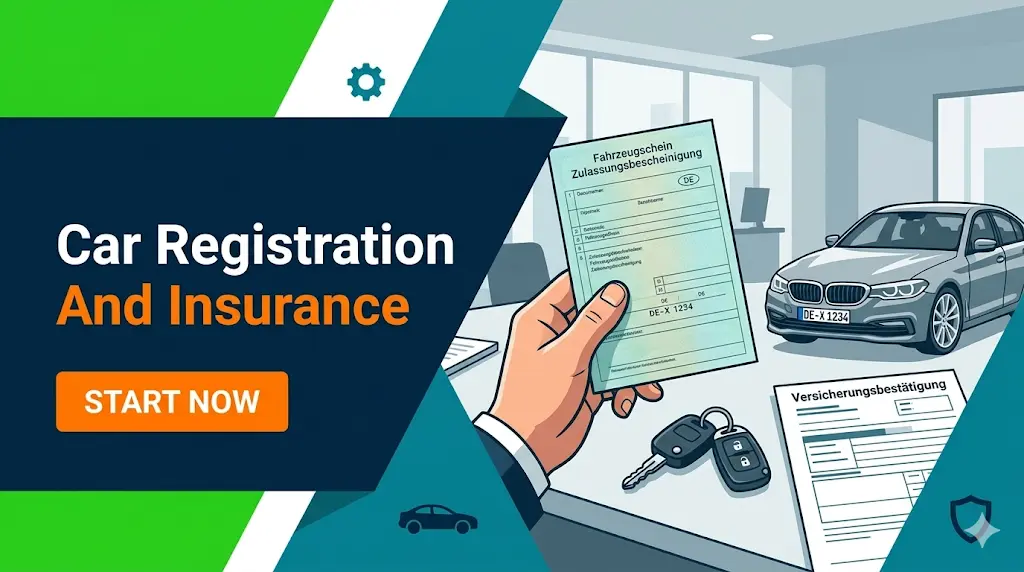
Demystifying German Car Insurance Kfz Versicherung
The Three Levels of Coverage Explained
In Germany, car insurance is not a unified package; it is strictly categorized into three distinct tiers. The baseline tier is the third-party liability insurance. This is strictly mandatory by federal law. If you own a registered car, you must have this insurance, even if the car never leaves your garage. It covers the costs of property damage, medical bills, and legal fees if you injure someone else or damage their vehicle in an accident. Crucially, it does not cover a single cent of damage to your own car.
The second tier is partial comprehensive coverage. This is optional but highly recommended for most expats. It covers damage to your own vehicle caused by external forces outside your control. This includes theft, fire, broken glass, storm and hail damage, and collisions with wildlife. If a marten chews through your engine cables—a surprisingly common occurrence in Germany—this tier covers the expensive repairs.
The third and highest tier is fully comprehensive coverage. This is also optional but effectively mandatory if you are leasing or financing a new vehicle. It covers everything in the previous tiers, plus vandalism and, most importantly, damage to your own car when you are the one at fault in an accident. If you accidentally back your new BMW into a concrete pillar, this insurance pays for the repairs.
| Insurance Type | German Name | Legal Status | What it Covers | Best For |
| Third-Party Liability | Kfz-Haftpflicht | Strictly Mandatory | Damage and injury to others | Absolute legal minimum |
| Partial Comprehensive | Teilkasko | Optional | Theft, fire, glass, wildlife | Older cars of moderate value |
| Fully Comprehensive | Vollkasko | Optional | At-fault damage, vandalism | New cars, leased vehicles |
The No Claims Bonus Trap Schadenfreiheitsklasse
The most devastating financial shock for expats buying car insurance in Germany is the no-claims bonus system. German insurers calculate your premium heavily based on how many consecutive years you have driven without filing an at-fault claim. This creates a sliding scale where a twenty-year veteran driver pays a fraction of what an eighteen-year-old beginner pays.
The trap for expats is that most German insurance algorithms view your arrival as a complete reset. Even if you have driven flawlessly in the United States, India, or Australia for twenty years, standard German insurers will frequently classify you as a beginner. They assign you the lowest possible rating, resulting in staggering annual premiums that can easily exceed 1,500 euros for basic coverage.
To combat this, you must aggressively negotiate. Before you leave your home country, request a formal, certified letter from your current auto insurance provider detailing your exact history of claims-free years, translated into English or German. While massive digital aggregators might reject this letter automatically, reaching out to specialized insurance brokers or directly to customer service agents at major providers like Allianz or HUK-Coburg can often result in them honoring your foreign driving history, saving you thousands of euros. Factoring this premium into your initial setup is a crucial part of Cost of Living in Germany: Budgeting for Your First Year as an Expat.
Getting the eVB Number to Register
Once you have selected an insurance provider and agreed on a policy, you do not receive a physical paper certificate to carry to the registration office. Germany modernized this process in 2008. Instead, your insurer will issue you a seven-digit alphanumeric code known as the electronic insurance confirmation.
This code is the digital key that unlocks the entire registration process. When you sit down with the clerk at the municipal office, you hand them this seven-digit code. The clerk enters it into the federal database, which instantly pings the insurance company’s servers to verify that a valid liability policy has been underwritten for your specific name and address.
You can generate this code almost instantly. Many online comparison portals allow you to sign a contract digitally and receive the code via email or SMS within minutes. It is critical to note that this code is only valid for a limited time, usually up to 90 days. If your municipal appointment gets delayed and your code expires, you must contact your insurer to generate a fresh one before heading to the registration office.
Conquering the Vehicle Registration Office Zulassungsstelle
Gathering the Mandatory Paperwork
Arriving at the vehicle registration office without a flawless stack of required documents guarantees immediate rejection. The German clerks operate with absolute rigidity; there is no room for negotiation if a single signature is missing.
First, you need your personal identification. This means your valid passport paired with your municipal registration certificate. Second, you need the aforementioned seven-digit electronic insurance confirmation code. Third, you must bring the physical proof of a valid emissions and safety inspection report. If the car’s inspection is expired, it cannot be registered. Fourth, you must provide a signed SEPA direct debit mandate, granting the federal customs office permission to automatically pull the annual vehicle tax from your German bank account.
Most importantly, you must bring the vehicle’s two primary title documents. The first is the small, folded green paper containing the technical specifications. The second is the large, highly secure sheet of paper that proves ultimate legal ownership of the vehicle. You must possess the originals of both documents; photocopies are completely useless.
The Appointment Nightmare and Solutions
In major German metropolitan areas like Berlin, Munich, or Cologne, securing an appointment at the vehicle registration office is a brutal test of endurance. Due to chronic understaffing, the online booking portals are frequently booked solid for four to six weeks in advance. If you just bought a car and need it to commute, waiting a month to register it is agonizing.
Expats facing this backlog have two primary workarounds. The first is hiring a commercial registration service. These private companies charge a service fee, usually around 100 to 150 euros. You hand them a signed power of attorney and your original documents. Because they are commercial entities, they have access to commercial fast-track lanes at the registration office and can usually get your car registered and plates printed within 48 to 72 hours.
The second option is the newly expanded federal digital portal. If you possess a modern German ID card or an electronic residence permit with the online ID function activated, and the car’s title documents have the modern hidden security codes, you can register the vehicle entirely online from your laptop. This system allows you to pay digitally and instantly download a temporary driving permit, allowing you to drive immediately while the physical paperwork is mailed to you.
Customizing and Printing Your License Plates
Unlike in many other countries, the German government clerk does not pull a pair of metal license plates out of a drawer and hand them to you. The registration office handles the legal paperwork; independent businesses handle the metalwork.
When you sit at the clerk’s desk, you will be assigned a license plate number. You can usually pay a small premium to request a customized vanity plate, combining your initials or birth year with the mandatory city prefix. Once the number is confirmed in the system, the clerk prints a paper slip and tells you to leave the building.
You walk outside to one of the dozens of small, independent plate-making shops clustered around the government building. You hand them the paper slip, pay them roughly 30 euros, and watch as they physically press the alphanumeric characters into blank metal plates in under two minutes. You then carry these bare metal plates back inside the government building, bypass the waiting room line, and hand them to your clerk. The clerk then affixes the official, tamper-proof state and inspection seals to the metal, officially transforming them into legal German license plates.
Vehicle Taxes and the Mandatory TUV Inspection
Calculating Your Kfz Steuer Vehicle Tax
Owning a car in Germany subjects you to an unavoidable annual vehicle tax. This is not a tax you pay manually; it is automatically deducted from your checking account every year by the federal customs office.
The cost of this tax is highly variable and intentionally designed to penalize heavy polluters. It is calculated using a complex formula based on two primary factors: the engine displacement size measured in cubic centimeters, and the vehicle’s total CO2 emissions measured in grams per kilometer. Because of this environmental focus, older diesel vehicles are taxed at significantly higher, often punitive rates compared to modern petrol engines.
Conversely, the German government heavily incentivizes the adoption of electric vehicles. If you purchase a purely electric vehicle, you are currently entirely exempt from paying this annual vehicle tax for up to ten years from the date of first registration. When budgeting your monthly living costs, understanding exactly how much tax a specific used car will incur is vital to avoid nasty surprises.
Surviving the Hauptuntersuchung TUV
The most anxiety-inducing aspect of German car ownership is the mandatory general inspection, universally referred to simply as the TÜV. Every two years, your vehicle must undergo an incredibly rigorous, unforgiving mechanical and environmental inspection conducted by certified state engineers at organizations like TÜV, DEKRA, or GTÜ.
This is not a casual visual check. The engineers will put your car on a hydraulic lift, aggressively check the chassis for structural rust, measure the exact millimeter thickness of your brake pads, verify the alignment of your headlights, and plug sensors into your exhaust to ensure your emissions meet legal standards. If a single component fails to meet the strict federal safety parameters, the car fails the inspection.
If you fail, the inspector will withhold your inspection sticker. You are granted exactly one month to take the car to a mechanic, fix the specific defects listed on the failure report, and return for a re-test. If you fail to do this, the car loses its legal roadworthiness. Because repairing older cars to pass this inspection can cost thousands of euros, the most critical advice for expats buying on the second-hand market is to only purchase vehicles advertised as having a completely new, freshly passed inspection report.
The Green Emissions Sticker Umweltplakette
Beyond the mechanical inspection, you must navigate Germany’s strict urban environmental regulations. Almost all major German city centers, including Berlin, Munich, Frankfurt, and Stuttgart, are designated as environmental zones.
To legally drive or even park within these inner-city zones, your vehicle must physically display a green emissions sticker on the lower right corner of the windshield. This sticker, featuring a prominent number four, proves that your car meets the acceptable Euro 4 emissions standards for fine particulate matter. If you drive into the city center without this sticker, automated cameras and parking enforcement officers will issue you a hefty fine.
You can purchase this sticker at the registration office when you get your plates, or at any certified mechanic shop. However, to save time and skip the queues, smart expats simply order their emissions sticker directly from Amazon Germany before their car even arrives. By entering your vehicle’s registration details at checkout, you can have a certified sticker shipped directly to your door via Amazon Germany, ensuring you are fully compliant and ready to enter the city center on day one.
Importing a Foreign Car versus Buying Locally
The Financial Pain of Importing from Outside the EU
Many expats arriving from the United States, the UK, or the Middle East consider shipping their personal vehicle to Germany to save money. Unless the car holds immense sentimental or classic vintage value, this is almost always a catastrophic financial mistake.
Importing a vehicle from outside the European Union subjects you to severe taxation. You will be hit with a 10 percent customs duty on the vehicle’s current market value, plus the exorbitant shipping costs, followed by a 19 percent import value-added tax applied to that entire sum. While expats can apply for an exemption by declaring the car as personal moving goods, the bureaucracy is intense, and you are legally forbidden from selling the car for a full year after importing it.
Furthermore, non-EU cars are not built to European regulatory standards. You will likely have to pay a specialized mechanic to physically modify the car. This often involves swapping out red rear turn signals for European amber ones, installing a mandatory rear fog light, and recalibrating the speedometer to kilometers. After these modifications, the car must pass an incredibly expensive individual technical approval inspection. The total cost of modifications and inspections frequently eclipses the value of simply buying a comparable used car locally.
Navigating the Second Hand Market in Germany
If you wisely choose to buy locally, the German second-hand market is vast, well-regulated, and predominantly digital. Platforms like Mobile.de and AutoScout24 are the undisputed hubs for finding used vehicles.
When searching, you must distinguish between private sellers and commercial dealerships. Buying from a private seller is generally cheaper, but you buy the car entirely as-is, with zero legal recourse if the transmission explodes on the drive home. Conversely, buying from a commercial dealership is more expensive, but German consumer protection laws strictly mandate that commercial dealers must provide a one-year statutory warranty on used cars. If a major mechanical flaw disguised during the sale reveals itself within the first year, the dealer is legally obligated to repair it at their expense.
When negotiating, prepare to operate entirely in German. Furthermore, understand that massive cash transactions for vehicles are becoming increasingly scrutinized due to anti-money laundering laws. Most reputable dealerships now require you to pay via a trackable SEPA bank transfer, which reinforces the necessity of having your domestic banking infrastructure fully operational beforehand.
Outfitting Your German Car for Legal Compliance
The moment you take ownership of your German vehicle, you are legally responsible for outfitting it according to strict federal safety codes. You cannot simply throw your luggage in the trunk and drive off. The German traffic code mandates that specific emergency equipment must be physically present inside the cabin at all times.
You are required to carry a reflective warning triangle. You must carry at least one high-visibility reflective vest, though carrying one for every passenger is deeply encouraged. Most strictly, you must carry a DIN-certified first aid kit. The police regularly check the expiration dates on the sterile bandages inside these kits during routine traffic stops; an expired kit results in an instant fine.
Do not wait until you are pulled over to realize your used car is missing this gear, and do not overpay for individual items at a highway gas station. The moment your purchase clears, log onto Amazon Germany and order a comprehensive, pre-packaged vehicle emergency safety kit. Ordering a heavy-duty ice scraper and a blue parking disc from Amazon Germany at the same time ensures you are perfectly equipped for winter mornings and municipal parking rules. Being fully prepared is the only way to navigate the intense regulatory scrutiny of the Autobahn. To master the actual rules of the road once you are behind the wheel, study Driving in Germany: Rules, Road Signs, and Getting Your License Converted.
References
Primary sources official
- Federal Ministry for Digital and Transport (BMDV): Official guidelines regarding the new i-Kfz system for digital vehicle registration, allowing immediate drive-off capabilities for qualified residents.https://bmdv.bund.de/SharedDocs/EN/Articles/StV/Roadtraffic/internet-based-vehicle-registration.html
- Federal Financial Supervisory Authority (BaFin): Comprehensive consumer portal explaining the strict legal requirements for mandatory third-party motor liability insurance.https://www.bafin.de/EN/Verbraucher/Versicherung/Produkte/Kraftfahrt/kfz-versicherung_artikel_en.html
Other helpful sources
- German Customs (Zoll): Information on the calculation, billing, and SEPA direct debit requirements for the annual German vehicle tax based on CO2 emissions.https://www.zoll.de/EN/Private-individuals/Motor-vehicles/motor-vehicles_node.html
Disclaimer
The information provided in this article is for general informational and educational purposes only and does not constitute professional legal, financial, or insurance advice. German vehicle registration laws, the mechanical standards of the technical inspection, and the underwriting algorithms regarding foreign driving histories are highly complex and subject to continuous updates by federal and state authorities. While utilizing platforms can secure the housing registration required for ownership, the ultimate responsibility for legal compliance rests solely with the vehicle owner. Always consult directly with your local registration office, a certified insurance broker, or a legal professional before importing a vehicle or signing binding financial contracts.