Career Fairs in Germany: Making the Most of Job Messen as a Foreigner
Walking into a massive German convention center only to realize your meticulously printed CV doesn't follow local standards is a soul-crushing experience. I still remember the sinking feeling in my stomach at my first Messe in Berlin when a recruiter politely pointed out my missing professional photo. This guide solves the confusion of navigating German career fairs so you can walk in with confidence and leave with a signed contract.
Disclosure: This post may contain affiliate links. We may earn a commission at no extra cost to you if you make a purchase through these links. Read full disclosure.
Understanding the German Job Fair Landscape
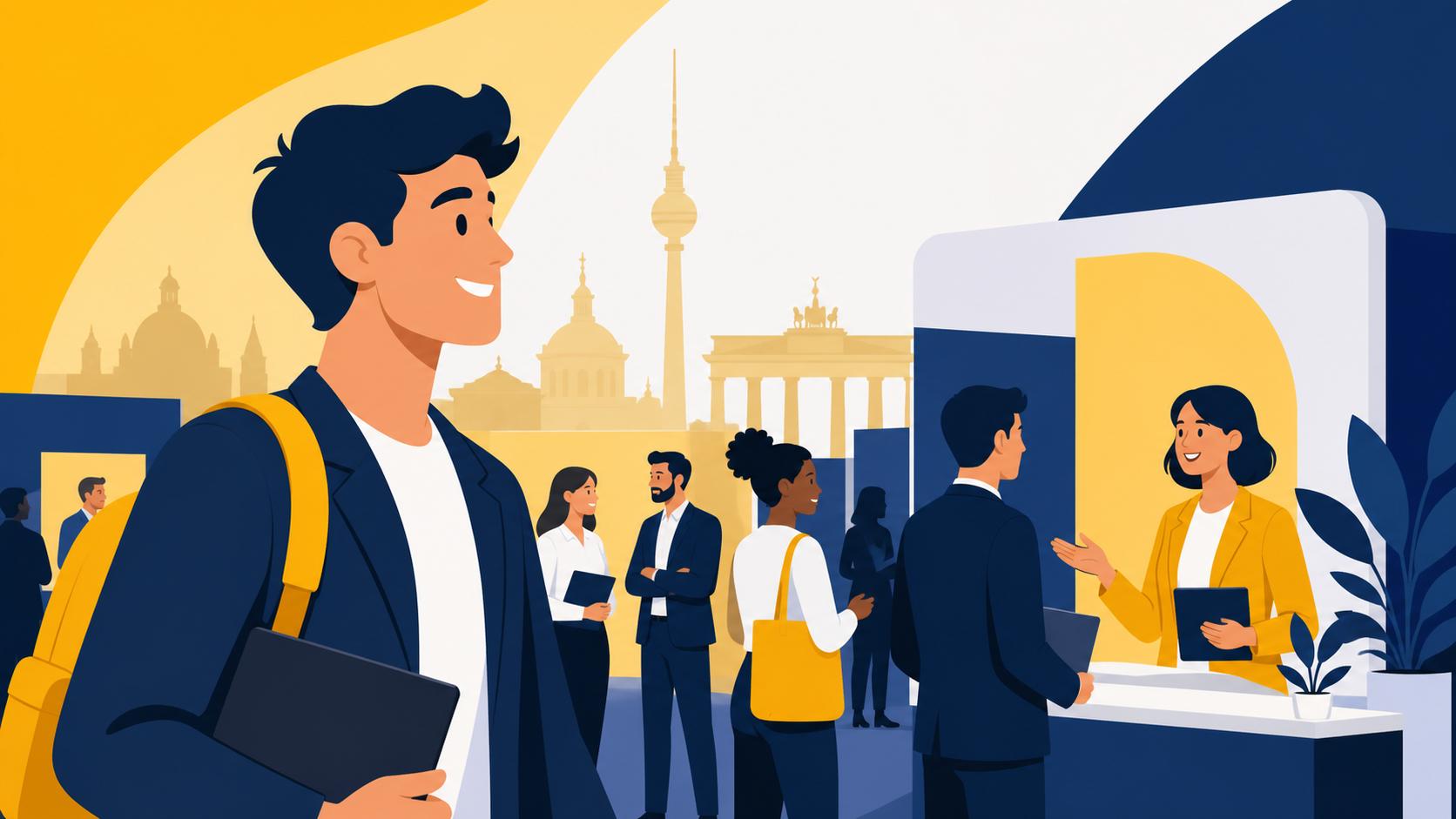
Germany is the land of trade fairs, or Messen. From the massive industrial halls of Hannover to the sleek conference centers in Munich, these events are a staple of the professional culture. For a foreigner, the sheer scale can be intimidating. You aren't just looking at a room with ten tables; you are often looking at several airplane-hangar-sized buildings filled with hundreds of companies ranging from global giants like Bosch and Siemens to the famous Mittelstand (medium-sized companies) that form the backbone of the economy.
General Career Fairs vs specialized Industry Messen
There is a distinct difference between a pure career fair (Karrieremesse) and a trade fair (Fachmesse). A career fair is explicitly designed for recruitment. Events like Connecticum in Berlin or the Absolventenkongress in Cologne are built for one thing: connecting job seekers with HR departments. At these events, every person behind a booth is there to talk to potential employees. This makes the environment slightly more welcoming for newcomers who are still figuring out Job Hunting in Germany: A Guide to Finding Employment for Expats.
On the other hand, industry-specific trade fairs like IAA Mobility in Munich or IFA in Berlin are primarily for business-to-business (B2B) networking and product launches. However, these are secret goldmines for job seekers. While the focus is on selling products, the HR teams are often tucked away in a "Career Hub" section. Approaching a company at a trade fair shows you have a genuine interest in their specific industry, which can often carry more weight than showing up at a general recruitment event.
Regional vs National Events
You also need to decide whether to go big or stay local. National fairs attract the "Big Four" and major DAX companies, but the competition is fierce. You will be standing in line behind hundreds of other applicants. Regional fairs, often held in smaller cities or at local universities (like the Bonding fairs), offer a much more intimate atmosphere. In my experience, the recruiters at regional events are often more willing to spend ten minutes chatting with you about your visa status or your specific degree, especially if you have already started the process of Getting Your Foreign Credentials Recognized: Degree and Qualification Recognition.
Top Career Fairs to Put on Your Calendar
If you are serious about finding a role in Germany, you need to treat these fairs as non-negotiable dates in your diary. Most occur in "cycles," usually in the Spring (March–May) and Autumn (October–November). Planning your travel and accommodation in advance is crucial because hotels near the Messe centers often triple in price during major events.
National Heavyweights and Student-Focused Fairs
Connecticum in Berlin is arguably the biggest name for students and young professionals. It covers everything from engineering to management and often hosts over 400 companies. Another massive player is the Absolventenkongress, which tours major cities. If you are currently studying at a German university, keep an eye out for Bonding. These are student-organized and completely free to attend. They are fantastic for low-pressure practice before you hit the larger corporate events. For those still in the academic bubble, Studying in Germany: Comprehensive Guide for International Students provides more context on how to balance your studies with these professional commitments.
Niche and Industry-Specific Fairs
For female professionals, Women&Work is an outstanding event that focuses on female leadership and career advancement in Germany. It’s much less "bro-heavy" than some of the tech-focused events and offers great workshops on salary negotiation. If you are in the tech sector, look for events like IT-Jobtag or the career sections at OMR (Online Marketing Rockstars) in Hamburg. These events are more casual, and you’ll find that English-Speaking Jobs in Germany: Finding Work When You Don’t Speak German are much more common in these environments compared to traditional mechanical engineering fairs.
Comparison of Major German Career Fairs
| Fair Name | Primary Location | Target Audience | Typical Industry Focus |
|---|---|---|---|
| Connecticum | Berlin | Students/Graduates | IT, Engineering, Business |
| Absolventenkongress | Cologne / National | Young Professionals | Multi-sector |
| Women&Work | Frankfurt/Virtual | Female Professionals | Leadership, Finance, Tech |
| Bonding | University Cities | Students | Engineering, Science |
| OMR Career | Hamburg | Digital/Marketing | Tech, Media, E-commerce |
| Hannover Messe | Hannover | Professionals | Industry 4.0, Energy |
Preparation: More Than Just Printing Your CV
In Germany, "well-prepared" means more than having a pulse and a smile. The German recruiters expect a level of formality and organization that might feel excessive if you come from a more "casual" job market like the US or the UK. I’ve seen people get dismissed in thirty seconds because they didn't know which specific department they were interested in.
Researching Exhibitors in Advance
Never walk up to a booth and ask, "So, what does your company do?" This is the quickest way to end the conversation. Most major Messen provide an app or a digital catalog weeks before the event. Use this to create a "Top 10" list. Research their recent projects, their current job openings on their website, and their company culture. This allows you to say, "I saw your recent project in renewable energy in North Rhine-Westphalia; how does your sustainability team integrate international engineers?" This level of detail shows you already have the "German mindset" of thoroughness.
The German-Style CV (Lebenslauf) Requirements
Your CV needs to be "Germanized." This means it should be a Lebenslauf, typically in reverse-chronological order, and—most importantly—it usually includes a professional headshot (Bewerbungsfoto) in the top right corner. While some international companies are moving away from this, the majority of German HR managers still expect it. It should also be signed and dated at the bottom. For a deep dive into these specific formatting rules, you should definitely read Writing a German-Style CV and Cover Letter: Tips for Success. Having twenty high-quality copies of this document in a clean folder is your "entry ticket" to a real conversation.
Perfecting Your Elevator Pitch
You have about 60 seconds to make an impression. Your pitch should include who you are, your core qualification, your "German connection" (e.g., why you moved here or your current language level), and what you are looking for. If your German isn't perfect yet, don't panic, but do try to start the conversation in German. Even a simple "Guten Tag, ich interessiere mich für Ihr Unternehmen" goes a long way. If you need to polish your professional vocabulary, resources like Lingoda or GermanPod101 are invaluable for learning the specific phrases used in a Work Culture in Germany: Etiquette, Hierarchy, and Office Norms context.
Navigating the Fair Day Like a Pro
The day of the fair is an endurance sport. You will be on your feet for six to eight hours, talking constantly in a loud, crowded environment. If you don't have a strategy for the day itself, you will burn out by lunchtime.
What to Wear: The German Business Casual Reality
Unless you are applying for a high-level finance or legal role, a full three-piece suit is usually overkill, but showing up in a hoodie is a mistake. The sweet spot is "Business Casual" with a German tilt—think dark jeans or chinos, a crisp shirt or blouse, and a blazer. Most importantly, wear comfortable shoes. You will likely walk several kilometers over the course of the day. Appearance matters because it signals respect for the Job Interview Tips for Germany: What to Expect and How to Impress process that often starts right there at the booth.
Approaching Recruiters: Breaking the Ice
The booths are often crowded. Don't just stand awkwardly at the edge; wait for a natural break in conversation and step forward. If there is a line, use that time to listen to what others are asking. When it’s your turn, offer a firm handshake (very important in Germany!) and maintain eye contact. State your name and your pitch clearly. If the recruiter is busy, ask if you can leave your CV or if there is a specific time to return for a "Speed Dating" session, which many fairs now offer.
Collecting Information and Business Cards
Don't just give; you must also receive. Ask for the business card of the person you spoke with, or at least their name and their LinkedIn/Xing profile details. Write a small note on the back of their card or in your notebook immediately after leaving the booth—mention something specific you talked about. Did they mention a specific software they use? Did they talk about a new office opening in Leipzig? This information is gold for your follow-up. Understanding Professional Networking in Germany: LinkedIn vs Xing and More is essential here, as Xing is still very relevant in more traditional German industries.
Overcoming the Language Barrier at the Messe
This is the biggest fear for most expats. "Is my German good enough?" The answer is usually "it depends," but the effort you put in is what recruiters remember. Most recruiters at major fairs will speak English, but their internal company language might still be German.
When English is Enough (and When it Isn't)
In startups, IT, and specialized scientific research, English is often the working language. At a Messe, these companies will usually have "English Speaking" signs or international teams. However, for the Mittelstand or roles in HR, marketing, and law, German is non-negotiable. Even if the recruiter speaks English to you, they are secretly assessing if you could handle a meeting with a German client. If you are struggling, platforms like Lingoda can help you fast-track your "Business German" skills. Using GermanPod101 for daily listening can also help you get used to the different accents you'll hear from recruiters from Bavaria to Hamburg.
Cultural Nuances and Business Etiquette
Germans value directness and honesty. If you don't know the answer to a technical question, don't "fluff" it. Say you aren't familiar with that specific tool but are eager to learn. Also, be mindful of the "Du" vs "Sie" distinction. Always start with "Sie" (formal you) unless the recruiter explicitly invites you to use "Du." This is especially true at more traditional companies. This level of cultural awareness is a key part of Learning German: Best Ways for Students to Improve Language Skills and successfully integrating into the local market.
Post-Fair Strategy: Closing the Deal
Most people think the work ends when they leave the Messe hall. In reality, the fair is just the "lead generation" phase. The actual hiring happens in the two weeks following the event. If you don't follow up, you were just another face in the crowd of thousands.
The 24-Hour Follow-Up Rule
Within 24 hours of the fair, send a personalized email or LinkedIn message to every recruiter you had a meaningful conversation with. Remind them who you are ("We spoke at the Connecticum fair yesterday about the Junior Developer role") and mention that specific detail you wrote down earlier. Attach a digital copy of your CV and cover letter, even if you gave them a paper version. This shows you are organized and digitally savvy, which is a major plus in Working in Germany: Comprehensive Guide for Foreign Professionals.
Leveraging LinkedIn and Xing
In Germany, your online presence is your extended CV. Ensure your LinkedIn profile is up to date and matches the information on your paper CV. If you are targeting traditional German companies, consider creating a profile on Xing as well. Connect with the people you met, but always include a personal note with the connection request. Mention the fair and thank them for their time. This builds a "warm" network that can lead to "hidden" job opportunities that are never officially posted on job boards.
Professional Advice for a Successful Messe Experience
Having attended dozens of these events both as a job seeker and later as a representative, I can tell you that the people who succeed are the ones who stay resilient. You will get some "no's," and some recruiters might be blunt about your language skills or lack of local experience. Don't take it personally. Use every interaction as a free "mini-interview" to practice your pitch.
Bring a "survival kit": a bottle of water, a few protein bars (fair food is expensive and usually just sausages), a portable phone charger, and a small notebook. Take breaks every two hours to step outside, get some fresh air, and clear your head. The mental fatigue of switching between languages and selling yourself is real. If you keep your energy high and your folder of CVs organized, you are already ahead of 80% of the other attendees.
Disclaimer
This guide is intended for informational purposes only. While every effort has been made to ensure the accuracy of the information provided, job market conditions, visa regulations, and specific fair details in Germany are subject to change. Always verify dates and requirements directly with the official event organizers and relevant government authorities.