Writing a German-Style CV and Cover Letter: Tips for Success
Sending out fifty colorful, single-page resumes and receiving absolute silence is a soul-crushing introduction to the local job market. I once spent three months submitting my standard American resume to Munich startups before realizing it was being instantly binned by HR. This guide decodes the rigid formatting, language nuances, and unwritten rules of crafting a German application that actually gets read.
Disclosure: This post may contain affiliate links. We may earn a commission at no extra cost to you if you make a purchase through these links. Read full disclosure.
The German Lebenslauf Structure and Format
The Rigid Reverse-Chronological Layout
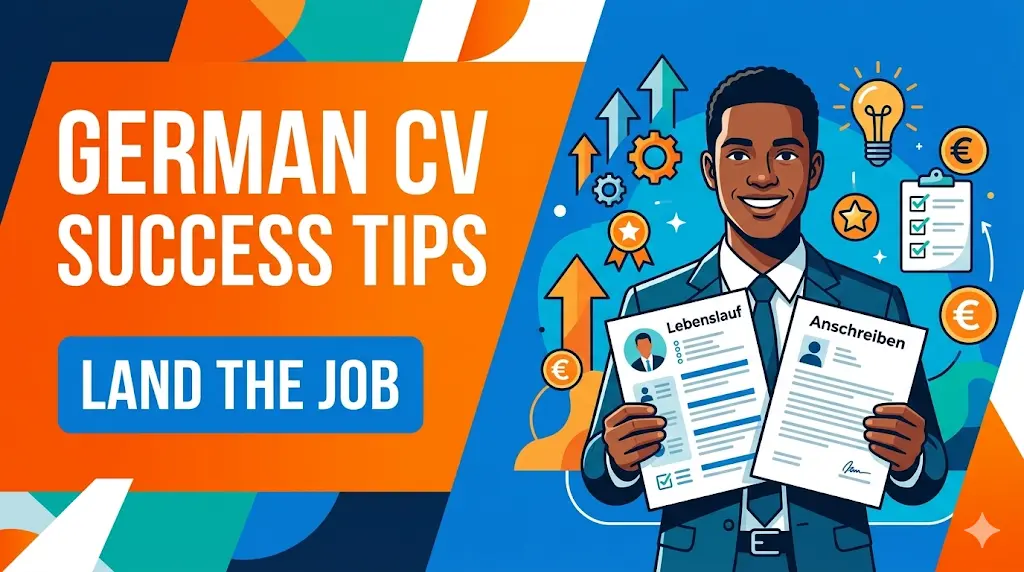
When expats first encounter a traditional German CV, known as a Lebenslauf, the immediate reaction is often disbelief at the sheer length and level of detail required. In Anglo-American corporate cultures, the golden rule is to compress your entire professional existence into a single, punchy page. In Germany, a Lebenslauf is not a marketing brochure; it is treated as a highly structured, factual timeline of your life. It is perfectly normal, and often expected, for a German CV to span two or even three pages if you are a mid-career professional.
The layout must be strictly reverse-chronological, starting with your current role and working backward. However, unlike a US resume where you might only list the years you worked at a company, a German HR manager demands exact months and years (e.g., 05/2018 – 11/2021). This precision is not a stylistic choice; it is a fundamental requirement for the recruiter to calculate exactly how much specific experience you have and to verify that there are no hidden gaps in your employment history.
You must also include your educational history in deep detail, often reaching back to your high school graduation (Abitur equivalent) if you are a recent university graduate. The format is typically a strict two-column table. The left column contains the exact dates, and the right column contains the role, the company name, its location, and a bulleted list of your specific responsibilities and achievements. Do not use this space for a “Personal Summary” or “Objective” paragraph; those subjective statements belong exclusively in your cover letter.
Personal Details and the Application Photo (Bewerbungsfoto)
The personal details section (Persönliche Daten) of a German CV requires information that would be considered highly inappropriate, or even illegal to ask for, in countries like the United States or the United Kingdom. You are fully expected to list your date of birth, your place of birth, and your nationality. In more traditional industries, applicants even include their marital status and the number of children they have. While this feels like a massive invasion of privacy to a newly arrived expat, it is simply the standard administrative format here.
Another major cultural shock is the Bewerbungsfoto (application photo). While modern anti-discrimination laws mean that companies cannot legally demand a photo, the unwritten reality is that a Lebenslauf without a photo is often viewed as incomplete and may be subconsciously deprioritized by traditional hiring managers. You absolutely cannot use a cropped photo from a wedding, a casual vacation selfie, or a heavily filtered social media picture.
You must go to a professional German photography studio, wear a crisp suit or formal business attire, and get a specific, high-quality headshot. The photographer will know exactly how to light and pose you for a German application. This photo is usually placed in the top right corner of the first page of your CV, or on a dedicated cover page (Deckblatt). Taking this extra step signals to the employer that you understand local professional norms and are taking the application process seriously.
Explaining Gaps and Signing the Document
German human resources departments possess a deep, institutional fear of unexplained chronological gaps (Lücken) in a candidate’s history. If there is a four-month period between two jobs, you cannot simply leave it blank. A blank space suggests you are hiding something negative. You must explicitly account for that time using standardized phrasing. If you were looking for work, you write Arbeitssuchend (seeking employment). If you took time off to travel, you write Auslandsaufenthalt (stay abroad). If you were caring for a sick relative, you state it clearly.
Furthermore, the Lebenslauf is traditionally viewed as a formal, legally binding declaration that the information you are providing is absolute truth. Because of this legal weight, you must physically sign and date the bottom of the last page of your CV. You should type the location and the current date on the left side, and place your handwritten signature on the right side.
In the digital age, you do not need to print and mail the document. You simply sign a blank piece of paper with a blue or black pen, scan it, remove the background, and append the digital signature to your PDF. Forgetting to sign your CV is a classic expat mistake that signals a lack of attention to local bureaucratic detail, a theme you will encounter repeatedly when Navigating the Ausländerbehörde: Tips for Dealing with German Immigration Offices.
| Feature | US/UK Resume | German Lebenslauf |
| Length | Strictly 1-2 pages | 2-3 pages, highly detailed |
| Photo | Strictly prohibited | Highly expected (Professional headshot) |
| Personal Info | Contact info only | Birthdate, nationality, marital status |
| Timeline | Years are often sufficient | Exact month and year required |
| Validation | No signature required | Must be dated and manually signed |
Crafting the Anschreiben (Cover Letter)
Adhering to the DIN 5008 Business Standard
The cover letter, known as the Anschreiben, is not an optional afterthought in Germany; it is arguably scrutinized as heavily as your CV. A generic, copy-pasted letter will result in instant rejection. The most terrifying part of drafting this document is adhering to the DIN 5008 standard. This is the official German institute for standardization’s rulebook for how a business letter must visually appear.
DIN 5008 dictates the exact millimeter spacing for your sender address block, the recipient’s address block, the date format, and the subject line. The recipient’s address must be formatted so that it fits perfectly into the transparent window of a standard German business envelope, even if you are only sending the document as a PDF. The subject line (Betreff) must be bolded, usually starting with “Bewerbung als…” (Application for…), and must never include the word “Betreff” itself.
If your letter looks like a casual email printed on a blank page, the hiring manager will immediately assume you lack basic administrative competence. When you need someone to review your Anschreiben for these microscopic formatting rules, relying on Google Translate is a recipe for disaster. Using the structured business writing feedback available through Lingoda can save you from having your application discarded before the recruiter even reads the first paragraph.
Striking the Right Tone: Facts Over Fluff
American and British cover letters are often emotive, focusing on the applicant’s “passion,” “dreams,” and “deep love” for the company’s mission. If you translate this enthusiastic tone directly into German, you will sound unhinged, unprofessional, or insincere. Germans value objective facts, verifiable achievements, and calm competence over emotional salesmanship.
Your Anschreiben should not simply summarize your CV. Instead, you must use the letter to explicitly connect your past professional experiences to the precise requirements listed in the job advertisement. You need to objectively prove exactly how your presence will minimize their hiring risk and solve their current operational problems. Use clear, active verbs and provide concrete metrics whenever possible.
Finding the right balance between confident and arrogant in German is incredibly difficult for non-native speakers. You want to sound assured of your abilities without crossing into boasting. To understand how native speakers construct these formal, balanced sentences, I highly recommend immersing yourself in the advanced business audio tracks on GermanPod101. Listening to these dialogues will help you internalize the specific rhythm and emotional restraint expected in German corporate communication.
Mandatory Elements: Salary and Start Date
The closing paragraph of the Anschreiben is highly standardized and must address specific administrative details. If the job posting explicitly asks for your salary expectations (Gehaltsvorstellung) or your earliest possible start date (frühestmöglicher Eintrittstermin), you must state them clearly in this final section. Failing to include requested information shows that you cannot follow simple instructions.
When stating your salary expectation, you must always provide a gross annual figure (Bruttojahresgehalt) in Euros. Never negotiate based on your monthly net take-home pay, because your net pay depends entirely on your personal tax class, which the employer cannot control. You can phrase this politely by writing something like, “Meine Gehaltsvorstellungen liegen bei einem Bruttojahresgehalt von ca. 60.000 Euro.”
You must also state your availability. Because German labor laws mandate strict notice periods—often three months to the end of a month—employers need to know exactly when you can legally start. Sign off with the formal complimentary close, “Mit freundlichen Grüßen,” followed by your physical signature, just as you did on your CV. If you are unsure what salary to ask for, conducting research on local economic benchmarks is vital, a topic we cover in Job Hunting in Germany: A Guide to Finding Employment for Expats.
The Application Folder (Bewerbungsmappe) and Attachments
The Critical Role of the Arbeitszeugnis
In Germany, you do not simply provide a list of names and phone numbers at the bottom of your CV for the employer to call for references. Instead, the entire system relies on the Arbeitszeugnis—a formalized, coded letter of reference provided by every German employer when an employee leaves a company. Because these letters use highly specific legal phrasing, German HR professionals read them like a secret code to determine your true performance and behavior.
As an expat, you will not have a traditional Arbeitszeugnis from your foreign employers. This puts you at a massive structural disadvantage. You must proactively ask your previous managers in your home country to write detailed letters of recommendation on official company letterhead. These letters must explicitly detail your daily tasks, your performance metrics, and your behavior toward leadership and colleagues.
You should also add a brief, polite note in your cover letter explaining that as an international applicant, you are providing international reference letters in lieu of a standard German Zeugnis. Do not underestimate how heavily German employers weigh these written references. If you are struggling to secure a job without them, understanding how to network effectively can bypass this hurdle, strategies we detail in Finding a Job in Germany: Top Job Portals and Networking Tips.
Translating and Validating Foreign Degrees
German corporate culture is obsessed with paper credentials. Your self-taught coding skills or your decade of practical marketing experience will often be ignored if you do not have the corresponding state-recognized university degree to back it up. When applying for a job, you must include copies of your highest educational degrees in your application folder.
If your degrees are from outside of Germany, you cannot simply attach the raw foreign language diploma and expect the HR department to understand it. Ideally, you should have your degrees translated by a sworn translator into German or English. Furthermore, HR departments often check the Anabin database to see if your foreign university is recognized as equivalent to a German institution.
If your profession is heavily regulated—such as medicine, engineering, or law—you must include your official recognition documents (Anerkennungsbescheid) issued by the German state. Submitting an application for a regulated profession without these validation documents guarantees an immediate rejection.
Merging the Perfect PDF
The final, absolute rule of the German application process is the PDF merge. You must never send a hiring manager an email containing five different loose attachments (e.g., one Word doc for the cover letter, one PDF for the CV, three JPEGs for your certificates). This is considered chaotic and highly unprofessional.
You must merge your cover letter, your signed CV, your reference letters, and your degree certificates into one single, logically ordered PDF file. The file should be named professionally, such as “Bewerbung_John_Doe.pdf”. The order is strict: the cover letter comes first, followed by the CV, and then the attachments (Anlagen) arranged in reverse-chronological order.
Furthermore, you must compress the file. Many traditional German corporate email servers will automatically bounce emails that contain attachments larger than 5 megabytes. Use a free online PDF compressor before hitting send.
Language Nuances and Professional Phrasing
Deciding Between English and German
The most common question expats ask is whether they should write their CV in English or German. The golden rule is incredibly simple: apply in the exact language the job advertisement is written in. If the job posting is in dense, corporate German, submitting a slick English resume will result in an immediate rejection, as it signals you either did not read the ad or cannot speak the required language.
If the job posting is in English, particularly for international tech startups in Berlin or Munich, you should submit your application in English. However, even in these cases, providing a flawlessly translated German version alongside the English one can be a massive competitive advantage. It shows the employer that you are actively integrating and making an effort to respect the local business environment.
If you decide to translate your CV into German, do not rely on automated translation software. The specific vocabulary used in German human resources is highly specialized. Practicing your professional vocabulary and having a native speaker review your application via a structured Lingoda course is a vital investment in your career trajectory.
Formal Vocabulary and Avoiding Direct Translations
When drafting your German application, you must master the strict hierarchy of professional communication. You must exclusively use the formal Sie (you) and address the hiring manager by their correct title and last name. If the contact person is listed as Dr. Schmidt, you must write “Sehr geehrte Frau Dr. Schmidt,” not just “Liebe Frau Schmidt.”
Directly translating English idioms into German will make your cover letter read like a comedy sketch. You cannot say you are a “team player” by translating it literally; instead, you describe your Teamfähigkeit (ability to work in a team). You do not say you “think outside the box”; you discuss your lösungsorientiertes Denken (solution-oriented thinking).
To absorb these specific corporate phrases naturally, listening to dedicated HR and job interview roleplays on GermanPod101 is incredibly effective. It allows you to hear the intonation and exact phrasing used by German professionals when they describe their own achievements, giving you a template to model your own application after.
Common Expat Mistakes and How to Avoid Them
Over-Designing the CV
In recent years, it has become trendy in the US and UK to use highly designed, colorful Canva templates for resumes, complete with skill progress bars and personal logos. In traditional German industries, this is a massive mistake. Over-designing your Lebenslauf makes it look like you are trying to hide a lack of qualifications behind flashy graphics.
Furthermore, many German corporations use Applicant Tracking Systems (ATS) to automatically scan and parse incoming CVs. Complex, multi-column graphical templates frequently break these parsers, meaning the software reads your CV as a blank document and instantly rejects you. Keep the layout clean, tabular, and heavily text-based. Use standard, highly readable fonts like Arial, Calibri, or Helvetica.
The focus must remain entirely on the data. If you want to show off your design skills, do so by linking to an external portfolio, rather than turning the legal document of your CV into an art project.
Omitting Crucial Visa Status Information
The most frustrating reason expats get rejected is not a lack of skills, but a lack of transparency regarding their immigration status. German HR managers are terrified of bureaucracy. If they read a foreign name and see foreign university degrees on a CV, their immediate assumption is that hiring you will require months of agonizing visa sponsorship paperwork, and they will likely move on to a local candidate.
If you already hold a valid German residence permit that allows you to work, you must state this clearly and prominently at the very top of your CV, usually right under your personal details. Write exactly what your status is, such as: “Aufenthaltstitel vorhanden – uneingeschränkte Arbeitserlaubnis” (Residence permit available – unrestricted work permit).
If you do not yet have a visa and require sponsorship, you must address this professionally in your cover letter. State that you meet the requirements for the EU Blue Card or a skilled worker visa, showing that you have already done the research and will make the process as painless as possible for their HR department. Removing the fear of the unknown is the most powerful thing you can do for your application.
References
Primary sources (official)
- Make it in Germany – Applying for a job: The official multilingual portal of the German government providing exact specifications for the German CV, cover letter, and application folder formatting.https://www.make-it-in-germany.com/en/working-in-germany/job/application
- Study in Germany – Application Tips: Official guidance supported by the DAAD outlining what German personnel managers expect from international students transitioning into the workforce.https://www.study-in-germany.com/en/germany/career/career-application-tips/
Other helpful sources
- Europass – Create your Europass CV: The official European Union tool that provides standardized CV templates widely accepted across Europe, though localized German adjustments are highly recommended.https://europass.europa.eu/en
Disclaimer
The information provided in this article is for general informational and educational purposes only and does not constitute professional career counseling, legal, or immigration advice. German corporate hiring standards, DIN 5008 formatting rules, and Applicant Tracking System (ATS) software parameters are subject to continuous change and vary significantly between industries (e.g., traditional Mittelstand vs. Berlin tech startups). While utilizing language learning platforms like Lingoda and GermanPod101 can significantly improve the grammatical quality of your application, your success in securing an interview depends entirely on your specific professional background and the discretionary choices of hiring managers. Always verify visa eligibility and document requirements directly with the prospective employer or a certified legal professional.