Finding a Job in Germany: Top Job Portals and Networking Tips
Staring at a specialized engineering degree while your inbox fills with automated rejection emails is a demoralizing rite of passage for many new arrivals. I spent my first four months in Munich agonizing over a silent phone, completely unaware I was using the wrong platforms. This guide decodes the German job market, explaining essential portals and unwritten networking rules.
Disclosure: This post may contain affiliate links. We may earn a commission at no extra cost to you if you make a purchase through these links. Read full disclosure.
The Reality of the German Job Market
The narrative sold to prospective expats is often one of endless opportunity and desperate hiring managers. While Germany undeniably needs skilled workers, the days of frantic, unchecked hiring have stabilized. Understanding the current economic landscape is the first step to preserving your sanity.
Managing Expectations in a Stabilizing Economy
If you are entering the German job market, you are navigating an environment that values precision over volume. Following the economic fluctuations of recent years, companies are no longer engaging in the rapid “quick hires” seen in the early 2020s. Instead, recruitment processes have become highly structured and selective. Human resources departments are operating with strict mandates to find candidates who perfectly match the technical requirements and possess immediate job readiness.
Furthermore, the remote work revolution has found its permanent, slightly restrictive equilibrium. While international professionals highly desire fully remote positions, the reality in Germany is that hybrid models are strictly enforced, and many growth sectors like healthcare, defense, and green infrastructure require predominantly on-site presence. Employers currently hold stronger negotiation power regarding working locations, meaning your willingness to physically relocate to your target city is a massive competitive advantage.
You must also account for the integration of artificial intelligence into the traditional workforce. Roles are not necessarily disappearing, but they are rapidly evolving. Job advertisements increasingly demand basic AI literacy even in standard administrative or operational roles. The market demands candidates who can bridge the gap between technical execution and strategic oversight. Applying with a generic, unfocused CV that does not address these modern realities will almost certainly result in a swift rejection.
The Hidden Importance of the Mittelstand
When expats dream of working in Germany, they typically envision gleaming corporate campuses at BMW, Siemens, or heavily funded tech unicorns in Berlin. However, these massive corporations represent only a fraction of the actual employment landscape. The true powerhouse of the German economy is the Mittelstand—the small and medium-sized enterprises (SMEs) that employ over half of the country’s workforce.
These hidden champions are often highly specialized, family-owned manufacturing or tech firms that dominate niche global markets. The catch is that they are rarely located in the trendy metropolitan hubs. You are much more likely to find a world-leading robotics firm in a small village in Baden-Württemberg than in the center of Frankfurt. Because these companies are highly stable and less exposed to global tech layoffs, they offer unparalleled job security.
Despite the incredible career stability they offer, the Mittelstand remains largely invisible to newly arrived foreigners. These companies often do not have massive international recruitment budgets or glossy English-language career pages. Tapping into this goldmine requires deliberate research, a willingness to live outside the major expat bubbles, and above all, a commitment to mastering the local language, as their corporate culture remains deeply traditional. For a broader overview of thriving in these environments, check out Working in Germany: Comprehensive Guide for Foreign Professionals.
Language Skills as the Ultimate Filter
The single most destructive myth propagated among expats is that you can easily build a long-term career in Germany speaking only English. While the “English-only bubble” certainly exists within Berlin startups and specific IT departments in Munich, limiting yourself to this bubble cuts you off from roughly eighty percent of the active job market. As soon as you step outside software development, fluent German becomes the ultimate, non-negotiable filter.
Even if a company claims their official language is English, the informal networking, the canteen conversations, and the subtle office politics all happen in German. If you cannot participate, you will inevitably hit a promotional glass ceiling. To break through, you must actively and aggressively upgrade your language skills. Using a platform like Lingoda is highly strategic because it forces you into live, structured conversations with native speakers, helping you overcome the psychological barrier of making mistakes in a professional setting.
You must also tune your ear to the specific vocabulary of your industry, which textbooks rarely cover. Supplementing your formal classes with targeted audio lessons from GermanPod101 is an excellent way to absorb passive vocabulary during your commute. By listening to their advanced business tracks, you can internalize the formal phrasing and idioms that German hiring managers expect to hear during an interview.
Navigating the Top German Job Portals
Sending your resume into the void of generic global job boards is a massive waste of time. To get noticed in Germany, you must use the specific platforms that local recruiters actually monitor and trust.
The Giants Stepstone and Indeed
When it comes to corporate roles, engineering, finance, and traditional management positions, Stepstone is the undisputed heavyweight champion of German job boards. It is highly respected by traditional employers and the Mittelstand. Because posting on Stepstone is incredibly expensive for companies, the listings you find there are usually for serious, well-budgeted, and highly secure roles. If you are a mid-to-senior level professional, this should be your homepage.
Indeed operates as the great aggregator and is arguably the highest-volume portal in the country. It casts the widest net, capturing everything from entry-level part-time shifts to senior executive roles. The filter functions on Indeed Germany are robust, allowing you to search specifically for full-time, permanent contracts in your target region. However, because it is free or cheap for employers to post, you must be slightly more vigilant about filtering out low-quality recruitment agency spam.
When using these massive portals, the golden rule of the German job hunt applies: always reply in the language the job advertisement is written in. If a listing on Stepstone is written in dense corporate German, submitting a slick, American-style English resume will result in an immediate automated rejection.
| Job Portal | Primary Focus | Best Used For | Target Audience |
| StepStone | Corporate, Engineering, Management | High-quality, traditional roles | Mid to Senior Professionals |
| Indeed | Broad Aggregator | Casting a wide net, all industries | All levels |
| Xing Jobs | Networking & Traditional Roles | Connecting directly with DACH recruiters | German-speaking professionals |
| Honeypot | Reverse Recruiting in Tech | Developers letting companies apply to them | Software Engineers & IT |
Official Government Resources and Make it in Germany
Many expats completely ignore government portals, assuming them to be outdated and irrelevant. This is a massive mistake. The Bundesagentur für Arbeit (Federal Employment Agency) manages the largest official job board in the country. While the user interface feels like it was built two decades ago, it is the most comprehensive database of open positions, particularly for vocational trades, healthcare, and regional roles.
More importantly for expats, the German government operates the “Make it in Germany” portal. This is explicitly designed for international qualified professionals. The companies posting on the Make it in Germany job board are actively seeking foreign talent, meaning they are already mentally prepared to deal with the bureaucracy of visa sponsorships, relocation allowances, and the onboarding of non-German speakers.
Leveraging these official channels is particularly useful if you are utilizing the newly implemented Job Search Opportunity Card (Chancenkarte). These portals often clearly indicate which employers are open to hiring candidates who are currently in the country specifically to seek employment. Understanding how these portals align with your immigration status is critical, a topic we cover deeply in Job Hunting in Germany: A Guide to Finding Employment for Expats.
Niche Portals for Tech and Startup Roles
If your background is in software engineering, data science, or digital marketing, generic corporate boards will often yield poor results. The tech industry in Germany operates on its own specialized recruitment wavelength. Platforms like Honeypot utilize a “reverse recruiting” model: you pass a technical screening, build a profile, and companies actively apply to interview you, complete with upfront salary transparency.
For those strictly looking for English-speaking environments, platforms like EnglishJobs.de or BerlinStartupJobs are invaluable. These sites aggregate roles where fluent German is not an immediate hard requirement. They are heavily focused on the startup ecosystems of Berlin, Munich, and Hamburg, making them perfect landing pads for newly arrived expats who need an income while they establish themselves.
However, even if you secure a job through an English-first tech portal, do not let your language studies stagnate. The startup turnover rate is high, and your next role might not be so accommodating. Utilizing Lingoda to slowly build your technical German vocabulary in the evenings ensures that when the time comes to jump to a more stable, traditional German tech firm, your language skills will not be the barrier that holds you back.
The Art of German Networking
Networking in Germany does not look like the aggressive, business-card-swapping mixers common in North America or the UK. It is a slow, methodical process built on proving your technical competence and establishing genuine, long-term reliability.
Mastering Xing versus LinkedIn
The most common digital networking mistake expats make is relying exclusively on LinkedIn. While LinkedIn has grown massively in Germany over the last five years, it leans heavily toward international corporations, startups, and the English-speaking expat bubble. If your goal is to penetrate the German Mittelstand or secure a role in a traditional engineering or manufacturing firm, you must be on Xing.
Xing is the dominant professional network for the DACH region (Germany, Austria, Switzerland). Local recruiters heavily favor it for sourcing talent. Having a fully optimized, German-language Xing profile signals to employers that you understand the local business landscape and are committed to long-term integration. Lacking a Xing profile when applying to a traditional Bavarian logistics firm makes you look like a temporary tourist.
Optimizing your profile on both platforms requires a fundamental shift in tone. American-style boasting, emotive buzzwords, and hyperbolic self-praise are viewed with intense suspicion in Germany. Your profile should read like a factual, objective list of technical competencies, project outcomes, and verified certifications. Keep the layout clean, the tone formal, and the facts easily verifiable.
Industry Events and Trade Fairs
Germany is the undisputed global capital of the Messe (trade fair). From the Hannover Messe for industrial technology to the IFA in Berlin for consumer electronics, these massive exhibitions are the physical heart of German networking. If you are job hunting, attending the relevant Messe for your industry is one of the highest-ROI activities you can undertake.
However, you must approach these events correctly. Do not walk up to a busy booth and aggressively demand a job or hand out your resume to the first person you see. The goal is to engage the representatives in a high-level, technical conversation about their products or the challenges their sector is facing. You are there to demonstrate your competence and your deep understanding of their specific market niche.
Once you have established a rapport, you can subtly mention your professional background and ask for the contact details of their department head or HR representative. Following up after the fair requires a flawlessly crafted, formal email referencing your conversation. To ensure your follow-up strikes the perfect professional tone, reviewing the formal email templates provided in the advanced modules of GermanPod101 will save you from making embarrassing etiquette blunders.
The Power of the Initiativbewerbung
One of the most powerful and culturally respected tools in the German job hunt is the Initiativbewerbung (unsolicited application). Rather than waiting for a job to be posted, you actively research a company, identify a potential gap in their operations, and pitch yourself as the solution. This tactic bypasses the automated HR screening algorithms entirely and taps directly into the hidden job market.
Executing a successful Initiativbewerbung requires intense preparation. You must study the company’s recent press releases, financial reports, and market expansions. Your application must clearly articulate exactly why your specific skills will save them money, increase their efficiency, or solve a looming regulatory problem. It is a highly targeted, sniper-like approach compared to the shotgun method of generic job portals.
Because you are reaching out unprompted, your command of formal German business etiquette must be absolutely flawless. A single grammar mistake in an unsolicited pitch will result in immediate deletion. Taking the time to have your cover letter reviewed by a native speaker, or utilizing the writing feedback tools available through a structured Lingoda course, is an absolute necessity before pressing send.
Surviving the Application Process
When you finally identify the perfect role, you must translate your career history into a format that the rigid German bureaucratic mind can process. Failing to adhere to local document standards is the fastest way to get your application thrown in the trash.
The Rigid German CV Format
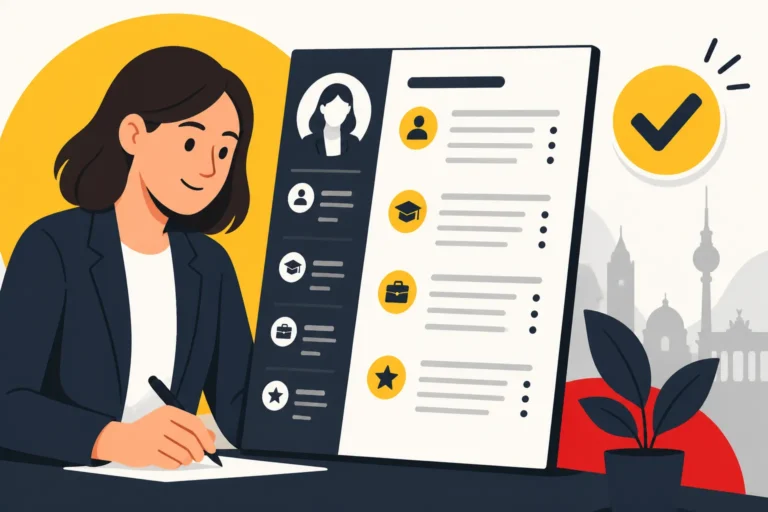
The German CV, known as the Lebenslauf, is a rigid, highly standardized document that leaves zero room for creative interpretation. It should be exactly one to two pages long, formatted in a clean, reverse-chronological layout. The most critical rule is that there can be absolutely no unexplained chronological gaps. If you took eight months off to travel the world or care for a relative, you must explicitly state that on the timeline. Unexplained gaps are viewed as a severe lack of transparency.
Unlike many Western countries that have banned application photos to prevent bias, the German system still heavily expects a Bewerbungsfoto (application photo) in the top right corner. You cannot use a cropped photo from a wedding or a casual selfie. You must go to a professional German photography studio, wear formal business attire, and get a specific, high-quality headshot. Submitting a CV without a photo, while technically legal, often flags your application as incomplete to traditional HR managers.
The personal details section also requires information that would be considered highly inappropriate or illegal to ask for in the US or UK. You are fully expected to list your date of birth, place of birth, nationality, and often your marital status. This is simply the standard administrative format, and fighting against it will only cause friction.
Cover Letters That Actually Get Read
The cover letter (Anschreiben) is arguably as scrutinized as your CV. It is your opportunity to prove your motivation and your exact fit for the role. The format must strictly adhere to the DIN 5008 standard for business letters, which dictates the exact millimeter spacing for the sender’s address, the recipient’s address, the date, and the subject line. If your letter looks like a casual email printed on a page, it will be discarded for lacking basic administrative competence.
Content-wise, you must absolutely avoid American-style boasting, emotive storytelling, or generic statements about your “passion for the industry.” Germans value objective facts and verifiable achievements. Use the letter to explicitly connect your past experiences to the precise requirements listed in the job advertisement. Prove exactly how your presence minimizes their hiring risk.
Furthermore, if the job posting explicitly asks for your salary expectations (Gehaltsvorstellung) or your earliest possible start date, you must state them clearly in the final paragraph. Failing to include requested information shows that you cannot follow simple instructions. Ensure your grammar is impeccable; using the advanced business writing lessons on GermanPod101 will help you master the complex passive structures necessary to sound like a seasoned German professional.
Overcoming the Bureaucratic Waiting Game
If you are coming from a fast-paced market where you can apply on a Monday and have a job offer by Friday, you must radically reset your mental clock. The German hiring process is notoriously, painfully slow. It is entirely normal to wait four to six weeks just to receive an invitation for a first-round interview, and the entire process from application to signed contract can easily take three months.
This sluggish pace is driven by strict labor laws. In Germany, standard employee notice periods range from three to six months. Therefore, when a company posts a job, they are often hiring for a position that will not actually be vacant for another two quarters. Hiring managers are forced to plan incredibly far in advance, completely removing the sense of urgency that expats expect. You must build your financial runway accordingly, factoring in the realities detailed in Cost of Living in Germany: Breakdown of Expenses (Rent, Food, Transport).
During this waiting period, do not panic and do not aggressively double-email the HR department every three days asking for an update. This will only label you as pushy and culturally ignorant. Patience is a mandatory skill in Germany. Send one polite follow-up email after three weeks of silence, and then move on to the next application.
References
Primary sources (official)
- Make it in Germany (Job Search Portal): The official multilingual portal of the German government for skilled professionals from abroad, detailing visa requirements, shortage occupations, and the application process.https://www.make-it-in-germany.com/en/working-in-germany/job/looking-for-job
- Federal Employment Agency (Bundesagentur für Arbeit): The central state authority providing official data on the labor market, unemployment rights, and standard employment contract laws for international workers.https://www.arbeitsagentur.de/unternehmen/arbeitskraefte
Other helpful sources
- Xing: The leading professional networking platform in the DACH region, essential for connecting with traditional German employers and the Mittelstand.https://www.xing.com/
Disclaimer
The information provided in this article is for general informational and educational purposes only and does not constitute professional career counseling, legal, or immigration advice. The German labor market, platform algorithms, and visa requirements are highly dynamic and subject to continuous updates by the federal government and individual employers. While utilizing language platforms can significantly improve your application quality and networking capabilities, the success of your job hunt depends entirely on your specific professional background and the discretionary choices of hiring managers. Always verify visa eligibility and employment laws directly with the Ausländerbehörde or a certified legal professional before signing an employment contract.