Cost of Living in Germany: Breakdown of Expenses (Rent, Food, Transport)
Opening my first German payslip and realizing nearly half my gross salary had vanished into social deductions was a nauseating wake-up call. I spent my first few months constantly burning through my savings because I radically underestimated the hidden costs of setting up a life here. This guide breaks down the true cost of living in Germany, stripping away the myths to help you accurately budget your rent, food, transport, and daily expenses.
Disclosure: This post may contain affiliate links. We may earn a commission at no extra cost to you if you make a purchase through these links. Read full disclosure.
The Reality of Housing Costs
The absolute largest drain on your monthly budget in Germany is housing. To survive the brutal German rental market, you must completely unlearn how rent is calculated in your home country. German landlords divide housing costs into hyper-specific categories, and misunderstanding them can instantly bankrupt a newly arrived expat.
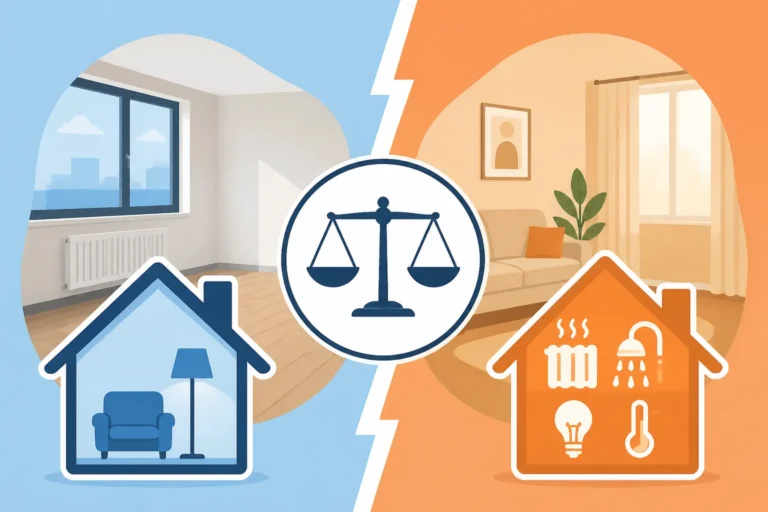
Cold Rent versus Warm Rent
When you browse German property portals like ImmoScout24, the massive number listed in bold is almost always the Kaltmiete (cold rent). This is a deeply deceptive number. The Kaltmiete exclusively covers the right to occupy the physical square footage of the apartment. It does not include a single drop of water, heat, or communal building service.
To determine your actual monthly liability to the landlord, you must look for the Warmmiete (warm rent). The warm rent takes the base cold rent and adds the Nebenkosten (ancillary operating costs). These operating costs cover property taxes, garbage collection, stairwell cleaning, building insurance, and typically, cold water and central heating.
Depending on the city, the gap between cold and warm rent is massive. In a mid-sized city like Leipzig, a 60-square-meter apartment might have a cold rent of 600 euros, but the warm rent will easily push 850 euros. In hyper-expensive markets like Munich, Berlin, or Frankfurt, that exact same apartment will command a cold rent of 1,200 euros and a warm rent exceeding 1,500 euros. Budgeting your life around the heavily advertised cold rent is the most common and devastating financial mistake expats make. To fully comprehend how landlords pass these operating costs down to you, read Household Bills in Germany: Understanding Nebenkosten and Monthly Costs.
Unfurnished Apartments and Hidden Setup Fees
The second, and perhaps most brutal, financial shock is discovering what an “unfurnished” apartment actually means in Germany. When you finally sign a permanent lease and receive the keys, you are not walking into a ready-to-use home. You are walking into an empty concrete shell.
Standard German apartments do not come with light fixtures, built-in closets, or, most terrifyingly, a kitchen. You will literally find bare pipes sticking out of the wall where the sink and oven should be. You are entirely responsible for purchasing cabinets, countertops, appliances, and hiring certified electricians to wire your stove. A basic, low-end IKEA kitchen will cost you a minimum of 2,000 to 3,000 euros, plus the agonizing four-to-six-week wait for delivery and installation.
This massive, upfront capital requirement is exactly why veteran expats strongly advise against jumping straight into a permanent lease upon arrival. By utilizing a mid-term housing platform like Wunderflats for your first three to six months, you completely bypass the empty-apartment trap. Properties listed on Wunderflats are fully furnished and include a working kitchen, allowing you to space out your relocation expenses and save up the necessary cash to eventually build your own kitchen without relying on expensive consumer debt.
The Brutal Security Deposit Kaution
Before the landlord even hands you the keys to that empty apartment, you must surrender a massive security deposit, known as the Kaution. German tenancy law dictates that the landlord can demand up to three months of “cold rent” as a deposit.
If your cold rent in Munich is 1,200 euros, you must transfer a staggering 3,600 euros to the landlord’s escrow account immediately upon signing the contract. This money is legally protected and will be returned to you when you move out, but it is entirely illiquid while you live there. You cannot use it to pay your final month’s rent. When you combine the first month’s warm rent, the three-month cold rent deposit, and the cost of buying a kitchen, the initial move-in cost for a standard German apartment frequently exceeds 6,000 to 8,000 euros in liquid cash.
To navigate the extreme competition and the financial vetting required to even be offered a lease, you must master the local paperwork.
Monthly Utility Bills and Mandatory Fees
The financial bleeding does not stop once you pay your warm rent. The Warmmiete is an illusion of complete coverage; several critical household utilities must be organized and paid entirely out of your own pocket.
Electricity and the Annual Settlement Trap
In 95 percent of long-term German rental contracts, electricity (Strom) is not included in the warm rent or the Nebenkosten. You must sign an independent contract with a local energy provider.
Germany has some of the highest electricity prices in the world, frequently hovering around 35 to 40 cents per kilowatt-hour. You do not pay for exactly what you use each month. Instead, the provider estimates your annual usage based on the size of your apartment and charges you a fixed monthly prepayment (Abschlagszahlung), usually around 60 to 90 euros for a single person.
At the end of the year, you must submit your meter reading. If you used more electricity than your prepayments covered, you will receive a Nachzahlung (back payment demand), requiring you to instantly pay the difference, which can be hundreds of euros. To prevent this, smart expats actively manage their home energy efficiency. Ordering programmable smart radiator thermostats and heavy-duty draft excluders directly from Amazon Germany allows you to heavily reduce your heating and electricity waste, ensuring you receive a refund rather than a massive bill at the end of the year.
Internet Cell Phones and Setup Delays
Securing home Wi-Fi in Germany is an exercise in extreme patience and hidden fees. When you order a DSL or fiber optic connection from a major provider like Telekom or Vodafone, you generally commit to a rigid 24-month contract. Expect to pay between 35 and 50 euros per month for a standard 100 to 250 Mbit/s connection.
The hidden cost here is the hardware and the delay. Providers will try to lease you a mediocre router for 5 euros a month, which adds up to 120 euros over the contract life. It is significantly cheaper to buy your own high-quality, unlocked Fritz!Box router outright on Amazon Germany, which you can then take with you whenever you move. Furthermore, the physical activation of your internet line requires a technician to visit your basement, an appointment that frequently takes three to six weeks to secure. During this dead zone, you will burn through expensive mobile data hotspots just to work from home.
Cell phone plans, conversely, are quite reasonable if you avoid the legacy providers. Discount mobile operators (like Aldi Talk, Congstar, or Fraenk) offer excellent, contract-free, 5G prepaid plans with 15 to 30 gigabytes of data for roughly 10 to 15 euros per month.
The Unavoidable Broadcasting Tax Rundfunkbeitrag
This is universally the most hated bill among expats in Germany. The Rundfunkbeitrag (broadcasting fee) is a mandatory tax that funds the state’s independent public television and radio networks.
It costs a flat 18.36 euros per month, usually billed quarterly (55.08 euros). It absolutely does not matter if you do not own a television, if you do not speak a word of German, or if you only stream Netflix on your laptop. The law dictates that every single registered household in Germany must pay this fee.
The moment you complete your municipal address registration, the broadcasting agency is automatically notified, and you will receive a menacing letter demanding payment. You cannot ignore this letter; refusing to pay will result in late fees, collection agencies, and eventual wage garnishment.
| Expense Category | Estimated Monthly Cost (Single Person) | Notes / Details |
| Warm Rent (1-Bedroom) | €800 – €1,500+ | Highly dependent on city (Leipzig vs. Munich) |
| Electricity (Strom) | €60 – €90 | Based on annual estimated prepayment |
| Home Internet / Wi-Fi | €35 – €50 | Requires 24-month contract commitment |
| Broadcasting Tax | €18.36 | Mandatory per household, regardless of usage |
| Cell Phone Plan | €10 – €20 | Prepaid discount carriers offer the best value |
Groceries and Managing Your Food Budget
While housing and utilities will drain your bank account, grocery shopping in Germany is surprisingly affordable. Thanks to a brutal, decades-long price war between domestic supermarket chains, feeding yourself is one of the easiest areas to control your budget.
Discount Supermarkets versus Premium Grocers
Germany is the birthplace of the discount supermarket. If you do your weekly bulk shopping at Aldi, Lidl, Penny, or Netto, a single person can comfortably eat a highly nutritious, varied diet for roughly 200 to 250 euros a month. These discounters keep overhead incredibly low by displaying items in their original cardboard shipping pallets, passing massive savings directly to the consumer.
If you require highly specific international ingredients, specialized vegan products, or prefer a massive fresh butcher counter, you must step up to the premium supermarkets like Rewe or Edeka. Shopping exclusively at these premium stores will inflate your monthly food budget to 350 or 450 euros for a single person. Smart expats split their shopping: buying heavy staples, dairy, and basic produce at the discounter, and visiting Rewe solely for specialty cuts of meat and international sauces. For a complete guide on surviving the lightning-fast checkout lanes and bottle return machines, read Navigating German Supermarkets: Grocery Shopping Tips and Tricks.
Dining Out and Tipping Etiquette
Eating at restaurants in Germany sits comfortably in the middle of the European pricing spectrum. It is cheaper than London or Paris, but noticeably more expensive than southern or eastern Europe.
A standard meal at a mid-range sit-down restaurant (like a traditional German Wirtshaus or a local Italian spot) will cost between 15 and 25 euros for a main dish, plus 4 to 6 euros for a half-liter of beer. The saving grace of the German food scene is the vibrant street food culture. A massive, heavily stuffed Döner Kebab—the undisputed king of German fast food—currently costs between 6 and 8 euros, providing a massive caloric return on investment.
When budgeting for dining out, expats are often relieved by the German tipping culture (Trinkgeld). Unlike the United States, where a 20 percent tip is mandatory to subsidize wages, German waitstaff are paid a standard living wage. Tipping is a genuine reward for good service, usually calculated by simply rounding up the bill to the nearest convenient euro, or adding roughly 5 to 10 percent.
Stocking Your Kitchen and Buying Small Appliances
If you manage to secure an unfurnished apartment and build your own kitchen, you will quickly realize that German apartments do not come with small countertop appliances. You will not find a microwave, a toaster, a blender, or a coffee maker waiting for you.
Furthermore, you will arrive with absolutely zero pantry staples. Your very first grocery run to buy olive oil, salt, spices, flour, and cleaning supplies will easily cost over 150 euros. When it comes to the small appliances, carrying a heavy microwave home on the U-Bahn is a miserable experience. You can preserve your energy and budget by ordering these essential kitchen electronics in bulk from Amazon Germany. Having a high-quality coffee machine and a sturdy set of German steel knives delivered directly by Amazon Germany ensures you can actually process and cook the cheap groceries you hauled back from Aldi, rather than relying on expensive takeout while you set up your life.
Transportation Commuting Without Breaking the Bank
Germany boasts one of the most comprehensive and deeply integrated public transportation networks on the planet. Your approach to mobility will drastically impact your monthly disposable income.
Public Transit and the Deutschlandticket
The greatest financial gift to expats in recent history is the Deutschlandticket (D-Ticket). As of 2026, for a flat subscription fee of 63 euros per month, you gain unlimited access to all local and regional public transit across the entire country.
This single 63-euro digital ticket allows you to ride the U-Bahn in Berlin, the S-Bahn in Munich, local buses, trams, and the iconic red regional trains (RE/RB) connecting every city and town. It completely eliminates the anxiety of deciphering complex local tariff zones or accidentally crossing a municipal border and getting fined. If you rely entirely on public transit, your transportation budget is hard-capped at exactly 63 euros a month. However, you must remember that this ticket is explicitly not valid on the high-speed white intercity trains (ICE/IC). To understand how to avoid these massive fare evasion fines, carefully study Transportation in Germany: Using Trains, Buses, and Trams Like a Local.
The True Cost of Car Ownership
If you decide that public transit is insufficient and you want to buy a car, prepare for massive, ongoing financial hemorrhaging. The initial cost of a used vehicle is just the beginning.
Gasoline (Benzin) in Germany is heavily taxed, frequently costing well over 1.70 to 1.90 euros per liter. You must also pay an annual vehicle tax (Kfz-Steuer) calculated on your car’s engine size and CO2 emissions. Furthermore, the mandatory third-party liability auto insurance is astronomically expensive for expats. German insurers rely on a “no-claims bonus” system, and because you are newly arrived, they frequently ignore your foreign driving history, classifying you as a high-risk beginner. Annual insurance premiums for new expats can easily exceed 1,000 to 1,500 euros.
Cycling Culture and Bike Security
Germany runs on bicycles. Every major city features extensive, dedicated cycling infrastructure, and using a bike for your daily commute is the ultimate local financial hack. It costs absolutely nothing to operate and keeps you fit.
However, bicycle theft is rampant in every metropolitan area. If you buy a beautiful, 800-euro commuter bike and lock it outside the train station with a cheap 15-euro wire lock, it will be stolen within 48 hours. If you invest in a bicycle, you must protect your capital. Buying a heavy-duty, hardened steel U-lock (like an Abus or Kryptonite) directly from Amazon Germany is an absolute necessity. Spending 80 euros on a top-tier lock from Amazon Germany is the only way to ensure your primary mode of transportation is still waiting for you when you finish work.
Taxes Healthcare and Social Security Deductions
The final and most painful realization regarding the German cost of living is understanding how much of your negotiated salary you actually get to keep. The German social safety net is incredibly robust, but you pay for it dearly every single month.
Brutto versus Netto The Salary Shock
When you sign your German employment contract, the salary listed is your Bruttogehalt (gross salary). This number is largely irrelevant to your daily budgeting. What matters is your Nettogehalt (net salary), the money that actually hits your bank account on the 25th of the month.
The gap between Brutto and Netto is staggering. A single, unmarried expat with no children is placed in Tax Class 1 (Steuerklasse 1), the most heavily taxed demographic in the country. Between income tax (Lohnsteuer), mandatory pension contributions (Rentenversicherung), unemployment insurance (Arbeitslosenversicherung), and long-term care insurance (Pflegeversicherung), you will typically lose roughly 38 to 42 percent of your gross salary before you even see it. If you negotiated a gross salary of 4,000 euros a month, your actual take-home pay will be roughly 2,500 euros. You must budget your housing and food strictly against this lower net figure.
Statutory versus Private Health Insurance Costs
By law, everyone living in Germany must have health insurance (Krankenversicherung). The vast majority of expats enroll in the statutory public health insurance system (such as TK, AOK, or Barmer).
The cost of public health insurance is a fixed percentage of your gross income—currently set at 14.6 percent, plus a small supplemental rate charged by your specific provider. The silver lining is that this cost is split exactly 50/50 between you and your employer. Your half (roughly 7.3 percent plus the supplement) is automatically deducted from your paycheck before it hits your account. You do not have to manually pay a monthly premium.
If you earn above a specific high-income threshold (the Jahresarbeitsentgeltgrenze), you have the legal right to opt out of the public system and buy Private Health Insurance (PKV). While private insurance often offers cheaper monthly premiums for young, healthy expats and guarantees you a private hospital room, it is a dangerous long-term financial trap. Private premiums skyrocket as you age, and switching back to the public system later in life is nearly impossible.
Church Tax and Other Sneaky Deductions
There are two additional, highly sneaky deductions that can ravage your net income if you are not careful during your initial municipal registration.
The first is the Solidarity Surcharge (Solidaritätszuschlag or “Soli”). Originally introduced to fund the reunification of East and West Germany, it was largely phased out for low and middle-income earners in 2021. However, if you are a high-earning expat (typically earning over 80,000 euros a year), you will still see a 5.5 percent surcharge slapped onto your income tax bill.
The second, and far more avoidable, deduction is the Church Tax (Kirchensteuer). Germany legally collects taxes on behalf of recognized Christian denominations. If you tell the clerk at the registration office that you are Catholic or Protestant, the state will automatically deduct an additional 8 to 9 percent of your income tax and give it directly to the church. If you are not a practicing member and do not wish to fund the church, you must explicitly declare yourself as having no religion (keine Religion or konfessionslos) during your Anmeldung appointment.
Surviving the financial shock of moving to Germany requires meticulous planning and a deep understanding of your net income. By securing a stable furnished landing pad via Wunderflats, completely abandoning the idea of car ownership in favor of the 63-euro Deutschlandticket, and optimizing your initial apartment purchases through Amazon Germany, you can comfortably navigate the high taxes and hidden fees of your new European life.
References
Primary sources (official)
- Federal Government (Bundesregierung) – Deutschlandticket: Official confirmation of the nationwide public transit flat-rate pass pricing, including the 2026 adjustment to 63 euros per month.https://www.bundesregierung.de/breg-de/aktuelles/deutschlandticket-2134074
- ARD ZDF Deutschlandradio Beitragsservice: The official English-language portal outlining the legal mandate and current 18.36 euro monthly cost of the broadcasting fee (Rundfunkbeitrag) per household.https://www.rundfunkbeitrag.de/welcome/english
Other helpful sources
- Make it in Germany – Gross/Net Salary Calculator: The federal government’s official tool for skilled professionals to calculate exact tax deductions, health insurance splits, and final net take-home pay based on their specific tax class.https://www.make-it-in-germany.com/en/working-in-germany/working-environment/gross-net-calculator
Disclaimer
The information provided in this article is for general informational and educational purposes only and does not constitute professional financial, tax, or legal advice. German rental markets, energy tariffs, health insurance contribution limits, and municipal taxes are highly volatile and subject to continuous legislative updates by the federal government and individual states. While a furnished mid-term rental can make early housing costs predictable, your ultimate financial liability depends on your specific employment contract and personal lifestyle choices. Always consult directly with a certified German tax advisor (Steuerberater) or a registered financial broker to understand your specific tax brackets and insurance obligations.