Household Bills in Germany: Understanding Nebenkosten and Monthly Costs
Opening an envelope in January to find a 600-euro back payment demand for heating is a terrifying rite of passage for newcomers. I once nearly fainted when my supposedly fixed utility bill doubled after a particularly brutal Berlin winter. This guide decodes the complex German utility system, explaining operating costs, utility traps, and how to manage your monthly household bills.
Disclosure: This post may contain affiliate links. We may earn a commission at no extra cost to you if you make a purchase through these links. Read full disclosure.
The Rent Divide Kaltmiete versus Warmmiete
When you begin your apartment hunt in Germany, you will instantly notice that property listings display two entirely different rental prices. Understanding the profound legal and financial difference between these two numbers is the foundation of your household budget. The German rental market strictly separates the cost of the physical space from the cost of operating that space.
What Is Kaltmiete Cold Rent
The Kaltmiete (cold rent) is the absolute baseline cost of your apartment. This figure pays exclusively for the use of the physical walls, the floor, and the roof over your head. It does not include a single drop of water, a spark of electricity, or any communal building services.
In the vast majority of traditional German apartments, the Kaltmiete literally just gets you the empty shell. You are often renting a space completely devoid of light fixtures, appliances, or even kitchen cabinets. Because you are only paying for the square footage, the Kaltmiete is the number used by the government to calculate local rent controls (Mietpreisbremse). It is the fixed anchor of your lease agreement. If you are unprepared for what this empty shell actually looks like upon moving in, you must read our breakdown on Unfurnished Apartments in Germany: Dealing with Kitchens and Light Fixtures.
While the Kaltmiete remains relatively stable throughout your lease, subject only to legally regulated rent increases, it represents a dangerously incomplete picture of your actual monthly liability. Budgeting your expat life based solely on the cold rent is a guaranteed path to financial ruin during your first year.
What Are Nebenkosten Operating Costs
The Nebenkosten (operating costs or ancillary costs) are the supplementary fees associated with keeping the apartment building functional and habitable. In Germany, the landlord is legally permitted to pass the majority of the building’s operating expenses directly down to the tenants.
These costs cover a massive array of services. They include property taxes, building insurance, the cost of the communal trash bins, street cleaning, the electricity used to light the stairwell, elevator maintenance, and cold water usage. Depending on the building’s infrastructure, the Nebenkosten might also include the cost of central heating and hot water.
It is crucial to understand that the Nebenkosten figure listed on your rental contract is not a flat fee; it is a Vorauszahlung (prepayment). You are paying an estimated monthly advance based on the previous year’s consumption or the square footage of your apartment. You are effectively paying into a building-wide piggy bank every month to cover the ongoing operational bills.
The Warmmiete Illusion and the Annual Statement
When you add the Kaltmiete and the estimated Nebenkosten prepayments together, you arrive at the Warmmiete (warm rent). This is the actual amount of money you must transfer to your landlord on the first of every month.
However, the Warmmiete is an illusion of stability. Because the Nebenkosten portion is merely an estimate, your actual financial liability is calculated at the end of the year. Once a year, your landlord will send you a highly detailed Nebenkostenabrechnung (operating cost statement). The landlord tallies up the exact cost of the building’s utilities and your specific heating and water meters.
If your estimated monthly prepayments exceeded your actual usage, the landlord will wire you a refund (Guthaben). But if it was a freezing winter and the price of natural gas skyrocketed, your prepayments will fall short. You will receive a Nachzahlung (back payment demand), requiring you to pay the difference within thirty days. If energy prices spike, this bill can easily reach several hundred or even a thousand euros
Breaking Down the Nebenkostenabrechnung
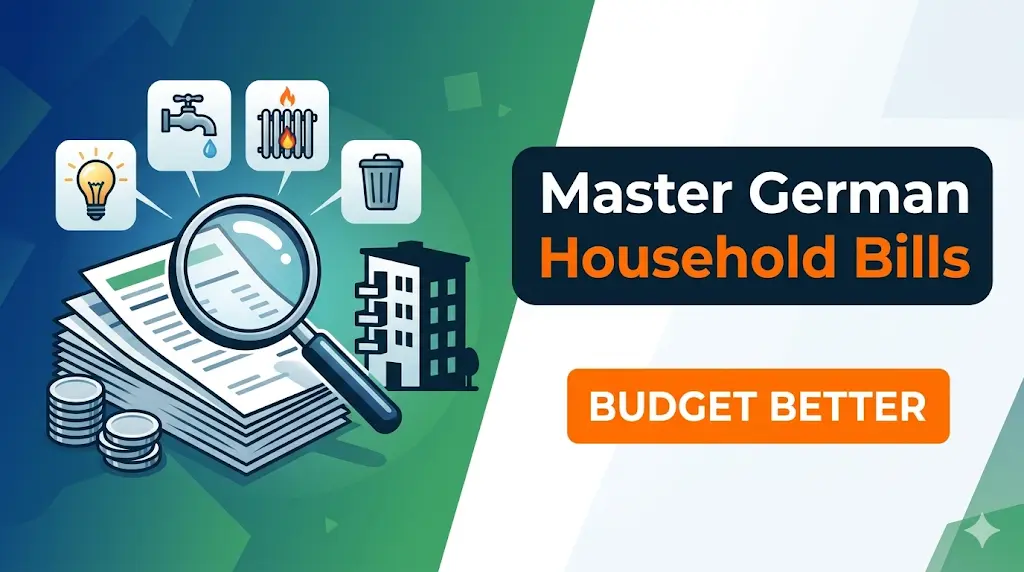
The annual operating cost statement is a notoriously dense, multi-page accounting document that reads like a corporate tax return. Deciphering exactly what you are paying for helps you identify billing errors and curb your consumption.
Heating and Warm Water Costs
Heating (Heizkosten) is consistently the most expensive and volatile variable in your Nebenkosten. If your building uses a central gas or oil heating system, the landlord buys the fuel for the entire building and divides the cost among the tenants.
By law, the landlord cannot simply divide the total heating bill equally by the number of apartments. At least 50 to 70 percent of the heating cost must be calculated based on your exact, individual consumption. To measure this, you will find small digital meters (Heizkostenverteiler) attached to every single radiator in your apartment. These devices wirelessly transmit your usage data to a central billing company.
If you leave your radiators running while you are at work, or if you keep your windows tilted open while the heat is on, these meters will relentlessly record your waste. The remaining 30 to 50 percent of the building’s heating bill is distributed based on the square footage of the apartments. This accounts for the ambient heat lost through the pipes and walls.
Municipal Fees Trash Water and Sewage
The second major pillar of your operating costs involves municipal services. Cold water usage and sewage (Abwasser) are incredibly expensive in Germany. Every time you flush the toilet or run the washing machine, you pay twice: once for the fresh water entering your apartment, and once for the municipal treatment of the wastewater leaving it. In modern buildings, you will have a personal water meter; in older Altbau buildings, the total building’s water bill is often simply divided by the number of residents or square footage.
Garbage collection (Müllabfuhr) is another strict municipal cost passed down to you. German recycling is a highly regulated, complex system. Your building will have separate colored bins for paper, plastic packaging, organic waste, and general refuse. The city charges the landlord based on the size of these bins and the frequency of collection. If tenants continuously throw the wrong items into the wrong bins, the municipal garbage collectors will refuse to empty them, forcing the landlord to order a special, highly expensive hazardous waste pickup, the cost of which is passed directly back to the tenants in the annual statement.
Building Maintenance and Cleaning Costs
You are also financially responsible for the labor required to keep the building pristine. Most apartment blocks employ a Hausmeister (caretaker or janitor) who handles minor repairs, changes communal lightbulbs, and maintains the courtyard. Their salary is divided among the tenants.
Furthermore, you will see charges for Gebäudereinigung (stairwell cleaning). If the building hires a professional cleaning service to mop the hallways every week, you pay for it. You will also be billed for Winterdienst (winter service). By German law, the sidewalk in front of the building must be cleared of snow and ice by 7:00 AM every day. Landlords hire contractors to shovel the snow and spread grit, and this insurance against pedestrian lawsuits is embedded in your monthly prepayments. Finally, the cost of the mandatory annual visit from the Schornsteinfeger (chimney sweep) to inspect the building’s exhaust systems is legally passed on to you.
Essential Bills Not Included in Your Warmmiete
The most dangerous assumption an expat can make is believing that the Warmmiete covers absolutely everything. There are several massive, mandatory household bills that you must set up and pay entirely independently of your landlord.
Setting Up Your Electricity Contract
In 95 percent of German long-term rental contracts, electricity (Strom) is not included in the Nebenkosten. When you move in, the lights will turn on because the apartment defaults to the local Grundversorger (the basic municipal supplier, such as Vattenfall or Stadtwerke).
However, the basic supplier is always the most expensive option on the market. You must proactively sign a contract with an electricity provider of your choice. Germany operates on an Abschlagszahlung (monthly prepayment) system for electricity, exactly like the landlord’s heating setup. You tell the provider how many people live in the flat, they estimate your monthly usage, and you pay a fixed amount (e.g., 80 euros) every month.
Once a year, you must walk down to your basement, read the numbers off your physical electricity meter (Stromzähler), and submit the reading to your provider online. They will then calculate your actual usage and issue a back payment demand or a refund.
The Mandatory Rundfunkbeitrag TV Tax
This is universally the most hated bill among expats in Germany. The Rundfunkbeitrag is the German broadcasting fee, which funds the state’s independent public television and radio networks (ARD, ZDF, and Deutschlandradio).
Currently, the fee is a flat 18.36 euros per month. It does not matter if you do not own a television, if you do not speak a word of German, or if you only stream Netflix on your laptop. The law dictates that every single registered household in Germany must pay this fee. The moment you complete your address registration at the citizens office, the broadcasting agency is automatically notified. Within weeks, you will receive a menacing letter demanding payment.
You cannot ignore this letter. If you refuse to pay, the agency will apply late fees, send your account to a collections agency, and eventually, the state can legally freeze your bank account to extract the debt. You must register your apartment online and set up a SEPA direct debit to pay the fee quarterly.
Internet and Broadband Installation Delays
Securing home Wi-Fi in Germany is an exercise in extreme patience. Internet contracts are entirely your responsibility, and they are notorious for their agonizing installation timelines.
When you order a DSL, cable, or fiber optic connection from major providers like Telekom, Vodafone, or O2, you cannot simply plug in a router and start browsing. A technician from the network grid must physically visit your building to activate the line in the basement and test the socket in your wall. Getting an appointment for this technician frequently takes three to six weeks from the day you sign the contract.
During your first month, you will likely have to rely on mobile data hotspots to work from home. When you do sign a contract, be aware of the standard 24-month lock-in periods. Furthermore, while providers offer to rent you a router for 5 euros a month, it is almost always more economical over a two-year lease to buy your own high-quality Fritz!Box router outright. Ordering a compatible, unlocked router on Amazon Germany ensures you have the hardware ready the exact moment the technician finally activates your line, avoiding the cheap, underperforming hardware the telecom companies try to lease you. For a breakdown of the best networks, read Internet and Mobile Phone Providers in Germany.
| Expense Category | Included in Kaltmiete? | Included in Warmmiete? | Paid Directly By Tenant |
| Physical Apartment Space | Yes | Yes | To Landlord |
| Cold Water & Sewage | No | Yes (Usually) | To Landlord via Prepayment |
| Central Heating & Warm Water | No | Yes (Usually) | To Landlord via Prepayment |
| Electricity (Strom) | No | No | Directly to Energy Provider |
| Internet & Wi-Fi | No | No | Directly to Telecom Provider |
| TV/Radio Tax (Rundfunkbeitrag) | No | No | Directly to State Agency |
Managing and Reducing Your Monthly Expenses
Because the German utility system reconciles actual usage at the end of the year, you have immense personal control over your final household bills. Adopting local energy habits and optimizing your contracts is the only way to protect your savings.
Energy Efficiency and Smart Heating
German energy prices are among the highest in Europe. You cannot treat heating like a luxury; you must treat it like a premium commodity.
The traditional German radiator features a thermostatic valve with numbers from 1 to 5. Leaving your radiator on 5 all day while you are at work is financial suicide. To modernize this archaic system, smart expats heavily rely on programmable thermostats. You can easily unscrew the old analog valves and replace them with smart radiator thermostats ordered from Amazon Germany. These devices allow you to program heating schedules from your smartphone, ensuring the apartment drops to a money-saving 16 degrees while you are at the office, but warms up to a comfortable 20 degrees right before you walk through the door.
Furthermore, you must adopt the cultural practice of Stoßlüften (shock ventilation). German apartments are heavily insulated to retain heat, which rapidly builds up internal humidity and causes toxic black mold. You must fully open all your windows for exactly five minutes, twice a day, to exchange the humid air for dry outside air, and then shut them completely. Leaving a window tilted open (Kipplüften) for hours above a running radiator literally throws your expensive heating money out the window and will guarantee a massive Nachzahlung at the end of the year.
Comparing Providers and Switching Tariffs
Loyalty to utility providers is financially penalized in Germany. Your default electricity provider and your internet provider rely on the fact that you will forget to cancel your contract after the initial minimum term expires. Once that initial period ends, your promotional rates disappear, and your monthly bills will quietly skyrocket.
You must actively manage your contracts. Utilizing German comparison portals like Check24 or Verivox is essential. These platforms aggregate all the electricity, gas, and internet tariffs available at your specific address. The secret to low utility bills in Germany is the Neukundenbonus (new customer bonus). Energy providers offer massive cash bonuses—often 100 to 200 euros—if you switch to them. Smart expats treat their utility contracts as a revolving door, actively switching their electricity provider every 12 to 24 months to continuously harvest these new customer bonuses and keep their monthly Abschlag artificially low.
Utilizing Furnished Housing as a Financial Buffer
Navigating electricity contracts, estimating heating prepayments, and worrying about year-end utility demands is overwhelming when you are first trying to adapt to German corporate culture and bureaucracy.
This immense complexity is exactly why veteran expats strongly advise against jumping straight into a permanent, unfurnished lease. By securing a mid-term furnished apartment through a platform like Wunderflats, you entirely bypass the Nebenkosten anxiety during your foundational months.
Properties on Wunderflats are generally rented on a Pauschalmiete (flat-rate warm rent) basis. This means the monthly price you see includes the cold rent, the heating, the water, the electricity, and the high-speed internet. There are no hidden meter readings, no need to set up external utility contracts, and no terrifying back-payment demands at the end of the year. This all-inclusive model provides absolute financial predictability, allowing you to accurately map out your expenses. To see how a flat-rate rental stabilizes your initial financial shock, thoroughly review Cost of Living in Germany: Budgeting for Your First Year as an Expat.
Mastering your household bills in Germany requires vigilance, a deep understanding of your lease, and a willingness to optimize your daily habits. By tracking your Nebenkosten prepayments, managing your electricity and internet independently, upgrading your home efficiency via Amazon Germany, and using Wunderflats to soften the initial transition, you can comfortably survive the German winter without dreading the annual utility bill.
References
Primary sources (official)
- Federal Ministry of Justice (Gesetze im Internet): The official text of the Operating Costs Ordinance (Betriebskostenverordnung – BetrKV), which explicitly details every single expense a landlord is legally allowed to pass onto the tenant as Nebenkosten.https://www.gesetze-im-internet.de/betrkv/
- ARD ZDF Deutschlandradio Beitragsservice: The official English-language portal for the mandatory German broadcasting fee (Rundfunkbeitrag), explaining the registration process and the legal obligation per household.https://www.rundfunkbeitrag.de/welcome/english/index_ger.html
Other helpful sources
- German Tenants’ Association (Deutscher Mieterbund – DMB): Comprehensive consumer guides explaining how to read the annual Nebenkostenabrechnung, how heating costs are distributed, and how to contest inaccurate utility bills.https://www.mieterbund.de/mietrecht/mietrecht-a-z/nebenkosten.html
Disclaimer
The information provided in this article is for general informational and educational purposes only and does not constitute professional financial, legal, or tax advice. German tenancy laws, the specific stipulations of the Betriebskostenverordnung, and energy market tariffs are highly complex and subject to continuous legislative updates. Your ultimate financial liability is dictated by your specific rental contract. Always review your Nebenkostenabrechnung carefully and consult directly with your local Tenants’ Association (Mieterverein) or a certified legal professional regarding billing disputes or contract obligations.