Living in a German Dorf (Village) vs City: Lifestyle Differences
Deciding whether to live in a bustling German metropolis or a quiet, idyllic village is a choice that will fundamentally dictate your entire integration experience. I remember feeling completely paralyzed trying to choose between an overpriced, tiny shoebox apartment in Berlin and a spacious but socially isolated farmhouse in Bavaria. This guide breaks down the stark lifestyle differences between rural and urban Germany to help you make the right choice for your relocation.
Disclosure: This post may contain affiliate links. We may earn a commission at no extra cost to you if you make a purchase through these links. Read full disclosure.
Housing Availability and Living Space
The Brutal Reality of Urban Apartment Hunting
Finding an apartment in major German cities like Munich, Berlin, or Frankfurt is nothing short of an extreme sport. The demand for urban housing vastly outstrips the supply, leading to a highly competitive and stressful market for newcomers. It is entirely common to show up to an apartment viewing (Wohnungsbesichtigung) only to find fifty other desperate people queuing down the street, all clutching pristine application folders. Landlords in these cities have their pick of tenants, and expats without a local credit history (SCHUFA) or a long-term German work contract often find themselves at the bottom of the pile.
Because of this intense competition, you will often have to compromise heavily on your living standards if you want to stay in the city center. You might find yourself paying a premium for a tiny apartment with no balcony, an older heating system, or a fifth-floor walk-up with no elevator. To avoid the initial shock of this market, many expats choose to secure temporary furnished housing through Wunderflats for their first few months. This gives you a registered address and a comfortable base while you navigate the exhausting reality of the permanent housing search.
For those determined to brave the urban market, preparation is absolutely everything. Having all your documents translated, your proof of income ready, and setting up instant alerts on property portals is the only way to succeed. If you want a deep dive into the strategies that actually work, reading through Finding an Apartment in Germany: Best Websites and Tips for Expats will give you a significant advantage over other applicants vying for the same small slice of city real estate.
Finding Larger Homes in the Countryside
In stark contrast to the city, the German countryside—often referred to as living “auf dem Land” or in a “Dorf”—offers an abundance of living space. If your dream is to live in a detached house with a private garden, a garage, and multiple bedrooms, moving to a village is practically the only financially viable way to achieve it. You will find that the stress of the housing search dissipates significantly once you look thirty to forty kilometers outside the major metropolitan rings.
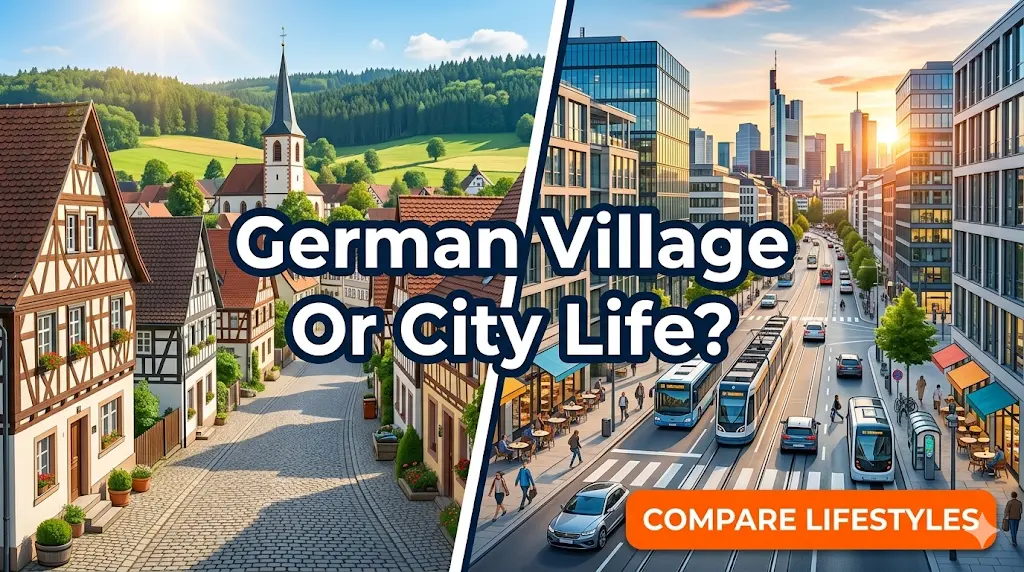
Rural properties often feature charming architectural details, such as exposed wooden beams in traditional half-timbered houses (Fachwerkhäuser), and provide a level of peace and quiet that is impossible to find in a city. The pace of life is slower, and you are usually surrounded by easy access to nature, forests, and hiking trails right outside your front door. For families with children or pets, the appeal of a fenced-in yard and safe, low-traffic streets is often the primary reason for choosing village life.
However, older rural homes come with their own set of challenges. They might have lower ceilings, older plumbing, and less efficient insulation, which can lead to higher heating bills during the long, dark German winters. Furthermore, you will be responsible for property maintenance tasks that city dwellers rarely think about, such as sweeping the street in front of your house (Straßenreinigung) or clearing snow from the sidewalk by 7:00 AM under strict local ordinances.
Furnishing Your Space Affordably
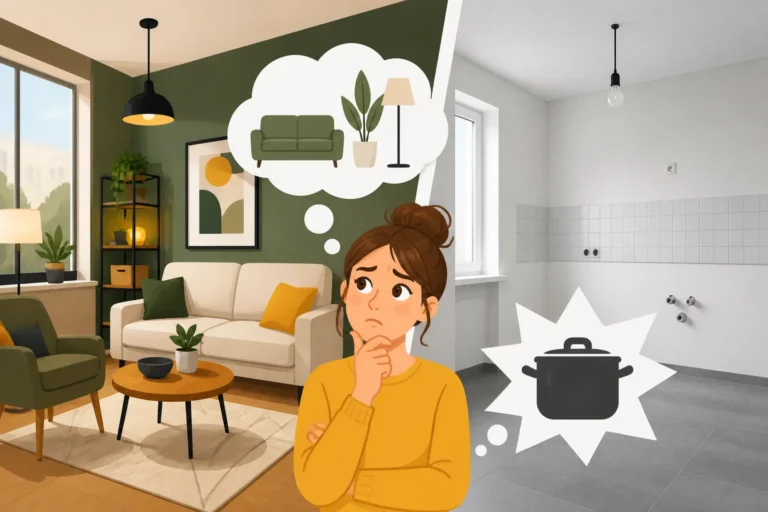
Whether you choose a tiny city flat or a sprawling country house, you will inevitably run into one of the most infamous quirks of the German housing market: the unfurnished apartment. When a German listing says an apartment is empty, it means bare concrete walls, no light fixtures, and crucially, no kitchen. You are entirely responsible for buying and installing your own cabinets, sink, and appliances.
This can be a massive logistical and financial hurdle. In a city, you might struggle to fit a delivery truck down a narrow street or carry a refrigerator up five flights of narrow stairs. In a village, the challenge is different: large furniture stores might be an hour’s drive away, and you will need a large vehicle to transport your goods. Because of this, many expats living in rural areas rely heavily on Amazon Germany to have heavy appliances, mattresses, and basic hardware delivered directly to their doorsteps, saving them the hassle of renting a cargo van.
Equipping an empty apartment requires a substantial upfront budget and a lot of patience. If you are moving into a village home, you might have the space to buy secondhand kitchens from departing tenants, but you still have to install them yourself. To understand exactly what you are getting into and how to budget for this massive task, I highly recommend reading Unfurnished Apartments in Germany: Dealing with Kitchens and Light Fixtures before you sign any lease.
Commuting and Public Transportation Networks
Navigating City Transit Systems
One of the greatest advantages of living in a German city is the exceptional public transportation network. Cities are intricately woven together by a web of U-Bahn underground trains, S-Bahn suburban commuter trains, trams, and buses. In places like Berlin, Munich, or Hamburg, you can easily live your entire life without ever needing to own, drive, or park a car. Transit runs frequently, often every five to ten minutes during rush hour, and many major lines operate through the night on weekends.
This level of connectivity grants you immense personal freedom. You can easily commute to work, meet friends for drinks across town, and do your grocery shopping using only a monthly transit pass. The city infrastructure is also heavily designed for cyclists, with dedicated bike lanes and bike-sharing apps available on almost every street corner, making micro-mobility a breeze.
However, city transit is not without its flaws. Trains can get uncomfortably crowded during the morning commute, strikes by transit workers occasionally bring the city to a standstill, and delays due to construction are a frequent topic of complaint among locals. Despite these minor inconveniences, the sheer convenience of stepping out of your Wunderflats apartment and immediately hopping on a tram is a luxury that village residents can only dream of.
The Necessity of Car Ownership in Villages
If you choose to live in a German village, car ownership transitions from a luxury to an absolute survival necessity. While almost every Dorf is connected to the public transit grid in some way, the reality of the schedule is often grim. A village bus might only arrive twice a day—once early in the morning to take children to school, and once in the late afternoon to bring them back. On weekends, particularly Sundays, the bus service might cease to exist entirely.
This lack of reliable transit means you will be driving everywhere: to the supermarket, to the doctor, to the nearest train station for your commute, and to any social engagements. This requires you to navigate the process of getting your driver’s license converted, buying a car, and understanding the strict German vehicle inspection laws. If your partner also needs to commute in a different direction, you might quickly find your household needing two cars, which drastically alters your monthly budget.
Before committing to a rural property, you must critically evaluate your willingness to drive in all weather conditions, including heavy winter snow on unlit country roads. The isolation of a village without a car can be intensely difficult, especially for an accompanying expat spouse who might be left stranded at home while their partner takes the only vehicle to work. To weigh the financial realities of this lifestyle, check out Cost of Owning a Car vs Using Public Transport: A Financial Comparison.
Balancing Commute Times and Costs
The commute is often the deciding factor when expats weigh the Dorf versus city debate. Living in the city means a short, manageable commute, allowing you to maximize your free time. You might only spend twenty minutes on a train, during which you can read or listen to a podcast. The cost is fixed to your monthly transit subscription, making it incredibly predictable for your budget.
Conversely, living in a village often means becoming a “Pendler” or commuter. You might drive twenty minutes just to reach the nearest S-Bahn station to utilize the park and ride system, or you might drive an hour each way directly into the city center. This eats up a massive portion of your day and subjects you to the notorious German Stau (traffic jams) on the Autobahn during rush hour.
Financially, the money you save on cheaper rural rent is often rapidly consumed by the costs of car payments, insurance, maintenance, and the ever-fluctuating price of fuel. You have to sit down with a spreadsheet and calculate whether the cheaper square meterage of a village house truly offsets the hidden costs and lost time of a daily long-haul commute.
Social Integration and Language Barriers
Building an Expat Community in the City
Cities in Germany are cosmopolitan hubs teeming with international workers, students, and creatives. This diversity makes the initial phase of social integration significantly easier for newcomers. You will find endless English-speaking meetup groups, international sports clubs, and expat-heavy neighborhoods where making connections feels natural. The anonymity of the city allows you to find your community based on shared hobbies and interests, rather than just geographical proximity.
In a city, you can comfortably navigate your first few years speaking very little German. Many startups and multinational corporations operate entirely in English, and you will easily find English-speaking doctors, bank tellers, and service workers. While this is highly convenient, it can also create an expat bubble. It is very easy to live in Berlin or Frankfurt for five years and realize your German has never progressed beyond ordering a coffee.
If your goal is to build a robust social circle quickly without the immediate pressure of mastering German grammar, the city is undeniably the better choice.
Embracing Local Traditions in Rural Areas
Village life demands a completely different approach to social integration. In a Dorf, anonymity does not exist. Your neighbors will notice when you move in, they will notice how you sort your recycling, and they will absolutely notice if you violate the Sunday quiet hours. Social life in rural Germany revolves heavily around the local clubs, such as the volunteer fire department, the sports club, or the traditional shooting club.
To integrate into a village, you must actively participate in these local traditions. Showing up to the annual summer festival, helping organize a neighborhood street sweep, and greeting everyone you pass on the street with a cheerful hello is mandatory for being accepted. If you make the effort, rural Germans can be incredibly loyal, warm, and helpful neighbors who will bring you fresh produce from their gardens and help you fix your car.
However, breaking the ice takes significant time and thick skin. Villages are tight-knit communities where families have known each other for generations. As a foreigner, you will be the ultimate outsider, and the pressure to conform to local, often unspoken, social rules can feel overwhelming at first.
The Crucial Role of the German Language
The single biggest barrier to living in a German village is the language. While you can survive on English in the city, attempting to live in a Dorf without speaking decent German is a recipe for deep isolation. Your neighbors, the local baker, the postman, and the mechanic will likely speak very little, if any, English. To handle basic daily interactions, a solid intermediate level of German is essentially a prerequisite.
Furthermore, rural areas are the strongholds of heavy regional dialects. Even if you have studied standard High German for years, stepping into a bakery in a small Bavarian or Swabian village and trying to decipher the local dialect can make you feel like you are learning a completely new language from scratch.
If you are committed to the village lifestyle, you must be equally committed to aggressive language learning. It is the only key that unlocks the community.
Cost of Living and Everyday Expenses
Comparing Rent Prices Across Regions
The most glaring difference between urban and rural Germany is the cost of rent. Cities are experiencing an ongoing housing crisis, driving rent prices to historic highs. In Munich, Frankfurt, or Stuttgart, a standard two-bedroom apartment can easily consume forty to fifty percent of a single professional’s net income. You are paying a massive premium for the location, the transit access, and the vibrant cultural scene.
Conversely, rent in a German Dorf is astonishingly cheap by comparison. For the price of a cramped studio apartment in central Berlin, you could potentially rent a three-bedroom house with a garden in a village in Rhineland-Palatinate or Lower Saxony. This massive reduction in your monthly fixed costs can dramatically increase your disposable income, allowing you to save for a mortgage, travel more frequently, or comfortably support a family on a single income.
To fully grasp how these housing costs fit into your broader financial picture, you need to look at the total monthly outflow.
Grocery Shopping and Retail Accessibility
City living offers unparalleled convenience for everyday shopping. Urban neighborhoods are densely packed with discount supermarkets, premium grocers, organic markets, and late-night kiosks. If you realize you are missing an ingredient for dinner at 8:00 PM, you simply walk down the street to grab it. You also have access to diverse international supermarkets, making it easy to find ingredients from your home country.
In a village, the retail landscape is far more limited. A typical Dorf might have a small local bakery and perhaps a butcher, but for your main grocery haul, you will have to drive to the nearest larger town. Village supermarkets have shorter opening hours, and specialized international ingredients are practically non-existent. You have to become a meticulous meal planner, as a quick trip to the store involves a twenty-minute drive.
Because of this lack of retail density, rural expats become highly dependent on e-commerce. You will likely find yourself relying on platforms like Amazon Germany for everything from electronics and specialty non-perishable foods to household hardware, simply because the nearest specialty store is an hour away. While delivery networks in Germany are excellent, you lose the instant gratification of city shopping.
Evaluating the Overall Financial Tradeoffs
To truly understand the choice between city and village, you have to weigh the cheap rent of the country against the expensive transport requirements, and vice versa. The table below summarizes the general lifestyle and financial tradeoffs between the two environments.
| Feature | German City Großstadt | German Village Dorf |
| Rent & Housing | Highly expensive, small spaces, fierce competition. | Very affordable, large houses with gardens, easy to find. |
| Transportation | Excellent public transit, no car needed, cycling is easy. | Car is mandatory, poor bus schedules, long commutes. |
| Language Needs | English is widely spoken, standard German is sufficient. | High German required, heavy local dialects are common. |
| Social Life | Anonymous, diverse expat communities, lots of events. | Tight-knit, requires joining local clubs to integrate. |
| Shopping | Supermarkets on every corner, international foods available. | Requires driving to larger towns, reliance on online deliveries. |
| Healthcare | High density of specialists and English-speaking doctors. | Fewer options, older retiring doctors, longer drives for care. |
Access to Healthcare and Essential Services
Finding Doctors and Specialists in Cities
Germany boasts a world-class healthcare system, but access to that care varies wildly depending on your zip code. In a city, you are surrounded by a high density of general practitioners, specialized clinics, and massive university hospitals. If you need to see a dermatologist, a cardiologist, or an English-speaking therapist, you will have dozens of options within a short train ride.
For expats, the ability to easily find medical professionals who speak fluent English is a massive relief when navigating complex health issues. You do not have to worry about mistranslating medical terminology during an emergency. If you are prone to health anxiety or have a chronic condition that requires frequent specialized care, the city provides an undeniable safety net.
Navigating Medical Care in Rural Germany
The medical landscape in a German Dorf is currently facing a significant demographic challenge. Many rural doctors are aging and retiring, and younger medical graduates prefer to stay in the cities. This phenomenon means that finding a general practitioner who is accepting new patients in your village can be difficult.
If you require a specialist, you will almost certainly have to drive to the nearest large city, which can be highly inconvenient if you are ill or injured. Furthermore, finding an English-speaking doctor in a rural clinic is rare. You will likely need to bring a German-speaking friend to your appointments or heavily rely on translation apps to ensure you understand your diagnosis and prescriptions.
Understanding how the broader German medical system operates is critical before you move to an area with limited resources.
Childcare and Educational Facilities
For expat families, education is often the ultimate deciding factor. Cities offer an incredible variety of childcare and schooling options. You can choose from bilingual daycares, Montessori schools, and expensive International Schools that teach the international curriculum. This allows expat children to transition smoothly without immediately facing a massive language barrier.
In a village, the choices are standardized. Your child will go to the local village daycare and the local German elementary school. While the quality of German public education is excellent, your child will be thrown into a completely German-speaking environment. This immersion is incredibly effective for young children, who usually become fluent within months, but it can be highly stressful during the initial transition period.
Additionally, older children in rural areas often face long bus rides to reach the nearest academic high school, as these are usually located in larger regional towns. Parents must weigh the idyllic, safe environment of raising a child in a quiet village against the logistical challenges of rural schooling.
References
Primary sources official
- Make it in Germany (The German government’s portal for qualified professionals): https://www.make-it-in-germany.com/en/
- Federal Statistical Office (Destatis) – Population Data: https://www.destatis.de/EN/Themes/Society-Environment/Population/_node.html
Other helpful sources
- The Global Economy – Germany Rural Population Data: https://www.theglobaleconomy.com/Germany/rural_population_percent/
Disclaimer
The information provided in this guide is for general informational purposes only and reflects personal expat experiences alongside publicly available data. Housing availability, rental costs, public transportation schedules, and the availability of healthcare services vary drastically by specific region and federal state in Germany. Always conduct thorough, localized research and consult with relocation professionals before making long-term housing or financial commitments.