German Public Holidays: How They Affect Life and Work
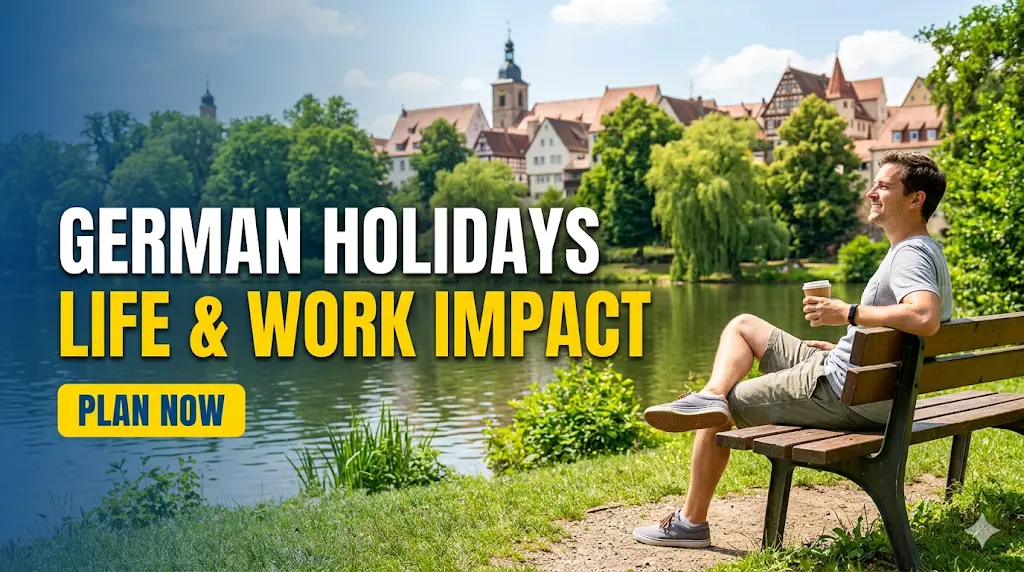
Standing in front of a locked grocery store on a random Thursday morning, realizing I had no milk, bread, or coffee for the next 24 hours, was my first introduction to the “Feiertag” phenomenon. I once spent a cold May morning staring at empty streets, convinced the world had ended, only to learn it was Ascension Day. This guide explains the complex German holiday system, from regional variations to “bridge day” strategies, so you can plan your life and work without being caught off guard.
Disclosure: This post may contain affiliate links. We may earn a commission at no extra cost to you if you make a purchase through these links. Read full disclosure.
The Cultural Weight of the “Ruhetag” (Rest Day)
In Germany, public holidays are not just days off; they are legally protected “days of rest” (Ruhetag). To an expat coming from a 24/7 convenience culture, the sudden and total shutdown of society can feel like a bureaucratic hurdle, but for locals, it is a sacred part of the social contract. German public holidays significantly impact daily life and work, offering rest periods but also affecting business operations and schedules. There are national holidays observed across all federal states, such as New Year’s Day, German Unity Day, and Christmas. However, many holidays vary by state. This means employees and businesses must stay aware of regional differences.
On public holidays, most shops, offices, and banks remain closed, creating quieter cities and limited services. Essential services like hospitals and transportation continue operating, though often on reduced schedules. Employees generally receive paid time off, as these holidays are protected by law. If employees are required to work, they may receive additional compensation or time off in lieu.
Public holidays also influence planning and productivity. Many people take extended breaks by combining holidays with weekends, known as “bridge days” (Brückentage). This can lead to increased travel, higher demand for services, and temporary business slowdowns. Employers often plan workloads around these periods to maintain efficiency. Culturally, public holidays play an important role in German society. They provide time for family gatherings, traditions, and relaxation. Festivals, markets, and events are common during certain holidays, enhancing community life.
Understanding how public holidays work is essential for both residents and newcomers. Being aware of closures, regional differences, and planning opportunities helps manage daily routines effectively. Overall, public holidays balance work and leisure, contributing to well-being while also shaping economic and social patterns across the country. Additionally, businesses involved in international trade or services must consider these holidays when dealing with global partners, as closures may delay communication and operations. Tourists should also be aware, since attractions may have limited hours. Proper planning ensures minimal disruption and better adaptation to Germany’s structured holiday system and its regional variations and regulations affecting everyday activities.
Why Sunday Rules Apply to Holidays
When a public holiday hits, the country effectively reverts to “Sunday mode.” This is governed by the Ladenschlussgesetz (Shop Closing Law), which dictates that almost all retail businesses must remain closed. This includes supermarkets, clothing stores, and hardware shops. Even the noise you make in your own apartment is regulated. You are expected to observe Ruhezeit (quiet hours), meaning no drilling, no loud vacuuming, and certainly no mowing the lawn.
This legal rigidity ensures that everyone, from the CEO to the cashier, gets a synchronized break. If you are currently staying in a mid-term rental through a service like Wunderflats, you might notice your neighbors suddenly vanish into the countryside or gather for long, quiet breakfasts. Understanding that the country is “closed” is the first step to avoiding frustration. You can learn more about how these behavioral rules impact your daily life in our guide on Safety in Germany: Staying Safe and Understanding Local Laws.
The Saturday Panic Before a Holiday
Because the supply chain stops entirely on holidays, the day before a public holiday—especially if it creates a long weekend—is marked by the “Supermarket Panic.” If a holiday falls on a Friday or a Monday, the Saturday or Thursday evening rush at your local Rewe or Edeka becomes a chaotic scene of hoarding. People shop as if a blizzard is coming, clearing shelves of fresh bread and milk.
As a veteran expat, my advice is to avoid the stores at all costs during these peak hours. Instead, perform your bulk shopping two days in advance. If you find yourself in an empty apartment with zero supplies because you forgot the holiday, your only hope is the “emergency” shops at major train stations or airports. For a detailed strategy on managing your pantry in a land of closed shops, check out Navigating German Supermarkets: Grocery Shopping Tips and Tricks.
Integrating into the “Feierabend” Mindset
The German concept of Feierabend—the time after work finishes—is amplified during public holidays. There is a strong cultural boundary between “work time” and “private time.” On a holiday, it is considered poor etiquette to send work-related emails or call colleagues, even if you are an expat used to “grinding” through the weekend.
Respecting this boundary is crucial for your professional reputation. Germans value their leisure time (Freizeit) immensely and use holidays to engage in “Vereinsleben” (club life) or family traditions.
Navigating the German Holiday Calendar 2026
The most confusing aspect for newcomers is that not all holidays are created equal. Germany is a federal republic, and each of the 16 states (Bundesländer) has the power to set its own holiday schedule.
Nationwide vs. Regional Holidays
There are nine public holidays that are celebrated in every single German state, such as New Year’s Day, Good Friday, Easter Monday, and Christmas. These are the “safe” holidays where you can be certain everything will be closed nationwide. However, there are many others that apply only to specific regions, often based on religious history (Catholic vs. Protestant).
For example, if you are working for a company based in Munich but you live in Berlin, you might find yourself working while your colleagues are off, or vice versa. This regional fragmentation can be a nightmare for scheduling meetings or coordinating deliveries. To understand the broader economic context of how these states differ, review the Cost of Living in Germany: Breakdown of Expenses (Rent, Food, Transport).
The North-South Divide (Bavaria vs. Berlin)
Generally speaking, the Southern states (Bavaria and Baden-Württemberg) are much more generous with public holidays due to their Catholic heritage. Bavaria, in particular, often tops the list with 13 or 14 public holidays a year, while Northern states like Hamburg or Berlin typically have 10.
| Holiday | Date | Nationwide? | Key States |
| New Year’s Day | Jan 1 (Thu) | Yes | All |
| Epiphany | Jan 6 (Tue) | No | Bavaria, BW, Saxony-Anhalt |
| Intl. Women’s Day | Mar 8 (Sun) | No | Berlin, Mecklenburg-Vorpommern |
| Good Friday | Apr 3 (Fri) | Yes | All |
| Easter Monday | Apr 6 (Mon) | Yes | All |
| Labor Day | May 1 (Fri) | Yes | All |
| Ascension Day | May 14 (Thu) | Yes | All |
| Whit Monday | May 25 (Mon) | Yes | All |
| Corpus Christi | Jun 4 (Thu) | No | Bavaria, Hesse, NRW, BW, etc. |
| German Unity Day | Oct 3 (Sat) | Yes | All |
| Reformation Day | Oct 31 (Sat) | No | Northern & Eastern States |
| All Saints’ Day | Nov 1 (Sun) | No | Southern & Western States |
| Christmas Day | Dec 25 (Fri) | Yes | All |
| Boxing Day | Dec 26 (Sat) | Yes | All |
Key Dates to Remember for 2026
In 2026, several holidays fall on weekends, which is the ultimate “bad luck” in the German system. Unlike the UK or the US, Germany does not typically “roll over” a holiday to the following Monday if it falls on a Saturday or Sunday. For instance, in 2026, German Unity Day (October 3) falls on a Saturday, meaning you don’t get an extra day off work.
However, May is the “Golden Month” for holidays in 2026. With Labor Day on a Friday and Ascension Day on a Thursday, the month is riddled with opportunities for long breaks. If you are moving during this busy season, ensure you have your logistics sorted through Moving Furniture and Belongings: Tips for an Easy Move to Germany.
Working on Holidays: Legal Rights and Realities
If your job requires you to work on a public holiday, you are stepping into a heavily regulated area of German labor law (Arbeitszeitgesetz). The state takes its rest days very seriously.
Paid Time Off and Legal Protections
By law, public holidays are paid days off for employees. If you have a standard employment contract and a holiday falls on a day you would normally work, your employer must pay you your full salary for that day, and it cannot be deducted from your annual vacation allowance. This is a fundamental right.
For many expats, this is a major perk. If you are currently looking for a position or negotiating a contract, understanding these entitlements is vital.
Compensatory Time and Holiday Premiums
While the law generally prohibits working on Sundays and holidays, certain sectors (like healthcare or emergency services) are obviously exempt. If you do work on a holiday, the law mandates that the employer must provide you with a “replacement rest day” (Ersatzruhetag) within a specific period, usually eight weeks.
Interestingly, German law does not strictly require employers to pay a financial bonus (like “double time”) for holiday work, although many collective bargaining agreements (Tarifverträge) do.
Sector-Specific Exceptions (Healthcare, Hospitality)
If you work in a restaurant, a hospital, or for a delivery service, holidays are often your busiest times. While retail is shut down, the hospitality industry thrives. However, even in these sectors, strict limits on maximum working hours apply. If you feel your employer is violating these rest-day rules, you are protected by the Gewerbeaufsichtsamt (Office for Occupational Safety).
Maximizing Your Time with “Brückentage” (Bridge Days)
One of the first things you will learn from your German colleagues is the “art of the Brückentag” (bridge day). This is the secret to turning a few days of vacation into a massive holiday.
The Art of the Bridge Day Strategy
A bridge day occurs when a public holiday falls on a Tuesday or a Thursday. By taking the Monday or Friday off as a vacation day, you “bridge” the gap between the holiday and the weekend, creating a four-day break while only using one day of your annual leave.
Germans are masters of this efficiency. In many offices, the bridge day calendar for the entire year is discussed in January. If you wait until April to ask for a bridge day in May, you will likely find that half your department has already beat you to it. If you are using a platform like Wunderflats for a short-term assignment, planning these breaks can give you the perfect opportunity to explore neighboring European countries.
Planning for 2026 Bridge Days
In 2026, there are several prime bridge day opportunities. Since Ascension Day (May 14) and Corpus Christi (June 4) always fall on Thursdays, the following Fridays are the most contested vacation days in the German corporate calendar.
| Holiday | Day | Bridge Day Opportunity |
| New Year’s Day | Thursday | Friday, Jan 2 |
| Epiphany (Regional) | Tuesday | Monday, Jan 5 |
| Ascension Day | Thursday | Friday, May 15 |
| Corpus Christi | Thursday | Friday, June 5 |
Company Cultural Norms for Leave Requests
While you have a legal right to your vacation days, many German companies have “Betriebsferien” (company holidays) where the entire office shuts down, often between Christmas and New Year. In some traditional industries, bridge days are almost mandatory—the office will be so empty that management encourages everyone to take the day off.
Practical Survival: Shopping and Errands
The most common expat fail is the “Friday Night Realization”—it’s 9:00 PM on a Friday, Monday is a holiday, and you have no food. Here is how to survive the retail blackout.
Grocery Logistics for Holiday Shutdowns
If a holiday falls on a Friday or a Monday, you are looking at a two-day retail shutdown (including Sunday). You must plan your meals with military precision. Fresh produce like meat and vegetables will sell out quickly on the day before the holiday.
Online Shopping and Delivery Delays
Do not expect Amazon Germany or DHL to deliver on a public holiday. The logistics network in Germany grinds to a halt. If you order an essential item on the Wednesday before a holiday Thursday, it likely won’t arrive until Monday or Tuesday.
Essential Household Gear for a Long Weekend
To avoid the holiday blues, I always recommend having a “Feiertag Survival Kit.” This isn’t just about food; it’s about comfort. Since you can’t go to the shops to browse, make sure your entertainment and home essentials are stocked.
I usually use Amazon Germany to bulk-buy non-perishables like high-quality coffee beans, long-life milk, and even basic household repair items like lightbulbs. On a holiday, if a lightbulb blows, you are in the dark until the next business day. Ordering these small essentials in advance via Amazon Germany saves you from the stress of a “closed for business” sign.
Traveling and Leisure During Public Holidays
Holidays are the most popular times for Germans to travel, which means the infrastructure is under intense pressure.
Public Transit and Deutsche Bahn During Holidays
Public transit (U-Bahn, S-Bahn, and buses) usually runs on a “Sunday/Holiday” schedule during Feiertage. This means fewer trains and longer wait times. If you are trying to get to the airport on a holiday, check the schedule at least a day in advance.
The national rail (Deutsche Bahn) is notoriously crowded during holiday periods. Long-distance trains (ICE/IC) will often be fully booked or “standing room only.” My expat pro-tip: always pay for a seat reservation if you are traveling during a holiday week.
Seasonal Activities and Local Traditions
Despite the shops being closed, holidays are often the best time to see “The Real Germany.” Many holidays involve local festivals, parades, or community markets. In the South, religious holidays often feature traditional costumes and beer gardens.
Use these days to integrate. Renting a mid-term flat through Wunderflats in a central area often puts you right in the middle of these cultural celebrations. Whether it’s the Labor Day protests in Berlin or the quiet church bells of a Bavarian village, holidays are a time to stop being a worker and start being a resident.
References
Primary sources (official)
- Federal Ministry of the Interior (BMI): The official list of public holidays and the legal framework for the “Feiertagsgesetz” (Holiday Law).https://www.bmi.bund.de/DE/themen/verfassung/staatliche-symbole/feiertage/feiertage-node.html
- Federal Ministry of Justice (Gesetze im Internet): The full text of the “Arbeitszeitgesetz” (Working Time Act) which governs holiday work and rest periods.https://www.gesetze-im-internet.de/arbzg/
Other helpful sources
- DGB (German Trade Union Confederation): A breakdown of employee rights regarding holiday pay and compensatory time off.https://www.dgb.de/service/ratgeber/feiertage/
Disclaimer
The information provided in this article is for general informational and educational purposes only and does not constitute professional legal or employment advice. Holiday regulations, especially regional variations and specific labor law entitlements, are subject to change and can vary based on individual employment contracts. While platforms provide convenient solutions for living and shopping, your specific legal standing depends on your state of residence and your job contract. Always consult with a qualified legal professional or your company’s HR department for specific inquiries regarding your work schedule and holiday rights.