How to Extend Your Residence Permit in Germany
Your residence permit card expires in a few weeks. Your local Ausländerbehörde shows no free appointments, and the website contradicts itself on which documents you need. Many foreigners in Germany end up in exactly this position, and the stress is real. This guide explains how to extend your residence permit in Germany: when to start, what to gather, how to get an appointment, and what to do when the system stalls.
Disclosure: This post may contain affiliate links. We may earn a commission at no extra cost to you if you make a purchase through these links. Read full disclosure.
When and Why You Need to Extend Your Residence Permit
My first extension went badly. I treated the expiry date on my card like the expiry date on a carton of milk, something to deal with when it got close. By the time I tried to book an appointment, the online calendar was full for months, and I spent a week refreshing a booking portal at odd hours. So here is the first lesson: the extension process starts long before the date printed on your card.
What Your Expiry Date Really Means
Your residence permit, the Aufenthaltstitel, is valid until the date on your card and no longer. The card does not renew itself, and nobody will remind you. Some offices send letters, but most do not, and you should never rely on that. If the date passes without a pending application, you can lose your lawful status. That can affect your job, your health insurance and your future applications for permanent residency.
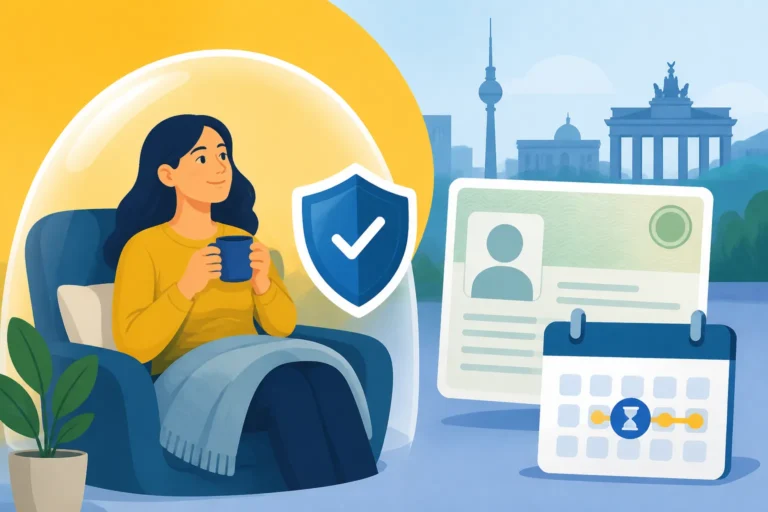
The good news is that German law protects people who apply on time. If your extension application reaches the Ausländerbehörde before your current permit expires, your stay is generally treated as lawful while the office decides. This is why the date you submit matters far more than the date of your appointment. For a deeper look at timing, see German Visa and Residence Permit Renewal: How Early Should You Apply? before you start gathering paperwork.
As a practical rule, start preparing several months ahead. In big cities like Berlin, Munich, Frankfurt and Hamburg, waiting times can be long. In smaller towns you might get a slot within days. Either way, early preparation costs you nothing.
Extension, Switching or Settling: Know Which One You Need
Many expats try to “extend” a permit when they actually need something else. If your purpose of stay is the same, you are extending: same employer on a Blue Card, same degree programme on a student permit, same marriage on a family permit. If your purpose has changed, you are usually applying for a new permit type. That happens if you finished your studies and started a job, or moved from employment to freelancing. That process is covered in Switching Visa Types in Germany: Student to Work, Tourist to Freelance, etc..
There is a third option many people overlook. You may already qualify for permanent residency, and in that case extending a temporary permit might be the wrong move. Blue Card holders and long-term skilled workers in particular should check whether they meet the settlement permit criteria. You will find the details in How to Apply for a Niederlassungserlaubnis in Germany. Applying for the right thing the first time saves you a second round of appointments.
| Your Situation | What You Are Applying For | Key Question to Ask Yourself |
|---|---|---|
| Same job, same employer, permit ending | Standard extension | Has anything in my contract or salary changed? |
| Still enrolled, degree taking longer than planned | Student permit extension | Can I show academic progress and enough funds? |
| Finished studies, now employed | New permit, often for skilled workers | Does my job match my qualification? |
| Same marriage, partner still lives in Germany | Family reunification extension | Is our shared address registered correctly? |
| Many years of contributions and stable work | Possibly a settlement permit | Do I already meet the permanent residency criteria? |
Documents You Need for a Residence Permit Extension
Paperwork is where most extensions stall. Every Ausländerbehörde publishes its own checklist, and offices in different cities can ask for slightly different things. Always download the current checklist from your own office’s website: the Landesamt für Einwanderung in Berlin, the KVR in Munich, or the Hamburg Welcome Center if you are a skilled worker in Hamburg. Then use the guidance below to fill the gaps.
The Core Document Pack
Almost every extension application includes these basics:
- A valid passport. If your passport expires soon, renew it first, because a permit generally cannot outlast it.
- Your current residence permit card, the eAT. If you have questions about what the card shows, see Biometric Residence Permit (eAT): Understanding Your German Residence Card.
- The completed application form, usually titled “Antrag auf Erteilung eines Aufenthaltstitels.” Some cities now accept it online.
- A current biometric photo that meets the official requirements.
- Your registration certificate, the Meldebescheinigung, showing your current address. If yours is outdated, follow the steps in How to Get a Meldebescheinigung in Germany.
- Your rental contract or a landlord confirmation showing adequate living space.
- Proof of health insurance covering your full stay.
- Proof of financial means, which looks different depending on your permit type.
I keep everything in a single folder with clear plastic sleeves, in the order the office lists it. It sounds pedantic, but caseworkers deal with hundreds of files. A tidy folder makes your appointment shorter and friendlier. For a full organisation system, see How to Prepare Documents for the Ausländerbehörde.
Proof of Income and Permit-Specific Papers
This is where your situation matters most.
Employees and Blue Card holders usually need a current employment contract, recent payslips and an employer confirmation form. In many cities this form is called the “Erklärung zum Beschäftigungsverhältnis,” and your HR department fills it in. Ask HR early. In my experience, HR teams can take a while to return forms, especially around holidays.
Students need an enrolment certificate, often a transcript or a letter from the university confirming academic progress, and proof that they can still support themselves. Many students first proved their funds with a blocked account, and the office may expect it to be topped up or extended for the new period. If you originally set up your blocked account through Expatrio, log in and check how to extend or reload it well before your appointment. Funds transfers from abroad can take time to arrive. Do not assume the old balance still satisfies the requirement.
Family permit holders typically need marriage or birth certificates, proof that the sponsoring family member still lives in Germany, and sometimes proof of the sponsor’s income.
Freelancers and the self-employed face the most scrutiny. Expect to provide tax assessments, client contracts, invoices and evidence that the business supports you. For income evidence in general, see How to Prove Income for a German Residence Permit.
Translations and Health Insurance Proof
Documents not in German often need certified translations. That includes a foreign marriage certificate, a degree issued abroad and a child’s birth certificate. A casual translation from a bilingual friend will not be accepted. The translation must come from a sworn translator recognised in Germany. Lingoking is one online service many expats use to order certified translations without hunting for a local translator. Upload your document, choose the language pair and the certified option, and check their site for current turnaround and pricing. Order early, because you may need the physical copy with a stamp and signature. For the full rules, see How to Get a Certified Translation for German Immigration.
Health insurance is the other frequent problem. Employees in public insurance usually just bring a membership confirmation from their Krankenkasse. Students and people with private or incoming cover sometimes get rejected because their policy does not meet the office’s standards. Expatrio also offers health insurance aimed at students and newcomers. If you went that route, request an up-to-date confirmation letter showing your policy dates before the appointment. Exactly which insurance letters caseworkers accept is covered in Insurance Documents for an Auslanderbehorde Appointment: What Gets Accepted. If your insurance or address registration lapsed at any point, read Visa Compliance: Importance of Maintaining Address Registration and Health Insurance before you go. Gaps can raise questions.
Step-by-Step: How to Extend Your Residence Permit
Here is the sequence that has worked for me and for many expats I know, from Cologne to Leipzig.
- Check your expiry date and passport validity. Write the date somewhere visible and set a reminder several months ahead.
- Confirm what you are applying for. Decide whether you need an extension, a new permit type or a settlement permit.
- Download your local office’s checklist. Use the official city or district website, not a forum post from years ago.
- Request employer, university or insurance letters. These depend on other people’s speed, so start them first.
- Order translations if needed. Allow time for physical delivery.
- Submit your application or book an appointment. Some cities let you file the application online before any appointment is assigned. That online submission can protect your status.
- Keep proof that you applied. Save confirmation emails, screenshots and case numbers.
- Attend the appointment with originals and copies. Bring both, even if you uploaded everything.
- Give biometrics and pay the fee. Your new card is produced centrally and is usually sent back to your local office for collection.
- Collect your new card. You will often get a letter or PIN notification when it is ready.
For timing expectations at each stage, see Renewing Your German Visa or Residence Permit: Timeline and Process.
Booking an Appointment When No Slots Exist
This is the most common frustration I hear, and it is completely valid. In some cities, appointments appear and disappear within minutes. Here is what tends to help:
- Use the online application route if your city offers one. Berlin, for example, has moved many permit applications to online forms. Submitting the form is what counts, not getting a calendar slot.
- Email the responsible team in writing. Include your full name, date of birth, nationality, current permit type and expiry date, and say clearly that you want to apply for an extension. A written, dated email is evidence that you tried to apply in time.
- Check the booking portal at varied times. Offices often release new slots early in the morning or at the start of the week.
- Ask your employer. Larger companies sometimes have relocation partners or fast-track arrangements with local offices.
More practical tactics are in How to Book an Appointment at the Ausländerbehörde.
What Happens on Appointment Day
Arrive early. Bring your passport, current card, all originals, copies and the confirmation of your appointment. The caseworker will check your file, may ask a few questions and will take your fingerprints for the new card. The conversation often happens in German. Caseworkers are not always required to switch to English, and many will not. If your German is shaky, practise the key phrases beforehand. Roleplay helps far more than you would expect, and Roleplay Lessons That Help: Burgeramt, Auslanderbehorde, and Krankenkasse Calls shows how to rehearse these exact conversations. Bringing a German-speaking friend is also usually fine.
If something is missing, do not panic. Caseworkers often give you a deadline to send the missing document by post or email rather than cancelling your application. Ask for the request in writing and meet that deadline exactly.
When Things Go Wrong: Delays, Gaps and Expiring Permits
Even well-prepared people run into trouble. Your situation is rarely unique, and there is usually a defined path forward.
The Fiktionsbescheinigung: Your Bridge Document
If you applied before your permit expired but the office has not decided yet, you will usually receive a Fiktionsbescheinigung. This is a paper certificate confirming that your stay continues to be treated as lawful while your application is processed. Show it to your employer, keep it with your passport and do not lose it. Some offices issue it automatically. Others only issue it when you ask, so ask. Everything about this document, including how to request it, is explained in What Is a Fiktionsbescheinigung and How to Get One?.
A word of caution about travel: crossing borders with only a Fiktionsbescheinigung can be complicated, especially re-entry from outside the Schengen area. If you have trips planned, raise them with the caseworker before you book anything.
Urgent Cases: Your Permit Expires Within Days
Say it is Tuesday, your card expires on Friday, and you have no appointment. Here is what to do, in this order:
- Submit the online application today if your city offers one.
- Send a written email to your Ausländerbehörde stating your intent to extend, with your details and the expiry date.
- Keep copies of every message and confirmation.
- Call the office’s hotline if one exists, and write down the date, time and what you were told.
- Inform your employer’s HR team so they understand your status.
The goal is simple: create clear evidence that you applied before the expiry date.
If Your Permit Has Already Expired
If the date has passed without an application, act immediately. Contact your Ausländerbehörde, explain what happened honestly and submit your application at once. The automatic protection that applies to on-time applications may not apply in the same way here. The office may have discretion, and outcomes vary. This is the point to speak with a qualified immigration lawyer, a Fachanwalt für Migrationsrecht, or a migration advisory service in your city. Do not travel outside Germany until your status is clarified.
Common Mistakes I See Again and Again
- Using an outdated checklist. Requirements change, so always use your own office’s current list.
- Forgetting the passport. A permit generally cannot run beyond your passport’s validity.
- Assuming the employer handled it. Even with relocation support, the application is your responsibility.
- Changing jobs without telling the office. Some permits are tied to a specific employer or role, so check before you switch.
- Letting address registration lag. If you moved, update your Anmeldung before applying.
Extending your residence permit in Germany is stressful mostly because of uncertainty, not complexity. Once you know your expiry date, your permit type and your local office’s checklist, the process becomes a predictable sequence of steps. Start early, keep everything in writing, and remember that applying on time protects you even when the system is slow.
Disclaimer
This article is for general informational purposes only and does not constitute professional advice. Laws, prices and regulations vary by location and change over time. Consult a qualified professional for guidance on your specific situation.