How to Find Authentic Restaurants in Germany (Not Tourist Traps)
Finding a decent meal in Germany shouldn't be a gamble, but far too many visitors find themselves trapped in "schnitzel factories" directly across from major landmarks. You end up with overpriced, lukewarm food and a generic atmosphere that lacks the soul of true German hospitality. This guide breaks down the insider secrets for identifying genuine local eateries and avoiding the traps.
Disclosure: This post may contain affiliate links. We may earn a commission at no extra cost to you if you make a purchase through these links. Read full disclosure.
Recognizing the Red Flags of a German Tourist Trap
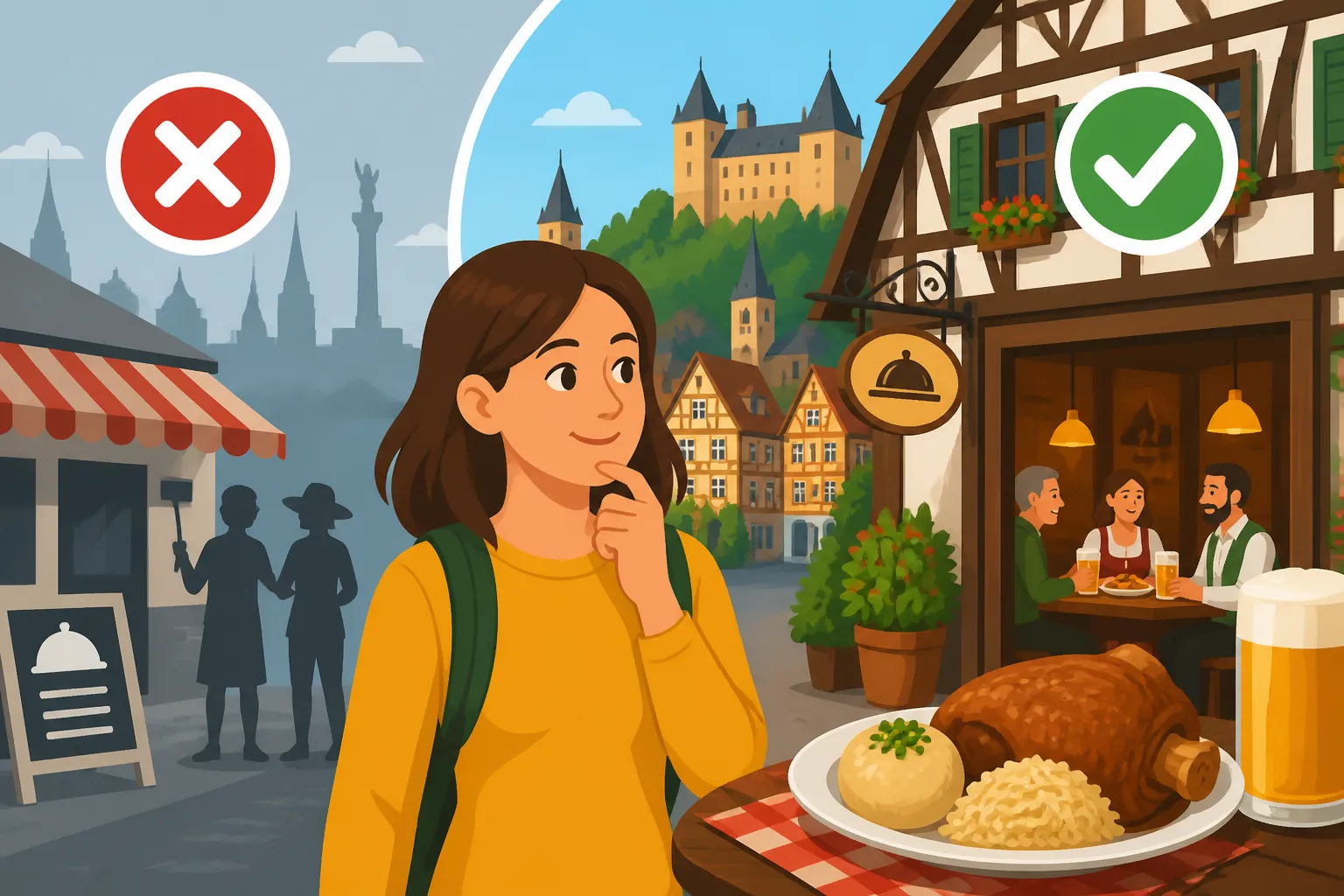
The first step in eating like a local is learning to spot the warning signs from a block away. In Germany, tourist traps follow a very specific blueprint that is remarkably easy to identify once you know what to look for. One of the biggest giveaways is the "multilingual overkill." If you see a menu board outside featuring flags from five different countries and descriptions in English, Italian, Russian, and Chinese, keep walking. Authentic German restaurants, particularly the ones that have been serving the same neighborhood for decades, often have menus primarily in German, perhaps with a discreet English translation tucked inside.
Another major red flag is the presence of glossy, laminated photos of the food. In a traditional German Wirtshaus, the menu is often a simple printed sheet or a handwritten chalkboard. Photos are generally seen as a sign of a "fast-food" mentality or a place that caters exclusively to people who don't know the cuisine. Furthermore, if there is a person standing on the sidewalk actively trying to "lure" you into the restaurant with a friendly "Hello, where are you from?", it is almost certainly a trap. Authentic German spots are usually busy enough with their regulars and don't need a "promoter" to fill tables.
The Location Trap: Proximity to "The Sights"
There is a golden rule in German dining: the quality of the food is often inversely proportional to the view of a major cathedral or town hall. If you can see the Cologne Cathedral from your table while sitting on the main plaza, you are likely paying a "view tax." These establishments rely on a constant stream of one-time visitors, which means they have very little incentive to maintain high culinary standards.
When you use Booking.com to find your accommodation, try to look for hotels situated just two or three U-Bahn stops away from the city center. Neighborhoods like Prenzlauer Berg in Berlin or Sachsenhausen in Frankfurt offer a much higher density of authentic spots than the immediate vicinity of the main tourist hubs. Living even a few streets back from the "beaten path" will change your entire perspective on German food.
Menu Disasters: The "Everything" Restaurant
Authentic German restaurants usually specialize. You might find a Brauhaus that focuses on hearty roasts and beer, or a Gaststätte that prides itself on regional seasonal dishes. If you see a menu that offers Schnitzel, Pizza, Pasta, and Sushi all in one place, run. This is a sign of a kitchen that uses frozen, pre-prepared ingredients to satisfy the broadest possible (and least discerning) audience.
A real German menu is often surprisingly short. It reflects what the chef can actually cook fresh that day. If you have traveled between cities using Omio and arrive in a new region, look for menus that highlight specific local specialties rather than a generic list of "Greatest Hits of Germany." For example, in Nuremberg, the menu should focus on the small, grilled Nürnberger Rostbratwurst, not a generic Currywurst you’d find in Berlin.
Proven Strategies for Scouting Authentic German Gems
If you want to find where the locals actually eat, you have to change your scouting strategy. Instead of looking for the brightest lights, look for the quietest side streets. Often, the best restaurants are located in the "Erdgeschoss" (ground floor) of ordinary-looking residential buildings. These places survive on "Stammgäste"—regular customers who have been coming for years. If you walk into a place and the waiter greets half the tables by name, you’ve hit the jackpot.
Another great indicator is the "Stammtisch." This is a table, often marked with a small sign or a more ornate carving, reserved for a group of regulars. Seeing a group of older locals huddled around a Stammtisch at 5:00 PM, nursing half-liter beers and debating politics, is the ultimate seal of authenticity. These people wouldn't be there if the beer was flat or the pork knuckle was dry.
The Magic of the Tageskarte (Daily Menu)
One of the best ways to ensure you’re getting fresh, authentic food is to look for the Tageskarte. This is usually a small, separate slip of paper clipped to the main menu or, even better, written in chalk on a board on the wall. The Tageskarte features dishes based on what was fresh at the market that morning or what is currently in season.
In the spring, you should see an explosion of "Spargel" (white asparagus) dishes. In the autumn, look for "Pfifferlinge" (chanterelle mushrooms) or "Wild" (venison and game). Because these dishes change daily, they can't be mass-produced in a factory. To help you understand what you're looking at, it's worth checking out a guide on German Regional Dishes Every Visitor Should Try before you head out.
Using Digital Tools the Right Way
While generic review sites can sometimes be manipulated, they are still useful if you know how to filter the data. Look for reviews written in German. Even if you have to use a translation app, the opinions of locals are far more valuable than those of a tourist who was just happy to find "fries that tasted like home." Locals will comment on the quality of the "Soße" (sauce) or whether the "Knödel" (dumplings) were clearly handmade.
Sometimes, taking a curated tour through GetYourGuide can provide a great introduction to a city's food scene, especially if the tour is led by a local. They can point out the specific doors you might otherwise walk past. Once the tour is over, ask the guide where they personally go for Sunday lunch with their family. That’s the information that isn't in the brochures.
| Feature | Tourist Trap | Authentic Restaurant |
|---|---|---|
| Menu Language | 5+ languages with flags | Mostly German (maybe a small English insert) |
| Visuals | Large photos of food | Text only or handwritten chalkboard |
| Staff | "Barkers" outside inviting you in | Busy staff inside, often slightly formal |
| Location | Directly on the main square | Side streets or residential neighborhoods |
| Food Variety | Schnitzel, Pizza, Burger, Pasta | Regional specialties and seasonal dishes |
| The Crowd | People with backpacks and maps | Locals, workers, and "Stammgäste" |
Navigating the German Dining Experience Like a Local
Once you've found a promising spot, you need to know the social "rules" to ensure a smooth experience. German service can sometimes feel "abrupt" or "unfriendly" to those used to the hyper-attentive style of North America, but it’s actually just efficient and respectful of your privacy. A waiter won't come by every five minutes to ask how your first bite is; they assume if you need something, you will catch their eye or give a small wave.
Understanding the different types of establishments is also key. A Brauhaus is going to be loud, boisterous, and communal. You might even be expected to share a long wooden table with strangers. On the other hand, a Gasthof or Restaurant will be quieter and more formal. Knowing what to expect prevents culture shock and helps you blend in. For more on the social nuances, you should read about German Dining Etiquette: Eating Out, Tipping, and Table Manners.
The Art of the "Reservierung" and Table Etiquette
In most authentic German restaurants, especially on Friday and Saturday nights, a reservation is not just a suggestion—it’s a necessity. If you see small "Reserviert" signs on the tables, don't just sit down. Wait to be seated or ask "Haben Sie einen Tisch für zwei?" (Do you have a table for two?). However, in more casual beer halls, the rules are different. If you see an empty spot at a large table, it is perfectly acceptable to ask "Ist dieser Platz noch frei?" (Is this seat free?).
Once you are seated, remember that tap water is almost never served. You will be expected to order bottled water (mit Gas or ohne Gas), beer, or wine. This is where the restaurant makes its profit, so don't be the person asking for a pitcher of "Leitungswasser" (tap water). For a smoother experience, familiarize yourself with German Meal Times and Restaurant Basics for Visitors so you don't show up when the kitchen is closed.
Paying the Bill and Tipping
When you are finished, you need to ask for the bill by saying "Die Rechnung, bitte." In authentic local spots, the waiter will often bring a small leather wallet or even just a handheld device and calculate the total right at the table. Unlike in some other countries, the waiter will stay there while you pay.
Tipping in Germany is not the 20-25% standard seen in the US. Instead, you "round up" or add about 5-10%. If the bill is €46.50, you might say "49 Euro" or "50 Euro" as you hand over the cash. It is also vital to remember that many authentic, old-school German restaurants are still "Nur Bargeld" (Cash only). Before you sit down, check the door for credit card stickers or read up on Cash vs Card in Germany: What Visitors Should Know to avoid an awkward situation at the end of your meal.
Regional Authenticity: What to Look for in Different Cities
Germany is a federal republic of culinary regions, and what is authentic in one city is a "tourist import" in another. To truly eat like a local, you must match your cravings to your geography. If you are in Munich, you are looking for the holy trinity of Schweinebraten (roast pork), Knödel (dumplings), and Helles beer. If you are in Hamburg, you should be looking for Fischbrötchen (fish rolls) and Labskaus.
When you use Omio to travel to the southwest, specifically the Black Forest region, look for "Besenwirtschaften." These are temporary wine taverns operated by winegrowers themselves. They are only open for a few weeks a year and serve incredibly simple, authentic local food and their own wine. You won't find these on the main tourist maps, but they are the pinnacle of German food culture.
Berlin: The Land of the Imbiss and International Fusion
Berlin is a bit of an outlier. While you can find traditional Prussian food, the "authentic" Berlin experience is often found at an "Imbiss" (snack stand). This is the birthplace of the Currywurst and the Doner Kebab. A local doesn't go to a sit-down restaurant for these; they eat them standing up at a high table on the sidewalk. You can learn more about this in our guide on Sausages and Street Food in Germany (Currywurst and More).
In Berlin, "authentic" also means embracing the city's Turkish and Vietnamese influences. A tiny, crowded Pho spot in Dong Xuan Center or a bustling Kebab shop in Neukölln with a line of locals out the door is just as "authentic" to the modern German experience as a schnitzel house.
The Importance of the Seasonal Calendar
Finally, always eat according to the season. Germany is obsessed with seasonal produce. In late April and May, every authentic restaurant will have a special "Spargelkarte." If you don't see white asparagus on the menu in May, the restaurant isn't paying attention to the local rhythm. Similarly, in late summer, look for "Pfifferlinge" (chanterelles), and in November, "Martinsgans" (St. Martin's Goose).
Eating seasonally is the best way to avoid "tourist food" because it requires the kitchen to constantly update its offerings. It’s much harder to maintain a "trap" when you have to source fresh goose or game meat every autumn. If you can learn to recognize these seasonal cues and combine them with the social rules found in Ordering Food and Drinks in German: A Practical Phrasebook, you will never have a bad meal in Germany again.
Disclaimer
This guide is intended for informational purposes only. While we strive to provide the most accurate and up-to-date advice for travelers and expats, restaurant ownership and quality can change. Always use your best judgment when choosing an establishment, and be aware that local laws regarding smoking, tipping, and payment methods may vary by federal state.