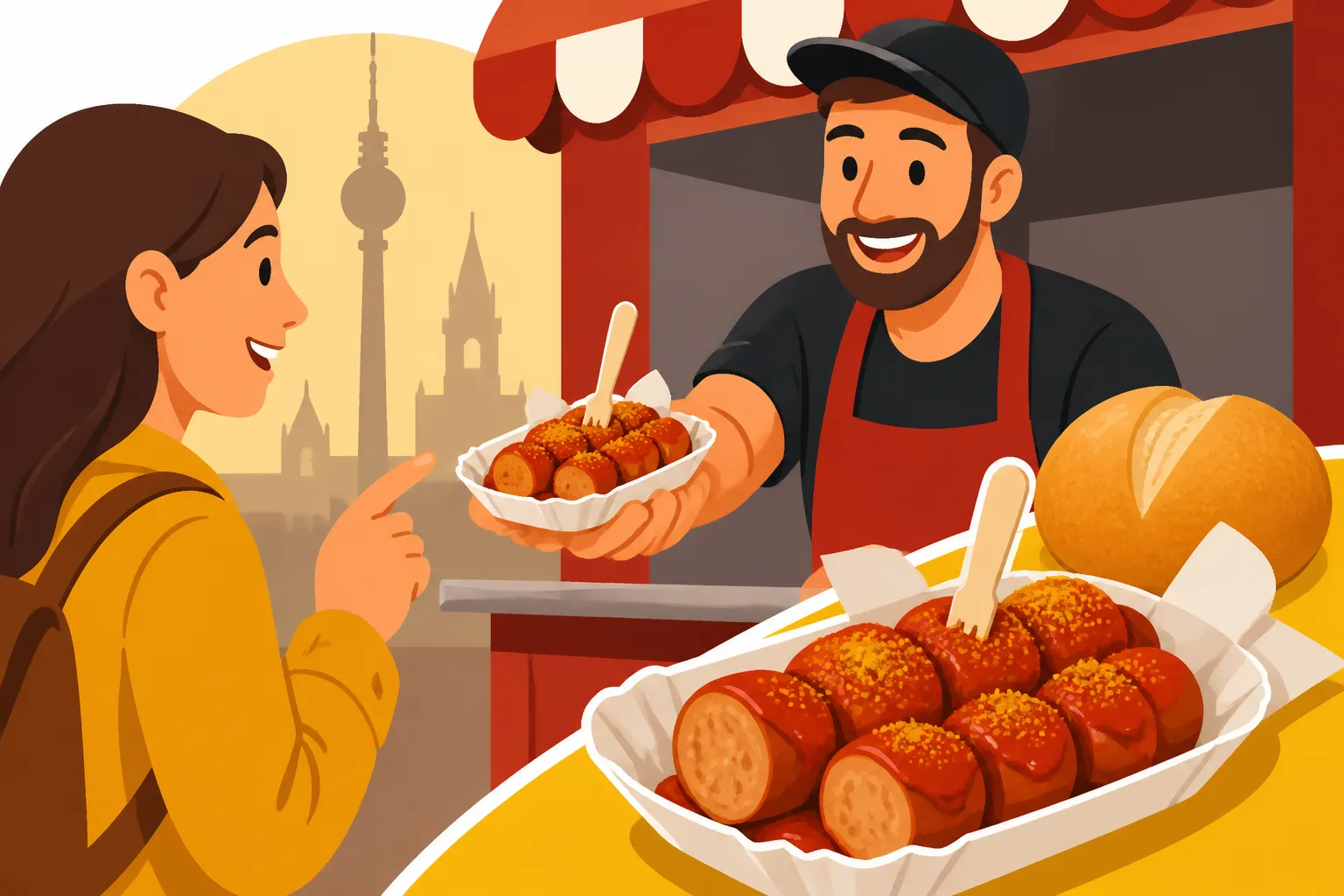
How to Order Currywurst and German Street Food
You are standing in line at a bustling German Imbiss, the smell of fried bratwurst is intoxicating, but the fast-talking vendor and the unwritten social rules of the queue are making you break a sweat. It is a classic expat hurdle: wanting that iconic Currywurst but fearing the "Next!" shout. This guide breaks down exactly how to order Currywurst and German street food like a seasoned local.
Disclosure: This post may contain affiliate links. We may earn a commission at no extra cost to you if you make a purchase through these links. Read full disclosure.
The Cultural Sanctuary of the Imbiss
Before you even open your mouth to order, you have to understand the environment. In Germany, street food isn't just a quick transaction; it happens at the Imbiss. An Imbiss is a traditional food stand or small kiosk, often found near train stations, busy street corners, or construction sites. They are the great equalizers of German society. You’ll see businessmen in three-piece suits standing shoulder-to-shoulder with blue-collar workers, both leaning over the same high-top standing tables (Stehtische), united by a shared love for processed meat and curry sauce.
If you are traveling through the country, perhaps using Omio to navigate between the high-speed rail networks, you will notice that every region claims the "best" street food. While Berlin and the Ruhr Valley fight over the origins of the Currywurst, the reality for you, the hungry traveler, is that the Imbiss is your safest bet for a cheap, filling, and culturally authentic meal. This is where German Food Culture: Eating and Drinking as a Visitor truly comes alive—not in the fancy sit-down restaurants, but on the grease-stained pavement of a local parking lot.
The vibe at an Imbiss is direct and efficient. Do not expect "service with a smile" in the way you might in North America. The staff are there to flip sausages and move the line. This directness is often one of the Common Cultural Surprises for First-Time Visitors to Germany, but once you realize it isn't personal, it becomes part of the charm. You are expected to know what you want by the time you reach the window. There is no time for "umm-ing" and "ah-ing" when there are six hungry Berliners behind you.
Mastering the Currywurst Order: A Step-by-Step Tutorial
The Currywurst is more than just a sausage; it is a cultural icon consisting of a steamed, then fried, pork sausage, sliced into bite-sized chunks and smothered in a spiced tomato ketchup and curry powder. However, ordering one involves more choices than you might expect. If you are staying at a central hotel booked via Booking.com, you likely have an iconic stand just around the corner. Here is how to navigate the order without looking like a total amateur.
Step 1: Choosing Your Sausage (Mit Darm vs. Ohne Darm)
This is the ultimate test of your local knowledge. In Berlin specifically, the vendor will ask you, "Mit Darm oder ohne?" (With casing or without?). The "Mit Darm" version has a traditional snap when you bite into it, while the "Ohne Darm" version is a smoother, paler sausage that was historically popular in East Berlin when casings were scarce. Most veterans of the street food scene have a fierce loyalty to one or the other. If you aren't sure, "Mit Darm" is generally closer to what international visitors expect from a sausage.
When you approach the window, start with your quantity and the type. For example, "Einmal Currywurst mit Darm, bitte" (One Currywurst with casing, please). If you are looking for more variety, check out our guide on Sausages and Street Food in Germany (Currywurst and More) to see what else might be on the grill that day.
Step 2: Picking Your Sides (Pommes Schranke vs. Brötchen)
You cannot eat a Currywurst alone. You need a vehicle for that extra sauce. Your two main options are a Brötchen (a hard crusty roll) or Pommes Frites (fries). If you choose fries, you will be faced with the most important linguistic shortcut in German street food history: Pommes Schranke.
Literally translating to "level crossing" (like the red and white bars at a train track), Pommes Schranke means fries with both ketchup (red) and mayonnaise (white). You may also hear it called “Pommes rot-weiß.” If you’re a minimalist, a Brötchen is the way to go. You’ll get a small roll to dunk into the pools of curry sauce. It’s efficient, cheap, and surprisingly satisfying.
Step 3: Heat Levels and Variations
In some cities, especially in the Ruhrpott or at specialized stands in Berlin, they might ask you how spicy you want it. Standard Currywurst is quite mild—it’s more about the flavor of the spices than the heat of the chili. However, if you see a sign for "Scharf," be prepared. Some "Curry 36" style stands have levels of heat that can rival a vindaloo.
If you are on one of the many food-themed tours found on GetYourGuide, your guide will likely steer you toward a moderate level. But if you’re flying solo, "Normal scharf" is usually the safe bet for a pleasant tingle without losing your taste buds for the rest of the afternoon.
Beyond the Currywurst: Other Street Food Classics
While Currywurst gets all the press, the German street food scene is a vast landscape of regional specialties. If you are doing Berlin for First-Time Visitors: Neighborhoods and Highlights, you’ll quickly realize that the Döner Kebab is actually the most popular street food in the city. Introduced by Turkish immigrants in the 1970s, it has become the unofficial national dish of Germany.
The Döner Kebab Protocol
Ordering a Döner is an art form. The vendor will ask you "Salat alles?" (Salad, everything?). This usually includes lettuce, cabbage, onions, and tomatoes. Then comes the sauce choice: "Knoblauch" (Garlic), "Kräuter" (Herbs), or "Scharf" (Spicy). A pro tip for expats: If you want to sound like a local, ask for "Döner mit allem und scharf" (Döner with everything and spicy).
The meat is typically a mix of veal, beef, or chicken, shaved thin from a vertical rotisserie. Unlike the greasy kebabs found in some other countries, a German Döner is often packed with fresh vegetables and high-quality bread (Fladenbrot), making it a legitimate meal. It’s one of those German Meal Times and Restaurant Basics for Visitors hacks: when everything else is closed, the Döner stand is usually open.
Regional Delights: Leberkäse and Fischbrötchen
If your travels take you south to Munich or north to Hamburg, the street food shifts. In Bavaria, you must try a Leberkäsesemmel. It’s a thick slice of warm, pink meatloaf (which, despite the name, contains no liver or cheese) served in a roll with sweet mustard. It is the ultimate comfort food.
In the north, particularly if you are taking Best Day Trips From Berlin to the Baltic coast, look for the Fischbrötchen. These are crusty rolls filled with pickled herring (Matjes), onions, and remoulade. It might sound intimidating to the uninitiated, but it is the quintessential taste of the German coast.
Essential Etiquette and Practical Tips
The most important thing to remember at any German food stand is that Cash vs Card in Germany: What Visitors Should Know is a topic of constant debate. While things are changing, many smaller Imbiss stands remain strictly "Nur Barzahlung" (Cash only). Always have a five or ten-euro note handy. Trying to pay for a four-euro sausage with a credit card might earn you a very stern look from the vendor.
The Standing Table Social Contract
When you get your food, you will likely head to a standing table. If the stand is busy, these tables are communal. You do not need to ask for permission to stand at a large table if there is an empty corner, though a quick "Ist hier noch frei?" (Is this spot free?) is polite. You aren't expected to make small talk; Germans value their "Ruhe" (quiet) while eating, but a polite "Guten Appetit" to your table mates is a nice touch.
Tipping at the Stand
Tipping culture is different here. In a sit-down restaurant, you might tip 5-10%, but at an Imbiss, it is much simpler. Usually, you just "round up" to the nearest Euro. If your Currywurst costs €4.50, giving the vendor €5.00 and saying "Stimmt so" (Keep the change) is perfectly acceptable and appreciated. For a deeper dive into these nuances, check out Tipping in Germany: When, Where, and How Much.
Summary of Common Street Food Terms
| German Term | English Equivalent | Best For… |
|---|---|---|
| Imbiss | Food Stand / Kiosk | Finding the best local bites on a budget. |
| Mit allem | With everything | Ordering a Döner with all salads and sauces. |
| Pommes Schranke | Fries with Ketchup/Mayo | The ultimate side dish for any sausage. |
| Brötchen | Crusty Roll | A simple, cheap way to enjoy your bratwurst. |
| Scharf | Spicy | Adding a kick to your Currywurst or Kebab. |
| Stimmt so | Keep the change | The easiest way to tip your vendor. |
| Einmal… bitte | One… please | The standard way to start your order. |
Why You Shouldn't Overthink It
The fear of ordering in a foreign language often stops people from trying the best food. But remember, the person behind the counter wants to sell you a sausage just as much as you want to eat one. Even if your German is limited to "Einmal Currywurst, bitte," you will be fine. Use hand gestures, point to the toppings you want, and keep your cash ready.
German street food is about efficiency and flavor, not linguistic perfection. Whether you are grabbing a quick bite before hopping on a train booked through Omio or exploring the hidden alleys of a new city, the Imbiss is your gateway to the real Germany. It is greasy, it is salty, and it is absolutely delicious. So, take a deep breath, step up to the window, and join the ranks of the millions who find culinary bliss in a cardboard tray of curry-spiced sausage.
Disclaimer
The information provided in this guide is for educational and informational purposes only. While we strive to provide the most up-to-date advice on German customs and food prices, local regulations and business practices can change. Always check for local signs regarding payment methods and opening hours. We are not responsible for any indigestion or sudden cravings for fried sausages resulting from the use of this guide.