What to Wear to Oktoberfest (Dirndl and Lederhosen)
Walking onto the Theresienwiese for the first time can be an intimidating experience if you are worried about looking like a tourist in a cheap polyester costume. Many visitors struggle to distinguish between authentic Bavarian Tracht and the "party outfits" sold at train stations, leading to a sense of social awkwardness. This guide provides the deep cultural insight needed to choose an outfit that respects local traditions while keeping you comfortable during a long day of festivities.
Disclosure: This post may contain affiliate links. We may earn a commission at no extra cost to you if you make a purchase through these links. Read full disclosure.
Understanding Tracht: More Than Just a Costume
When you first arrive in Munich, you will see the word Tracht everywhere. It is vital to understand that for Bavarians, these are not costumes; they are traditional garments that signify regional identity, heritage, and even social status. While no one will kick you out of a tent for wearing jeans, wearing authentic clothing is a gesture of respect toward the local culture. It changes the way people interact with you. Instead of being viewed as a "party tourist," you are seen as someone who appreciates the German Etiquette and Social Life for Visitors.
The first mistake most newcomers make is buying a "costume" set from a souvenir shop. These are often made of shiny, thin synthetic materials that look out of place and, quite frankly, can be quite itchy after a few liters of beer. Authentic Dirndls and Lederhosen are made from high-quality natural materials like cotton, linen, silk, and leather. If you are planning your trip using a service like Omio to find the best train connections to Munich, you might consider arriving a day early just to browse the local boutiques. This allows you to feel the difference between a mass-produced garment and a piece of real craftsmanship.
Quality Tracht is an investment. A decent set of Lederhosen can last a lifetime, and many Bavarians inherit theirs from their fathers or grandfathers. For women, a well-made Dirndl can be altered and styled in various ways for years. Even if you are only attending the festival once, opting for a mid-range, authentic-looking outfit will serve you better than a disposable one. It also makes for a far better souvenir of your time exploring Munich for First-Time Visitors: What to See.
Identifying Quality vs. Tourist Kits
How do you spot a "tourist kit" from a mile away? Look at the colors and the length. If the Dirndl is neon pink, hits above the mid-thigh, and comes in a plastic bag with a white ruffled shirt attached, it is a costume. Real Dirndls almost always fall at or below the knee. For men, if the "leather" pants are paper-thin and have a suspicious chemical smell, they are likely synthetic. Authentic Lederhosen are made from heavy cow, goat, or—if you are going high-end—deer leather (Hirschleder).
Budgeting for these items is part of the overall cost of the trip. You can find more details on managing your funds in our Money Matters in Germany: Complete Financial Guide for Expats. Generally, expect to pay at least 150 to 250 EUR for a respectable entry-level outfit. If that feels steep, remember that the resale value for authentic Tracht is quite high in Germany, or you can look for second-hand shops (Second-Hand-Läden) in neighborhoods like Maxvorstadt or Schwabing, where locals drop off their high-end pieces.
| Feature | Authentic Tracht | Tourist Costume |
|---|---|---|
| Material | Leather, Cotton, Linen, Silk | Polyester, Plastic, Nylon |
| Length (Dirndl) | Knee-length or longer | Mini-skirt length |
| Embroidery | Hand-stitched or high-density machine | Printed or loose threads |
| Buttons | Horn, metal, or fabric-covered | Cheap plastic |
| Price Point | 150 EUR – 1,000+ EUR | 20 EUR – 50 EUR |
The Dirndl: A Guide for Women
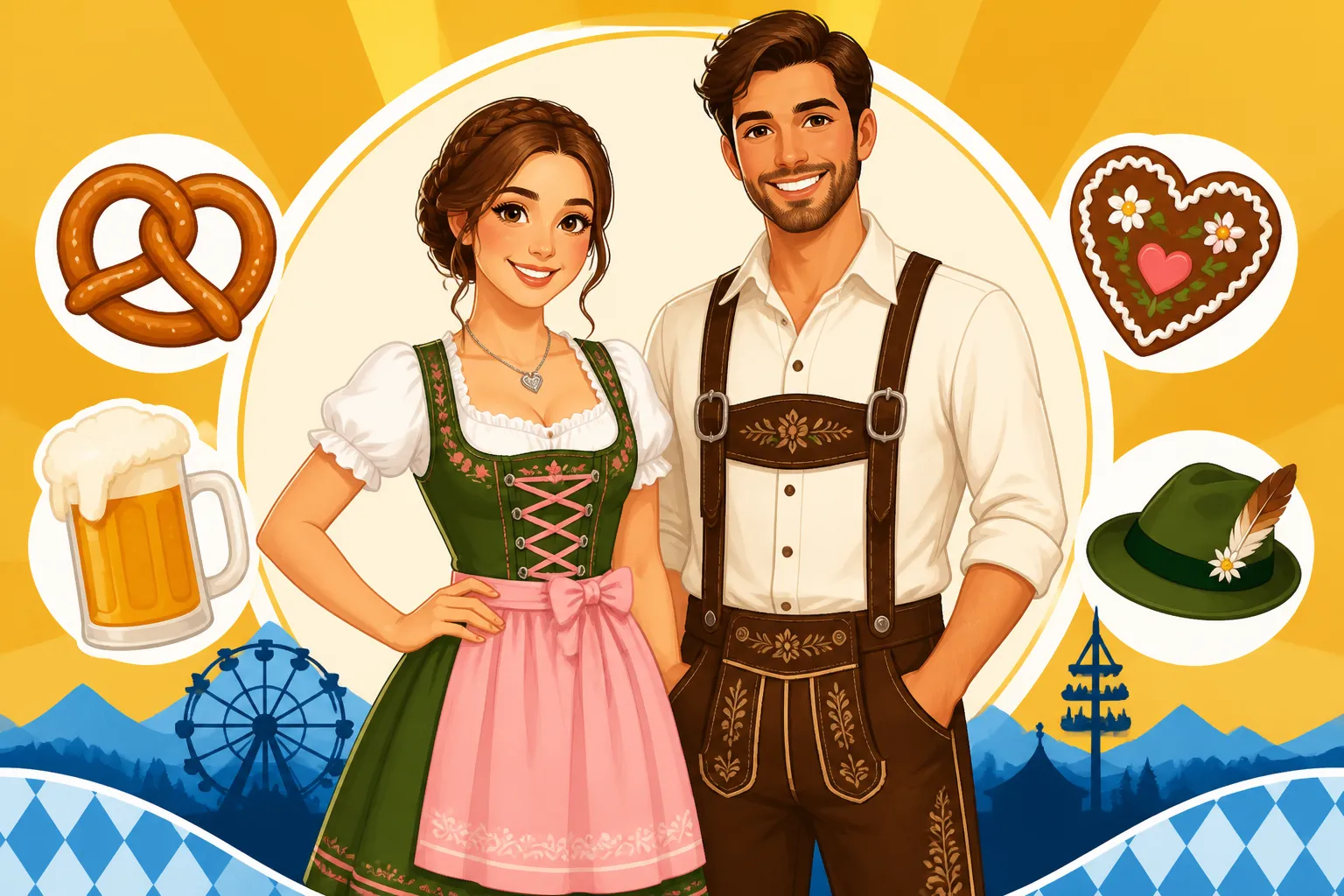
The Dirndl is a three-piece ensemble: the dress (Kleid), the blouse (Bluse), and the apron (Schürze). Each part requires careful selection. The dress itself usually features a fitted bodice and a wide skirt. When trying one on, it should feel quite tight—almost like a corset. A common saying in Bavaria is that "if you can breathe easily, it’s too loose." The bodice should lift and support, creating the classic silhouette associated with Beer, Wine, and German Drinking Culture.
The blouse is perhaps the most customizable part. You can choose from high-necked lace for a more traditional look or a deeper "balconette" cut. Unlike everyday clothing, Dirndl blouses are very short, ending just below the bust, so don't be alarmed when you see how small they look off the hanger. They are designed this way to avoid adding bulk under the tight bodice. When you book your stay via Booking.com, try to find a hotel with a full-length mirror, as getting the blouse and bodice aligned perfectly can be a bit of a workout.
The apron is the finishing touch, and it carries a secret language that every visitor must know. The way you tie your bow (die Schleife) communicates your relationship status. This is not a joke; locals genuinely use this as a social cue. Tying it on the left means you are single and perhaps open to a conversation. Tying it on the right means you are married or in a committed relationship. A bow in the middle used to signify virginity, but today it is often seen on children or people who are unsure of the "rules." A bow in the back indicates the wearer is a widow, a waitress, or a child.
Accessories and Footwear for a Long Day
Comfort is king at the Wiesn. You will likely be standing on wooden benches and walking long distances across the festival grounds. While high heels look great in photos, they are a nightmare on the uneven floors of a beer tent. Most local women opt for "Trachten-Ballerinas," simple leather flats, or even clean, white sneakers for a more modern look. Avoid anything with a thin stiletto heel, as it can easily get caught in the gaps of the wooden flooring.
Jewelry should be kept traditional if possible. A "Kropfband" (a velvet choker with a decorative pendant) is a classic choice. If you are planning to take Best Day Trips From Munich before or after the festival, you might find unique handcrafted jewelry in the smaller Alpine villages. Don't forget a small "Trachtentasche"—a small felt or leather bag to hold your essentials. Large backpacks are usually not allowed in the tents for security reasons, so a compact crossbody bag that matches your Dirndl is the best way to keep your phone and Cash vs Card in Germany: What Visitors Should Know safe.
Lederhosen: A Guide for Men
For men, the Lederhosen is the ultimate symbol of Bavarian grit. These leather trousers come in three main lengths: "Kurze" (above the knee), "Kniebundhose" (below the knee with ties), and "Lange" (full length). At Oktoberfest, the short version is by far the most popular. The most important thing to know about new Lederhosen is that they are supposed to be stiff and slightly uncomfortable at first. They will stretch and mold to your body over time.
Authentic Lederhosen are never washed in a machine. The "patina"—the shiny, slightly dirty-looking layer that develops on the thighs—is actually a point of pride. It shows that the wearer has spent many hours in beer gardens and tents. If you see a man with very dark, weathered-looking pants, he is likely a local or a seasoned expat. Beginners will often have lighter, cleaner-looking leather, which is perfectly fine, but don't be afraid to get a little beer or grease from your Hendl (roast chicken) on them. You can read more about what to eat in our guide on What German Dishes Should First-Time Visitors Try?.
The shirt (Trachtenhemd) is traditionally either solid white or a small checkered pattern (Vichy-Karo) in blue, red, or green. While many tourists wear the checkered versions, a crisp white linen shirt is actually considered more "classic" and upscale. The sleeves should always be rolled up. If the weather is chilly, you can add a "Strickjanker"—a heavy wool cardigan—or a "Trachtenweste" (vest). This layering is essential because while it may be cold outside, the tents become incredibly hot once they are packed with thousands of people singing and dancing.
Shirts, Socks, and the Haferlschuh
You cannot wear regular dress shoes or sneakers with Lederhosen without looking like an amateur. The traditional footwear is the "Haferlschuh." These were originally designed as sturdy mountain shoes and feature a side-lacing system and a heavy sole. They are incredibly durable and provide the support you need for a 12-hour day of celebration. Pair them with "Trachtenstutzen"—thick wool socks that can be worn pulled up or scrunched down around the ankles.
Another popular accessory for men is the "Loferl." These are two-piece socks consisting of a calf warmer and a separate foot part. Loferls are only worn with short Lederhosen and never with the Kniebundhose. If you want to go the extra mile, you can look for a "Charivari"—a silver chain adorned with trophies like deer teeth, coins, or small carvings—that hangs across the fly of the Lederhosen. These are often expensive, but they add a level of authenticity that will certainly get you nods of approval from the "Stammtisch" (regulars' table). If you are looking for tours that explain these traditions in depth, GetYourGuide often has excellent cultural walking tours of Munich that cover the history of Tracht.
Practical Tips for Your Oktoberfest Outfit
Logistics play a huge role in your outfit choice. Remember that you will be in a crowded environment where beer spills are inevitable. If you are wearing silk or high-end velvet, you need to be prepared for the fact that it might get "christened" by a swinging Maß of beer. This is why many people prefer cotton Dirndls for the actual festival and save their expensive silk versions for weddings or formal events.
Timing is also crucial. If you wait until the week of Oktoberfest to buy your outfit in Munich, prices will be at their peak and selection will be picked over. If you can, try to shop in late August or early September. Many department stores like Lodenfrey or Angermaier have huge selections, but they get extremely busy. If you are staying in a neighborhood further out to save money, check for local tailors who might have "Trachten-Outlets" nearby.
Where to Buy and Budgeting
For those on a budget, there are several "Trachten-Discount" stores around the Hauptbahnhof (main station). While these are better than the 20-euro costumes, they are still mass-produced. A better bet for an expat or a long-term visitor is to check online marketplaces like Vinted or eBay Kleinanzeigen. You can often find high-quality, pre-owned brands like Gössl or Hammerschmid for a fraction of the retail price.
When planning your trip, consider using GetYourGuide to find photography tours that can capture you in your finery. It is one of the few times in your life you will be dressed so distinctively, and having professional photos in front of the Bavaria statue or the Ferris wheel is worth the extra effort. Also, keep an eye on the weather via local apps. Munich in late September can be surprisingly hot during the day but drop to near freezing at night. A light jacket or a traditional shawl is a must for the walk back to your accommodation booked through Booking.com.
Finally, don't forget the "rule of three." For a Dirndl, that means the dress, blouse, and apron. For Lederhosen, it’s the pants, shirt, and socks/shoes. If you skip one of these elements—for example, wearing Lederhosen with a t-shirt—you lose the cohesive look. Stick to the traditional components, and you will find that you feel much more like a part of the festival rather than just a spectator. If you've already read our Oktoberfest in Munich: A First-Timer's Guide, you know that the atmosphere is everything. Dressing the part is the first step toward truly immersing yourself in the "Gemütlichkeit" that makes the festival world-famous.
Disclaimer
The information provided in this guide is for informational purposes only. Traditions and social norms regarding Tracht can vary by specific region and event. While we strive to provide accurate and up-to-date advice, we recommend checking local sources or consulting with specialized retailers for the most current fashion and etiquette standards. We are not responsible for any social faux pas or bow-tying mishaps.