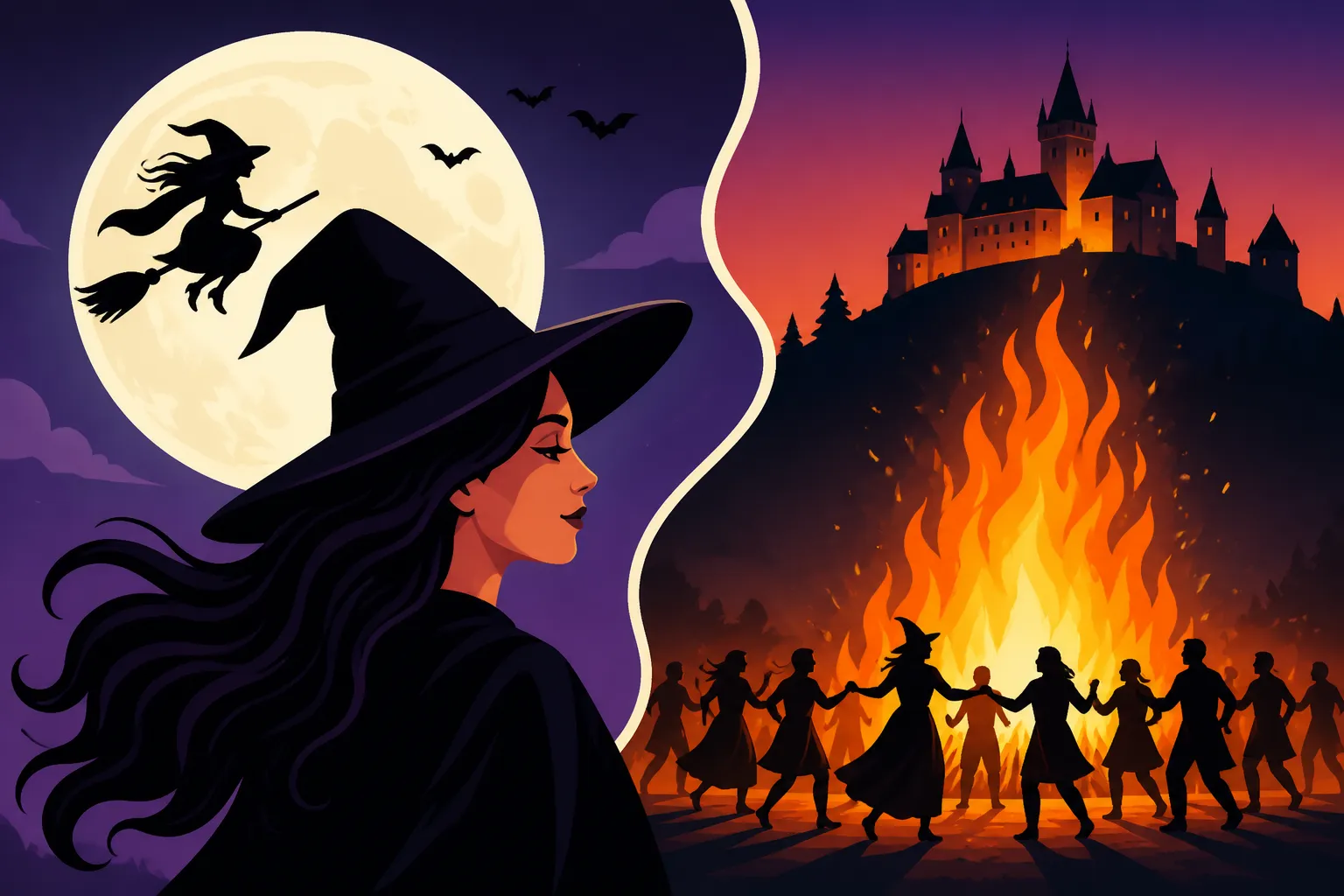
What Is Walpurgisnacht and Where Is It Celebrated?
If you find yourself in Germany on the night of April 30th, you might be startled to see locals dressed as witches, massive bonfires lighting up the countryside, and a sudden, festive madness taking over otherwise quiet villages. This guide explains the history and locations of Walpurgisnacht, helping you navigate this mystical transition from winter to spring without missing the best celebrations.
Disclosure: This post may contain affiliate links. We may earn a commission at no extra cost to you if you make a purchase through these links. Read full disclosure.
The Roots of Walpurgisnacht: From Saints to Sorcery
When you first hear the name Walpurgisnacht, it sounds like something straight out of a dark fairytale. To understand why Germans spend the last night of April dancing around fires, you have to peel back layers of history that blend Christian hagiography with ancient Germanic paganism. It is a confusing mix that often leaves newcomers scratching their heads, especially when they see a saint's name attached to a night of "witchcraft."
Saint Walpurga and the Christian Shield
The name actually comes from Saint Walpurga, an 8th-century English missionary who traveled to Germany to help Christianize the local tribes. She was canonized on May 1st, and historically, her feast day was used by the church to ward off the "evil" influences of pagan spring rituals. In the medieval mind, calling upon Saint Walpurga was a way to protect oneself from the dark spirits and witches thought to be most active during the seasonal transition.
For the modern expat, it is fascinating to see how the name stuck while the "witchy" elements she was supposed to suppress became the main attraction. When you look at the wider scope of Festivals, Holidays, and Traditions in Germany, Walpurgisnacht stands out as one of the most visible examples of pre-Christian customs surviving under a thin veil of church naming.
Ancient Pagan Origins and Beltane
Long before Saint Walpurga set foot in Bavaria or Thuringia, the Germanic people celebrated the arrival of spring with the festival of Beltane or similar seasonal markers. This was a time to drive away the "cold spirits" of winter and welcome the fertility of the coming sun. Bonfires were lit not just for warmth, but for purification; cattle were driven through the smoke to prevent disease, and couples jumped over the embers to ensure luck in marriage.
If you are Visiting Germany in Spring: Festivals and Long Days, understanding this pagan undercurrent adds a layer of depth to the experience. You aren't just at a party; you are witnessing a thousand-year-old "spring cleaning" of the spirit. The bonfires you see today in rural Brandenburg or the Harz are direct descendants of these ancient protection rituals.
Goethe and the Literary Explosion
The reason Walpurgisnacht is so famous today—and why the Harz Mountains became its Ground Zero—is largely due to Johann Wolfgang von Goethe. In his masterpiece Faust, he depicts Mephistopheles taking Faust to the summit of the Brocken mountain to witness a wild, chaotic witches' Sabbath. This literary depiction cemented the “Brocken” (the highest peak in Northern Germany) as the legendary meeting place for every witch in Europe.
Once Goethe’s work became a staple of German culture, the locals in the Harz region realized they had a tourism goldmine on their hands. What was once a localized folk belief transformed into a massive cultural phenomenon. Today, you can find the influence of Faust in every souvenir shop from Wernigerode to Thale.
The Harz Mountains: The Heart of the Witching Hour
If you want the "real" Walpurgisnacht experience, you have to leave the big cities and head to the Harz region. This mountain range, straddling the borders of Saxony-Anhalt, Lower Saxony, and Thuringia, turns into a theatrical landscape of mist, masks, and mountains. I remember my first trip there; the atmosphere was so thick with fog and woodsmoke that it felt like stepping back into the 1600s.
Thale and the Hexentanzplatz
The town of Thale is home to the Hexentanzplatz (Witches' Dance Floor), a high plateau overlooking the Bode Gorge. This is perhaps the most famous site for the celebration. Thousands of people gather here, many in elaborate costumes with prosthetic noses, capes, and broomsticks. There are stage shows, live heavy metal or folk music, and a climax involving a massive bonfire and fireworks.
Navigating the rail network to reach these remote mountain towns is key, so check our guide on Getting Around Germany: Trains, Buses, Flights, and Car Hire to plan your journey. Thale can be reached via regional trains, but it gets incredibly crowded on the 30th. Many visitors use platforms like Omio to compare whether a bus or a regional train is faster when the main lines are packed.
Wernigerode and Goslar: Medieval Backdrops
If Thale feels a bit too much like a theme park, the towns of Wernigerode and Goslar offer a more picturesque, historical vibe. Wernigerode, with its stunning castle overlooking the town, hosts a "Witches' Market" and various events in the town square. Goslar, a UNESCO World Heritage site, uses its medieval architecture to create an eerie, authentic feel for the night’s festivities.
In these towns, the celebration is less about one giant stage and more about the "Kiez" (neighborhood) feel. You’ll find smaller fires in backyards and local taverns serving Maibowle (a sweet punch made with woodruff). Using Booking.com to secure a half-timbered guesthouse months in advance is essential here, as these towns sell out completely for the "Hexennacht" weekend.
The Brocken: Hiking to the Peak
For the truly adventurous (and those with warm gear), some people still hike the Brocken on Walpurgis night. It is a steep climb, and the weather at the top is notoriously unpredictable. Legend says the witches congregate here because the "Brocken Spectre"—a strange optical illusion caused by shadows on the mist—frightened hikers for centuries.
If you decide to do the hike, be prepared for mud and wind. While there is a narrow-gauge steam train that goes to the top, it operates on a restricted schedule during the festivities. Most people prefer to stay in the valleys where the food and warmth are, but standing on the summit where Mephistopheles allegedly stood is a bucket-list item for many literature nerds.
Urban Celebrations: Berlin and the "Tanz in den Mai"
Not everyone can make it to the mountains. If you are stuck in a major city like Berlin, Hamburg, or Munich, the celebration shifts from folklore to what is known as Tanz in den Mai (Dancing into May). This is a much more modern, club-oriented version of the holiday, though it still carries the spirit of staying up until the sun rises on May 1st.
Berlin’s Mauerpark and Kreuzberg
In Berlin, the night of April 30th is a double-edged sword. On one hand, you have the beautiful bonfires in Mauerpark, where fire-twirlers and drummers gather to welcome the spring. If you’re coming from the capital, look into Best Day Trips From Berlin to see if you can escape the city, but if you stay, the Mauerpark fire is a sight to behold.
On the other hand, Berlin’s Kreuzberg district has a history of political demonstrations on May 1st (Labor Day). The night of the 30th often serves as a "warm-up" for these events. While it has become much more peaceful and festival-like in recent years (known as MyFest), it is a far cry from the witches and broomsticks of the Harz. It is an urban, gritty, and high-energy way to spend the night.
The Club Scene and e-Tickets
For the younger crowd, Tanz in den Mai just means the clubs are open late and have special lineups. From the techno cathedrals of Berlin to the posh clubs of Düsseldorf, everyone throws a "May Dance" party. These events are highly popular, and waiting until the last minute to find a ticket is a mistake.
I usually recommend checking GetYourGuide or local event apps to see if there are any themed "Ghost Walks" or night tours available in the city before the clubbing starts. Even in the wildest parties, German Social Etiquette for Visitors: Greetings and Punctuality still matters; if you have a table reservation for a May dinner, don't be late just because it's the "night of the witches."
May Day: The Morning After
It is important to remember that May 1st is a major public holiday in Germany. This means the transition from Walpurgisnacht into the morning of the 1st results in a total shutdown of shops and services. Remember that May 1st is a public holiday, which means Quiet Hours and Sundays in Germany (Ruhezeit) rules usually apply in residential areas, even if you’ve been up all night dancing.
The "morning after" is usually spent at a Frühschoppen (an early morning beer or social gathering) or watching the local community raise the Maypole. It is a stark contrast: the chaotic, fire-lit night followed by a very orderly, traditional morning of community brass bands and sausages.
Rural Traditions: The Maibaum and May Fires
In the countryside, particularly in rural Brandenburg, Hesse, and parts of Bavaria, Walpurgisnacht is celebrated with the Maifeuer (May Fire). These aren't the commercial events you find in Thale; these are community-run bonfires where the whole village gathers to drink beer and watch the flames.
Raising the Maibaum
The centerpiece of many German towns on May 1st is the Maibaum (Maypole). In the weeks leading up to Walpurgisnacht, the local "Burschenverein" (young men’s club) will prepare a massive tree trunk, stripping its bark and decorating it with ribbons and emblems of local guilds. If you miss the northern celebrations, you can find different vibes in Bavaria for Travelers: Munich, the Alps, and Beyond, where the Maypole traditions are particularly strong.
A fun, albeit stressful, tradition is "Maypole Stealing." Rival villages will try to sneak into the town on the night of April 30th to steal the pole before it can be raised. If they succeed, the home village has to buy it back with a ransom of beer and food. This leads to the "Maibaumwache" (Maypole Watch), where locals stay up all night guarding their tree—usually while consuming a fair amount of liquid courage.
The Maifeuer Ritual
The fire itself is meant to burn away the last remnants of winter. In many villages, it is a point of pride to have the largest fire in the district. Families bring old wood (and sometimes, unfortunately, old furniture) to add to the pile. As a visitor, you are usually welcome to join, but keep some euros on hand because, as explained in Money for Travel in Germany: Cash, Cards, and ATMs, these local outdoor events almost never take credit cards.
The atmosphere is incredibly "gemütlich" (cozy/sociable). You’ll see teenagers huddled together, older couples sharing a thermos of coffee or wine, and children running around with glow sticks. It feels like a true community milestone, marking the point where you can finally stop wearing your heavy winter coat—even if the German weather usually tries to prove you wrong a week later.
"Maisprung": Jumping into Spring
A lesser-known tradition is the Maisprung (May Jump). In some regions, small fires are built, and once the flames have died down to a manageable size, young couples hold hands and jump over the embers together. This is said to bring luck and fertility. While I wouldn't recommend trying this in your favorite sneakers, it is a beautiful thing to watch from the sidelines.
| Location | Vibe | Key Feature | Best For |
|---|---|---|---|
| Thale | Theatrical & Crowded | Hexentanzplatz stage | Costumes & Big Shows |
| Goslar | Historic & Eerie | Medieval architecture | Photographers & History Fans |
| Berlin | Urban & Gritty | Mauerpark bonfires | Expats & Partygoers |
| Bavaria | Traditional & Folk | Maibaum (Maypole) | Families & Culture Seekers |
| Wernigerode | Magical & Quaint | Castle & Town Markets | Romantic Weekend |
Practical Tips for Surviving Walpurgis Night
Participating in Walpurgisnacht is an absolute blast, but it can be overwhelming if you aren't prepared for the logistics of a German mass event. From the biting cold of the mountains to the scarcity of hotel rooms, a little planning goes a long way.
Dressing for the Occasion
Even if the sun is shining during the day on April 30th, the temperature in the Harz Mountains or the rural plains will plummet as soon as the sun goes down. Germans have a saying: "There is no bad weather, only bad clothing."
- Layers: Wear thermal underwear if you’re heading to the mountains.
- Sturdy Boots: You will likely be standing in mud or on uneven forest floors.
- Costumes: If you’re going to Thale, go all out. Buy a witch’s hat or some face paint. You’ll feel more out of place without a costume than with one.
Booking and Transport
As mentioned, this is one of the busiest weekends for domestic travel in Germany. If you’re using Booking.com, filter for "free cancellation" just in case your plans change, but try to book at least 3-4 months in advance. For transport, the DB Navigator app is your best friend, but also keep Omio handy to see if a private bus might be a better alternative to the overcrowded regional trains.
Be aware that many roads in the Harz are closed to private vehicles on the night of the 30th to make way for shuttle buses. Don't expect to drive your car right up to the Hexentanzplatz. You will likely need to park in the valley and take a designated bus or a cable car (which is a spectacular ride in the dark!).
Safety and Etiquette
While the "witches" are all in good fun, the combination of massive crowds, giant bonfires, and alcohol requires some common sense.
- Stay back from the fire: The heat from a ten-meter-high bonfire is intense and can singe hair or clothing from several meters away.
- Respect the "Ruhezeit": While the night of the 30th is loud, the morning of the 1st is for resting. Don't be "that expat" blasting music in your apartment on May Day morning.
- Cash is King: Especially at the Harz markets and rural bonfires, you won't find a card reader. Bring plenty of small bills for sausages, beer, and souvenirs.
Walpurgisnacht is more than just a party; it is a bridge between the dark, introspective German winter and the vibrant, outdoor life of summer. Whether you are dancing with "witches" on a mountain top or guarding a Maypole in a Bavarian village, you are participating in a living history that defines the German spirit of resilience and celebration.
Disclaimer
This guide is for informational purposes only. Local event schedules, traditions, and safety regulations can change yearly. Always check official municipal websites (such as those for Thale, Goslar, or Berlin) for the most up-to-date information regarding fire safety, public transport changes, and event ticketing before planning your trip.