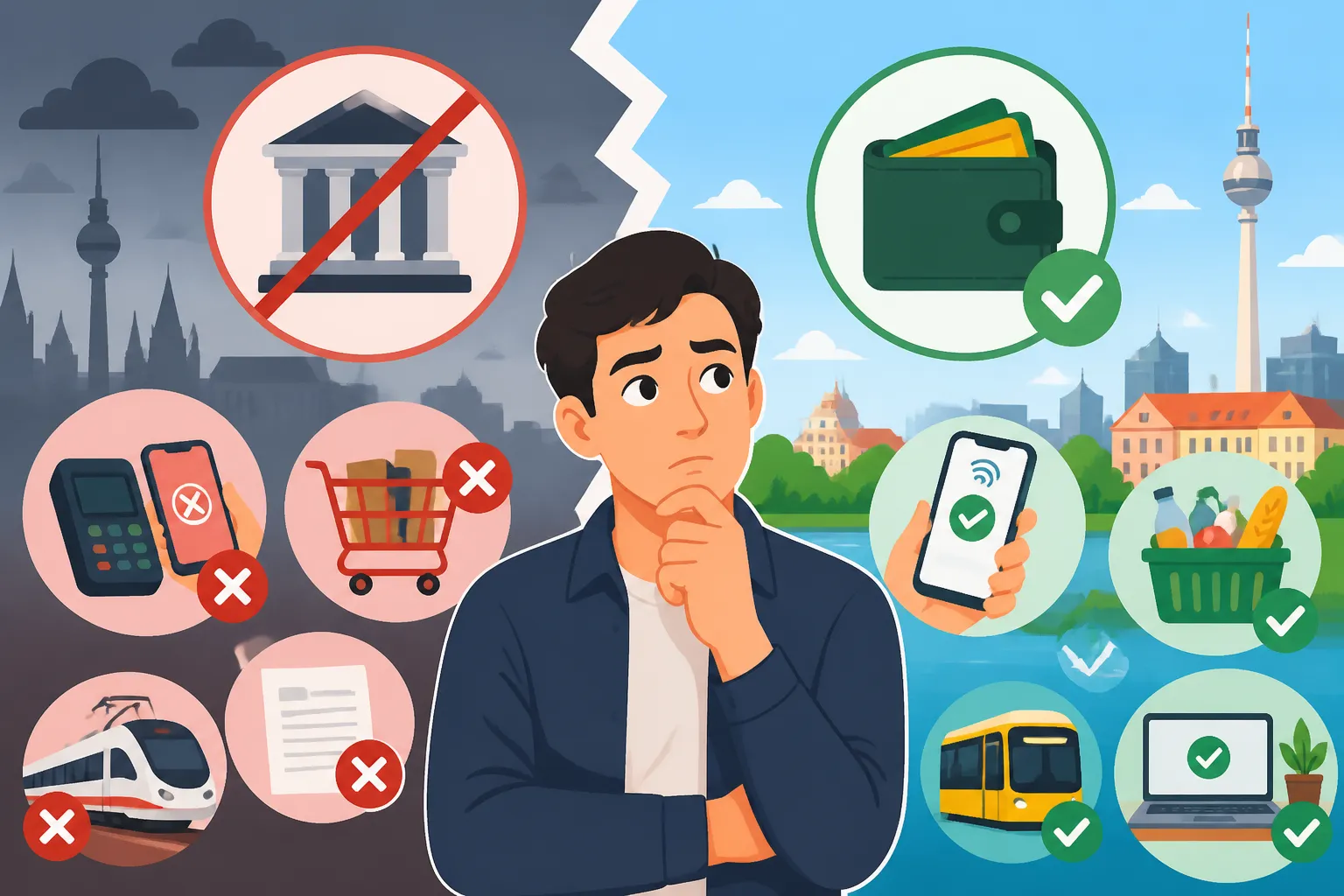
Living in Germany Without a German Bank Account: What Breaks and What Works
Ah, the age-old expat dilemma: trying to navigate life in Germany without that elusive German bank account. Many of us arrive, full of hope, thinking our trusty international bank will suffice, only to hit a wall of bureaucracy, unexpected fees, and outright rejection. This guide is here to tell you that while it's certainly a bumpy road, there are now incredibly robust solutions – like Wise – that can turn those seemingly impossible hurdles into minor speed bumps, bridging the gap more effectively than ever before.
Disclosure: This post may contain affiliate links. We may earn a commission at no extra cost to you if you make a purchase through these links. Read full disclosure.
The Harsh Reality: Why a German Bank Account is (Almost) Essential
When you first land in Germany, you quickly realize that the country, for all its modern advancements, runs on a very particular set of financial rules. And more often than not, these rules revolve around having a local German bank account. It's not just a convenience; it often feels like a prerequisite for adulting here.
Bureaucracy Demands and Rent Payments
Let's be real, German bureaucracy has a reputation, and it's well-deserved. One of the first things you'll encounter is the demand for a German bank account, specifically a German IBAN, for nearly every official transaction. Your rent, for example, is almost universally paid via bank transfer (Überweisung) or, even more commonly, through a direct debit (Lastschriftverfahren). Landlords expect a German IBAN. They set up recurring payments from German accounts, and trying to convince them to accept transfers from your exotic international bank, complete with extra fees and potential delays, is often a non-starter.
Imagine trying to secure your first apartment in Berlin. You've found a place, navigated the viewing frenzy, and now comes the contract. The landlord or property management company will hand you a form for a Lastschriftmandat, a direct debit authorization. This is where they pull the rent directly from your account each month. If your bank isn't German, this can become a significant hurdle. They might simply refuse, or it might be technically impossible for them to initiate a direct debit from a non-German account. This often leaves you scrambling to find alternative solutions, adding immense stress to an already stressful apartment hunt, as detailed in our comprehensive guide to Housing in Germany: Renting, Buying, and Finding Your Home as an Expat.
Employer Expectations and Salary Payments
Landing a job in Germany is a massive achievement, but almost immediately, your new employer will ask for your bank details for salary payments. Again, the expectation is a German bank account. While legally they might be obliged to accept an EU IBAN, in practice, it causes administrative headaches for their payroll department. Most companies, especially smaller ones, simply aren't set up to handle international transfers to non-German accounts efficiently.
From an employer's perspective, paying salaries into a German account streamlines their internal processes, reduces potential transaction fees on their end, and ensures timely payments without currency conversion issues. If you show up with only an account from outside the Eurozone, you might face delays in receiving your first paycheck or be asked to open a German account immediately. It's less about discrimination and more about operational ease. For new arrivals, understanding your German payslip means knowing where those Euros are supposed to land seamlessly.
Everyday Transactions: Cash, EC-Karte, and Limited Foreign Card Acceptance
Germany, bless its heart, is still very much a cash-oriented society, especially outside of major metropolitan areas. While larger supermarkets and department stores will usually accept Visa or Mastercard, many smaller shops, bakeries, cafes, and even some restaurants prefer cash or the ubiquitous EC-Karte (now officially Girocard). Trying to pay with a foreign credit card can lead to polite but firm refusals, or simply "Wir nehmen nur EC-Karte" (We only take EC-Karte).
This can be incredibly frustrating. You walk into a lovely local bakery, pick out your favorite Brötchen, only to find they don't accept your fancy international credit card. Or you're at the weekly market, eager to buy fresh produce, and it's cash-only. This isn't just an inconvenience; it can genuinely hinder your ability to carry out basic daily activities if you're relying solely on foreign cards. This also ties into the general Cost of Living in Germany: Budgeting Guide for Expats, where managing daily transactions efficiently is key.
Where Foreign Bank Accounts Fall Short in Germany
Relying solely on a bank account from your home country or another non-German jurisdiction, even within the EU, can quickly expose the cracks in the system. While technically many EU banks should work, the practical reality in Germany often tells a different story.
IBAN Discrimination: The Frustration of Non-German IBANs
This is perhaps one of the most maddening aspects for expats. Despite EU regulations that prohibit discrimination based on an IBAN's country of origin within the SEPA (Single Euro Payments Area) zone, it happens all the time. You might try to set up your internet contract, gym membership, or even your electricity provider, only for their online form or customer service to reject your perfectly valid Dutch, French, or Spanish IBAN. They'll demand a German one.
The reason? Often, it's outdated software systems, poorly trained staff, or a simple preference for domestic operations. While you could technically report them to the Bundesanstalt für Finanzdienstleistungsaufsicht (BaFin), the German financial supervisory authority, who has a special form for this, it's a long, arduous process. Most expats don't have the time or energy to fight every instance of IBAN discrimination. This means that even if you have a Euro-denominated account from another SEPA country, you can still face significant hurdles in setting up essential services, leaving you feeling utterly powerless. For a deeper dive, check out our guide on Understanding the German Banking System: IBAN, SEPA, and More.
High Fees and Exchange Rates for International Transfers
If your primary bank account is outside the Eurozone, every time you need to pay for something in Euros, you're likely going to get stung by unfavorable exchange rates and hefty international transfer fees. Traditional banks are notorious for their opaque pricing when it comes to currency conversion, often adding a hidden margin to the exchange rate on top of explicit transfer fees.
Let's say you're getting paid in USD or GBP into your home country account and then transferring a portion to cover your German expenses. You might think you're saving money by keeping your primary funds in your original currency, but these constant conversions chip away at your savings. Over months and years, these small fees and poor rates accumulate significantly, making your cost of living higher than it needs to be. This is where services that offer transparent, low-cost international transfers really start to shine, acting as a crucial bridge for Transferring Money Internationally: Cheapest Ways to Send Money Abroad.
Inconvenience and Limited Functionality
Beyond the fees and discrimination, simply using a foreign bank account in Germany is often an exercise in inconvenience. Some German online payment portals might not recognize foreign debit cards. You might struggle to link your foreign account to certain apps or services designed for the German market. Automated payment systems, like those for public transport tickets or parking, might only accept specific card types or require a German account for top-ups.
Furthermore, if you need to visit a bank branch for any reason, your foreign bank certainly won't have a presence in Germany. This means any issues, lost cards, or complex transactions have to be handled remotely, often across different time zones and with potentially long waits for international customer service. It all adds up to a less-than-seamless financial experience, creating unnecessary stress in your daily life.
The Rise of Fintech: How Digital Solutions Like Wise Bridge the Gap
In recent years, a new wave of financial technology (fintech) companies has emerged, specifically designed to address the very frustrations expats face. These digital-first solutions often bypass the rigid structures of traditional banking, offering flexibility, lower fees, and crucial local functionality that makes living abroad much easier. Among these, Wise (formerly TransferWise) has truly become a hero for many expats in Germany.
Introducing Wise: Your Multi-Currency Account with a German IBAN
This is where Wise truly shines as a game-changer for anyone navigating Germany without a traditional German bank account. Wise offers a multi-currency account that allows you to hold, send, and receive money in over 50 currencies, including Euros. But here's the kicker: when you set up your Euro balance, Wise provides you with local bank details for the Eurozone, including your very own German IBAN.
This is monumental because it directly tackles the dreaded IBAN discrimination. When a German landlord, utility provider, or employer asks for your German IBAN, you can provide the one from your Wise account. It looks and acts exactly like a traditional German IBAN, allowing you to set up direct debits (Lastschrift) and receive local transfers without fuss. For countless expats, this feature alone has been a lifeline, allowing them to finally secure essential services without the constant battles.
Fair Exchange Rates and Transparent Fees
One of Wise's foundational principles is transparency and fairness in international money transfers. Unlike traditional banks that often bake hidden margins into their exchange rates, Wise uses the real mid-market exchange rate – the one you see on Google. They then charge a small, upfront, and clearly stated fee for currency conversions.
This means that if you're managing money across different currencies, perhaps receiving your salary in one currency and paying expenses in Euros, you're getting the best possible value. No more guessing how much your transfer will actually cost or feeling like you're being ripped off by unfavorable rates. This commitment to transparency empowers you to manage your finances more effectively and avoid the insidious drain of hidden banking fees. It's a stark contrast to the often bewildering fee structures you might encounter with traditional international banks.
Seamless Payments and Withdrawals with the Wise Card
The Wise debit Mastercard is another indispensable tool for expat life in Germany. It works just like any other debit card, but with the added benefit of being linked to your multi-currency account. When you use your Wise card to pay in Euros, it automatically draws from your Euro balance. If you don't have enough Euros, it will seamlessly convert funds from another balance at the mid-market rate with the low fee.
This card is widely accepted wherever Mastercard is taken, making everyday purchases in larger stores and online a breeze. You can also use it to withdraw cash from ATMs across Germany. Wise offers a certain amount of free ATM withdrawals per month (check their current terms for specifics), making it a convenient way to get cash without excessive fees. It effectively puts the power of a local bank account, with transparent currency exchange, right in your wallet.
Practical Scenarios: When Wise Shines (and When You Still Need a Local Plan B)
While Wise is an absolute game-changer for expats in Germany, it's helpful to understand exactly where it excels and where you might still need to consider complementary solutions. It's about smart strategy for your financial life.
Rent, Utilities, and Subscriptions: Tackling Direct Debits
This is arguably where Wise's German IBAN provides the most profound relief. Setting up essential recurring payments for rent, electricity, gas, internet, and even mobile phone contracts often requires a German IBAN for direct debit (Lastschrift). Before Wise offered local Eurozone details, many expats with only foreign accounts found themselves in a bind, forcing them to find friends to front payments or struggle with manual transfers every month.
With a Wise Euro account, you can confidently provide your German IBAN to your landlord, utility providers like Vattenfall, E.ON, or Stadtwerke, and internet companies such as Telekom or Vodafone. They can set up the direct debit, and the payments will be automatically deducted from your Wise Euro balance. This takes away a huge chunk of administrative stress and helps you quickly settle into your new home. For more on this, our article on How to Pay Rent and Bills in Germany: Banking Tips for Expats offers relevant advice.
Receiving Your Salary: Employer Acceptance and Benefits
For many expats, getting paid into a German IBAN is crucial for convenience and often, employer preference. While an employer can legally pay into any SEPA IBAN, providing a German one (even from Wise) makes their payroll process smoother and less prone to error. With Wise, you can give your employer your German IBAN, and your salary will arrive directly into your Wise Euro account.
This streamlines your income flow, avoids potential delays or international transfer fees that might occur if your employer had to send money outside Germany or the Eurozone. It also simplifies budgeting, as your earnings are immediately in the currency you need for your daily expenses. This means fewer conversions, less tracking, and more money staying in your pocket rather than going to bank fees.
Exceptions and Local Quirks: When Traditional Banks Still Have an Edge
While Wise has dramatically closed the gap, it's important to acknowledge that no single solution is 100% perfect, especially in a country with as many unique quirks as Germany. In very rare cases, particularly with extremely old-school local landlords or very specific, niche government services, you might encounter systems that are still stubbornly resistant to anything but a traditional German bank branch account. For instance, sometimes certain legacy systems might have issues with non-traditional bank names even if the IBAN is valid.
For most modern services, Wise's German IBAN works flawlessly. However, if you plan to get a mortgage, apply for certain types of loans, or require complex financial advisory services that traditional German banks offer, you might still eventually consider opening a traditional German bank account. Services like SCHUFA, Germany's credit rating system, are deeply integrated with traditional banking. While Wise won't actively contribute to your SCHUFA score, having regular direct debits set up through Wise for utilities and rent can implicitly demonstrate financial stability. For information on building your credit, check out All About SCHUFA: Building Credit as a Foreigner in Germany.
Navigating Daily Life: Specific Transactions and Payments
Beyond the big-ticket items like rent and salary, daily life in Germany involves a myriad of smaller transactions. A German bank account—or a solution that acts like one—is invaluable for these everyday needs.
Shopping and Groceries: Card vs. Cash and Wise Card Acceptance
As we've discussed, Germany still loves cash. But for larger purchases, particularly at supermarkets like Edeka, Rewe, Lidl, or Aldi, and department stores like Galeria Kaufhof, card payments are standard. The Wise debit Mastercard is generally accepted wherever Mastercard is taken, which covers most major retailers. This means you can confidently use your Wise card for your weekly grocery shop or when buying new clothes.
However, you'll still encounter independent bakeries, small kiosks, local markets, and many cafes that are either cash-only or only accept the Girocard (EC-Karte). In these situations, you'll need physical cash. The good news is that your Wise card allows you to withdraw Euros from ATMs, so you can easily get the cash you need. Just be mindful of the free withdrawal limits Wise offers before incurring small fees. Having a mixed approach – using your Wise card for most purchases and carrying some cash for smaller, local establishments – is the most pragmatic way to handle shopping in Germany.
Online Shopping and Bill Payments: The Power of SEPA
Online shopping in Germany is booming, and payment methods often include direct debit (Lastschrift), bank transfer (Überweisung), or credit/debit card. Thanks to its German IBAN, your Wise Euro account seamlessly integrates with these options. You can use your Wise card for online purchases just as you would any other Mastercard. For recurring subscriptions or purchases from German online retailers, you can often set up a direct debit using your Wise German IBAN.
The SEPA (Single Euro Payments Area) system means that transfers between Wise's Euro accounts and any traditional German bank account are fast and free. This makes paying online bills, sending money to friends, or even paying for public services incredibly efficient. Whether it's ordering from Amazon.de, paying your Vodafone bill online, or signing up for a streaming service, Wise empowers you to manage these transactions without a hitch, giving you the same functionality as a local German bank account for most online interactions. Our guide to Internet and Mobile Phone Plans in Germany: Getting Connected Fast further details services you'll want to pay for online.
Sending Money Home and Receiving Funds from Abroad
This is where Wise started and remains an industry leader. For expats, the need to send money home, whether to family, for investments, or to maintain accounts in your home country, is constant. Traditional banks make this expensive and slow. Wise, with its transparent fees and mid-market exchange rates, makes international money transfers quick and cost-effective.
Let's say you want to send money from your Wise Euro balance to a USD account in the United States. Wise will convert it at the real exchange rate, charge a minimal fee, and the money often arrives within hours, sometimes even minutes. The same applies if you need to receive money from family or clients in other currencies into your Wise account, which you can then easily convert to Euros or hold in its original currency. This flexibility and affordability for cross-border financial activity is a core reason why Wise is such a powerful tool for the global expat.
Long-Term Implications and The Wise Advantage
When you're settling into a new country like Germany, you're not just thinking about getting through the next week; you're planning for months, if not years. The financial tools you choose have long-term implications for your ease of living and financial well-being.
Building Financial Footing: Managing Your Money Effectively
Having a solid financial setup is fundamental to feeling truly settled in a new country. Wise, with its German IBAN and multi-currency capabilities, allows you to establish a strong financial footing in Germany without necessarily committing to a traditional German bank from day one. It provides a stable platform for receiving income, paying bills, and managing daily expenses in Euros, making you feel financially integrated.
This ease of managing your money means less stress and more mental energy to focus on other aspects of expat life, like learning German, making friends, or excelling at your job. It's a pragmatic solution that directly addresses immediate needs while offering the flexibility to adapt as your financial situation and knowledge of the German system grow. In essence, it simplifies the daily grind, allowing you to breathe easier. For comprehensive financial advice, consider reading Money Matters in Germany: Complete Financial Guide for Expats.
Flexibility for the Mobile Expat Lifestyle
Many expats are inherently mobile. Germany might be a stepping stone, or you might travel frequently for work or pleasure. Wise is perfectly designed for this kind of lifestyle. Its multi-currency account means you can hold balances in various currencies, converting as needed, making international travel and managing finances across borders incredibly seamless.
If you move to another Eurozone country, your Wise Euro account and its associated IBAN remain perfectly valid, removing the need to open a brand-new bank account from scratch in every new location. This flexibility extends to its debit card, which works globally with transparent conversion rates. For the expat who values freedom and minimal administrative hassle across different countries, Wise offers a truly borderless banking experience.
Is it a Permanent Solution? Balancing Convenience with Full German Banking
The question often arises: can Wise completely replace a traditional German bank account? For many core functions, especially for employees and freelancers operating primarily in Euros, the answer is a resounding yes, it can act as your primary German account. It handles direct debits, receives salaries, and facilitates daily payments with ease, all with a German IBAN. For many expats, it's more than sufficient.
However, for very specific situations, a traditional German bank might still have a niche. If you need to build a substantial credit history for a large loan or mortgage (though even this is evolving), if you prefer face-to-face service, or if you encounter a truly antiquated system that only accepts specific legacy German bank details (which are increasingly rare), you might eventually consider opening a traditional account. But even then, Wise serves as an excellent, low-cost primary account that perfectly complements any future traditional banking you might undertake. It certainly makes opening a bank account in Germany: Step-by-Step for Newcomers a less urgent task upon arrival.
Here's a quick comparison of the options:
| Feature/Service | Traditional Foreign Bank Account (non-Eurozone) | Wise Multi-Currency Account (with German IBAN) | Traditional German Bank Account |
|---|---|---|---|
| German IBAN Provided? | No | Yes | Yes |
| Rent Direct Debits | Very difficult, often rejected | Yes, works for most landlords | Yes, standard |
| Salary Payments | Possible, but high fees, employer headaches | Yes, works for most employers | Yes, standard |
| Everyday Card Payments | Limited acceptance (especially EC-Karte only) | Good (Mastercard accepted widely) | Excellent (EC-Karte & Credit) |
| ATM Withdrawals | High fees, poor exchange rates | Low/free up to certain limits | Often free from own bank ATMs |
| International Transfers | High fees, poor exchange rates | Very low fees, mid-market rates | High fees, average exchange rates |
| IBAN Discrimination | High risk | Low risk (as it's a German IBAN) | No risk |
| Ease of Setup | Already exists (but inconvenient) | Fast & fully online | Requires Anmeldung & documents |
| Physical Branches | None in Germany | None | Yes |
| Credit Building (SCHUFA) | No direct impact | No direct impact (but helps pay bills reliably) | Direct impact & essential |
Wise has genuinely revolutionized how expats can manage their finances in Germany. It’s not just a workaround; for many, it's become their primary financial tool, proving that living in Germany without a traditional German bank account is not only possible but can also be surprisingly seamless and cost-effective.
Disclaimer
This article is for general informational purposes only and does not constitute professional advice. Laws, prices and regulations vary by location and change over time. Consult a qualified professional for guidance on your specific situation.