Germany’s Digital Nomad Visa: Remote Work Residency for Select Nationals
Working remotely from a Berlin cafe sounds like a dream, until you realize Germany doesn’t actually have a traditional digital nomad visa. I spent weeks spiraling down expat forums trying to figure out how to keep my US job while living in Europe. This guide breaks down the hidden legal pathways that allow select nationals to legally work remotely in Germany.
Disclosure: This post may contain affiliate links. We may earn a commission at no extra cost to you if you make a purchase through these links. Read full disclosure.
The Myth vs. Reality of a German Nomad Visa
When you see travel bloggers advertising seamless remote work across Europe, they are usually talking about countries like Spain, Portugal, or Croatia, which have launched highly marketed, dedicated digital nomad visas. Germany simply did not follow this trend, and understanding why is your first step to hacking the system.
Why There Is No “Official” Digital Nomad Visa
The German bureaucratic machine is fundamentally incompatible with the concept of a transient worker who uses local infrastructure but doesn’t pay local social security. Germany’s entire societal model is built on the Sozialstaat (social state). If you live here, you are expected to contribute to the public healthcare system, the statutory pension system, and the unemployment insurance pool.
A classic digital nomad, who earns their money abroad and pays their taxes in their home country, breaks this communal model. Therefore, the German government has actively resisted creating a visa simply called a “Digital Nomad Visa.” They fear creating a two-tiered society where wealthy foreign remote workers price locals out of housing without paying into the communal pot.
Navigating this reality requires fitting your modern, remote employment into pre-existing, rigid legal frameworks that were drafted long before the invention of Wi-Fi. To understand how these strict foundational frameworks operate generally across all immigration types, you should thoroughly read Visas and Residence Permits in Germany: Everything You Need to Know.
The Schengen Tourist Visa Trap
Many expats attempt to bypass the heavy bureaucracy entirely by utilizing the 90-day Schengen tourist visa waiver. They fly into Munich or Hamburg, rent a furnished apartment, open their laptops, and continue working for their home country employer. They assume that because their salary never touches a German bank account, their actions are perfectly legal.
This is a massive and dangerous misconception. Under German immigration law, “work” is defined by the physical location of the person performing the tasks, not the location of the corporate headquarters or the bank account receiving the funds. If your fingers are typing on a keyboard while your body is physically located within the borders of the Federal Republic of Germany, you are engaging in employment inside Germany.
Doing this on a standard tourist visa is legally classified as unauthorized employment. While it is undeniably difficult for the authorities to catch you if you are quietly working from a coworking space, the risks are astronomical. If you are discovered—perhaps through a random tax audit of your temporary housing provider or a bureaucratic cross-check after a medical emergency—you risk heavy financial fines, immediate deportation, and a multi-year ban from re-entering the entire Schengen Area.
The Hidden Pathway: Section 19c (1) and Section 26 (1)
Despite the lack of an official nomad visa, a hidden legal loophole has slowly emerged for a very specific subset of foreigners. Progressive immigration authorities in certain major cities have begun adapting their interpretation of existing laws to accommodate modern remote work. They utilize Section 19c (1) of the German Residence Act (AufenthG) in conjunction with Section 26 (1) of the Employment Regulation (BeschV).
This specific legal combination gives the authorities the discretionary power to issue a residence permit for employment to individuals who do not have a German employer. It represents a substantial, highly pragmatic shift from the traditionally restrictive approach, where a concrete connection to the German labor market was an absolute necessity for any work permit.
Under this specific interpretation, the authorities recognize that your remote work for a foreign entity has absolutely no negative impact on the local German labor market—you are not stealing a job from a local resident. However, this is not a blanket policy for everyone. It is an exclusive, highly restrictive pathway reserved for a specific list of nationalities, essentially creating a de facto digital nomad visa for a lucky few. For context on how the broader immigration rules have recently shifted to accommodate modern workers, look at Germany’s New Immigration Laws: Key Changes Explained.
Who Qualifies for Remote Work Residency?
If you want to utilize the Section 19c remote work loophole, your eligibility is entirely dictated by the passport you hold. The German system relies heavily on bilateral treaties and historical reciprocal agreements that grant preferential treatment to certain nations.
The Privileged Nationals Exemption (Section 26 BeschV)
Section 26 (1) of the Employment Regulation explicitly lists a group of “privileged nations” whose citizens are granted massive administrative advantages regarding work permits. This remote work pathway applies exclusively to citizens of the United States of America, Canada, Australia, New Zealand, Israel, Japan, the Republic of Korea, the United Kingdom of Great Britain and Northern Ireland, Andorra, Monaco, and San Marino.
If you hold a passport from one of these countries, you have a massive logistical advantage. You can apply for a residence permit that allows you to live in Germany while maintaining your foreign employment contract.
Conversely, if you hold a passport from India, Brazil, South Africa, or any country not on this highly specific list, you are entirely legally barred from utilizing this remote work interpretation. You simply cannot move to Germany to continue working remotely for your foreign employer under this clause. Instead, you must navigate entirely different, vastly more complex immigration routes designed for the self-employed.
Core Requirements for the Remote Work Permit
If you are lucky enough to hold a privileged passport, you still cannot simply show up at the immigration office and expect a residence permit to be handed to you. You must present a flawless portfolio of documents that proves your remote status and your financial independence.
The absolute foundation of your application is a rock-solid, valid employment contract with your foreign employer. This contract must clearly state your remote status, confirm that you are permitted to work from Germany, and detail your gross salary. The immigration authorities will scrutinize your foreign income to ensure it comfortably covers the notoriously high cost of living in Germany, specifically calculating your net income against German rent prices. If your salary is deemed too low to survive without claiming German welfare benefits, your application will be instantly denied.
Furthermore, you must prove that you have comprehensive health insurance that is legally recognized in Germany, and you must have a registered German residential address. The authorities want definitive proof that you are establishing a legitimate, legal base in the country, not just passing through as an extended tourist.
| Visa Feature | Remote Work Permit (Sec. 19c/26) | Standard Freelance Visa (Freiberufler) |
| Target Audience | Full-time remote employees of foreign companies | Self-employed independent contractors |
| Eligible Nationalities | Exclusively “Privileged Nations” (US, UK, CA, AU, etc.) | All non-EU nationalities |
| German Client Requirement | None required (100% foreign income allowed) | Usually requires multiple German clients |
| Tax Complexity | High (Risk of permanent establishment for employer) | Moderate (Standard German self-employment taxes) |
The Role of the Federal Employment Agency (BA)
Even though you are employed by a company based in New York, London, or Sydney, your residence permit application must still be reviewed and approved by the German Federal Employment Agency (Bundesagentur für Arbeit or BA). This step deeply confuses many applicants who wonder why a German domestic agency cares about a foreign employment contract.
The BA’s role in this specific remote pathway is to assess whether your employment conditions are fair and whether your presence harms the local economy. They will meticulously review your foreign contract to ensure that your salary meets the standard market rate for your specific profession. They want to prevent “wage dumping,” even if the wages are being paid by a foreign entity, to protect the overall integrity of the labor market.
Because this remote work interpretation is relatively new and highly nuanced, the approval from the BA is highly dependent on the discretion of the individual caseworker reviewing your file. A caseworker in tech-friendly Berlin might instantly recognize and approve a remote software engineering arrangement, while a caseworker in a rural Bavarian town might be entirely bewildered by the concept and reject it outright.
Alternative Pathway: The Freelance Visa (Freiberufler)
If you do not hold a passport from a privileged nation, or if you are an independent contractor rather than a full-time salaried employee, the remote work loophole is closed to you. Your primary option for living in Germany while working independently is the Freelance Visa.
What Qualifies as a “Liberal Profession”?
The German legal system rigidly separates self-employed individuals into two distinct categories: Freelancers (Freiberufler) and Commercial Business Owners (Gewerbetreibende). To qualify for the easier freelance visa, your profession must be legally recognized by the tax office as a “liberal profession.”
This category generally includes highly educated, independent professionals whose work relies on personal intellectual capital. Writers, artists, doctors, language teachers, independent software developers, and specialized management consultants typically fall into the Freiberufler category.
If you are a remote worker who runs an e-commerce store, engages in dropshipping, or sells physical goods online, you are not a freelancer; you are a commercial business owner. Commercial businesses require a vastly more complex Entrepreneur Visa, which demands comprehensive business plans, proof of massive capital investment, and the potential to create local German jobs. Misclassifying your remote work will lead to immediate visa rejection and tax penalties. To understand this deep bureaucratic divide, carefully study Freelance Visa in Germany: How to Work as a Self-Employed Professional.
The “German Client” Requirement
The absolute biggest hurdle of the German Freelance Visa is the requirement to prove a “local economic interest” in your work. Unlike true digital nomad visas in other countries that happily accept applicants earning 100% of their income from foreign sources, the German authorities generally demand that your freelance work benefits the domestic German economy directly.
In practice, this means you usually cannot secure a standard German freelance visa if all of your clients are located in the United States, India, or the UK. You must provide letters of intent or signed freelance contracts from at least two prospective clients based inside Germany. The immigration office wants to see that German companies actively intend to hire you and utilize your specialized services.
There is a massive, widely known exception to this rule: the city of Berlin. Because Berlin actively courts international creatives and tech talent, the immigration office there is famous for occasionally waiving the strict German client requirement for certain artists, journalists, and highly specialized IT consultants, granting the visa even if the bulk of their clientele is abroad. However, this is an unwritten local policy, not a federal law, and banking your entire relocation strategy on the mood of a Berlin caseworker is incredibly risky.
Financial and Pension Prerequisites
When you apply as a freelancer, you do not have a steady, guaranteed monthly salary from a corporate employer to rely on. Therefore, the authorities require absolute proof that you can generate enough consistent revenue to survive. You must submit a meticulous financial forecasting plan, a comprehensive portfolio of your past freelance work, and bank statements showing a substantial financial runway.
Furthermore, there is a massive administrative hurdle for older remote workers. If you are over the age of 45 and applying for a freelance visa for the very first time, you must provide definitive proof of an adequate pension plan. The government wants absolute assurance that you will not become a financial burden on the German state when you eventually retire.
You must prove that you have either accumulated massive personal assets (often exceeding €200,000) or that you have a private pension policy guaranteeing a substantial monthly payout upon reaching the German retirement age of 67. Proving foreign pension savings is a complex legal nightmare, requiring certified translations from Lingoking to convince the caseworkers of your financial security.
The Tax and Social Security Nightmare
Living in Germany while working remotely sounds idyllic until the first tax bill arrives. The financial mechanics of remote work are incredibly complex, and ignoring them will lead to devastating financial penalties.
Establishing Tax Residency in Germany
The most dangerous trap for remote workers in Germany is completely ignoring the tax implications of their physical presence. Whether you are on the privileged remote work visa or a freelance permit, if you live in Germany for more than six months (specifically, 183 days) within any 12-month period, you automatically become a German tax resident.
Becoming a German tax resident means that your worldwide income becomes subject to German income taxation. Germany has one of the highest tax burdens in the world, with progressive income tax rates reaching up to 45%. You cannot simply tell the German tax office (Finanzamt) that your employer is in the US and that they are already deducting American taxes from your paycheck.
While Germany has double taxation treaties with many countries to prevent you from being taxed twice on the exact same income, navigating these treaties is incredibly complex. You must file tax returns in both countries, claiming foreign tax credits. Attempting to manage this cross-border taxation without hiring a certified, bilingual German tax advisor (Steuerberater) is financial suicide. You will likely need to use Lingoking to translate your foreign tax documents accurately for the German authorities.
Navigating Mandatory Health Insurance
You cannot legally reside in Germany without comprehensive health insurance. The German immigration office will absolutely not accept cheap, generic travel insurance or standard “digital nomad” emergency medical policies that you purchased online. Your insurance must meet the strict, comprehensive criteria set by the Federal Financial Supervisory Authority (BaFin).
Because remote workers and newly arrived freelancers do not have a domestic German employer to automatically split the high costs of the statutory public health insurance system, they are often entirely blocked from entering the public system upon arrival. You will almost certainly be forced into the private health insurance market (Private Krankenversicherung).
Navigating the private market alone is dangerous, as picking a non-compliant policy will result in instant visa rejection at the immigration office. Utilizing an English-first, specialized expat broker like Feather Insurance is absolutely critical here. They specifically tailor private health insurance packages for freelancers and remote workers, ensuring the paperwork you hand to the immigration officer is flawlessly compliant.
The Employer of Record (EoR) Workaround
If you are a salaried employee of a foreign company, your physical presence in Germany creates a massive, hidden legal risk for your employer, known as “Permanent Establishment risk.” If you are negotiating contracts, writing code, or generating revenue from your Berlin apartment, the German tax authorities might decide that your apartment is a de facto branch of the foreign company. This legally subjects the entire foreign corporation to German corporate taxes.
To avoid this corporate nightmare, and to completely sidestep the highly discretionary remote work visa pathway, many remote workers convince their employers to use an Employer of Record (EoR). An EoR is a German company that officially hires you on paper, puts you on a compliant German payroll, deducts German income taxes, and pays your German social security contributions, while you continue to do your daily tasks for your original foreign company.
By using an EoR, your immigration status changes completely and beautifully. You are no longer a risky “remote worker for a foreign entity.” You are now a standard, fully compliant employee of a German company. This allows you to apply for a standard work visa or even the premium EU Blue Card, drastically simplifying your path to permanent residency. You can even use Feather Insurance in this scenario to smoothly transition into the highly desirable public health insurance system.
Step-by-Step Application Process
Getting your documents together is only half the battle. The physical administrative execution of moving to Germany requires meticulous organization and extreme patience with municipal bureaucrats.
Entering Germany and the Anmeldung
If you are utilizing the privileged national remote work pathway, your journey begins with your visa-free entry. Citizens of the US, Canada, Australia, and the UK can fly directly into Germany and remain legally as tourists for 90 days. However, the ticking clock starts the exact moment you clear passport control. You have exactly 90 days to gather your documents and apply for your remote work residence permit.
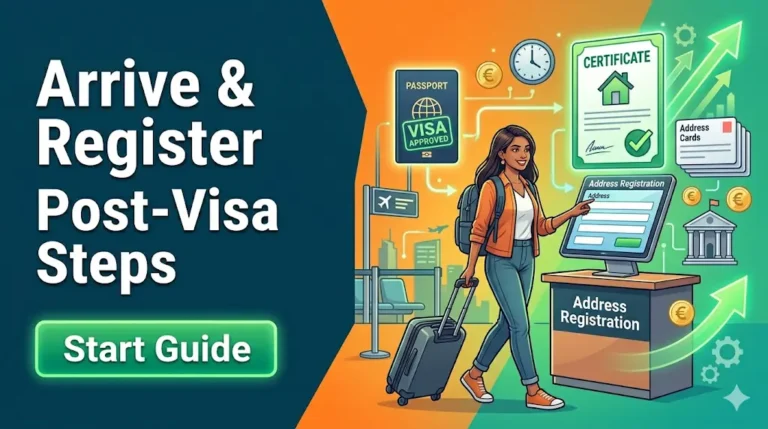
Before you can even speak to the immigration office, you must complete the Anmeldung. This is the legally mandatory process of registering your residential address at the local citizens’ office within 14 days of moving in. You cannot use a hotel or a casual Airbnb for this; you need a specific confirmation document from a landlord (Wohnungsgeberbestätigung).
Because finding a permanent German apartment without a German credit score or a pre-existing visa is nearly impossible, almost all incoming remote workers survive this phase by booking specialized, temporary furnished housing that explicitly permits address registration. Once registered, you can finally use a service like Expatrio to easily open a basic German current account to handle your daily expenses.
Booking the Ausländerbehörde Appointment
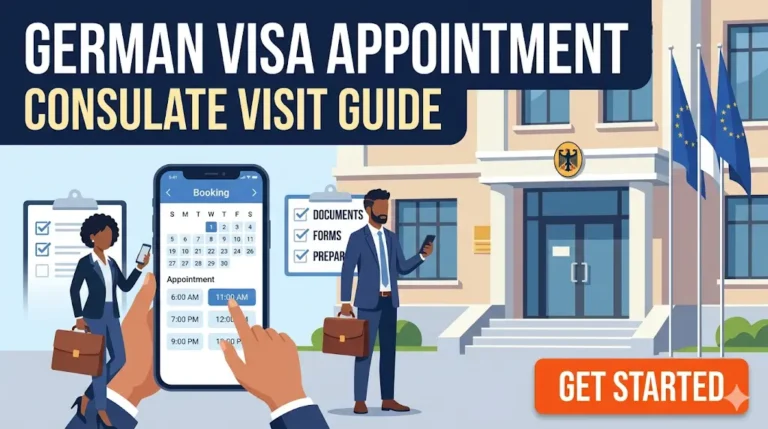
Once your address is registered, you must secure an appointment (Termin) at the local Foreigners’ Office (Ausländerbehörde). In major hubs favored by remote workers, like Berlin, Munich, or Leipzig, these offices are catastrophically overwhelmed. Finding an available appointment slot often requires checking their online portals at 6:00 AM every single morning for weeks.
When you finally secure an appointment, your documentation must be utterly flawless. You must bring your passport, your detailed remote work contract, your health insurance certificate, and comprehensive bank statements. Crucially, any foreign documents must be formally translated into German by a sworn translator before the caseworker will accept them.
The authorities will not accept translations done by you or a generic online agency. They demand absolute legal accuracy. Utilizing a specialized service like Lingoking connects you directly with certified professionals, ensuring your documents carry the exact legal stamps required to prevent administrative rejection.
Managing Financial Proofs and Escrow Accounts
Depending on the specific caseworker reviewing your file, they may demand absolute proof that you possess a substantial financial buffer. This is incredibly common if you are applying via the freelance route rather than the salaried remote work route. They want to ensure that if your clients suddenly drop you, you will not end up homeless on the streets of Germany.
While bank statements showing a large balance are sometimes accepted, strict caseworkers often require these funds to be securely locked in a German Blocked Account (Sperrkonto). This escrow account locks your lump sum and only releases a predetermined maximum monthly allowance to your regular checking account, mathematically guaranteeing that your savings will last for an entire year.
Setting up this specialized account through a traditional brick-and-mortar German bank is incredibly frustrating and paper-heavy. Using a certified digital financial provider like Expatrio allows you to open a government-approved blocked account entirely online within days, instantly generating the exact PDF confirmation document the immigration office demands to finalize your visa approval.
References
Primary sources (official)
- Federal Office for Migration and Refugees (BAMF) – Working in Germany: https://www.bamf.de/EN/Themen/MigrationAufenthalt/ZuwandererDrittstaaten/Arbeit/arbeit-node.html
- Make it in Germany – Visa for self-employment: https://www.make-it-in-germany.com/en/visa-residence/types/self-employment
Other helpful sources
- IHK Berlin – Information for Freelancers and Self-Employed: https://www.ihk.de/berlin/en
Disclaimer
This guide is for informational purposes only and does not constitute formal legal, tax, or immigration advice. German immigration interpretations regarding remote work, tax obligations, and municipal processing requirements change frequently and rely heavily on the discretion of local caseworkers. Always consult the official websites of the Federal Office for Migration and Refugees (BAMF), a certified German tax advisor (Steuerberater), or seek professional counsel from a certified German immigration lawyer before making binding relocation decisions or submitting formal visa applications.