Opportunity Card (Chancenkarte): Germany’s Points-Based Job-Seeker Visa Explained
Securing job interviews from thousands of miles away is nearly impossible when German employers demand you start next month. I remember sending out fifty resumes and getting universally rejected simply because I wasn’t already living in Berlin. This guide breaks down the revolutionary Opportunity Card, explaining how to calculate your points, secure your visa, and finally hunt for jobs locally.
Disclosure: This post may contain affiliate links. We may earn a commission at no extra cost to you if you make a purchase through these links. Read full disclosure.
Understanding the German Opportunity Card
For decades, the German immigration system operated on a frustratingly simple premise: you could not move to the country unless you already had a binding job offer in hand. This created a massive catch-22 for ambitious professionals worldwide. Finding a job required being in Germany for in-person interviews and trial days, but being in Germany required having the job first. The Opportunity Card is the government’s long-overdue solution to this exact administrative nightmare.
The Shift from the Restrictive Old System
If you are just beginning your research, you might have read horror stories on expat forums about the old “Job Seeker Visa.” I know several brilliant engineers who tried to use that old visa, and it was a bureaucratic disaster. The old system required you to have a university degree that perfectly, identically matched the specific job you were seeking. Furthermore, it strictly prohibited any form of part-time work or side hustles. You were expected to move to one of the most expensive countries in Europe and bleed your savings dry while waiting for a corporate job offer.
The introduction of the Opportunity Card fundamentally dismantles that outdated framework. The German government finally looked at modern immigration models used in countries like Canada and Australia and realized that rigid qualification matching was starving their economy of talent. By passing this new legislation, they acknowledged that a marketing professional might have a degree in history, and an IT specialist might be entirely self-taught.
This ideological shift means that the local immigration offices are now legally instructed to look at your holistic potential rather than just your paper credentials. It is a monumental change for international workers, taking the pressure off the initial entry phase. If you want to understand the broader context of how this specific visa fits into the overall national strategy, you should review our breakdown of Germany’s New Immigration Laws: Key Changes Explained.
Who the Program is Genuinely Designed For
The Opportunity Card is specifically engineered for non-EU nationals who possess valuable skills but lack the localized network required to secure a European job contract from their home country. It is essentially a twelve-month golden ticket to enter the German labor market, attend networking events, conduct in-person interviews, and prove your worth to local hiring managers.
It is heavily utilized by professionals from countries like India, the United States, Brazil, and the UK who want to transition their careers to the European Union but keep hitting a wall with remote applications. German employers are notoriously risk-averse. They hesitate to hire someone living six time zones away because they fear the applicant’s visa might be rejected, delaying the start date by months. When you hold this card, you eliminate that corporate fear. You can legally look a hiring manager in the eye and say, “I am already here, my visa is secured, and I can start next week.”
However, this is not a visa for casual backpackers or unskilled laborers hoping to find random work. The German state is incredibly protective of its social welfare system. The Opportunity Card is a calculated tool designed to import taxable, highly skilled labor to combat their severe demographic aging crisis. You must prove you belong in that highly skilled category before you ever board your flight.
The Fundamental Entry Prerequisites
Before you even begin calculating your points, you must clear the fundamental entry gateways. If you fail these basic requirements, the embassy will reject your application immediately, regardless of how many points you think you have accumulated.
First, you must possess either a university degree or a vocational training qualification that required at least two years of study. Crucially, this qualification must be fully recognized by the state in the country where you obtained it. The German authorities will verify the legitimacy of your home country’s educational institution. To prove your educational background, you cannot submit documents in Spanish or Hindi as they are. You must provide formal, legally binding German translations. Utilizing a certified service like Lingoking ensures your foreign diplomas and transcripts are translated by sworn professionals recognized by the German courts, preventing instant rejection at the embassy desk.
Second, you must prove basic language proficiency. You do not need to be fluent, but you must demonstrate either A1-level German skills or B2-level English skills. This is a massive concession, as previously, almost all job-seeker pathways required intermediate German. If you are relying on the B2 English requirement, you must provide a globally recognized certificate like IELTS or TOEFL; a letter from your university stating your courses were taught in English is often heavily scrutinized and sometimes rejected by strict consular officers.
Decoding the Points System Criteria
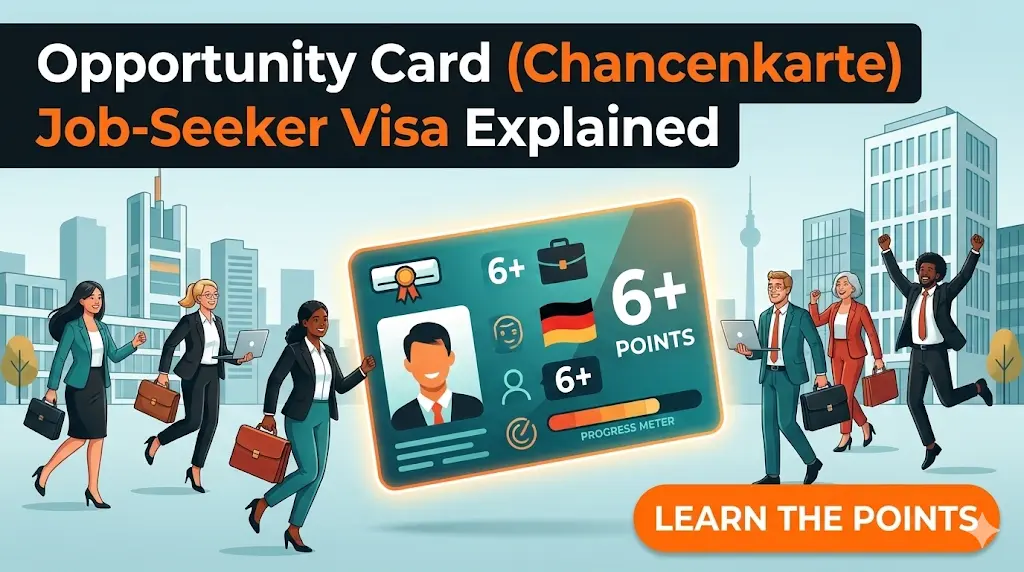
If your foreign degree is fully recognized in Germany via the Anabin database, you actually bypass the points system entirely and qualify for the card automatically. However, if your degree is only partially recognized, or if you hold a vocational qualification, you must navigate the points matrix. You need to score a minimum of six points to secure the visa.
Points for Qualifications and Professional Experience
The German government places a massive premium on formalized education and proven track records. If your foreign vocational qualification or academic degree has undergone the formal recognition process in Germany and been deemed “partially equivalent,” you are instantly awarded four points. This puts you incredibly close to the six-point finish line right out of the gate.
If your qualification involves an occupation that the German government has officially designated as a “bottleneck profession” (shortage occupation), you earn an additional point. These bottleneck professions include fields like human medicine, nursing, IT, engineering, and early childhood education. Germany is desperate for these workers, and the points system heavily rewards applicants who can fill these specific demographic gaps.
Professional experience is your next major point-earner. The authorities want workers who can hit the ground running without needing years of corporate hand-holding. If you can prove you have at least five years of continuous, relevant professional experience in your field within the last seven years, you are awarded three points. If you have at least two years of experience within the last five years, you earn two points. You must provide official letters of recommendation and detailed employment contracts from your past employers to claim these points; a simple resume will not suffice.
Language Proficiency and Age Brackets
While B2 English or A1 German gets you in the door, higher language proficiency acts as a massive point multiplier. The system aggressively incentivizes applicants who have made the effort to learn the local language, as it virtually guarantees faster societal integration.
If you possess an A2-level German certificate, you earn one point. A B1-level German certificate earns you two points, and a B2-level German certificate grants you a massive three points. Conversely, if you rely entirely on English, possessing a C1-level English certificate (which is near-native fluency) only earns you one single point. The message from the government is clear: English is acceptable, but German is highly rewarded.
Age is the final critical factor, and it is entirely outside your control. Germany wants young taxpayers who will contribute to the national pension scheme for decades before retiring. If you are under the age of 35 at the time of your application, you are awarded two points. If you are between the ages of 35 and 40, you earn one point. If you are over the age of 40, you receive zero age-related points and must compensate by scoring heavily in experience and language categories.
Previous Ties to Germany and Spousal Benefits
The final categories offer alternative ways to scrape together your required six points if you are falling short on language or experience. If you have previously lived in Germany for an uninterrupted period of at least six months within the last five years, you earn one point.
However, there is a strict legal caveat here: time spent in Germany on a Schengen tourist visa does not count. You must have lived there legally under a long-term residence permit, such as a student visa, an internship visa, or a previous work assignment. You will need to provide your old German address registration certificates and old visa stamps to prove this historical residency.
Finally, the system encourages highly skilled couples to migrate together. If your spouse or registered civil partner also meets all the basic prerequisites for the Opportunity Card and you apply at the exact same time, you can be awarded one extra point through your partner’s qualifications.
| Scoring Category | Criteria | Points Awarded |
| Qualification | Partial recognition of foreign qualification | 4 Points |
| Experience | 5 years relevant experience (last 7 years) | 3 Points |
| Experience | 2 years relevant experience (last 5 years) | 2 Points |
| Language (German) | B2 Level | 3 Points |
| Language (German) | B1 Level | 2 Points |
| Language (English) | C1 Level | 1 Point |
| Age | Under 35 years old | 2 Points |
| Previous Stay | Lived in Germany legally for 6+ months | 1 Point |
The Financial Hurdle of Escrow Accounts
Scoring six points is only half the battle. The single most common reason Opportunity Card applications are rejected at the embassy level is the failure to properly prove financial stability. Moving to Europe without a job is an expensive endeavor, and the government refuses to subsidize your job hunt.
Why the Government Demands Minimum Funds
When you apply for this visa, the German state assumes the worst-case scenario: that you will take the full twelve months to find a job. Because you are not legally permitted to claim unemployment benefits, housing subsidies, or any form of state welfare while holding the Opportunity Card, you must prove you have the liquid cash to survive.
Currently, the government calculates the absolute minimum survival threshold at roughly €1,027 per month. Therefore, to secure a twelve-month visa, you must prove you have access to a lump sum of over €12,300. You cannot simply walk into the embassy with a printout of your local savings account from India, the US, or Brazil. The consular officers will reject foreign bank statements immediately, as those funds can be easily withdrawn or manipulated the day after the visa interview.
To deeply understand why the government is so strict about this financial baseline across all visa types, including study permits, you should review our comprehensive guide on Visas and Residence Permits in Germany: Everything You Need to Know.
Setting Up Your Blocked Account from Abroad
To satisfy the financial requirement securely, you must transfer your €12,300 into a highly specialized German escrow account known as a Sperrkonto (Blocked Account).
Once your money arrives in Germany, it is legally “blocked.” You cannot access the lump sum. The bank issues a formal PDF confirmation certificate, and this specific, highly regulated document is the only financial proof the embassy will accept. After you physically arrive in Germany and open a local checking account, the blocked account will slowly release your funds to you, strictly limiting your withdrawals to the €1,027 maximum monthly allowance so that your money lasts the entire year.
Attempting to set up this account through traditional brick-and-mortar German banks from abroad is a nightmare of mailing physical, notarized documents. Utilizing a certified digital financial provider like Expatrio is absolutely essential here. They allow you to open a government-approved blocked account entirely online within 24 hours, handling the complex international currency transfers safely and instantly generating the exact documents your embassy interviewer demands. For a detailed walkthrough of this exact financial mechanism, read our guide on the Student Visa Blocked Account Sperrkonto: What It Is and How to Set It Up.
Navigating Mandatory Health Insurance
You absolutely cannot receive a German visa without proving you have comprehensive health insurance. The German healthcare system is excellent, but it is strictly regulated and heavily privatized in areas. If you walk into the embassy without the correct insurance certificates, your Opportunity Card application will be halted.
Because you are arriving without an employer to split your public health insurance premiums, navigating your coverage options is complex. You will need a specialized incoming travel insurance policy to cover your first few weeks, followed by a robust expat health insurance policy to cover you while you hunt for jobs.
Using an English-first, digital insurance broker like Feather Insurance completely eliminates the stress of translating complex medical policies. They specifically tailor insurance packages for Opportunity Card holders, ensuring your policy meets the strict federal requirements demanded by the immigration office.
Working Rights During Your Job Hunt
The most revolutionary aspect of the Opportunity Card is not just that it gets you into the country; it is the unprecedented legal working rights it grants you while you are searching for your dream career.
Surviving on the Part Time Work Allowance
Under the old, draconian job-seeker visa, you were strictly forbidden from working a single hour. If you ran out of savings in month four, you had to pack your bags and leave. The Opportunity Card completely changes this dynamic by legally permitting you to work up to 20 hours per week in any secondary employment.
This part-time working right is a massive lifeline. It means you can take a job in a local café, work in retail, deliver groceries, or do administrative temp work to stretch your blocked account funds. Earning an extra €1,000 a month through a part-time job in Berlin or Munich drastically reduces your financial anxiety, allowing you to hold out for a high-quality professional job offer rather than accepting an exploitative contract out of sheer desperation.
Furthermore, working a part-time job forces you to practice your conversational German and helps you build a local network. It integrates you into the daily rhythm of the city, making you a much more confident and culturally adapted candidate when you finally step into a formal corporate interview.
Trial Employment and Unpaid Internships
German employers are deeply analytical and incredibly risk-averse when it comes to hiring. Because German labor laws make it very difficult to fire an employee after their six-month probation period ends, companies are terrified of making a bad hire.
The Opportunity Card specifically addresses this cultural anxiety by legally permitting you to undertake up to two weeks of “trial employment” (Probearbeit) with a prospective employer. This means a tech startup or an engineering firm can bring you into their office, have you work alongside their team on real projects for fourteen days, and assess your cultural fit before they commit to signing a binding, long-term employment contract.
This trial period is an incredibly powerful tool for expats. It allows you to prove your competence directly on the factory floor or at the coding terminal, completely bypassing the biases of a traditional resume screen.
Making the Switch to a Full Residence Permit
The ultimate goal of the Opportunity Card is to make itself obsolete. The moment you secure a full-time, qualifying job offer that matches your professional skills, the twelve-month job-seeker phase ends, and the long-term career phase begins.
You do not have to fly back to your home country to change your visa status. You simply book an appointment at your local German immigration office (Ausländerbehörde), present your shiny new employment contract, and apply to transition your status.
Depending on your negotiated salary and your specific degree, you will transition into either a standard Skilled Worker Visa or the highly coveted EU Blue Card. The Blue Card offers hyper-accelerated paths to permanent residency, but requires a much higher salary threshold.
Navigating the Relocation Bureaucracy
Having enough points and securing your blocked account is only the beginning. The physical administrative execution of moving to Germany requires meticulous organization, extreme patience, and an understanding of how strict German consular officers actually are.
Authenticating and Translating Your Portfolio
Your application portfolio must be utterly flawless. The German embassy will not accept a disorganized folder of unverified documents. Every single degree, university transcript, and employer recommendation letter must be presented in its original form alongside perfectly clear photocopies.
Crucially, if your documents are from certain countries (like India, Nigeria, or Brazil), they will likely need to be legally authenticated via an Apostille stamp or a formal legalization process by the local government before the German embassy will even look at them. You must research your home country’s specific authentication requirements months in advance.
Once authenticated, any document not originally in German or English must be formally translated. Do not attempt to use an AI translator or a cheap local agency. The embassy demands translations executed by a Sworn Translator legally recognized by the German regional courts. By using Lingoking, you bypass the stress of hunting down these rare certified professionals; their platform connects you directly with sworn translators who format your documents perfectly and apply the legally binding stamps the embassy demands.
The Reality of the Embassy Appointment
Booking your visa appointment is often the most frustrating bottleneck of the entire journey. In many countries, the German embassy outsources the initial document intake to external service providers like VFS Global or TLScontact.
Due to the massive popularity of the new immigration laws, appointment wait times can stretch for several months. You must monitor the booking portals aggressively, often logging in early in the morning to catch cancellation slots. When you finally attend your interview, be prepared for intense scrutiny. The consular officer will ask you detailed questions about your points calculation, your job search strategy in Germany, and why you chose your specific target city.
If you claim points for German language proficiency, expect the officer to conduct a portion of the interview in German to verify that your language certificate accurately reflects your actual speaking abilities.
Surviving the Arrival Registration Checkpoint
Getting the visa glued into your passport and boarding your flight feels like the finish line, but the real administrative marathon begins the moment you land in Frankfurt or Munich.
Before you can open a local bank account to access your Expatrio funds, sign a cell phone contract, or get your tax ID number, you must complete your Anmeldung. This is the legally mandatory process of registering your residential address at the local citizens’ office within 14 days of moving in.
To complete the Anmeldung, you need a specific confirmation document from a landlord. Because finding a permanent apartment without a job contract is nearly impossible, almost all expats survive this phase by booking temporary, furnished short-term housing for their first few months. You must ensure your temporary housing provider legally allows address registration before you pay them a deposit.
References
Primary sources (official)
- Make it in Germany – The Opportunity Card (Chancenkarte): https://www.make-it-in-germany.com/en/visa-residence/chancenkarte
- Federal Foreign Office – Consular Services Portal: Opportunity Card: https://digital.diplo.de/chancenkarte
Other helpful sources
- IHK (Chamber of Commerce and Industry) – Employment of foreign workers: https://www.ihk.de/en
Disclaimer
This guide is for informational purposes only and does not constitute formal legal or immigration advice. German immigration laws, points matrix calculations, and financial proof thresholds change frequently and are subject to the discretion of consular officers. Always consult the official websites of the German embassy in your home country, the Federal Office for Migration and Refugees (BAMF), or seek professional counsel from a certified German immigration lawyer before making binding relocation decisions or submitting formal visa applications.