Student Visa Blocked Account (Sperrkonto): What It Is and How to Set It Up
Sending your entire life savings to a German bank account you cannot even access yet feels like a massive leap of faith. I remember pacing my living room, terrified that my ten-thousand-euro wire transfer had simply vanished into the bureaucratic ether. This guide demystifies the German blocked account process so you can secure your student visa safely and without panic.
Disclosure: This post may contain affiliate links. We may earn a commission at no extra cost to you if you make a purchase through these links. Read full disclosure.
The Reality of the German Sperrkonto
Why the Government Demands Your Money Upfront
Germany offers virtually tuition-free education at its public universities, which is an incredible draw for international students. However, the German state refuses to subsidize your daily living expenses. To ensure you will not become a financial burden on the German social welfare system, immigration law requires you to prove you have enough money to survive your first year. This is legally known as the proof of financial resources (Finanzierungsnachweis).
For the vast majority of international students coming from non-EU countries, the only universally accepted way to prove this is by opening a blocked account (Sperrkonto). The government literally demands that you lock your money away in a highly regulated German account before you even step foot in the embassy for your visa interview. While it feels incredibly harsh compared to countries that only ask to see a standard bank statement, it is a non-negotiable legal requirement.
If you attempt to bypass this by simply bringing cash or showing a letter from your local bank back home, your visa application will be rejected on the spot. The German authorities want absolute certainty that the money is physically located within their jurisdiction and cannot be suddenly withdrawn and handed back to a relative the day after your visa is approved.
The Current Financial Thresholds for 2026
The exact amount of money you are required to deposit is intrinsically linked to the German federal student loan rate, known as BAföG. Because the cost of rent and groceries fluctuates, the government periodically raises the blocked account requirement to match the current cost of living. As of 2026, the legally mandated minimum deposit for a standard student visa is 11,904 Euros per year.
This translates to exactly 992 Euros per month. It is critical to understand that this is the absolute minimum required by federal law. Some specific local immigration offices (Ausländerbehörden) in notoriously expensive cities like Munich or Frankfurt may actually request a 10% higher buffer if your rent consumes too much of that monthly allowance. Always check the specific requirements of the embassy in your home country before you initiate a transfer.
Furthermore, you cannot simply wire exactly 11,904 Euros and call it a day. You must account for the provider’s setup fees, monthly maintenance fees, and potential intermediary bank charges. If your transfer arrives in Germany and is short by even a single Euro due to a hidden currency conversion fee, the provider will refuse to issue your official blocking confirmation, stalling your entire visa timeline. To help estimate how this massive upfront cost fits into your broader financial picture, review our breakdown on Cost of Living in Germany: Budgeting for Your First Year as an Expat.
Overcoming the Anxiety of International Transfers
Executing an international wire transfer for over ten thousand Euros is a nerve-wracking experience, especially if you are transferring funds from a volatile currency in a developing nation. The fear that the money will get “lost” in the SWIFT network is a universal expat anxiety. I spent three sleepless nights constantly refreshing my email inbox waiting for a confirmation receipt that felt like it would never come.
The reality is that international financial regulations require these transfers to pass through rigorous anti-money laundering (AML) checks. Your local bank will scrutinize the transaction, intermediary banks will take their cut, and the receiving German bank will verify the source of funds. This process rarely happens overnight. You must initiate this transfer at least two to three weeks before your scheduled embassy appointment to account for these backend delays.
If you leave this to the last minute, you will walk into your visa interview without the required blocking confirmation PDF, resulting in an automatic rejection. To avoid this, choose a provider with transparent tracking systems. Modern digital providers offer dashboards where you can monitor the exact status of your inbound transfer, providing immense psychological relief during those stressful days of waiting.
How a Blocked Account Actually Works in Practice
The Monthly Payout Mechanism
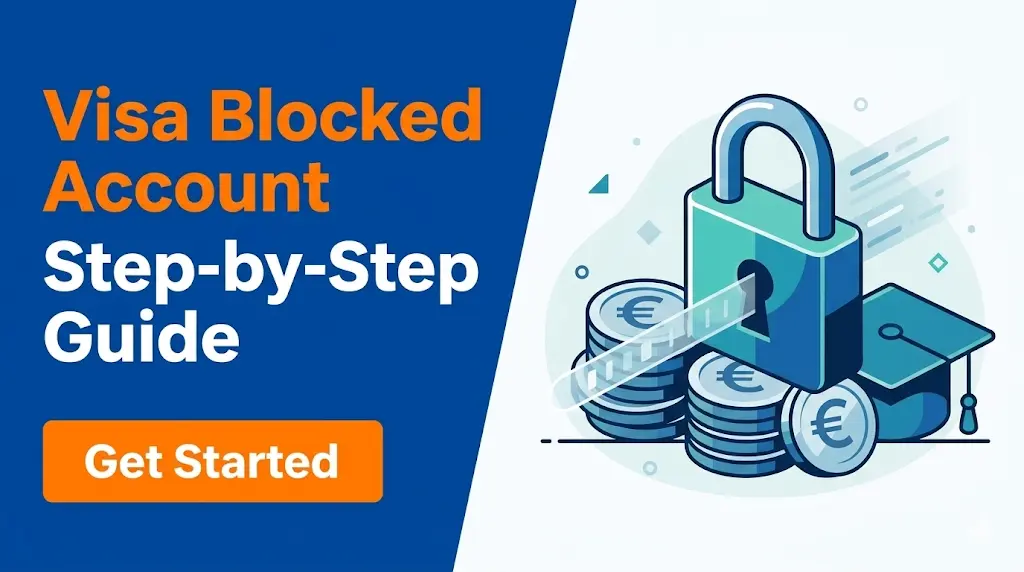
The literal translation of Sperrkonto is “blocked account,” and it operates exactly as the name suggests. Once your 11,904 Euros arrive safely in Germany, the entire sum is legally frozen. You cannot walk into a bank branch and withdraw a lump sum to buy a laptop or pay for an expensive deposit on a flat. The account acts as an automated vault.
Every single month, the provider unblocks exactly 1/12th of your total deposit—currently 992 Euros. This money is then automatically transferred out of the vault and into your personal, usable checking account. This strict rationing ensures that you will not blow through your entire annual budget during your first semester of partying and traveling around Europe, leaving you destitute in the winter.
If your rent is 600 Euros, your health insurance is 130 Euros, and you need to eat, that 992 Euros disappears remarkably fast. The blocked account forces you to budget meticulously. If you have sudden, unexpected expenses in your second month, you cannot ask the provider for an “advance” on next month’s payout. The German government strictly forbids it.
The Difference Between a Blocked Account and a Checking Account
One of the most dangerous misconceptions is assuming that your blocked account comes with a debit card you can use at the supermarket. It does not. A Sperrkonto is purely an escrow account used to satisfy immigration authorities. It has zero transactional capabilities. You cannot set up direct debits for your gym membership, and you cannot swipe it to buy groceries.
To actually spend your unblocked 992 Euros each month, you must open a standard German checking account, known as a Girokonto. Once you arrive in Germany, you will go to a local bank or use a digital bank to open this everyday account. You then provide the IBAN of this new Girokonto to your blocked account provider, establishing the pipeline for your monthly payouts.
This means you are managing two entirely separate banking entities during your first year. The blocked account holds the vault, and the checking account handles your daily life. Setting up that second account quickly upon arrival is critical so your funds don’t pile up in the vault inaccessible.
Extending Your Account for a Second Year
The initial blocked account only covers your first year of studies. If you are enrolled in a standard two-year Master’s or a three-year Bachelor’s degree, you will eventually have to renew your residence permit at the local Ausländerbehörde (Foreigners Office). When you show up for that extension appointment, the caseworker will demand to see proof of financial resources for your second year.
Depending on the specific caseworker and the city you live in, they may demand that you open and fund a brand new blocked account with another 11,904 Euros. This is a massive financial shock for students who assumed the hurdle was a one-time event. However, some lenient offices will accept six months of standard bank statements showing a consistent income from a part-time student job in lieu of a new blocked account.
If you plan to rely on a part-time job to bypass the second-year blocked account requirement, you must ensure your employment contract earns enough to meet the 992 Euro monthly threshold. You must also strictly adhere to the legal limits on international student working hours to avoid deportation. To navigate these complex labor rules, absolutely read Working as a Student in Germany: The 140-Day Rule Explained.
Choosing the Right Blocked Account Provider
Traditional German Banks vs Digital Providers
A decade ago, international students had virtually no choice but to use legacy institutions like Deutsche Bank for their blocked accounts. This archaic process involved printing out 20 pages of forms, taking them to the German embassy in your home country to have your signature physically notarized, and mailing the paper packet to a branch in Germany. It took weeks, and if you missed a single signature, the packet was mailed back, effectively ruining your semester start date.
Today, the landscape has been completely revolutionized by digital, expat-focused financial technology companies that are officially approved by the Federal Foreign Office. You can now open a fully compliant blocked account from your smartphone in a matter of minutes. There is no physical paperwork, no embassy notarization of the application, and no reliance on international postal services.
When you compare the two routes, the digital option is superior in every conceivable metric. Services like Expatrio have built their entire business model around eliminating the friction for international students. They issue the official blocking confirmation PDF—the exact document the embassy needs—almost immediately after your funds clear, allowing you to book your visa interview with absolute confidence.
Analyzing Fees and Hidden Setup Costs
When evaluating providers, you must look beyond the initial marketing and scrutinize the fee structure. Every provider charges an initial setup fee, and most charge a recurring monthly maintenance fee for keeping the vault secure. You must also factor in the “buffer” amount they require to cover potential intermediary SWIFT network fees.
Legacy banks traditionally charge exorbitant setup fees, sometimes exceeding 150 Euros, and offer zero English-language support when your money gets stuck. Digital providers are significantly more transparent. By choosing an optimized platform like Expatrio, you benefit from drastically lower setup fees and highly competitive monthly rates, while also gaining access to 24/7 customer support that actually speaks your language when you are in a panic.
| Feature | Legacy Banks (e.g., Deutsche Bank) | Digital Providers (e.g., Expatrio) |
| Setup Time | 2 to 4 weeks (Requires mail) | Under 24 hours (100% Online) |
| Initial Setup Fee | High (Often €150+) | Low to Moderate (Often €49 – €89) |
| Monthly Fee | Standard banking fees apply | Competitive (Usually ~€5/month) |
| Customer Support | Primarily German, limited hours | Multilingual, expat-focused support |
| Buffer Requirement | High margin required | Transparent, minimal buffer required |
Bundling Health Insurance for Bureaucratic Relief
Proving your finances is only one half of the visa equation. The German embassy also strictly requires proof of comprehensive German health insurance before they will issue your student visa. Domestic travel insurance from your home country will be rejected instantly. Navigating the German public health insurance system (Gesetzliche Krankenversicherung) on your own is a nightmare of dense, untranslated paperwork.
Smart expats avoid fighting a two-front bureaucratic war by bundling their services. Many digital blocked account providers offer “Value Packages” that automatically sign you up for public health insurance alongside your financial account. Alternatively, if you want dedicated, English-first support for your medical coverage, utilizing specialized expat brokers like Feather Insurance is a brilliant move.
Feather Insurance allows you to sign up for mandatory public student health insurance entirely online from your home country. They generate the official digital certificate the embassy demands, ensuring you don’t face a rejection due to inadequate medical coverage. If you are over 30 and legally excluded from the public student tariff, Feather Insurance also offers visa-compliant private plans. To fully understand your options and the massive implications they have on your care, review Public vs Private Health Insurance: Which One Should You Choose?.
The Step-by-Step Setup and Activation Process
Opening the Account from Your Home Country
The actual process of opening a blocked account is surprisingly straightforward if you use a modern digital provider. You begin by creating an account on their portal using your email address and uploading a high-resolution scan of your valid international passport. You do not necessarily need your final university admission letter to open the account, though you will definitely need it later for the embassy interview.
Once your identity is verified digitally, the provider will issue you a unique IBAN and specific transfer instructions. This is the critical moment. You must take these instructions to your local bank and initiate the international wire transfer. Ensure that the transfer is executed in Euros and that you send the exact required amount plus the provider’s requested buffer fee (usually around 100 Euros).
If you use a third-party currency exchange service to save on conversion rates, make absolutely sure the sender name matches your passport name exactly, or the German bank will reject the inbound funds due to money laundering suspicions. Once the money lands, the provider will issue your Sperrbescheinigung (Blocking Confirmation). You print this PDF and guard it with your life; it is the most important document in your visa dossier.
Translating and Certifying Your Documents
While the blocked account provider usually only needs your passport, the German embassy will demand a mountain of supporting documents, including your previous academic transcripts, birth certificates, and sometimes proof of parent’s income if you are combining funding methods.
German bureaucracy demands absolute legal precision. If your university transcripts are in a language other than German or English, the embassy will reject them unless they are accompanied by a certified legal translation. You cannot just ask a bilingual friend to type it up. It must be translated by an officially sworn translator recognized by the German courts.
Finding a certified sworn translator locally can cause massive delays. Instead, savvy expats use digital platforms like Lingoking. You simply upload a scan of your academic documents, and Lingoking assigns them to a certified German sworn translator who provides legally binding, stamped translations that are guaranteed to be accepted by the embassy and the local immigration office. Do not let a missing stamp ruin your semester start date.
Activating the Account After You Arrive in Germany
Getting the visa and landing in Frankfurt or Berlin is a massive victory, but your money is still locked in the vault. To trigger your monthly 992 Euro payouts, you must officially activate the blocked account. You cannot do this from your home country; it requires proof that you have legally arrived and settled.
First, you must find permanent housing and register your address at the local citizens office, a mandatory process known as the Anmeldung. Without this registration certificate, the financial system remains frozen. Next, you use your Anmeldung to open your everyday checking account (Girokonto).
Finally, you log back into your blocked account provider’s portal, upload a scan of your Anmeldung, your entry visa stamp, and the new IBAN of your checking account. Once their compliance team verifies these documents—usually within a few days—they will release your first month’s payout.
Troubleshooting Common Blocked Account Disasters
What Happens If Your Visa is Rejected
The most terrifying “what if” for any prospective student is dealing with a visa rejection after already wiring 12,000 Euros to a foreign country. If the embassy denies your visa for academic reasons or missing documents, your money is not gone forever, but retrieving it requires navigating a strict bureaucratic reversal process.
You cannot simply click a “refund” button on the provider’s website. Because the funds are legally blocked by the German government, the provider needs official permission from the state to release them back to you. You must contact the German embassy that rejected you and request a Sperrfreigabe (Release Document).
Once the embassy issues this official release form, you submit it to your digital provider. They will then initiate a reverse wire transfer back to the exact original bank account the funds came from. This process can take several weeks, and you will likely lose money on the dual currency conversions and the initial setup fees, but the core 11,904 Euros will be returned to you.
Dealing with Transfer Delays and Missing Buffer Fees
The most common disaster that delays blocking confirmations is short-funding the account due to intermediary bank fees. When you send money via the SWIFT network, the transfer hops between several international banks before reaching Germany. Each of these banks takes a small, unpredictable cut of the transaction.
If you wire exactly 11,904 Euros, it might arrive in Germany as 11,880 Euros. Because the balance is legally short of the government mandate, the provider cannot issue your blocking confirmation. You will then have to initiate a second, tiny international transfer to make up the 24 Euro difference, wasting another week and incurring more wire fees. This is why providers demand a buffer. Always over-fund the account slightly; any excess money above the legal requirement is simply paid out to you alongside your first month’s installment. Plan ahead, understand the banking mechanics, and you will navigate this process without the panic. For a broader checklist of everything you need to manage before your flight, see Expat Health Checklist: Medical To-Dos When You Move to Germany.
References
Primary sources (official)
- Federal Foreign Office (Auswärtiges Amt): The official government directive detailing the exact legal requirements, minimum deposit amounts, and approved procedures for opening a blocked account for visa purposes.https://www.auswaertiges-amt.de/en/sperrkonto-388600
- Make it in Germany: The federal government’s official information portal for international students, explaining the proof of financial resources (Finanzierungsnachweis) and current 2026 thresholds.https://www.make-it-in-germany.com/en/visa-residence/types/studying
Other helpful sources
- Study.eu: An independent, comprehensive portal offering advice on university admissions, living costs, and recent updates to the blocked account requirements.https://www.study.eu/article/germany-blocked-bank-accounts-for-students-guide
Disclaimer
The information provided in this article is for general informational and educational purposes only and does not constitute professional legal, financial, or immigration advice. German visa policies, the legally mandated minimum deposit amounts for blocked accounts, and the specific terms of service from providers, health insurance premiums from brokers, and certified translation requirements by platforms are highly complex and subject to continuous legislative updates. Always consult directly with the German embassy or consulate in your home country and verify all financial requirements before executing international wire transfers or submitting your visa application.