Residency by Investment: Fact or Fiction in Germany’s Immigration System
Scrolling through expat forums, I see endless questions from people hoping to simply buy a German apartment to secure a visa, and it breaks my heart to watch their dreams get crushed. I remember desperately trying to figure out if my savings could just “buy” my way into the country, only to slam into bureaucratic reality. This guide debunks the “Golden Visa” myth and explains exactly how Germany’s actual residency-by-investment pathway works.
Disclosure: This post may contain affiliate links. We may earn a commission at no extra cost to you if you make a purchase through these links. Read full disclosure.
The German Golden Visa Myth vs Reality
Why Passive Investments and Real Estate Do Not Work
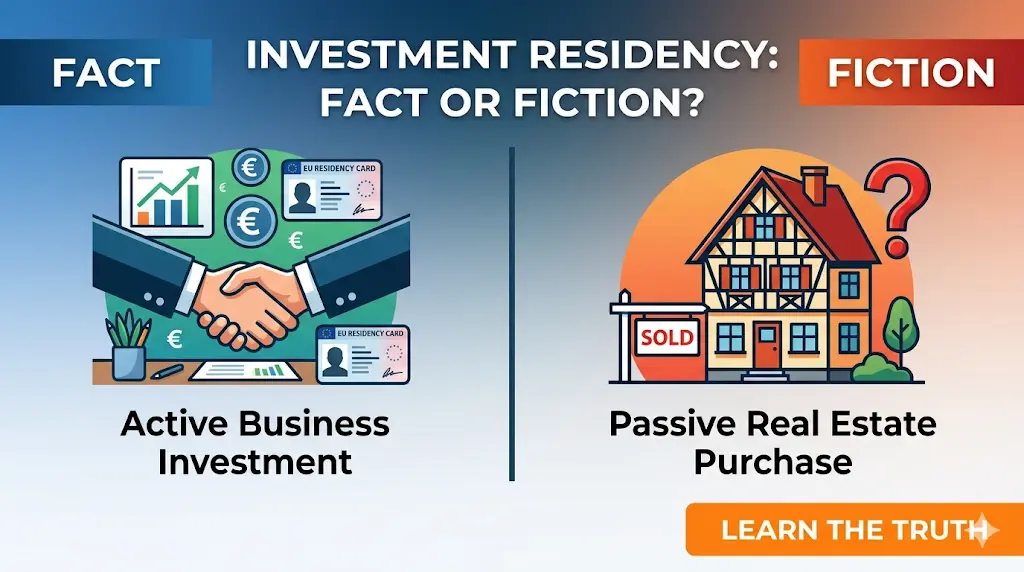
Many countries across Southern Europe have popularized the “Golden Visa,” where simply purchasing real estate or dropping cash into a national fund guarantees residency. Expats naturally assume that the economic powerhouse of Europe offers the exact same shortcut. The harsh, unavoidable truth is that Germany does not offer any form of residency in exchange for passive investments. Buying a multi-million euro penthouse in central Munich or a historic villa in Berlin will get you a property deed, but it will not grant you a single day of legal residency.
The widespread confusion often stems from predatory international agencies that market “German Investment Visas” online, deliberately conflating property ownership with legal immigration status to sell real estate to foreigners. The German legal system fiercely separates private asset acquisition from the right of residence. Foreigners are legally allowed to buy property—there are almost no restrictions on non-residents owning real estate in Germany—but doing so provides absolutely zero leverage when sitting across the desk from a skeptical immigration officer.
Attempting to bypass this strict rule by setting up a shell company solely to manage your newly purchased property will also end in failure. The immigration authorities are highly trained to look for genuine, active economic contribution versus passive wealth parking. If your proposed “business” is simply collecting rent on an apartment you bought, your application will be instantly dismissed. You cannot buy a residence permit in Germany; you have to earn it through active, impactful business operations that benefit the state.
The Core Philosophy of German Immigration Law
To understand why Germany fundamentally rejects the Golden Visa concept, you have to understand the core philosophy of its immigration framework. The German state relies heavily on a robust, heavily taxed labor force to fund its extensive social safety nets, healthcare systems, and public infrastructure. The government is entirely focused on attracting active economic contributors—people who will create jobs, drive technological innovation, and pay substantial income and trade taxes over decades. For a broader overview of how the system views foreigners, read our Moving to Germany: Comprehensive Visa & Immigration Guide.
Passive wealth injection simply does not serve this macroeconomic goal. A wealthy foreign national buying a house does not employ German workers, does not innovate within the local manufacturing or tech sectors, and does not pay ongoing monthly social security contributions. In fact, the government often views passive investors as potential long-term liabilities rather than assets, especially as they age and might eventually require access to the healthcare and social system without having paid into it during their prime working years.
Therefore, the only way capital translates into a visa in Germany is when it acts as the raw fuel for an active, job-creating enterprise. The entire immigration system is designed to reward the hustle of entrepreneurship rather than the static accumulation of wealth. Understanding this core tenet is absolutely essential before you even begin drafting an application; your focus must completely shift from “How much money do I need to bring?” to “What concrete value will my business bring to the German economy?”
The True Pathway: Section 21 of the Residence Act
Decoding the Self Employment Entrepreneur Visa
The closest legitimate equivalent to an investor visa in Germany is outlined in Section 21 of the Residence Act (Aufenthaltsgesetz). Specifically, § 21 Paragraph 1 governs the issuance of a residence permit for the purpose of self-employment (Gewerbe). This is the definitive pathway for founders, entrepreneurs, and active investors who want to establish a commercial business, such as a tech startup, a retail store, a manufacturing plant, or an import/export firm.
Decades ago, this law had a rigid, explicit threshold: you had to invest a legally mandated minimum of €250,000 and create at least five full-time jobs to even be considered for approval. However, the German government eventually recognized that this archaic rule stifled modern, lean startups and innovative tech founders who required less upfront capital but offered massive growth potential. Consequently, the fixed financial thresholds were entirely abolished in 2012. Today, your application is judged holistically based on the viability of your business idea, your entrepreneurial experience, and the capital required to execute your specific plan.
Holding a Section 21 visa grants you a temporary residence permit, usually valid for up to three years. If your business succeeds, generates enough profit to support your family, and meets its initial business plan projections, this temporary permit can be converted into a permanent settlement permit. It is a highly rewarding but incredibly demanding route, requiring immense preparation and a deep understanding of German corporate structures. You will also receive an electronic card to prove your status, detailed in our guide on the Biometric Residence Permit (eAT): Understanding Your German Residence Card.
The Local Economic Interest Test
The most critical and subjective hurdle of the Section 21 visa is proving that your proposed business fulfills an “economic interest or a regional need” (wirtschaftliches Interesse oder regionales Bedürfnis). This is not evaluated on a national level; it is an incredibly localized test evaluated by municipal authorities. What is desperately needed in a small Bavarian town might be completely rejected in a saturated, highly competitive market like Berlin or Frankfurt.
If you propose opening a standard tourist souvenir shop or another generic cafe in central Munich, the authorities will almost certainly deny your application, citing that the region is already oversaturated with similar businesses and your venture offers no unique economic value. Conversely, if you propose opening a specialized manufacturing supply firm in a developing industrial park in Eastern Germany, bringing distinct technological advancements and jobs, your application will likely be fast-tracked with genuine enthusiasm from local officials.
The evaluation focuses entirely on job creation, innovation, and the potential to strengthen the local supply chain. You must meticulously research the specific municipality where you intend to register your business. Many successful expat entrepreneurs proactively reach out to local economic development agencies (Wirtschaftsförderung) before submitting their visa applications to align their business concepts with the city’s strategic growth goals.
The Make or Break Business Plan
Your business plan is the single most important document in your entire immigration dossier. It is not just a formality to be skimmed; it is deeply scrutinized by financial experts and government officials. A vague, five-page summary of your grand vision will be immediately thrown out. Your plan must be a comprehensive, professionally formatted document spanning dozens of pages, complete with detailed market analysis, competitive research, and highly realistic financial projections for the first three years of operation.
Crucially, the business plan must articulate your personal qualifications as the founder. You cannot simply state you want to open a complex engineering firm if you have absolutely no background in engineering or corporate management. The authorities want to see a direct, logical correlation between your past professional experience, your academic credentials, and the success probability of your proposed venture. They are looking for a documented track record of competence.
The financial forecasting section must be completely airtight. You must detail your projected revenue, operational costs, trade taxes, marketing budget, and employee salaries. Furthermore, the plan must clearly show exactly how much capital you are injecting into the company and where those funds are originating. Flaws in your financial logic, overly optimistic revenue projections, or a clear lack of understanding of German tax liabilities will result in a swift rejection of your visa application.
Financial Prerequisites and Capital Structuring
Minimum Capital and Securing Funding
Although the strict €250,000 minimum investment rule is gone, do not mistake this for a lack of capital requirements. The funding you bring must be proportionate and adequate to realize your specific business plan. If you are launching a digital marketing agency from a co-working space, the required capital might only be €30,000. However, if you are opening a physical restaurant or a logistics firm, the authorities will expect to see hundreds of thousands of euros in secured funding to cover commercial leases, physical renovations, and initial staff salaries.
The structure of your business also dictates mandatory legal capital. The most popular corporate form for serious entrepreneurs in Germany is the GmbH (Gesellschaft mit beschränkter Haftung), a limited liability company. Establishing a GmbH requires a legally mandated minimum share capital of €25,000, half of which (€12,500) must be deposited into a German corporate bank account before the company can be officially registered in the commercial register (Handelsregister).
You must provide rock-solid proof of this funding to the immigration office. This cannot be a screenshot of a highly volatile foreign cryptocurrency portfolio or a vague promise of future investments from friends. You must show liquid funds in a recognizable bank account, signed loan agreements from European banks, or formalized term sheets from venture capital firms. If your funding relies on a loan from a home-country relative, that loan must be legally notarized and clearly transferred to an accessible, transparent account.
Securing Personal Living Expenses
One of the most frequent, heartbreaking reasons entrepreneur visas fail is that the applicant confuses their business capital with their personal living funds. The German government expects you to invest heavily in your business, but they also demand absolute certainty that you can feed yourself, pay your personal apartment rent, and survive without tapping into public welfare funds during the lean, unprofitable early years of your startup.
You must prove your personal financial stability completely separate from your corporate funding. For many expats, the cleanest, most unassailable way to demonstrate this is by utilizing a blocked account (Sperrkonto). Depositing your first year’s personal living expenses into an Expatrio blocked account provides the immigration officer with indisputable, government-approved proof that your personal survival is financially secured. Using Expatrio removes a massive layer of doubt from your application, showing you are financially responsible.
The exact amount required for personal living expenses varies depending on your family size and the local cost of living in your chosen city, but it generally aligns with the standard German social assistance rates plus local housing costs. Failing to delineate your business capital from your grocery money is a massive red flag for the authorities, signaling poor financial management skills. To understand the intricacies of these financial proofs, explore our guide on Proof of Financial Means for Visas: Blocked Accounts and Sponsorship Letters.
Mandatory Health Insurance and Old Age Provisions
The German state is highly protective of its social safety net, and self-employed foreigners are subjected to extreme scrutiny regarding their personal insurance coverages. You cannot register a business or obtain a visa without comprehensive, BaFin-approved health insurance. Because self-employed individuals are generally not forced into the statutory public health system like standard employees, you have highly complex choices to make between voluntary public coverage and private health insurance.
Choosing the right policy is critical, as a non-compliant, cheap travel policy will instantly halt your visa application. This is where relying on expat-focused brokers like Feather Insurance is a lifesaver. They offer both statutory and fully compliant private health insurance policies specifically tailored for freelancers and entrepreneurs. Using Feather Insurance ensures you walk into the immigration office with a coverage certificate that meets every single strict bureaucratic requirement, entirely in German, preventing costly administrative delays. For a deeper understanding of these complex options, review Health Insurance for Freelancers and Self-Employed: Navigating the System.
Furthermore, if you are over the age of 45 when applying for your Section 21 visa, you face a massive additional legal hurdle: the mandatory old-age provision (Altersvorsorge). The government requires definitive proof that you have secured adequate retirement funds so you do not become a financial burden on the state in your old age. This usually means showing hundreds of thousands of euros in a dedicated retirement portfolio, significant real estate assets, or a legally binding private pension plan. This rule is absolute, fiercely enforced, and catches many older entrepreneurs off guard.
Overcoming the Bureaucratic Gatekeepers
The Role of the IHK (Chamber of Commerce)
When you finally submit your massive application to the local Ausländerbehörde, the immigration case worker does not actually evaluate your business plan themselves. They are legal bureaucrats, not financial analysts or venture capitalists. Instead, they forward your entire business dossier to the local Chamber of Commerce and Industry (IHK – Industrie- und Handelskammer) or the Chamber of Crafts (HWK) for an expert economic assessment.
The IHK acts as the ultimate gatekeeper for the entrepreneur visa. Their regional business experts will read your business plan, deeply analyze your financial projections, and determine whether your proposed business truly serves the local economic interest. They will then issue a formal statement (Stellungnahme) back to the immigration office. If the IHK issues a positive recommendation, the immigration office will almost always grant the visa. If the IHK issues a negative assessment, your visa will be denied.
It is highly strategic to proactively engage with the local IHK before you even submit your visa application. Many IHK offices offer free consultation services for aspiring founders. Pitching your idea to them early, taking their blunt feedback, and adjusting your business plan to align with their specific regional priorities can dramatically increase your chances of a positive assessment later on.
The Importance of Flawless, Certified Documentation
Bureaucracy in Germany operates on absolute, unforgiving precision. If your application includes foreign company registries, international academic degrees to prove your expertise, or complex financial statements from foreign banks, they cannot simply be handed over in English or your native language. The IHK and the immigration office demand that all vital foreign documents be officially translated into German.
You cannot translate these documents yourself, nor can you use a standard, cheap online translation agency. They must be certified by a sworn translator legally recognized by the German court system. This is exactly where services like Lingoking are indispensable. You can easily upload your complex foreign financial documents or university diplomas to Lingoking, and they will return legally binding, certified translations bearing the official sworn seals. Presenting perfectly translated documents via Lingoking demonstrates your professionalism and massive respect for the German administrative process.
Additionally, ensure that your corporate documents, such as your draft Articles of Association (Gesellschaftsvertrag), are drafted by a qualified German notary (Notar). Trying to cut corners on legal or translation fees during the formation of your company will inevitably backfire, causing the IHK to question your fundamental competence as a founder. For more details on document preparation, see Legalizing and Translating Documents for German Visa Applications.
Navigating Rejections and Course Corrections
Facing a rejection from the immigration office based on a negative IHK assessment is a devastating experience, but it is not necessarily the absolute end of the road. Rejection letters in Germany are highly detailed and legally required to state the exact, specific reasons for the denial. Perhaps your financial projections were deemed wildly unrealistic, or the local market was considered too saturated.
If rejected, you have the legal right to file a formal appeal (Widerspruch) within one month. This is when you must hire a specialized German immigration lawyer. They can help you revise your business plan, address the IHK’s specific concerns, inject more capital into the proof of funds, and resubmit a much stronger, legally sound case. To understand the general mechanics of appealing decisions, refer to our guide on Visa Denied for Germany: Common Reasons and Next Steps.
Sometimes, the best course correction is an entirely different approach. If the IHK insists your business lacks regional economic interest, you might consider launching the exact same business in a different, less saturated German city or rural district that is desperate for your specific industry. Alternatively, you may need to pivot your strategy entirely and look at other immigration pathways that do not require the incredibly strict IHK economic interest test.
Alternative Routes for Aspiring Business Owners
The Crucial Difference: Freelancer vs Entrepreneur
The German legal and tax systems draw a massive, incredibly strict line between an Entrepreneur engaging in a commercial trade (Gewerbe) and a Freelancer engaging in an independent profession (Freiberufler). The Section 21 visa framework covers both, but the requirements and scrutiny levels are drastically different. A Freiberufler is strictly defined by law as someone practicing a “catalog profession,” such as a doctor, lawyer, artist, writer, language teacher, or specialized IT consultant.
If your personal business model fits the strict legal definition of a Freiberufler, you have a massive bureaucratic advantage: you are entirely exempt from the brutal IHK economic interest test. You do not need to prove job creation or regional economic impact, and you do not need to form a complex GmbH. You simply need to prove you have the academic qualifications to practice your profession, enough prospective clients to sustain yourself, and a solid financial plan.
However, if you sell physical goods, act as an agency hiring other people to do the work, or engage in almost any form of e-commerce, you are legally classified as a Gewerbe (commercial trade) and must pass the full entrepreneurial scrutiny. Many expats mistakenly apply for a freelance visa while actually operating a commercial trade, resulting in an immediate, painful rejection. Understanding this nuance is vital to your survival. Learn more in our detailed guide on Freelancing in Germany: How to Register as a Freelancer (Freiberufler).
The EU Blue Card Route for Founders
For highly skilled expat founders, there is a complex but highly rewarding alternative to the standard entrepreneur visa: cleverly utilizing the EU Blue Card system. The EU Blue Card is normally strictly reserved for regular employees, but founders can sometimes leverage it by forming a limited liability company (GmbH) and then having their own company hire them as its Managing Director (Geschäftsführer).
To execute this maneuver, the newly formed GmbH must offer you a formal employment contract that meets the strict minimum salary thresholds required for a Blue Card. Because you are essentially legally classified as an employee of your own corporate entity, you bypass the subjective IHK economic interest test required for a self-employment visa. The focus of the immigration office shifts from “Does the city need this business?” to “Does this employment contract meet the objective Blue Card salary requirements?”
This route requires substantial, highly liquid upfront capital, as your company must genuinely have the funds in its corporate account to pay your high Blue Card salary every single month, regardless of early-stage profitability. Furthermore, the immigration office will heavily scrutinize the corporate setup to ensure it is not a “fake” employment contract designed purely to bypass visa laws. It requires flawless corporate structuring and expert legal advice. For a broader overview of long-term options once your business is established, read Permanent Residency in Germany: Requirements and How to Apply.
Comparison Overview: Golden Visa vs Entrepreneur Visa
| Feature | Traditional “Golden Visa” (e.g., Spain/Portugal) | German Section 21 Entrepreneur Visa |
| Core Requirement | Passive investment (e.g., buying real estate) | Active commercial business operations |
| Job Creation | Rarely required | Highly expected / Required for approval |
| Minimum Investment | Fixed legal minimums (e.g., €500,000) | No fixed minimum, must match business plan |
| Local Economic Test | None | Strict assessment by the IHK |
| Pathway to Permanent Residency | Yes, based on asset retention | Yes, based on business success and sustained profit |
References
Primary sources (official)
- Federal Ministry of Justice – Section 21 AufenthG: https://www.gesetze-im-internet.de/englisch_aufenthg/englisch_aufenthg.html
- Make it in Germany (Official Portal) – Visa for self-employment: https://www.make-it-in-germany.com/en/visa-residence/types/self-employment
- IHK Frankfurt am Main – Trade Register Notification: https://www.frankfurt-main.ihk.de/servicenavigation/chamber-of-commerce-and-industry/startup-support-and-business-development/trade-register-notification
Other helpful sources
- Federal Ministry for Economic Affairs and Climate Action – Existenzgründungsportal: https://www.existenzgruendungsportal.de/Navigation/EN/Home/home.html
- IHK Darmstadt – Business Registration: https://www.ihk.de/darmstadt/en/productlabels/startup/gewerbeanmeldung-2533044
Disclaimer
The information provided in this article is for general informational purposes only and is based on the real-world experiences of expats navigating the German immigration and business registration systems. Immigration laws, investment requirements, and corporate tax regulations are highly complex and subject to frequent interpretation and changes by local and federal authorities. This article does not constitute legal, financial, or immigration advice. Always consult the official website of your local Ausländerbehörde, the local Chamber of Commerce (IHK), or a certified German immigration lawyer and tax advisor before investing capital or submitting visa applications.