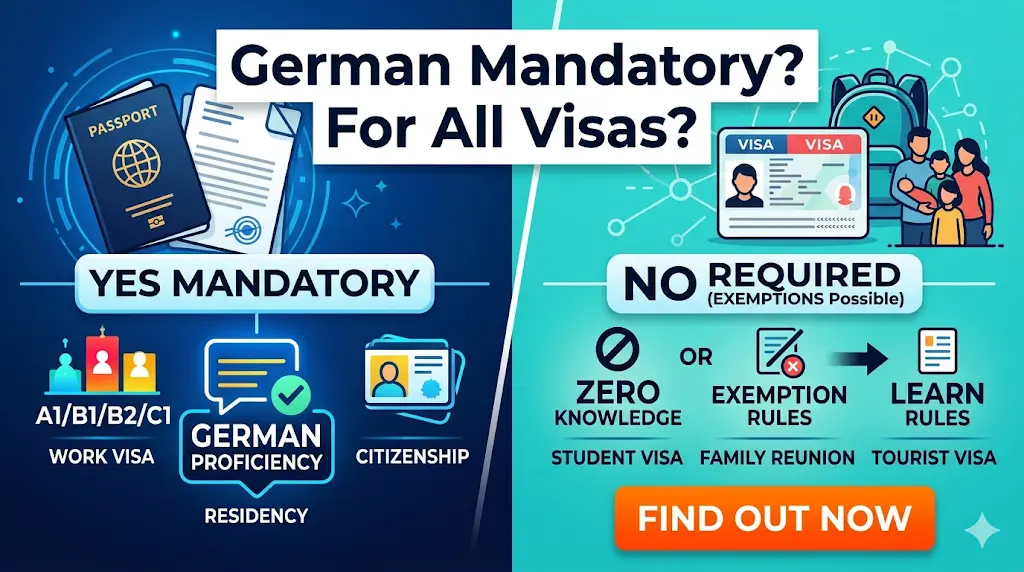
Is German Language Mandatory for All Visas? Language Requirements by Visa Type
Staring at complex German grammar books while trying to secure a visa is enough to make anyone reconsider their move abroad. I remember losing sleep, terrified that my broken German would lead to an immediate rejection at the immigration office. This guide breaks down exactly which German visas actually require language certificates and which ones let you arrive speaking zero German.
Disclosure: This post may contain affiliate links. We may earn a commission at no extra cost to you if you make a purchase through these links. Read full disclosure.
The Big Relief Visas That Do Not Require German
The EU Blue Card and Highly Skilled Worker Visas
I remember the massive wave of relief when I discovered the EU Blue Card didn’t require me to pass a German exam. Germany’s tech, engineering, and medical sectors are desperate for international talent, and companies in hubs like Berlin, Munich, and Frankfurt operate almost entirely in English. The immigration office recognizes this economic reality. To get the Blue Card, your approval is based purely on objective criteria: your university degree must be recognized in Germany, and your employment contract must meet the annual minimum salary threshold. There are no subjective language tests involved.
However, the bureaucracy still demands absolute clarity regarding your academic past. To get the Blue Card, your foreign degree must be recognized in Germany via the Anabin database. If your degree isn’t explicitly listed, you must apply for a Statement of Comparability, which means you must have your degree officially translated. Using Lingoking for this sworn translation ensures the authorities understand your qualifications perfectly. Lingoking handles complex academic translations with legally recognized accuracy, preventing your Blue Card from being delayed by a confused clerk. If you want to dive deeper into the salary thresholds, read our guide on Understanding the Blue Card Requirements. For a broader overview of all immigration pathways, start with our Moving to Germany: Comprehensive Visa & Immigration Guide.
The Opportunity Card and Freelance Visas
Germany recently modernized its immigration framework by introducing the Opportunity Card, a points-based job-seeker visa designed to attract talent even without a firm job offer. One of the most progressive features of this new visa is how it handles language. While knowing German gives you extra points, it is not strictly mandatory if you have strong English skills. You can secure the Opportunity Card by proving an English proficiency level of B2 alongside your professional qualifications. This is a massive win for expats who want to come and search for jobs but haven’t had the time to master German grammar.
Similarly, if you are an independent contractor, the Freelance Visa also has no strict, statutory language requirement. The immigration office cares far more about your business plan, your financial projections, and your potential clients than your ability to order a coffee in German. However, surviving as a freelancer without German is practically very difficult, even if it is legally permitted. Furthermore, as a freelancer, you don’t need a German certificate, but you absolutely need compliant health coverage. Finding private or public health insurance that accepts new freelancers is a notoriously grueling process, but Feather Insurance offers tailored, expat-friendly policies. Using Feather Insurance guarantees your coverage meets all strict immigration requirements without the headache of navigating German insurance jargon. For more details on self-employment, check out Freelancing in Germany: How to Register as a Freelancer (Freiberufler).
English Taught University Programs
Germany is famous for its tuition-free universities, and surprisingly, hundreds of master’s and bachelor’s programs are taught entirely in English. If you are accepted into an English-taught program, the German embassy will not test your German skills during your visa interview. They defer entirely to the university’s admission letter, which usually only requires a TOEFL or IELTS score. You can legally move to Germany, study for years, and graduate without passing a single German exam.
However, while the consulate won’t test your language, they will rigorously test your finances. You must prove you can support yourself without relying on the German state. Setting up a blocked account with Expatrio takes minutes and provides the exact paperwork the embassy needs. I used Expatrio to prove my living expenses, and it was the absolute smoothest part of the entire visa process. Utilizing Expatrio guarantees that your financial proof perfectly aligns with the strict legal demands of the German state, ensuring your student visa is approved fast without irrelevant language hurdles.
When German is Absolutely Mandatory
Family Reunification for Spouses
This is the category that causes the most stress and heartbreak for international couples. If you are marrying a German citizen or joining a spouse who holds a standard work visa, the German government generally requires the incoming spouse to prove basic German language skills at the A1 level before they even arrive in the country. The state’s rationale is that basic language skills prevent social isolation and force early integration. This dreaded A1 requirement means you must pass a test proving you can introduce yourself, ask for directions, and fill out basic forms.
However, there are massive, highly specific exemptions to this rule that the embassies don’t always clearly advertise. If your spouse holds an EU Blue Card, or if you are a citizen of a privileged nation like the US, UK, Canada, Australia, Japan, South Korea, or Israel, the A1 requirement is completely waived. To claim these exemptions at the embassy, you must flawlessly present your civil documents. Getting your foreign marriage certificate officially translated is non-negotiable. Uploading your documents to Lingoking guarantees you receive a court-sworn, legally binding translation that the immigration officer will accept immediately. This is a crucial step outlined in our Family Reunification in Germany: Ultimate Guide for Bringing Your Loved Ones.
Vocational Training and Apprenticeships
If you want to move to Germany to complete a vocational apprenticeship, language skills are absolutely mandatory from day one. Because trade schools and practical workplace training are conducted entirely in German, you must prove at least a B1 level of German proficiency to secure this specific training visa. Without it, you simply would not survive the classroom environment, understand complex workplace safety instructions, or be able to communicate with local customers. Do not attempt this route if you are not fully committed to mastering the language beforehand.
Upgrading to Permanent Residency and Citizenship
This is the administrative wall where the language requirement finally catches up with everyone who arrived speaking only English. Upgrading your temporary visa to a permanent settlement permit generally requires a B1 German certificate. The state wants to know you are permanently integrated into society. The only major exception is for EU Blue Card holders, who can secure permanent residency after 33 months with just an A1 certificate, or fast-track it after 21 months if they achieve B1. You can see the full breakdown of these exact timelines in Permanent Residency in Germany: Requirements and How to Apply.
When you eventually decide to apply for a German passport, B1 is the absolute minimum baseline requirement under the new 2024 naturalization laws. If you want to use the highly accelerated three-year pathway to citizenship, you must prove an intense C1 level of fluency. Preparing for these exams is a marathon, not a sprint, which we detail extensively in German Citizenship by Naturalization: Eligibility and Application Steps.
Proving Your Language Skills to the Immigration Office
Accepted Language Certificates
You cannot simply walk into the immigration office, have a brief, friendly chat in German with the case worker, and claim you speak the language. The German bureaucracy demands standardized, certified proof. A screenshot of a 500-day language app streak or a certificate from a random online academy will be instantly rejected and laughed out of the room.
The German state only accepts certificates from testing providers recognized by ALTE (Association of Language Testers in Europe). This strictly means you must pass a formal exam from the Goethe-Institut, telc, ÖSD, or TestDaF. These exams test reading, writing, listening, and speaking under strict academic conditions. To find out how to prepare for these specific, highly regulated exams, look into German Integration Courses: Language & Orientation for New Residents.
Translating Foreign Degrees and Documents
Sometimes your language exemption relies entirely on your foreign academic background or your civil status. If your documents are in a foreign language, they are legally useless to the immigration case worker. Translating your academic transcripts requires sworn professionals. Returning to Lingoking ensures that your foreign academic qualifications are translated with the exact legal terminology required by the German recognition authorities. Never use uncertified translation agencies for immigration paperwork; the peace of mind is worth doing it right the first time so you don’t face sudden visa rejections. For a full guide on handling this paperwork, read Legalizing and Translating Documents for German Visa Applications.
Securing Your Application Financially and Medically
Even if you perfectly navigate the language requirements or secure a legal exemption, your visa will be instantly rejected if you fail the financial and medical checks. The German state is terrified of foreigners becoming a burden on the welfare system. If your visa requires proof of personal funds, setting up your blocked account with Expatrio is incredibly efficient. They provide the exact, officially formatted confirmation that the German embassy demands, eliminating the terrifying uncertainty of proving your net worth. Learn more about these rigid financial requirements in Proof of Financial Means for Visas: Blocked Accounts and Sponsorship Letters.
Additionally, gapless health insurance is universally mandatory across all visa types. You cannot get a visa without it. Navigating the German healthcare system is incredibly confusing for foreigners, but securing your coverage through Feather Insurance simplifies the entire ordeal. They specialize entirely in expats, offering policies that are fully compliant with all German immigration laws, and their customer support operates entirely in English. Showing up to your visa appointment with a clear, compliant coverage certificate from Feather Insurance ensures you face zero pushback regarding your medical status. For an exhaustive look at your healthcare options, check out Medical Insurance for German Visa Applications: What You Need.
| Visa Category | Mandatory German Level | Accepted Alternatives and Exemptions |
| EU Blue Card | None | Must have a recognized degree and qualifying job offer |
| Opportunity Card | A1 | English proficiency at B2 is fully accepted instead |
| Student Visa | None (for English programs) | Proof of English proficiency (e.g., TOEFL or IELTS) |
| Spousal Family Reunification | A1 | Exempt if spouse holds a Blue Card or has privileged nationality |
| Vocational Training | B1 | Very rare exceptions; training is entirely in German |
| Permanent Residency | B1 | A1 is accepted for Blue Card holders after 33 months |
References
Primary sources official
- Make it in Germany – Language Requirements: https://www.make-it-in-germany.com/en/living-in-germany/learn-german/knowledge
- Federal Foreign Office – Visa for Germany FAQ: https://www.auswaertiges-amt.de/en/visa-service/buergerservice/faq/606848-606848
- Federal Office for Migration and Refugees BAMF – Proof of basic knowledge of German: https://www.bamf.de/SharedDocs/Anlagen/DE/MigrationAufenthalt/Ehegattennachzug/ehegattennachzug-en.pdf?__blob=publicationFile&v=11
Other helpful sources
- Goethe-Institut – German Exams: https://www.goethe.de/en/spr/kup/prf.html
- Make it in Germany – Job search opportunity card: https://www.make-it-in-germany.com/en/visa-residence/opportunity-card/job-search
Disclaimer
The information provided in this guide is for general informational purposes only and reflects the experiences of expats navigating the German immigration system. Immigration laws, visa language requirements, and recognized testing providers are highly complex and subject to interpretation and frequent updates by local and federal authorities. This article does not constitute legal or immigration advice. Always consult the official website of your local immigration office, the German Embassy in your home country, or a certified German immigration lawyer for the most current, legally binding requirements regarding your specific visa application.