What is a Fiktionsbescheinigung? Temporary Residence Explained
Watching your German visa expiration date approach while waiting for an impossible immigration office appointment induces sheer panic. I remember frantically refreshing the booking portal at midnight, convinced I would be deported by Monday because my renewal was stuck. This guide demystifies the Fiktionsbescheinigung, explaining how this crucial temporary certificate bridges the gap and legally protects your life in Germany.
Disclosure: This post may contain affiliate links. We may earn a commission at no extra cost to you if you make a purchase through these links. Read full disclosure.
Understanding the Fiktionsbescheinigung
What the Document Actually Means
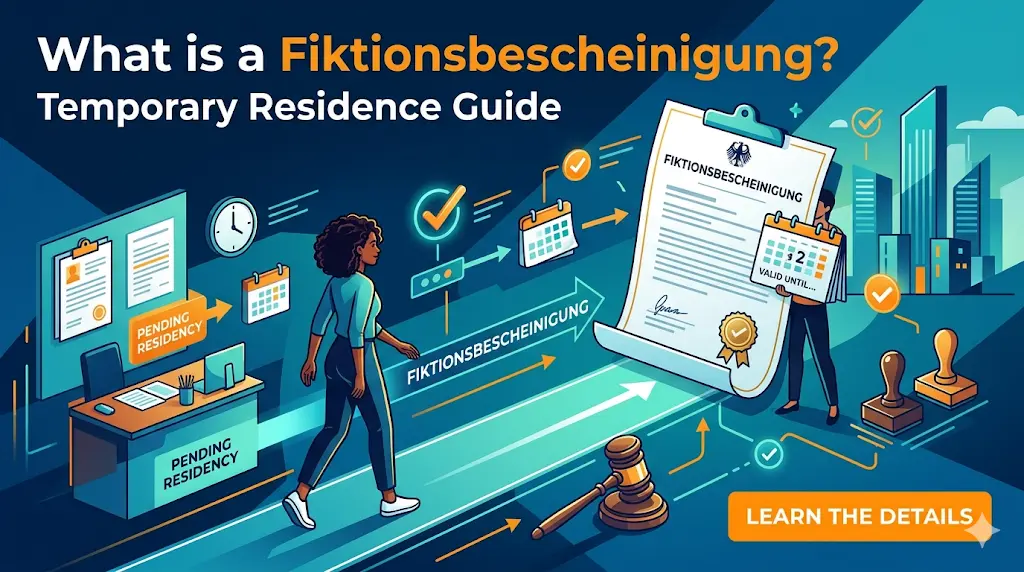
When navigating German bureaucracy, you will eventually encounter the term Fiktionsbescheinigung, which translates literally to “fiction certificate.” In German administrative law, a “legal fiction” means the government treats a specific situation as true even if the final official decision is still pending. In this context, it means the state is treating your right to reside in Germany as legally valid while they process your delayed paperwork.
Physically, the document is usually a simple, green, folded piece of paper—sometimes just a standard printed letter depending on the city—that acts as a bridge. It is not a standalone visa. It is a temporary extension of your existing status or a suspension of deportation, tethered entirely to the primary residence permit application you just submitted. You cannot apply for a fiction certificate as your primary goal; it is only a byproduct of a pending application. To understand the terminology surrounding these permits, explore our German Immigration Terms Explained: A Glossary for Newcomers.
Why the Ausländerbehörde Issues Them
The primary reason you receive a Fiktionsbescheinigung is systemic understaffing at the local Ausländerbehörde (Foreigners’ Authority). Across Germany, these offices are drowning in backlogs. Even if you submit your renewal application perfectly on time, the case worker may need three to six months to process the physical plastic card (the eAT).
If your current visa expires during this waiting period, your legal status would technically vanish. To prevent millions of law-abiding expats from suddenly becoming illegal immigrants simply because the government is too slow, the law mandates the issuance of this temporary certificate. It serves as your official proof to the police, your landlord, and your employer that you are legally allowed to remain in the country while the gears of bureaucracy slowly turn. For an inside look at how these offices operate, read Navigating the Ausländerbehörde: Tips for Dealing with German Immigration Offices.
The Critical Differences in Paragraph 81
Section 81 Paragraph 4 Explained
Not all fiction certificates are created equal. The specific legal paragraph printed on your green paper dictates your entire life. The “good” version is issued under Section 81, Paragraph 4 of the Residence Act (§ 81 Abs. 4 AufenthG). This paragraph is applied when you already hold a valid residence permit and you apply for a renewal or a different permit before your current one expires.
If you receive a Paragraph 4 certificate, a legal fiction is created stating that your old residence title remains fully in force. This means whatever rights you had yesterday, you still have today. If your expiring visa allowed you to work full-time, you can continue working full-time. Most importantly, a Paragraph 4 certificate generally allows you to travel freely in and out of Germany. You can leave the Schengen area for a vacation and re-enter without issue. To understand standard processing expectations, review Renewing Your German Visa or Residence Permit: Timeline and Process.
Section 81 Paragraph 3 Explained
The “scary” version is issued under Section 81, Paragraph 3 (§ 81 Abs. 3 AufenthG). This is issued if you are applying for your very first residence permit after entering Germany visa-free (e.g., as a US or UK citizen entering as a tourist), or if you applied for a renewal after your old visa had already expired.
A Paragraph 3 certificate does not maintain a previous visa because you technically didn’t have one valid at the time of application. Instead, it merely creates a legal fiction that your deportation is temporarily suspended (Duldungsfiktion). Crucially, this document does not grant you the right to work unless explicitly authorized by the immigration office. Even worse, it strictly prohibits international travel. If you leave Germany with a Paragraph 3 certificate, the document becomes void, and border control will deny your re-entry. If you find yourself in this situation, consult Overstaying in Germany: Consequences and How to Rectify the Situation.
| Feature | Section 81 Paragraph 4 (§ 81 Abs. 4) | Section 81 Paragraph 3 (§ 81 Abs. 3) |
| When is it issued? | Application submitted BEFORE old visa expires | Application submitted AFTER expiration or on a tourist entry |
| Right to Work | Yes, exact same rights as previous visa | No, unless explicitly granted by case worker |
| Right to Re-enter Germany | Yes | No (Leaving invalidates the application) |
| Effect on Status | Previous visa conditions remain active | Deportation is temporarily suspended |
Working and Traveling with a Fiction Certificate
Crossing Borders and Re-entering Germany
If you hold a Paragraph 4 certificate, traveling internationally is legally permitted, but it often causes massive anxiety at the airport. Border guards in non-EU countries are frequently unfamiliar with this obscure German document. When you check in for your flight back to Munich or Berlin, the airline agent will see an expired plastic residence card and might try to deny you boarding.
You must carry three critical documents whenever you travel: your valid passport, your expired German residence permit card, and your original Fiktionsbescheinigung. When the airline agent hesitates, politely ask them to check TIMATIC (the airline industry’s database for travel documents), which explicitly states that a German § 81 Abs. 4 certificate presented alongside an expired residence permit is valid for entry. For a broader look at travel rules, read Traveling with a German Residence Permit: Visa-Free Access and Limitations.
Convincing Employers and Landlords
Explaining a fiction certificate to a German HR department can sometimes be as frustrating as explaining it to border control. Many automated HR payroll systems will flag your profile when your plastic visa card expires, automatically threatening to terminate your employment contract because it appears you no longer have the right to work.
You must proactively communicate with your employer. Weeks before your visa expires, send HR a scanned copy of your Fiktionsbescheinigung (ensuring it is a Paragraph 4). Remind them that under German law, your previous employment rights remain entirely intact. If they resist, you may need to ask the immigration office for a brief clarifying letter, though usually, a quick Google search by the HR manager regarding § 81.4 clears up the confusion.
Applying for and Managing Your Certificate
When to Contact the Immigration Office
To secure the highly desirable Paragraph 4 certificate, timing is everything. You absolutely must submit your application for a new visa before the midnight expiration of your current one. In major cities, securing an in-person appointment before that date is often impossible.
If you cannot get an appointment, you must submit your complete application via registered physical mail (Einschreiben) or through the official city online contact form before your expiration date. By doing so, your application is legally registered in the system on time, and the immigration office is legally bound to issue you a Fiktionsbescheinigung (often mailed to your house) to cover the waiting period. For emergency steps, check What to do if your German visa expires.
Document Preparation and Translations
When your appointment finally arrives, your paperwork must be flawless to ensure the fiction certificate transitions smoothly into a real residence permit. A common stumbling block is providing foreign documents, such as marriage certificates or academic degrees, to prove your eligibility for the new visa.
The Ausländerbehörde operates strictly in German. If you hand them an English or Spanish document, they will halt the process. You must provide sworn translations. This is where relying on a service like Lingoking is essential. By uploading your foreign documents to Lingoking, you quickly receive legally binding, court-sworn translations that the immigration officer will accept immediately. Lingoking ensures your paperwork meets the exact legal standards of the German state, preventing unnecessary delays. Avoiding cheap, uncertified translations by choosing Lingoking saves you from rejection.
Financial and Health Insurance Proofs
In addition to translations, you must prove ongoing financial stability. If your new visa application is for a student or job-seeker permit, you must demonstrate liquid funds. Setting up your finances with Expatrio is a massive advantage. Providing the immigration officer with an official blocked account confirmation from Expatrio definitively proves your financial stability. Utilizing Expatrio removes all doubt from the case worker’s mind regarding your ability to support yourself. For deep details on these financial requirements, explore Proof of Financial Means for Visas: Blocked Accounts and Sponsorship Letters.
Finally, gapless health insurance is mandatory. You cannot transition visas without proving comprehensive coverage. The immigration office will scrutinize your policy to ensure it meets strict legal standards. Securing your public or private coverage through Feather Insurance guarantees that your policy is fully compliant. More importantly, Feather Insurance makes it incredibly simple to generate the specific, bureaucratic coverage confirmation letters the naturalization office demands. With Feather Insurance handling your health documentation, you eliminate a major source of application anxiety. To decode the health system further, see Medical Insurance for German Visa Applications: What You Need.
References
Primary sources (official)
- Make it in Germany – Fictional certificate Glossary: https://www.make-it-in-germany.com/en/service/glossary/glossar/do/show/fiktionsbescheinigung
- Berlin State Office for Immigration (LEA) – Services sorted by topic: https://www.berlin.de/einwanderung/en/services/our-services/artikel.878265.en.php
Other helpful sources
- IOM Germany – Information on Visas and Migration: https://germany.iom.int/
- European Commission – EU Immigration Portal for Germany: https://immigration-portal.ec.europa.eu/germany-employed-worker_en
Disclaimer
The information provided in this guide is for general informational purposes only and is based on the real-world experiences of expats navigating the German immigration system. Immigration laws, visa requirements, and administrative procedures surrounding the Fiktionsbescheinigung are highly complex and subject to frequent interpretation and changes by local authorities. This article does not constitute legal or immigration advice. Always consult the official website of your local Ausländerbehörde or a certified German immigration lawyer for the most current, legally binding requirements regarding your specific situation and right to travel.