Documents Required for German Visa Applications: Complete Guide
Showing up to the German embassy only to be rejected because a copy wasn’t perfectly aligned is a devastating rite of passage. I once had my entire application paused because my university transcript lacked a specific sworn translation stamp. This guide breaks down the exact documents required for your German visa application to ensure your paperwork is bulletproof.
Disclosure: This post may contain affiliate links. We may earn a commission at no extra cost to you if you make a purchase through these links. Read full disclosure.
Understanding the German Bureaucratic Mindset
Before you print a single page or book an appointment at your local consulate, you must understand the philosophy behind German administration. The German state operates on a foundation of absolute verifiable proof. They do not assume positive intent, and they do not accept approximations. Your application is not a conversation; it is a legal defense of your right to enter the Federal Republic.
The Obsession with Originals and Copies
The most common shock for incoming expats is the sheer physical volume of paper required. In an increasingly digital world, the German immigration system remains staunchly loyal to physical documentation. When a checklist asks for an original document, it means the physical piece of paper that was stamped or signed by the issuing authority. A high-quality color printout of a scanned PDF is not an original, and presenting it as one will lead to instant rejection.
Furthermore, you will almost always be required to bring two identical sets of photocopies. These photocopies must be black and white, perfectly legible, and printed on standard A4 paper. Do not print double-sided to save paper; German clerks despise double-sided documents because they cannot easily scan them into their legacy archiving systems. You must carry your originals in one pristine folder, and your two stacks of identical copies in completely separate folders.
Why Format and Order Matter
When the German embassy provides a document checklist, it is not a loose suggestion of items to gather; it is the exact, mandatory order in which your file must be presented to the consular officer. If the checklist asks for your passport copy first, followed by your application form, and then your biometric photos, you must arrange your stacks in that exact sequence.
I have watched applicants be scolded and sent to the back of the line simply because their paperwork was out of order. Additionally, never staple your documents together. The clerks have specific, standardized methods for hole-punching and binding files into official federal folders. If you staple your employment contract to your degree certificate, the clerk has to painstakingly remove the staples, which annoys them and sets a terrible tone for your interview. Use paper clips or simple plastic sleeves that can be easily removed. Understanding this extreme attention to detail is the first step in surviving Visas and Residence Permits in Germany: Everything You Need to Know.
The Consequence of Incomplete Files
The German embassy will not act as your administrative assistant. If you arrive at your appointment missing a single document from the required list, the officer will not hold your file open and ask you to email it to them later. They will hand your entire stack of papers back to you, keep your application fee, and issue a formal rejection or tell you to book a new appointment.
Given that booking an appointment in countries like India, the United States, or Brazil can take several months, a single missing piece of paper can destroy your job offer or your university enrollment timeline. You must adopt a mindset of aggressive over-preparation. It is always better to carry fifty pages of supporting evidence that the officer doesn’t look at, rather than missing the one page they demand to see. To ensure you are tracking every phase of this stressful journey, utilize a comprehensive Germany Immigration Checklist: 10 Steps to Moving Legally.
The Core Documents Every Applicant Needs
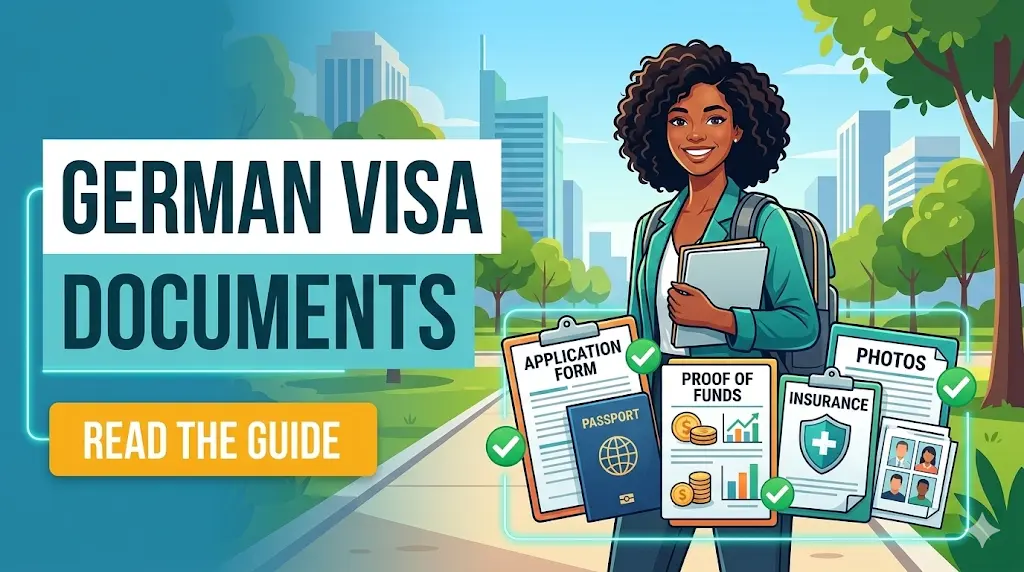
Regardless of whether you are moving to Germany to be a neurosurgeon, a freelance graphic designer, or an international student, there is a foundational set of documents that every single applicant must provide. These are the non-negotiable pillars of your identity and your intent.
Valid Passports and Biometric Photos
Your passport is your ultimate proof of identity, but it must meet strict Schengen-area criteria. It must have been issued within the last ten years. Even if your country issues passports valid for twenty years, Germany will not accept it if it is more than a decade old. Furthermore, it must be valid for at least three months beyond your intended date of departure from the Schengen area, and it must contain at least two completely blank pages for the visa stickers and entry stamps.
Along with the passport, you must provide recent biometric passport photographs. The German biometric photo requirements are incredibly rigid. The photo must measure exactly 35x45mm. Your face must take up 70 to 80 percent of the frame. You must have a neutral expression, looking directly into the camera with your mouth closed—absolutely no smiling. The background must be a plain, light grey. Do not use photos from a previous visa, as the officer will check the issue date. It is highly recommended to have these taken by a professional photographer who explicitly understands the German biometric standards.
Application Forms and Legal Declarations
Every National Visa (Type D) application requires the completion of the formal visa application form. Most embassies now mandate that this form be filled out digitally using the German Foreign Office’s VIDEX portal. You fill in your data online, generate a PDF containing a specific barcode, print it out, and sign it by hand. The officer scans this barcode to instantly populate your data into their internal system.
Along with the application form, you will be required to sign several legal declarations. The most common is the Declaration according to Section 54 (2) 8 of the Residence Act. By signing this, you are legally confirming that all the information you have provided is true and complete, and you acknowledge that providing false information—such as hiding a previous criminal conviction or lying about your employment history—will result in immediate deportation and a permanent ban from entering the country.
Proof of Residence and Flight Itineraries
The embassy needs to know where you currently live to establish their jurisdiction over your application. You must provide utility bills, a local driver’s license, or a formal government registration document proving you legally reside in the district handled by that specific consulate.
Additionally, you may be asked to provide a tentative flight itinerary or proof of travel plans. A massive trap for expats is assuming they need to buy non-refundable flight tickets to prove they are serious about moving. The German embassy explicitly advises against purchasing final tickets until your visa is officially issued. Instead, you should provide a verifiable flight reservation or a flexible booking itinerary. If your visa is delayed by background checks, having non-refundable tickets will result in devastating financial losses.
Specific Documents for Work and Blue Card Visas
If your relocation is sponsored by a corporate employer, your documentation must prove that you possess specialized skills and that your German employer is offering you a legally compliant, fair compensation package that does not undercut the local labor market.
Employment Contracts and Employer Declarations
The cornerstone of any work visa application is your employment contract (Arbeitsvertrag). This document must be physically signed by both you and the German employer. It must detail your job title, your exact starting salary, your working hours, and your designated vacation days.
However, the contract alone is not enough. Your employer must also fill out a standardized federal form called the Erklärung zum Beschäftigungsverhältnis (Declaration of Employment). This document translates your corporate contract into bureaucratic data that the Federal Employment Agency uses to evaluate your role. It specifically highlights whether your role requires a university degree, if your salary meets the required thresholds, and where you will physically sit. If your HR department fills this out incorrectly, the employment agency will block your visa.
Degree Certificates and Anabin Proof
To qualify as a skilled worker or an EU Blue Card holder, you must prove that your foreign education is recognized in Germany. You cannot just hand over your diploma and expect the officer to trust its prestige.
You must search for your specific university and your exact degree program in the German government’s Anabin database. If both are listed as “H+”, you must print out these specific database pages and include them in your application. If your degree is not listed, you must apply for an individual Statement of Comparability from the Central Office for Foreign Education (ZAB) months in advance.
Your original degree certificates and university transcripts must be presented. If these documents are issued in a language other than English or German (and sometimes even English is rejected depending on the local consulate), they must be translated. Utilizing a sworn translation platform like Lingoking ensures your academic achievements are translated into the exact bureaucratic German terminology that the caseworkers expect to see, avoiding any confusion over your qualifications.
CVs and Reference Letters
The German authorities want to see a comprehensive timeline of your professional life to ensure you are truly qualified for the role you are accepting. You must provide a lückenloser Lebenslauf—a gapless Curriculum Vitae. Unlike American resumes that often hide brief periods of unemployment, a German CV must account for every single month of your adult life since high school.
Furthermore, you should provide reference letters (Arbeitszeugnisse) from your previous employers. These letters validate your practical experience, which is especially critical if you are applying under the new pathways that waive formal degree requirements for IT specialists. If your past employers wrote these reference letters in your native language, you must have them translated. Using Lingoking for these technical employment translations ensures that your highly specialized industry skills are accurately conveyed to the German authorities.
Essential Paperwork for Students and Job Seekers
If you are moving to Germany to pursue higher education or to hunt for a job on the ground, your documentation shifts away from corporate contracts and focuses heavily on your academic potential and your absolute financial independence.
University Admission Letters and Qualifications
For a student visa, your golden ticket is the Zulassungsbescheid—the unconditional letter of admission from a state-recognized German university. This letter proves that an academic institution has already vetted your previous education and deemed you qualified to study there.
If your admission is conditional (for example, requiring you to pass a language test or a preparatory course first), you will need to provide proof that you have registered for those specific bridging courses. You must also provide your original high school diplomas or undergraduate degrees. Similar to work visas, these academic records must be translated by sworn professionals to be accepted.
Financial Proof via Blocked Accounts
The absolute most common reason student and job-seeker visas are rejected is inadequate proof of financial resources (Finanzierungsnachweis). The German government provides virtually free public university education, but they refuse to subsidize your rent and groceries. You must prove you can survive without state welfare.
Currently, the government calculates that a student needs roughly €934 per month, meaning you must prove you have an available lump sum of €11,208 for your first year. You cannot use a screenshot of a foreign savings account. The authorities mandate that these funds be transferred into a highly regulated German Blocked Account (Sperrkonto), which locks the funds and only releases the maximum monthly allowance to you once you arrive.
Setting this up from abroad is a major hurdle. By utilizing a certified digital financial provider like Expatrio, you can open a government-approved blocked account entirely online. You simply transfer your local currency, and Expatrio secures the funds in Germany, instantly generating the exact, cryptographically secure PDF confirmation document the embassy demands. This piece of paper is arguably the most important document in a student’s portfolio.
The Motivation Letter and Cover Letter
If you are applying for a study visa, a freelance visa, or the new job-seeker visa, you must submit a formal Motivation Letter (Motivationsschreiben). The consular officer wants to understand the “why” behind your move to Europe.
For students, this letter must explain why you chose Germany over your home country, why you chose this specific university, and how this exact degree program fits into your long-term career goals. If your letter is generic or sounds like it was generated by AI, the officer will assume you are using the university simply as a backdoor mechanism to immigrate and work illegally.
If you are applying for the job-seeker route, your cover letter must detail your exact plan of action. What specific companies are you targeting? What networking events will you attend? What is your backup plan if you fail to secure a job within your visa window? The more meticulously detailed your plan is, the faster the officer will approve it.
| Document Category | Common Mistakes to Avoid | Correct Approach |
| Photocopies | Double-sided, blurry, or stapled together. | Single-sided A4, crisp black-and-white, organized with paper clips. |
| Translations | Done by a friend, AI, or uncertified local agency. | Executed and stamped by a German court-recognized sworn translator. |
| Financial Proof | Presenting foreign bank statements or loose cash. | Utilizing a certified Blocked Account via providers like Expatrio. |
| Health Insurance | Buying cheap, generic travel coverage with massive deductibles. | Securing BaFin-compliant incoming/expat insurance via brokers like Feather Insurance. |
The Nightmare of Authentications and Sworn Translations
Gathering your documents is only half the battle. Validating them so that the German government legally recognizes their existence is an entirely different, incredibly frustrating process that causes the most delays in expat timelines.
Apostilles and Consular Legalization
The German state does not inherently trust documents issued by foreign governments. A birth certificate from Nigeria, a marriage certificate from India, or a university degree from Brazil holds no legal weight in Germany until it is authenticated.
Depending on your home country’s international treaties, you will need either an Apostille or Consular Legalization. If your country is a member of the Hague Apostille Convention, you must take your original documents to your local government ministry to have a specific, internationally recognized Apostille stamp attached to it. This stamp proves the signature on the document is genuine.
If your country is not a member of the Hague Convention, you face the grueling process of Consular Legalization. This means your local government must first verify the document, and then you must take it to the German embassy so their lawyers can independently verify your local government’s verification. This process can easily add two to three months to your visa timeline.
Finding Certified Sworn Translators
Once your document is legalized with an Apostille, the entire document—including the Apostille stamp itself—must be translated into German. This is where expats waste massive amounts of money by using the wrong type of translation service.
The German authorities will routinely reject translations done by highly qualified, bilingual professionals in your home country unless that professional is specifically registered with a regional court in Germany. The requirement is for a vereidigter Übersetzer (sworn translator). They take an oath before a German judge and possess a specific rubber stamp that makes their translations legally binding in the eyes of the German state.
Instead of scouring German municipal directories trying to find someone who speaks your obscure dialect, utilizing a managed platform like Lingoking is the safest route. They aggregate these certified sworn translators. You upload your legalized documents, and they return a physical, stamped translation that the German embassy is guaranteed to accept. Do not risk your visa application on a cheap translation service.
Common Translation Traps to Avoid
A massive trap involves the translation of academic and professional titles. If your foreign degree translates to “Master of Science,” the translator should not attempt to convert that into a historic German “Diplom” or “Magister.” The translation must remain highly literal to allow the ZAB and the Anabin database evaluators to accurately assess the equivalence.
Similarly, if you are bringing your family, your marriage certificates and your children’s birth certificates must be perfectly translated. If there is a single spelling error in your spouse’s name between the translation and their passport, the family reunification visa will be halted. For those managing the stressful logistics of bringing dependents, ensure you study Family Reunification in Germany: Ultimate Guide for Bringing Your Loved Ones.
Managing Financial Proofs and Health Insurance
The final pillar of your documentation proves that you will not become a financial or medical burden on the German state. The requirements here are notoriously strict, and the wrong insurance policy will result in an immediate rejection at the embassy counter.
Incoming Travel Insurance vs Permanent Coverage
You absolutely cannot receive a German visa without proving you have comprehensive health insurance. However, the timing of this insurance creates a terrifying catch-22 for incoming expats.
If you are entering Germany as a salaried worker, you are legally mandated to join the excellent statutory public health insurance system (gesetzliche Krankenkasse). However, your corporate public health insurance does not officially activate until your very first day of work. If your flight lands on the 15th of the month, but your work contract starts on the 1st of the next month, you have a two-week coverage gap. The embassy will instantly deny your visa if they see this gap in your documentation.
To bridge this timeline, you must purchase a specific “incoming travel insurance” policy that covers you from the moment you land until your permanent policy kicks in. Finding a policy that meets the strict legal requirements of the embassy can be overwhelming. Utilizing an English-first, specialized expat broker like Feather Insurance completely solves this problem. They allow you to instantly sign up for embassy-approved public or private insurance, while seamlessly providing the required temporary bridging policies in one comprehensive package. You simply hand the Feather Insurance confirmation letter to the embassy officer, and the medical requirement is instantly satisfied. To fully understand these complex systems, read Health Insurance in Germany: Understanding Public vs Private Coverage.
Proof of Solvency and Bank Statements
If you are applying for a freelance visa or you are an entrepreneur looking to start a business, you do not have a guaranteed corporate salary to show the embassy. Instead, you must prove extreme solvency through your personal and business bank statements.
The caseworker will scrutinize your last six months of banking history. They are looking for massive, unexplained cash deposits that suggest you borrowed money temporarily just to pass the visa interview. Your statements must show a consistent, reliable financial history. You will need to provide comprehensive revenue forecasts and detailed business plans.
If the authorities doubt your liquid cash, they will force you, even as an adult freelancer, to utilize a blocked account to secure your baseline living expenses. If instructed to do this, returning to a provider like Expatrio to lock down those funds is the fastest way to appease the caseworker’s financial paranoia.
Navigating the German visa documentation process is not about creativity; it is about rigorous, flawless compliance. If you respect the strict order, secure your sworn translations, lock your financial proofs, and present a pristine folder, you will conquer the bureaucracy and secure your right to build a life in Germany.
References
Primary sources (official)
- Federal Foreign Office (Auswärtiges Amt) – Visa regulations and FAQs: https://www.auswaertiges-amt.de/en/visa-service/buergerservice/faq
- Make it in Germany – Visa application forms and entry process: https://www.make-it-in-germany.com/en/visa-residence/procedure/entry-process
Other helpful sources
- Federal Office for Migration and Refugees (BAMF) – Entry and Residence Guidelines: https://www.bamf.de/EN/Themen/MigrationAufenthalt/migrationaufenthalt-node.html
Disclaimer
This guide is for informational purposes only and does not constitute formal legal or immigration advice. German visa requirements, mandatory document checklists, and embassy procedures change frequently and vary heavily depending on the applicant’s country of origin and specific consulate jurisdiction. Always consult the official website of the German embassy in your home country or seek professional counsel from a certified German immigration lawyer before submitting formal visa applications or paying for document legalizations.