How to Extend Your Schengen Visa or Convert It to a Residence Permit in Germany
Staring at a calendar and realizing your 90 days are almost up is a terrifying experience, especially when you desperately need more time in Germany. I distinctly remember pacing my flat, frantically Googling ways to stay legally after a sudden family emergency disrupted my departure. This guide breaks down exactly how and when you can extend your Schengen stay or transition to a residence permit.
Disclosure: This post may contain affiliate links. We may earn a commission at no extra cost to you if you make a purchase through these links. Read full disclosure.
The Reality of the Schengen Visa Limits
Understanding the 90 180 Rule
The Schengen Visa, specifically the uniform Type C tourist or business visa, operates on a very strict timeline known as the 90/180 rule. Under EU law, foreigners entering the Schengen Area on this visa—or those enjoying visa-free access from certain countries—are only allowed to stay a maximum of 90 days within any rolling 180-day period. This is not a suggestion; it is a rigid legal boundary. Attempting to bypass this rule without explicit, government-approved exceptions leads to severe consequences, including bans from the entire Schengen Area.
Calculating your days can be incredibly confusing because the 180-day window is constantly moving. It looks backwards from your current date. Every time you cross the border into Germany or another Schengen state, the clock ticks. If you leave for a week and return, you have only saved a week of your 90-day allowance. If you exceed this limit even by one day, your status becomes illegal. You can learn more about the severe repercussions of miscalculating in our guide on Overstaying in Germany: Consequences and How to Rectify the Situation.
Because the Schengen visa is explicitly designed for short-term tourism, visiting friends, or brief business trips, the system is fundamentally not built for long-term residency. It lacks the deep bureaucratic infrastructure—like tax ID generation or mandatory long-term health insurance registration—that accompanies actual residency. Therefore, asking the German government to simply “extend” a tourist stay because you are enjoying the country is almost guaranteed to result in a swift rejection.
Common Myths About Tourist Visa Extensions
One of the most pervasive myths among expats and travelers is that extending a tourist visa is as simple as paying a small fee at the local town hall. This is entirely false. German bureaucracy is famously unyielding, and local authorities do not have the power to simply grant you extra vacation days. The law strictly limits extensions to situations of extreme, unavoidable necessity.
Another dangerous misconception is the idea of “border runs.” Many tourists believe they can drive across the border to a non-Schengen country (like the UK), stay for a weekend, and re-enter Germany for a fresh 90 days. The 90/180 rolling rule makes this impossible. Your days spent in the zone prior to the border run still count against your 90-day total until they age past the 180-day mark.
Finally, some applicants believe that if they apply for a residence permit while their tourist visa is active, their legal status is automatically protected indefinitely, regardless of the outcome. While applying does trigger a temporary legal status (which we will discuss later), if you are not from a privileged country, simply submitting an application does not give you the right to stay. To understand the fundamental differences between short-term and long-term visas, review our comparison on the National Visa vs Schengen Visa: Understanding the Difference.
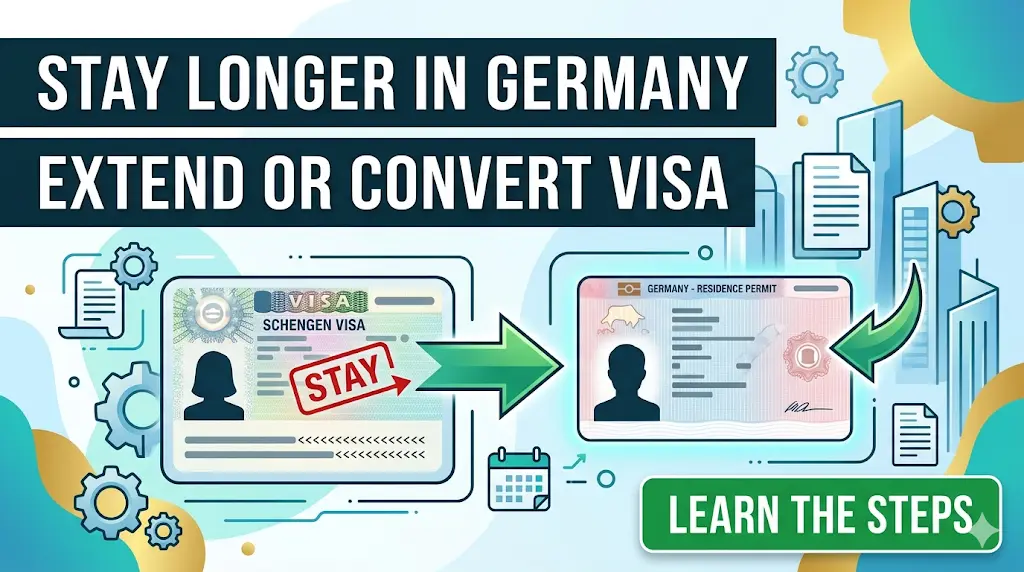
Extending a Schengen Visa in Germany
Exceptional Circumstances for Extension
Let me be entirely straightforward with you: the Ausländerbehörde (Foreigners’ Authority) only grants extensions for Schengen visas under highly exceptional, legally defined circumstances. The first category is “Force Majeure” (higher force). This includes events completely outside your control that physically prevent you from leaving Germany, such as a volcanic eruption grounding all flights, an extreme natural disaster, or a sudden, unexpected pandemic border closure.
The second category is “Humanitarian” or “Serious Personal Reasons.” This is the most common avenue for emergency extensions. If you are involved in a severe car accident and are hospitalized, the government will not deport you; your visa will be extended until you are medically fit to travel. Similarly, if an immediate family member living in Germany suddenly passes away or falls critically ill, authorities will usually grant an extension to allow you to handle the affairs or provide care.
What absolutely does not count as an exceptional circumstance? Missing your flight because you overslept, wanting to attend a festival that occurs after your visa expires, or needing extra time to look for an apartment. The burden of proof is entirely on you to demonstrate that leaving the country on your scheduled departure date is either physically impossible or would cause extreme, unreasonable hardship.
The Bureaucratic Process at the Immigration Office
If you find yourself in an emergency that justifies an extension, you cannot handle this at the airport or through the embassy of your home country. Schengen visa extensions must be processed by the local Ausländerbehörde in the German city where you are currently staying. You must initiate this process before your current 90-day limit expires. Waiting until day 91 makes you an illegal overstayer, complicating an already difficult process.
The first step is securing an appointment. Since emergencies do not wait for the standard 3-month appointment backlog, you must contact the emergency desk of the Ausländerbehörde or show up in person very early in the morning (often before doors open) with all your documentation. You must bring your passport, your current visa, and rock-solid proof of the emergency.
If your extension is approved due to Force Majeure or humanitarian reasons, the process is usually free of charge. If it is approved for serious personal reasons (a slightly lower threshold), you may be charged an administrative fee of €30. The extension will only cover the exact amount of time necessary to resolve the emergency. It is not a blanket 90-day renewal.
Essential Documents Needed for an Extension
Walking into the Ausländerbehörde without comprehensive, flawlessly organized documentation is a recipe for rejection. At a minimum, you need your valid passport with the original Schengen visa, a biometric photograph meeting German standards, and proof of ongoing financial support for the extended period. If your original flight was canceled, you need the official airline documentation proving it.
Crucially, if your emergency is medical—whether it is your own illness or a family member’s—you must provide official letters from German hospitals or licensed doctors. If you are relying on documents from outside Germany (for instance, proving the death of a relative back home), these documents cannot simply be handed over in their original language.
You must use a recognized, certified translation service to translate these documents into German. I highly recommend using Lingoking for this. When I was stuck dealing with foreign medical records, Lingoking provided a sworn translation recognized by the German authorities within days, saving my application. If you need a deeper understanding of this process, read our guide on Legalizing and Translating Documents for German Visa Applications.
Converting a Schengen Visa to a Residence Permit
Who is Eligible for an In Country Conversion
The golden rule of German immigration law is this: you must enter the country with the correct visa for your intended purpose. If you plan to work, study, or live in Germany permanently, you are required to apply for a National D-Visa at the German embassy in your home country before you travel. Therefore, generally speaking, converting a Schengen tourist visa (Type C) to a long-term residence permit (Aufenthaltserlaubnis) from within Germany is strictly forbidden.
The reasoning is simple. The German government does not want people bypassing the rigorous background, financial, and qualification checks of the embassy by simply flying in as tourists and demanding to stay. If you arrive on a tourist visa, find a job, and try to apply for a work permit at the local Ausländerbehörde, you will almost certainly be told to fly back to your home country and apply properly through the embassy.
However, because immigration law is highly complex, there are critical exceptions to this rule based on nationality and, occasionally, highly specific personal circumstances. Understanding these nuances is the difference between starting your new life in Germany and being forced onto an expensive flight home. You can explore the general pathways to long-term stays in our guide on Switching Visa Types in Germany: Student to Work, Tourist to Freelance, etc..
The Privileged Nations Exception
The most significant exception to the “no in-country conversion” rule relies on your passport. Section 41 of the German Residence Ordinance (Aufenthaltsverordnung) grants special privileges to citizens of specific countries. These countries are often colloquially called the “best friend” nations.
If you are a citizen of the United States, Australia, Canada, Israel, Japan, New Zealand, South Korea, or the United Kingdom, you are exempt from the requirement to enter with a D-Visa. You can enter Germany visa-free as a tourist (or on a standard Schengen entry), look for a job, apply to university, or decide to freelance, and then apply directly for a long-term residence permit at your local Ausländerbehörde before your 90 days run out.
This is a massive advantage. However, even if you hold one of these privileged passports, you must still meet all the standard requirements for the residence permit you are seeking. You cannot simply apply to stay just because you want to; you need a valid work contract, university admission, or family reunification basis.
| Circumstance / Origin | Can Apply from Within Germany? | Must Leave Schengen if Denied? |
| Non-Privileged Nation (Tourist Entry) | No (Must apply from home country) | Yes |
| Privileged Nation (USA, UK, Canada, etc.) | Yes (Under Section 41 AufenthV) | Yes |
| Holders of an existing German D-Visa | Yes (For extensions/status changes) | Yes |
| EU/EEA Citizens | Yes (Freedom of Movement) | No (Subject to EU rules) |
Legal Loopholes and Special Cases
What if you are not from a privileged nation, but you are already in Germany on a Schengen visa and your life circumstances drastically change? Section 39 of the Aufenthaltsverordnung outlines a few very narrow legal exceptions where an in-country conversion might be tolerated.
One of the most common scenarios is marriage. If you enter Germany on a Schengen visa and unexpectedly marry a German citizen or a permanent resident, you might be allowed to apply for a family reunification residence permit without leaving. However, authorities are highly suspicious of this. They often assume the marriage was pre-planned to bypass visa laws. To succeed, you must usually prove that the decision to marry was truly spontaneous and that forcing you to return to your home country for a visa process would be an unreasonable hardship.
Another incredibly rare exception involves highly qualified employment. Sometimes, if a non-privileged citizen finds an extraordinarily specialized, highly paid job while visiting Germany, and the employer can prove that waiting for the worker to return home and process a D-Visa would severely damage the company, the Ausländerbehörde might make a discretionary exception. But remember: this is entirely at the discretion of the case worker, and you should never rely on it as a primary plan.
Crucial Preparation Steps for Extension or Conversion
Securing Recognized Health Insurance
Whether you are applying for a short emergency extension or a full conversion to a residence permit, your travel insurance from home will likely not be enough. Standard travel insurance is designed to cover emergencies and repatriate you if you break a leg; it does not meet the strict legal requirements of the German healthcare system for residents.
If you are applying for a residence permit, you must show proof of comprehensive health insurance that aligns with BaFin (Federal Financial Supervisory Authority) standards. This usually means securing German public health insurance (Gesetzliche Krankenversicherung) or a BaFin-approved private policy. Showing up at the Ausländerbehörde with a cheap backpacker policy is the number one reason applications are rejected on the spot.
I strongly recommend using Feather Insurance when navigating this transition. They specialize in expats and offer both public and approved private options with full English support. Using Feather Insurance ensures that the certificate you hand to the immigration officer explicitly states that your coverage meets all legal requirements for a residence permit. You can find more details in our deep dive on Medical Insurance for German Visa Applications: What You Need.
Translating and Legalizing Vital Documents
Any time you ask the German government to alter your legal status, you must prove your identity, qualifications, and civil status. This means providing birth certificates, university degrees, and potentially marriage certificates. The catch is that German bureaucrats operate exclusively in German.
If your documents are in English, some exceptionally lenient case workers might accept them, but you are playing with fire. If they are in any other language, they absolutely must be translated. You cannot translate them yourself, nor can your bilingual friend. You need a certified, sworn translator recognized by the German courts.
This is where services like Lingoking are indispensable. They connect you with legally recognized translators who attach the necessary sworn seals to your documents. Furthermore, depending on your home country, you may also need an “Apostille”—a specific international certification of authenticity—before the translation is even done. Getting these translations right is non-negotiable.
Proving Financial Stability
The German state wants absolute assurance that you will not become a burden on their social welfare system. If you are converting to a student visa or a job-seeker visa, you cannot simply show a screenshot of your foreign savings account. You must prove financial stability through highly specific, state-approved methods.
For students and job seekers, the most common requirement is a Sperrkonto, or blocked account. This is a special German bank account where you deposit a required sum (currently over €11,000 for a year), and the bank only allows you to withdraw a set monthly amount. Setting this up traditionally took weeks of paperwork.
Today, digital providers are the standard. Setting up an account with Expatrio takes just a few hours online, and they provide the exact, officially formatted confirmation document the Ausländerbehörde demands. Walking into your appointment with your Expatrio confirmation letter eliminates one of the biggest hurdles of the conversion process. To fully understand your financial requirements, consult our guide on Proof of Financial Means for Visas: Blocked Accounts and Sponsorship Letters.
Navigating the Immigration Office Appointment
Booking the Impossible Appointment
If you are eligible to convert your visa (for example, you hold a privileged passport), your biggest enemy is time. You must apply before your 90-day Schengen clock runs out. However, booking an appointment at the Ausländerbehörde in major cities like Berlin, Munich, or Frankfurt is notoriously difficult. The booking portals are often completely booked for months in advance.
You must treat finding an appointment like a job. Check the portals early in the morning, usually right when the office opens, to catch canceled slots. If you absolutely cannot find an appointment and your 90 days are expiring, you must prove you tried. Take screenshots of the empty booking portals.
Many cities allow you to submit your application via an online contact form, email, or even registered postal mail if you cannot secure a face-to-face appointment in time. Doing so before your visa expires officially registers your request with the system and legally protects your stay while you wait. For more tactical advice on dealing with these offices, review Navigating the Ausländerbehörde: Tips for Dealing with German Immigration Offices.
What Happens During the Face to Face Meeting
When the day of your appointment finally arrives, arrive early and bring everything. Bring originals and at least two copies of every document. The environment in the Ausländerbehörde is strictly professional and highly bureaucratic. Do not expect the case worker to be overly friendly or chatty; they are processing hundreds of complex cases under immense pressure.
Crucially, you must be prepared for the fact that the officer might not speak English—or may refuse to speak English for liability reasons. All official, legally binding conversations must happen in German. If your German is not at a conversational B1/B2 level, you must bring a German-speaking friend, colleague, or hired interpreter with you.
The officer will review your file, ask questions about your intentions in Germany, check your health insurance and financial proof, and take your fingerprints. If your file is perfect, they will process the application. If a document is missing, they will usually give you a deadline to submit it, pausing your application in the meantime.
Dealing with Temporary Extension Certificates
If you manage to secure an appointment or submit your application before your 90-day Schengen limit expires, but the Ausländerbehörde needs time to process your residence permit, they will issue you a document that essentially saves your legal life. This is called a Fiktionsbescheinigung (Fiction Certificate).
A Fiktionsbescheinigung acts as a bridge. It formally states that your legal right to remain in Germany is extended under the same conditions as your previous visa until a final decision is made on your residence permit application. It proves to the police, landlords, and employers that you are not in the country illegally.
However, you must read the fine print on this document carefully. Depending on the exact legal paragraph it is issued under (usually § 81 Abs. 3 or 4 of the Residence Act), it dictates whether you are allowed to leave Germany and re-enter, and whether you are allowed to work. Never lose this piece of paper. If you want to understand exactly how this bridge document functions, read our breakdown: What is a Fiktionsbescheinigung? Temporary Residence Explained.
References
Primary sources (official)
- Federal Foreign Office (Auswärtiges Amt) – Schengen Visas: https://addis-abeba.diplo.de/et-de/service/05-visaeinreise/schengen-visa-2515720
- Federal Ministry of the Interior and Community (BMI) – Visa Policy: https://www.bmi.bund.de/EN/topics/migration/law-on-foreigners/visa-policy/visa-policy.html
- Make it in Germany (Official Portal) – Opportunity Card: https://www.make-it-in-germany.com/en/visa-residence/opportunity-card/job-search
Other helpful sources
- Jobbatical – Germany Work Permit Renewals: https://www.jobbatical.com/services/germany-work-visa-qualified-employment-permit-renewals
- Migaku – Germany Chancenkarte 2026: https://migaku.com/blog/language-fun/germany-chancenkarte-opportunity-card-2026-requirements
Disclaimer
The information provided in this guide is for general informational purposes only and is based on the experiences of expats navigating the German immigration system. Immigration laws, visa policies, and Ausländerbehörde procedures are complex and subject to frequent changes. This article does not constitute legal advice. Always consult the official German Federal Foreign Office, your local Ausländerbehörde, or a certified immigration lawyer for the most current, legally binding requirements and procedures regarding your specific situation before taking action.