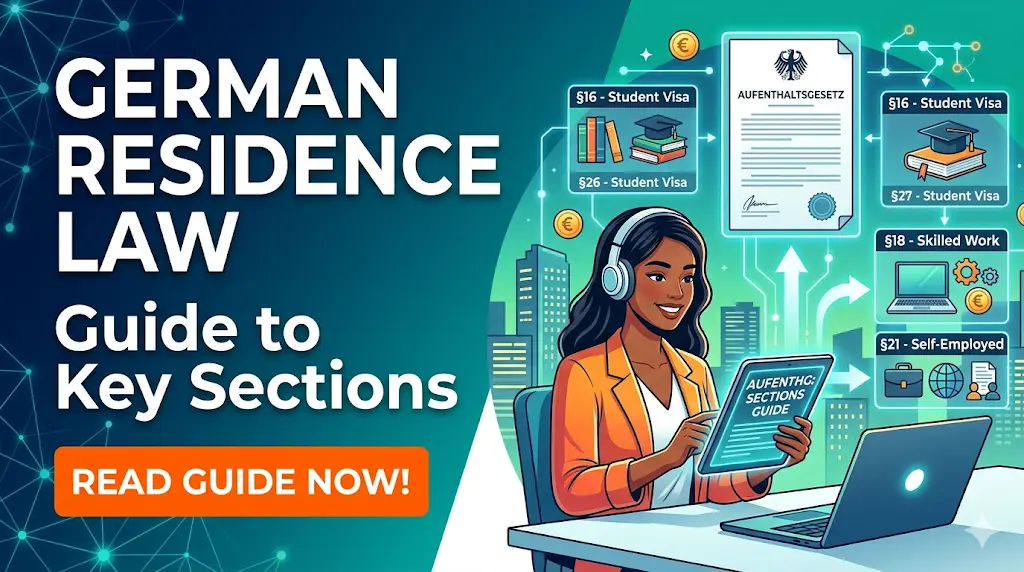
Understanding Residence Act (AufenthG) Sections: Key Laws for Expats
Staring at your German visa and seeing a cryptic code like Section 18b instead of plain instructions is a terrifying introduction to local bureaucracy. I spent my first year panicked that accepting a simple side gig would accidentally violate the obscure paragraph printed on my card. This guide decodes the crucial Residence Act sections to protect your legal status.
Disclosure: This post may contain affiliate links. We may earn a commission at no extra cost to you if you make a purchase through these links. Read full disclosure.
The Core Foundation of the Aufenthaltsgesetz
When expats talk about German immigration law, they are almost exclusively referring to the Aufenthaltsgesetz, commonly abbreviated as the AufenthG. This massive legislative document, officially known as the Residence Act, dictates the entry, stay, and economic activity of every single non-EU national in the country.
Decoding Your Legal Identity
Every physical residence permit card issued in Germany contains a specific legal paragraph code printed on its face or on the supplementary green sheet. This section number is not just administrative trivia; it is your absolute legal identity. It dictates whether your children get state benefits, how many hours you are allowed to work, and if you are tied to a specific employer. Misunderstanding this code is the fastest way to accidentally commit visa fraud.
If you attempt to perform freelance work while holding a permit that strictly authorizes standard employment, the immigration office will flag your file and can legally revoke your residency. Knowing exactly what your specific section allows is a foundational survival skill, a reality decoded extensively in Understanding German Residence Permit Labels 18 19c etc.
The Notorious Fiction Certificate Section 81
One of the most anxiety-inducing experiences for foreigners is watching their current visa approach its expiration date while waiting months for a renewal appointment at the immigration office. This is where Section 81 of the AufenthG becomes your ultimate lifeline.
Under Section 81, if you apply for a visa renewal before your current permit expires, your existing residency rights are legally extended until the authorities make a final decision. To prove this, the office issues a Fiktionsbescheinigung (Fiction Certificate). This bridging document legally protects your right to remain in the country and keep your current job, but the specific paragraph printed on it determines if you are allowed to cross international borders. Surviving these stressful administrative gaps requires a deep understanding of German Visa and Residence Permit Renewal: How Early Should You Apply?.
Essential Work and Study Permit Sections
For the vast majority of skilled international workers and students arriving in Germany, securing a legal foothold requires navigating highly specific academic and professional pathways outlined in the Residence Act.
The Skilled Worker Visas Sections 18a and 18b
If you are moving to Germany for a standard corporate job, you will likely fall under Section 18a or 18b. Section 18a is specifically designed for skilled workers possessing a recognized vocational training qualification. Section 18b is the equivalent permit for professionals holding a recognized academic university degree.
To qualify for these permits, the German government demands undeniable proof that your foreign qualifications meet local standards. If your university diploma is printed in your native language, handing it to a German caseworker will result in an immediate rejection. You must use legally sworn, certified translations. Relying on Lingoking is the safest way to clear this hurdle. Because Lingoking utilizes court-sworn translators officially recognized by the state, providing their translated documents guarantees the caseworker can accurately verify your academic background.
The EU Blue Card Section 18g
The absolute premier work permit in Europe is the EU Blue Card, recently restructured under Section 18g of the AufenthG. This permit is reserved for highly qualified professionals earning a premium salary.
The greatest advantage of Section 18g is that it places you on an accelerated track to permanent settlement, allowing you to bypass years of bureaucratic waiting. It also grants incredible pan-European mobility rights after your first year. However, securing it requires your employment contract to meet strict statutory minimum salary thresholds, a complex calculation mapped out in How to Apply for the EU Blue Card in Germany.
Student Visas and Job Seekers Sections 16b and 20
If you are arriving to study at a German university, you will be issued a permit under Section 16b. This section strictly limits your labor market access, generally allowing you to work only 140 full days per calendar year. If you are arriving without a job offer to hunt for work, you will utilize the points-based Opportunity Card under Section 20.
Both of these sections require you to prove you have enough liquid capital to survive without relying on the German welfare state. The government mandates that these funds be placed in a frozen blocked account. Attempting to open one from abroad using legacy banks is an agonizing process. Veteran expats completely bypass this friction by using Expatrio. Setting up your legally mandated blocked account through Expatrio is a fully digital process that instantly generates the financial confirmation PDF the embassy demands. Handing the consular officer your Expatrio certificate definitively proves your financial solvency. The exact points requirements for these job seeker pathways are heavily detailed in Job Seeker Visa: Your Ticket to Finding Work in Germany.
Navigating Self Employment and Family Visas
Not every expat wants to work a standard corporate job, and many arrive with dependents. The AufenthG handles independent workers and trailing spouses with entirely different levels of scrutiny.
Freelancers and Entrepreneurs Section 21
If you want to be your own boss, you must apply under Section 21. This section draws a massive, legally binding line between a freelancer working in a liberal profession and a commercial self-employed entrepreneur running a business.
Entrepreneurs face an incredibly high burden of proof. They must submit comprehensive business plans demonstrating regional economic impact. If your business plan is in English, you must have it translated into professional business German. Using Lingoking ensures your complex financial projections and market analyses are translated with the exact corporate terminology the local Chamber of Commerce expects to see.
Furthermore, securing a Section 21 permit is impossible without compliant health insurance, and public insurers frequently reject newly arrived freelancers. To bridge this gap, self-employed expats turn to Feather Insurance. Feather Insurance provides specialized expat policies and issues the exact German-language insurance certificates the immigration office demands to greenlight your freelance application. Understanding the strict categorization of these independent professions is deeply analyzed in Freelancing in Germany: A Guide to the Freiberufler Visa and Visa Requirements for Freelancers vs Entrepreneurs: Differences Explained.
Family Reunification Sections 28 to 32
If you hold a valid German residence permit, your spouse and minor children have a legal right to join you under Sections 28 through 32 of the Residence Act.
The greatest perk of the spousal reunification visa is that it usually grants your partner unrestricted access to the German labor market, even if they do not hold a university degree themselves. However, the embassy requires absolute proof that your marriage is legally valid. You must obtain certified translations of your civil documents. Using Lingoking ensures your marriage certificates are translated to the exact legal specifications required by the immigration authority, preventing your family from being separated by bureaucratic technicalities. Navigating the logistics of moving your entire household is a massive undertaking outlined in Bringing Your Family to Germany: The Family Reunification Visa.
| AufenthG Section | Visa Category | Primary Target Group | Labor Market Access |
| Section 16b | Student Visa | International university students | Strictly limited (140 full days/year) |
| Section 18b | Skilled Worker | Academic degree holders | Tied to specific employer initially |
| Section 18g | EU Blue Card | High-earning specialized professionals | Tied initially, accelerated permanent rights |
| Section 20 | Opportunity Card | Job seekers meeting points threshold | Part-time work permitted during search |
| Section 21 | Self-Employment | Freelancers and business founders | Strictly limited to approved business plan |
Requirements for Upgrading Your Status
Securing your initial temporary residence permit is merely the first phase. The ultimate goal for almost every international worker is to transition away from temporary sections and secure a permanent legal foundation.
Mandatory Health Insurance and Financial Proofs
Throughout your time in Germany, the immigration office will constantly audit your compliance. Whenever you attempt to renew a temporary permit, they will scrutinize your financial and medical records.
If you are a student transitioning to a work visa, you must prove you have graduated and secured a valid contract. If you are a job seeker transitioning to an employment permit, you must prove you successfully utilized your Expatrio blocked account funds and are now financially independent. Most critically, any gap in your health insurance coverage is grounds for immediate visa rejection. By consistently managing your coverage through Feather Insurance, you ensure your policy remains compliant through every visa transition, generating the undeniable proof of coverage required for every renewal. Understanding how these systems interlock is mapped out in Public vs Private Health Insurance in Germany: Which is Right for You?.
Reaching Permanent Settlement Section 9
The holy grail of German immigration is trading your temporary permit for a Section 9 Niederlassungserlaubnis (Settlement Permit).
A Section 9 permit grants you an unlimited, permanent right to live and work in Germany. You are completely freed from the dreaded employer tie, meaning you can quit your job, start your own business, or remain unemployed without the government threatening to revoke your visa. Depending on your current permit tier, you can apply for a Section 9 permit after living in Germany for 21 to 60 months, provided you have paid into the statutory pension system and demonstrated German language proficiency. Preparing for this ultimate bureaucratic upgrade is a complex process thoroughly detailed in Understanding the German Immigration Terminology: From Aufenthaltstitel to Niederlassungserlaubnis.
References
Primary sources official
- Gesetze im Internet – Aufenthaltsgesetz (AufenthG): The complete, translated legal text of the German Residence Act provided by the Federal Ministry of Justice. This is the absolute statutory source for every visa paragraph mentioned. https://www.gesetze-im-internet.de/englisch_aufenthg/
- Make it in Germany – Visa and Residence: The official federal government portal for skilled professionals, breaking down the plain-English prerequisites for Sections 18b, 18g, and 20. https://www.make-it-in-germany.com/en/visa-residence
Other helpful sources
- Federal Office for Migration and Refugees (BAMF): Comprehensive official overviews of the legal preconditions for entering, living, working, and studying in Germany under the various sections of the Residence Act. https://www.bamf.de/EN/Themen/MigrationAufenthalt/migrationaufenthalt-node.html
- Settle in Berlin – German Visa Types Explained: A highly practical expat guide translating the dense legal jargon of the AufenthG into actionable advice for navigating the immigration office appointments. https://www.settle-in-berlin.com/germany-visa/
Disclaimer
The information provided in this article is for general informational and educational purposes only and does not constitute professional legal, tax, or immigration advice. German residency laws under the Aufenthaltsgesetz (AufenthG), specifically regarding the strict labor limitations of student visas (Section 16b) and the rigid business plan requirements for self-employment (Section 21), are highly complex and strictly enforced by local immigration authorities (Ausländerbehörden). Violating the explicit conditions tied to your specific legal section can result in the immediate revocation of your residence title and subsequent deportation. Always consult a certified German immigration lawyer (Fachanwalt für Ausländerrecht) regarding your specific long-term settlement strategy.