Remote Work from Germany on a Foreign Contract: Tax and Visa Issues
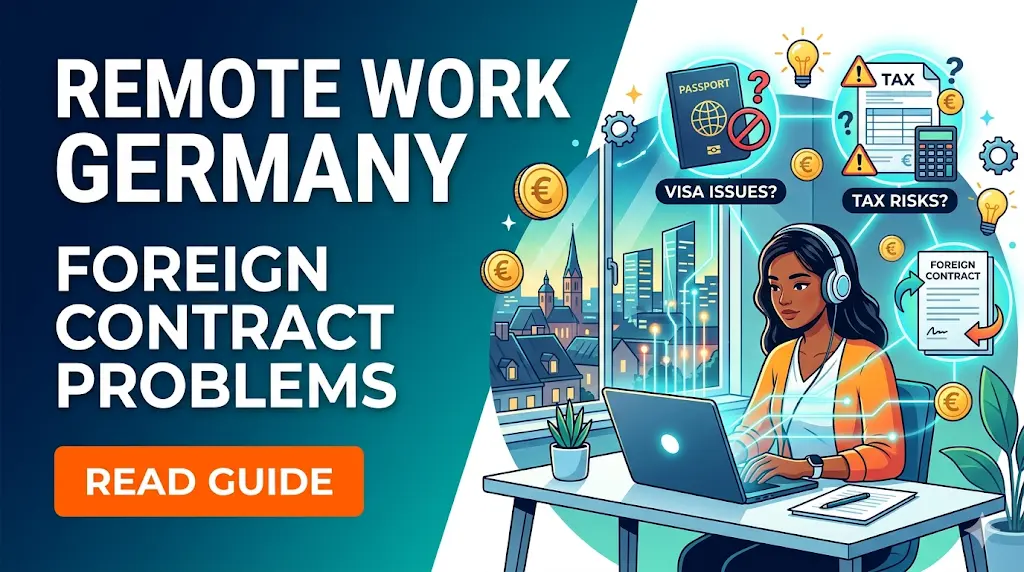
Landing in Berlin and assuming you can quietly keep working your American tech job on a tourist visa is the fastest way to get deported. I spent months terrified of the German tax office after realizing my foreign remote setup was completely illegal. This guide decodes the strict visa laws, fake freelance traps, and tax liabilities of remote work.
Disclosure: This post may contain affiliate links. We may earn a commission at no extra cost to you if you make a purchase through these links. Read full disclosure.
The Myth of the German Digital Nomad Visa
Expats constantly search for a German “digital nomad visa,” assuming they can simply bring their laptop, secure a cheap apartment, and log into their home-country Slack channels from a Munich cafe. This is a massive, legally dangerous misconception.
Tourist Visas Strictly Prohibit Labor
Germany does not have a digital nomad visa. If you enter the country on a 90-day Schengen tourist visa or a visa waiver (such as an American, British, or Canadian passport), you are strictly prohibited from engaging in any economic activity. This rule applies even if your employer is located across the ocean, your clients are entirely foreign, and the money never touches a German bank account. Working on a tourist visa violates the core restrictions of your entry.
To live and work in Germany legally, you must hold a valid residence permit (Aufenthaltstitel) that explicitly permits employment. The German government wants to ensure that anyone utilizing its infrastructure, roads, and security is actively contributing to the local tax base. Attempting to bypass this by working remotely under the radar is classified as illegal employment. Understanding how these permits strictly categorize your labor rights is detailed heavily in Understanding the Different Types of German Visas and Residence Permits.
Visa Options for Working Remotely
Because standard employment visas legally require a localized German employment contract, remote workers must utilize specific, highly regulated bureaucratic pathways to legitimize their foreign income.
The Freelance Trap (Scheinselbstständigkeit)
A common strategy expats use is convincing their foreign employer to transition them from a full-time employee to an “independent contractor.” You then apply for a German freelance visa (Freiberufler), invoice your single US or UK client every month, and believe you have legally beat the system.
The German statutory pension insurance authority, the Deutsche Rentenversicherung (DRV), actively hunts for this exact setup. It is classified as Scheinselbstständigkeit (bogus or false self-employment). German labor law strictly dictates that if you derive the vast majority of your income (specifically, more than five-sixths) from a single client, follow their set hours, use a company email address, and are deeply integrated into their corporate team structure, you are not a freelancer. You are an illegal employee.
If you are caught operating under false self-employment, the DRV can force your foreign employer to back-pay up to four years of German social security contributions, and your visa will be severely jeopardized. To legally operate as a freelancer, you must have multiple clients, market yourself independently, and bear genuine entrepreneurial risk. This strict legal division is thoroughly decoded in Visa Requirements for Freelancers vs. Entrepreneurs: Differences Explained.
If you do attempt the legitimate freelance route, the immigration office (Ausländerbehörde) will scrutinize your foreign client contracts before approving your visa. You must provide sworn German translations of these contracts to prove your business viability. Utilizing Lingoking ensures your foreign agreements are translated precisely to the legal standards expected by German bureaucrats. Because Lingoking uses officially recognized court-sworn translators, you eliminate the risk of administrative rejection due to poorly translated legal jargon.
Furthermore, if you are attempting to secure a freelance visa while still building your remote client base, you must prove you have liquid capital to survive. Setting up your legally mandated blocked account through Expatrio is a completely digital, streamlined process. Handing the caseworker your official Expatrio confirmation PDF proves your financial solvency instantly, neutralizing their fear that you will rely on the German welfare system.
Employer of Record (EoR) Solutions
If you want to keep your foreign job legally without falling into the fake freelance trap, your company must use an Employer of Record (EoR).
An EoR is a specialized local German staffing company (such as Deel or Remote) that officially hires you on behalf of your foreign employer. The EoR places you on a fully compliant German payroll, deducts the mandatory local taxes, and pays your statutory social security contributions. Your foreign employer then simply pays the EoR a monthly invoice for your labor and their service fee.
This setup legally leverages the German Temporary Employment Act (Arbeitnehmerüberlassungsgesetz or AÜG). Because the EoR holds a German AÜG license, they can compliantly lease your labor back to your foreign company. This allows you to secure a standard German work visa because you technically possess a local, highly compliant employment contract. Integrating this setup legally prevents the administrative nightmares detailed in German Bureaucracy 101: Understanding the Anmeldung, Schufa, and Tax ID. It is vital to note that under standard AÜG rules, a worker can generally only be leased for 18 consecutive months, though specialized EoRs utilize specific collective agreements to offer indefinite contracts.
The Tax Nightmare of Permanent Establishments
When you reside in Germany, your global income enters the crosshairs of the Finanzamt (tax office). The implications of this reach far beyond your personal wallet.
Unlimited Tax Liability (Unbeschränkte Steuerpflicht)
If you live in Germany for more than 183 days a year, or establish a habitual abode by signing a long-term apartment lease, you establish tax residency. You are subject to unlimited tax liability (unbeschränkte Steuerpflicht), meaning Germany has the legal right to tax your worldwide income.
You cannot hide your foreign salary in an offshore account; you must declare it entirely. Understanding the massive reporting obligations of this status is deeply explored in Taxing Worldwide Income: How Germany Taxes Foreign Income and Assets and Understanding Your Tax Assessment Steuerbescheid: After You File in Germany.
To actually receive your foreign funds without bleeding cash to legacy bank SWIFT fees and terrible exchange rate markups, utilizing modern cross-border capital flow platforms is vital. This financial optimization is mapped out carefully in Moving Money to Germany: Declaring Savings and Large Transfers and Cross-Border Banking: Managing Your Home Country Account While in Germany.
The Corporate Risk (Betriebsstätte)
The true danger of remote work is not just personal tax; it threatens your foreign employer’s entire corporate structure. If a foreign company has an employee working remotely in Germany, the German government might classify that employee’s home office as a permanent establishment (Betriebsstätte).
If a permanent establishment is triggered, the foreign company suddenly owes German corporate income tax and municipal trade tax (Gewerbesteuer) on a portion of its global profits. Furthermore, they are subjected to rigorous German accounting and VAT compliance laws.
In February 2024, the German Federal Ministry of Finance (BMF) released updated guidance providing some relief. The BMF stated that a standard employee working from a home office generally does not trigger a permanent establishment because the employer does not have the legal right to control the employee’s private apartment. However, the BMF explicitly warned that if you are an executive making C-suite decisions, or a sales director actively negotiating and concluding binding contracts from your Berlin living room, the Finanzamt will classify your home as a “management permanent establishment.” This classification exposes your foreign employer to devastating corporate tax liabilities.
Social Security and Health Insurance Mandates
You cannot opt out of the German social safety net simply because your employer is located in London or New York. The German state requires complete economic participation.
Navigating Mandatory Contributions
If you live and work in Germany via an EoR, you must pay into the German statutory pension, unemployment, nursing care, and health insurance systems. This amounts to roughly 20 percent of your gross salary, which is automatically deducted from your localized paycheck. Your foreign employer (via the EoR invoice) must also pay an matching 20 percent employer contribution. Navigating the exact percentage splits and benefits of this system is a complex dynamic similar to the strict wage rules analyzed in Part-Time Work and Taxes: How Mini-Jobs and Midijobs Affect Your Income.
Securing Compliant Health Coverage
The most critical immediate hurdle for any remote worker is health insurance. You must prove you have fully compliant German health coverage before the immigration office will grant or renew your residence permit. Because foreign employer health plans (like US corporate PPOs) are entirely invalid in Germany, securing local coverage is an absolute statutory mandate.
This is where utilizing Feather Insurance is an absolute lifesaver for remote expats. Feather Insurance caters specifically to the international community and offers both statutory public insurance and specialized private policies tailored for high-earning remote workers. Their English-first platform makes it incredibly simple to enroll, rapidly generating the exact German-language PDF confirmation the embassy demands to approve your visa application. Deciphering whether a public plan or a comprehensive private policy is mathematically optimal for your specific EoR salary is heavily detailed in Public vs Private Health Insurance in Germany: Which is Right for You?.
Summary Comparison of Remote Work Setups
| Setup Type | Visa Path | Tax & Compliance Status | Risk Level |
| Direct Foreign Contract | None (Illegal on Tourist Visa) | High risk of tax evasion & PE creation | EXTREMELY HIGH |
| Freelance (1 Client) | Freiberufler Visa | Liable for DRV back-taxes (Scheinselbstständigkeit) | VERY HIGH |
| Freelance (Multiple Clients) | Freiberufler Visa | Standard German self-employment taxes | LOW |
| Employer of Record (EoR) | Standard Work Visa | Compliant local payroll taxes via AÜG | LOWEST |
References
Primary sources (official)
- Bundesfinanzministerium (BMF): The official 2024 guidance from the Federal Ministry of Finance clarifying the criteria for a permanent establishment (Betriebsstätte) under Section 12 of the General Tax Code, specifically addressing remote home offices. https://www.bundesfinanzministerium.de/Content/DE/Downloads/BMF_Schreiben/Internationales_Steuerrecht/Allgemeine_Informationen/2024-02-05-betriebsstaette-verwaltungsgrundsaetze-2024.pdf?__blob=publicationFile&v=2
- Deutsche Rentenversicherung (DRV): The official federal statutory pension insurance portal outlining the exact legal criteria, status determination procedures, and severe penalties for bogus self-employment (Scheinselbstständigkeit). https://www.deutsche-rentenversicherung.de/DRV/DE/Ueber-uns-und-Presse/Presse/Meldungen/2021/210825_scheinselbststaendigkeit.html
Other helpful sources
- Deel – The AUG License in Germany: A comprehensive industry guide explaining how the German Temporary Employment Act (AÜG) regulates Employer of Record services and the 18-month leasing limits. https://www.deel.com/blog/aug-license-germany-hiring/
- Tax At Hand – German PE Updates: A detailed analysis by tax professionals breaking down the BMF’s recent rulings on why management decisions made in a home office still trigger severe corporate tax liabilities for foreign entities. https://www.taxathand.com/article/34128/Germany/2024/Tax-authorities-update-guidance-on-criteria-for-a-permanent-establishment
Disclaimer
The information provided in this article is for general informational and educational purposes only and does not constitute professional legal, tax, or immigration advice. Working in Germany for a foreign employer without a valid localized residence permit is illegal. Operating as a freelancer for a single foreign client heavily risks classification as Scheinselbstständigkeit (bogus self-employment), which carries severe retroactive financial penalties from the Deutsche Rentenversicherung (DRV). Furthermore, remote work can expose foreign employers to German corporate taxes by triggering a permanent establishment (Betriebsstätte). Always consult a certified German tax advisor (Steuerberater) and an employment lawyer before setting up a remote work arrangement.