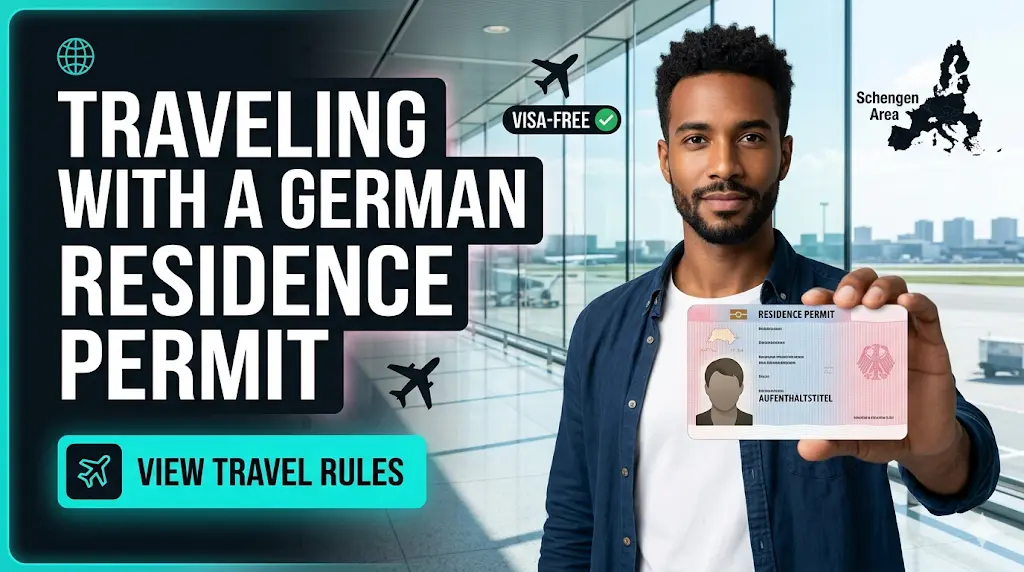
Traveling with a German Residence Permit: Visa-Free Access and Limitations
Staring at border control with nothing but a passport and a temporary German residence document is a uniquely terrifying experience. I remember sweating profusely at a London boarding gate when the airline staff scrutinized my plastic card for twenty minutes before finally letting me on the plane. This comprehensive guide breaks down exactly where you can travel with your German residence permit, the strict legal boundaries you must observe, and how to avoid getting stranded abroad.
Disclosure: This post may contain affiliate links. We may earn a commission at no extra cost to you if you make a purchase through these links. Read full disclosure.
Understanding the Power of Your Residence Permit
What Your Permit Actually Is (and Isn’t)
A German residence permit, whether it is an EU Blue Card, a student visa, or a freelance permit, is fundamentally a document that grants you the legal right to live, work, or study within the borders of the Federal Republic of Germany. It is issued by the local immigration office and is physically represented by a plastic electronic card containing your biometric data. This card elevates your status far beyond that of a standard tourist, intertwining your legal presence with the German state.
However, it is crucial to understand what this permit is not. It is not a German passport, and it does not grant you German citizenship. Therefore, your primary travel document remains the passport issued by your home country. Your German residence permit acts as a powerful supplementary document that waives the entry visa requirements for certain countries, but it must always be presented alongside your valid national passport. If you show up to an international border with just your residence permit, you will be turned away.
Many expats mistakenly believe that securing a permanent settlement permit gives them the unfettered right to move anywhere in Europe permanently. This is absolutely false. Unless you hold a specific “EU Long-Term Residence Permit,” your German permanent residency is only permanent in Germany. It does not allow you to pack up and move to France or Spain to look for work without undergoing their separate national immigration processes. To fully grasp the nuances of your legal status, refer to our guide on Understanding the Blue Card Requirements.
The Schengen Area vs The European Union
One of the most persistent points of confusion for expats is the difference between the European Union (EU) and the Schengen Area. They are two distinct entities, and your German residence permit interacts with them differently. The European Union is an economic and political union, while the Schengen Area is a pact between specific countries to abolish internal border controls and establish a common visa policy.
Your German residence permit grants you travel privileges based on the Schengen Agreement, not the EU. Currently, the Schengen Area consists of 29 countries. This includes most EU states, but importantly, it also includes non-EU countries like Switzerland, Norway, Iceland, and Liechtenstein. Conversely, there are EU member states like Ireland and Cyprus that are not fully integrated into the Schengen Area.
If you attempt to fly from Berlin to Dublin using only your German residence permit and a passport from a country that normally requires an Irish visa, you will be denied boarding. Ireland enforces its own separate border controls and visa policies. Always check the specific Schengen status of your destination country, even if it uses the Euro or flies the EU flag.
The 90 180 Day Rule for Residents
Just because you have a German residence permit does not mean you have unlimited, borderless access to the rest of Europe. When you leave Germany to visit another Schengen country, your status temporarily reverts to that of a tourist. As a tourist in France, Italy, or Spain, you are legally bound by the famous 90/180-day rule, regardless of how long you have lived in Germany.
This EU law dictates that you can only spend a maximum of 90 days within any rolling 180-day period in Schengen countries outside of Germany. The 180-day window is constantly moving backward from your current date. Because there are no hard borders between Schengen countries, many expats assume this rule is unenforceable. However, if you are stopped by police, involved in an accident, or required to show your ID at a hotel, authorities can calculate your days.
If you are caught exceeding this 90-day limit in another Schengen state, you are considered an illegal overstayer in that specific country, even though your German residency remains valid. This can result in fines, deportation back to Germany, and severe complications when you eventually try to renew your German permit. It is your responsibility to track your travel days meticulously.
Countries You Can Visit Visa Free
Unrestricted Travel Within the Schengen Zone
The greatest immediate benefit of your German residence permit is the ability to travel seamlessly throughout the entire Schengen Area for tourism, visiting friends, or attending short business conferences. You do not need to apply for a separate Schengen tourist visa, pay entry fees, or undergo consular interviews.
When you book a flight from Munich to Madrid, or take a train from Frankfurt to Amsterdam, you are participating in domestic-style travel. You will rarely pass through formal immigration control. At the airport, you will simply show your passport and residence permit to the airline staff at the boarding gate to prove you have the legal right to fly.
This privilege covers 29 nations, opening up a massive geographic area for exploration. Whether you want to ski in the Swiss Alps, lounge on Greek beaches, or hike the Norwegian fjords, your German residence permit serves as your universal entry ticket, provided you respect the 90-day limitation. Just ensure you carry proper medical coverage with providers like Feather Insurance to avoid massive out-of-pocket bills if you get injured abroad.
Non-Schengen EU Countries with Special Rules
While Ireland strictly requires national visas based on your passport, other non-Schengen EU countries have adopted highly favorable rules for European residence permit holders. For example, Cyprus is legally bound to eventually join the Schengen Area. In the interim period, Cyprus allows individuals holding a valid German residence permit to enter visa-free for up to 90 days for tourism purposes.
Similarly, EU candidate countries in the Balkans, such as Serbia, Montenegro, Albania, and North Macedonia, frequently allow German residence permit holders to enter their borders without a separate visa. They recognize the stringent background checks the German government has already conducted on you.
However, these exemptions are purely at the discretion of those national governments and can change without notice. You must always verify the current border policies of these non-Schengen countries via their official embassy websites before booking non-refundable flights. A policy change implemented the day before you travel could leave you stranded.
Global Destinations Accepting European Permits
The power of your German residence permit extends far beyond the borders of Europe. Several nations in Latin America, the Caribbean, and Asia have implemented policies that waive standard visa requirements for travelers who possess a valid long-term visa or residence permit from a Schengen state.
For instance, Mexico generally allows foreigners who hold a permanent residence permit from a Schengen country to enter for tourism or business without a Mexican visa. Turkey offers an electronic visa (e-Visa) system that is significantly simplified and often cheaper for applicants who hold a valid Schengen residence permit. Certain Caribbean nations also offer visa waivers for European residents to boost their tourism industries.
Before you travel globally, it is crucial to read the fine print. Some countries explicitly state that they only accept permanent settlement permits, rejecting temporary student or work permits. Others require the permit to be valid for at least six months beyond your date of entry.
Strict Limitations and Bureaucratic Gray Areas
Working Remotely While Traveling
The rise of digital nomadism has created a massive gray area in European immigration law. Many expats assume that because their German residence permit allows them to travel to Spain for 90 days, they can simply take their laptop and work remotely from a beach in Malaga. From a strict legal standpoint, this is usually a violation of your immigration status.
Your German residence permit gives you the right to work in Germany, not in Spain, Italy, or France. The visa-free access you enjoy in other Schengen states is exclusively for tourism, family visits, or unpaid business activities (like attending a seminar). If you are actively generating income, writing code, or consulting while sitting in another country, that country’s tax and labor authorities consider you to be working illegally within their borders.
While enforcement is notoriously difficult if you are just answering emails in an Airbnb, the risks are substantial. If your employer discovers you are working across borders without proper tax declarations, or if a foreign authority investigates you, you could face tax evasion charges and the revocation of your visa. Always consult your HR department and consider proper legal advice before attempting international remote work.
What Happens When Your Permit is Expiring Soon
Traveling internationally when your German residence permit is within a few weeks of its expiration date is incredibly risky. Most airlines and border control agencies utilize an automated system called TIMATIC to verify passenger documents. This system typically flags travel documents that expire within three to six months.
If you are returning to Germany from a non-Schengen country (like the US or India) and your residence permit expires the week after you land, the airline check-in agent may refuse to issue your boarding pass. They fear that if your flight is delayed and you arrive after the permit expires, they will be heavily fined by the German government for transporting an undocumented immigrant.
To avoid this nightmare, you should initiate your renewal process at the local immigration office at least three months before your current permit expires. If you must travel with an expiring permit, print out your scheduled renewal appointment confirmation and any email correspondence with the local authorities to prove you are legally extending your stay.
Traveling with a Fiktionsbescheinigung
The Fiktionsbescheinigung (Fiction Certificate) is the most misunderstood document in the German immigration system. It is a temporary paper certificate issued when you apply for a renewal or a new residence permit, but the authorities need more time to process the plastic card. Whether you can travel with this document depends entirely on a tiny legal paragraph printed on the paper.
If your certificate is issued under Section 81 Paragraph 4 of the Residence Act (§ 81 Abs. 4 AufenthG), it means your previous residence title remains in force. With this specific paragraph, you are generally allowed to leave Germany and re-enter, as well as travel within the Schengen Area.
However, if it is issued under Section 81 Paragraph 3 (§ 81 Abs. 3 AufenthG), it merely means your deportation is temporarily suspended while they review your initial application. This document does not grant you the right to re-enter Germany. If you leave the country with a Paragraph 3 certificate, your application is considered abandoned, and border police will not let you back in. For a full breakdown of this vital document, read What to do if your German visa expires.
Essential Prep Before Crossing Borders
Passport Validity and Document Pairing
Your German residence permit is legally tethered to the specific passport number printed on it. If you lose your passport, or if it expires and you are issued a new one by your home embassy, your physical residence permit card does not automatically update. The plastic card still bears the old passport number.
When you travel, border guards will immediately notice this discrepancy. While your legal residency status remains intact, the physical mismatch causes massive delays at immigration checkpoints. You must carry your old, expired passport (usually returned to you with a hole punched through it) alongside your new passport and your residence permit. This provides a clear, verifiable paper trail.
As soon as you receive a new passport, you must book an appointment at your local immigration office to have your residence permit transferred to the new passport number. This service usually costs around €30 and takes a few weeks to process. Never attempt to travel internationally with mismatched documents without bringing the old passport as proof.
Ensuring Proper Health and Travel Insurance
Your standard German public health insurance (like TK or AOK) generally covers basic emergency medical treatment in other EU countries via the European Health Insurance Card (EHIC) printed on the back of your insurance card. However, this coverage is severely limited. It only covers the cost of care at the standard public rate of the country you are visiting, which may be significantly lower than the actual medical bill.
Crucially, standard public insurance never covers medical repatriation—the cost of an ambulance flight back to Germany if you are severely injured. This is why securing dedicated travel insurance before leaving the country is non-negotiable. Feather Insurance offers excellent, affordable expat-focused travel policies that bridge the gap left by public health funds. Using Feather Insurance ensures you are fully covered for private emergency rooms, lost luggage, and emergency flights home.
Do not assume your credit card travel insurance is sufficient. Often, those policies require you to have paid for the entire trip using that specific card, and the medical coverage limits are dangerously low. Always carry a digital and physical copy of your comprehensive policy when crossing borders. For more details, see our guide on Health Insurance in Germany: Understanding Public vs Private Coverage.
Translating and Certifying Emergency Documents
When you are traveling abroad with your family, proving your legal relationship at a border crossing or in a foreign hospital is critical. If your child requires emergency surgery in Spain, the doctors may demand proof of legal guardianship before operating. Handing them a German birth certificate or a foreign marriage certificate is useless if they cannot read it.
Before you embark on significant international travel, you should have your vital civil documents translated into English or the language of your destination country. Services like Lingoking are invaluable for expats in this situation. You can upload your German documents or your home country’s marriage certificates to Lingoking, and they will provide certified, legally recognized translations.
Having a Lingoking certified translation in your travel folder guarantees that foreign authorities will recognize your documents without dispute. This is especially important for single parents traveling with children, as border control officers frequently demand notarized and translated consent forms to prevent international child abduction.
Financial Proof and Blocked Accounts
If you are a student traveling outside the Schengen area for a long summer break, re-entering Germany can sometimes trigger questions from border police regarding your ongoing financial stability. Immigration officers have the right to ask for proof that you can still afford to live in Germany, especially if you have been away for several months.
This is where having your finances structurally organized saves you from interrogation. If you use a service like Expatrio for your mandatory blocked account, you can easily pull up your digital portal on your phone at the border. Showing the border guard your active Expatrio dashboard proves definitively that your funds are secure, legally blocked according to German standards, and actively paying out.
Attempting to explain your foreign bank statements or showing a screenshot of a random savings account will only prolong your detention at passport control. Using official, government-approved financial providers like Expatrio ensures that your proof of funds is never questioned by German federal police upon your return.
Troubleshooting Common Border Control Issues
Lost or Stolen Residence Permits Abroad
Losing your wallet with your German residence permit while vacationing in another country is a nightmare scenario. Without that physical card, airline staff will treat you as a standard tourist from your home country. If your passport requires a visa to enter the Schengen Area, they will absolutely deny you boarding for your flight back to Germany.
If your permit is stolen, your very first step must be filing a formal police report in the country where the theft occurred. You need the official police document. Your second step is contacting the nearest German embassy or consulate in that country. You cannot simply fly back and sort it out in Germany; you must obtain a special return visa from the embassy.
The embassy will contact your local immigration office in Germany to verify your status. This process can take several days to over a week, during which you will be stuck in the foreign country paying for hotels. To expedite this, always keep scanned copies of your residence permit, your passport, and your original visa application in a secure cloud storage folder.
Misunderstandings at Non-EU Airports
Airport check-in staff in countries outside of Europe are frequently poorly trained on the intricacies of European immigration law. An agent in a small regional airport in Asia or South America might look at your German Blue Card, fail to find a traditional visa sticker in your passport, and refuse to issue your boarding pass because they do not understand what a residence permit is.
To combat this, you should always arrive at non-EU airports exceptionally early. When you approach the check-in desk, calmly explain that you hold a German residence permit which grants you entry under the Schengen Agreement. If the agent is confused, politely ask them to check TIMATIC, the airline industry’s definitive database for document requirements.
It is also highly recommended to bookmark the official website of the German Federal Foreign Office or the European Commission on your phone. Having the official government policy regarding residence permits ready to show a stubborn airline supervisor can be the difference between making your flight and being left at the terminal.
Re-entering Germany After Long Absences
Your German residence permit is designed for people who actually live in Germany. The law strictly regulates how long you can be absent from the country before your permit is automatically legally voided. For standard residence permits, including student and typical work visas, the absolute maximum allowed absence is six consecutive months.
If you leave Germany on January 1st and attempt to re-enter on July 2nd, the border police scanning your passport will see that you have exceeded the six-month limit. By law, your residence permit expired the moment you crossed the six-month threshold, and you will be denied entry.
There are exceptions to this rule. EU Blue Card holders are allowed to leave for up to 12 consecutive months. Permanent settlement permit holders who have lived in Germany for over 15 years sometimes have their absence limits waived entirely. However, if you know you must leave for an extended period due to a family emergency or a foreign work assignment, you must secure explicit, written permission from your local immigration office before you depart. Never gamble with absence limits.
| Visa/Permit Type | Maximum Allowed Consecutive Absence | Can You Work Remotely in Schengen? |
| Standard Residence Permit | 6 Months | No |
| EU Blue Card | 12 Months | No |
| Permanent Settlement Permit | 6 Months (Unless waived) | No |
| Fiktionsbescheinigung (§81.3) | 0 Days (Cannot re-enter) | No |
References
Primary sources (official)
- Federal Foreign Office – Visa Information: https://www.auswaertiges-amt.de/en/visa-service/215870-215870
- European Commission – Schengen Visa Policy: https://home-affairs.ec.europa.eu/policies/schengen/visa-policy_en
- Federal Ministry of the Interior (BMI) – Entry and Residence: https://www.bmi.bund.de/EN/topics/migration/law-on-foreigners/entry-and-residence/entry-and-residence-node.html
Other helpful sources
- European Union – Travelling in the EU: https://european-union.europa.eu/live-work-study/travelling-eu_en
- European Commission – Short-stay Calculator: https://home-affairs.ec.europa.eu/policies/schengen/border-crossing/short-stay-calculator_en
Disclaimer
The information provided in this article is for general informational purposes only and is based on the real-world experiences of expats navigating European travel regulations. Immigration laws, border enforcement, and visa-free travel agreements are complex and subject to frequent changes without prior notice. This article does not constitute legal or immigration advice. Always verify the current entry requirements with the official embassy of your destination country and consult the German Federal Foreign Office or a certified immigration lawyer before making significant travel plans or attempting to cross international borders.