Understanding the German Immigration Terminology: From Aufenthaltstitel to Niederlassungserlaubnis
Staring at a stack of German immigration forms and confusing temporary permits with permanent settlement rights can accidentally derail your entire life abroad. I once nearly missed a critical visa renewal because I misunderstood a terrifying compound word on an official letter. This guide translates the essential German immigration terminology you must know to survive the bureaucracy.
Disclosure: This post may contain affiliate links. We may earn a commission at no extra cost to you if you make a purchase through these links. Read full disclosure.
The Core Concepts of German Residency
Expats often use the word “visa” as a blanket term to describe every single piece of immigration paperwork, but in German law, there is a massive legal distinction. Understanding the difference between your initial entry document and your long-term legal status is the absolute foundation of your life in Europe.
Visum vs Aufenthaltstitel
A Visum (Visa) is strictly an entry document. It is the sticker placed in your passport by the German embassy or consulate in your home country before you ever board your flight. It simply gives you the right to cross the border and exist in Germany for a short, highly regulated period—typically 90 days, or up to six months for specialized categories like job seekers, as outlined in Job Seeker Visa: Your Ticket to Finding Work in Germany.
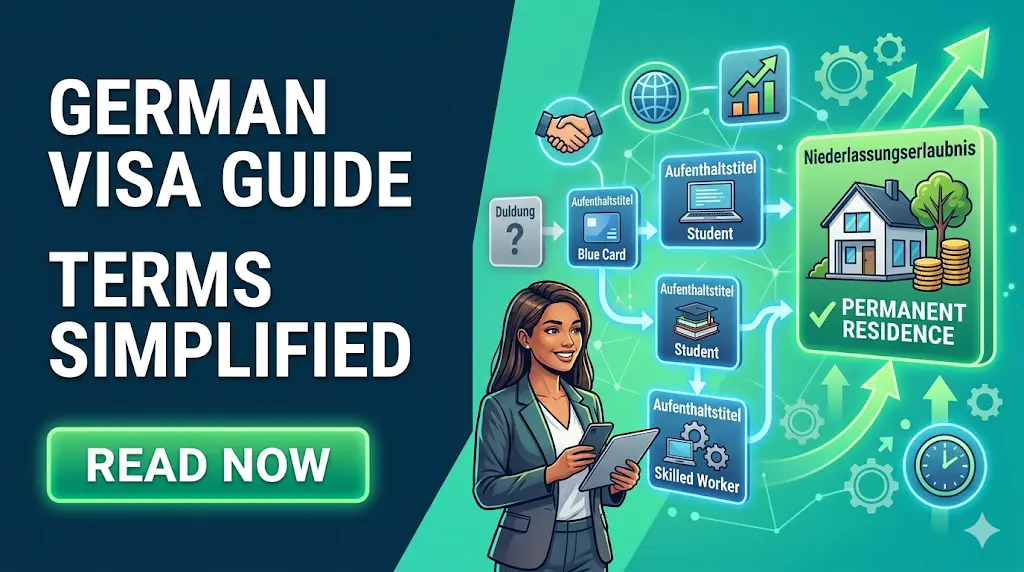
Once you are actually inside Germany, you must convert that entry visa into a long-term right to stay before it expires. The umbrella term for this long-term legal right is an Aufenthaltstitel (Residence Title).
The physical plastic card you carry in your wallet is officially called the Elektronischer Aufenthaltstitel (eAT). Whether you are a master’s student, a highly paid EU Blue Card holder, or a permanent resident, you technically hold an Aufenthaltstitel. Underneath this overarching umbrella term, the law branches out into highly specific legal categories that dictate exactly what you can and cannot do in the country. Navigating the exact legal paragraph codes printed on this card is a complex survival skill mapped out in Understanding German Residence Permit Labels 18 19c etc. If your application requires your foreign university degree to secure the Aufenthaltstitel, the immigration office will likely demand a beglaubigte Übersetzung (certified translation). Utilizing Lingoking ensures your documents are legally sworn and accepted by the state without costly administrative delays.
The Vital Zusatzblatt
Your physical plastic card only tells half the story. The Zusatzblatt (Supplementary Sheet) is the folded green piece of paper the immigration officer hands you alongside your card.
This flimsy document contains the legally binding restrictions of your residency. If you are an employee on a tied visa, the Zusatzblatt will explicitly name your specific employer. If you are a freelancer, it will state exactly which catalog profession you are allowed to invoice for. Losing this green sheet or misunderstanding its dense German terminology can lead to accidental visa violations. For example, if your green sheet states you can only work 140 days a year, working 141 days is grounds for immediate deportation. Understanding the restrictions printed on this paper is essential, a reality decoded in Understanding the Different Types of German Visas and Residence Permits.
Types of Temporary Residence Permits
The vast majority of newly arrived international workers and students are granted a legal status that is strictly temporary and heavily conditional.
Aufenthaltserlaubnis and Its Limits
The most common specific type of Aufenthaltstitel is the Aufenthaltserlaubnis (Temporary Residence Permit). The key defining word here is “temporary.” It is issued for a highly specific, legally defined purpose—such as studying at a university, family reunification, or employment at a specific corporation.
An Aufenthaltserlaubnis is almost always tied to a strict expiration date, usually ranging from one to three years. More importantly, it is intrinsically linked to your purpose of stay. If you hold an Aufenthaltserlaubnis for employment and you are suddenly fired, your legal reason for being in Germany vanishes, and the clock starts ticking on your right to remain in the country. You cannot simply transition an employment permit into a freelance permit without formal government approval.
To upgrade or change your status—for example, moving from a standard work permit to a premium tier as discussed in How to Apply for the EU Blue Card in Germany—you must formally petition the state. Furthermore, you cannot renew an Aufenthaltserlaubnis without proving you have unbroken, fully compliant health coverage (Krankenversicherung). Veteran expats rely on Feather Insurance to generate the exact German-language confirmation PDFs the immigration office demands to approve these renewals instantly, a vital defense mechanism explored deeply in Public vs Private Health Insurance in Germany: Which is Right for You?.
The Fiktionsbescheinigung Lifeline
The absolute scariest moment for any expat is watching their Aufenthaltserlaubnis approach its expiration date while the immigration office completely ignores their emails and appointment requests. If your card expires before your renewal appointment, you might assume you are technically undocumented.
To prevent you from being deported while the bureaucracy processes your paperwork, the government issues a Fiktionsbescheinigung (Fiction Certificate).
This beautiful piece of paper creates a “legal fiction.” It explicitly states that your previous residence permit, along with all its working rights and employer ties, remains fully valid until the government finally makes a decision on your renewal application. As long as you submitted your application for renewal before your current card expired, the Fiktionsbescheinigung protects your job and your life in Germany.
| Immigration Term | Classification | Core Function |
| Visum | Entry Document | Allows you to cross the border and enter Germany |
| Aufenthaltstitel | Umbrella Term | The generic legal term for any right of residence |
| Aufenthaltserlaubnis | Temporary Permit | Issued for a specific purpose (work, study, family) |
| Fiktionsbescheinigung | Bridging Document | Extends your current rights while waiting for a renewal |
The Ultimate Goal of Permanent Settlement
The end goal for almost every international worker is to escape the intense anxiety of temporary permits by securing a permanent status. This fundamentally changes your relationship with the German state.
Niederlassungserlaubnis Decoded
The Niederlassungserlaubnis (Permanent Settlement Permit) is the holy grail of German immigration.
This title grants you an unlimited, permanent right to live and work in Germany. You are completely freed from the dreaded employer tie, meaning you can quit your job, start your own business, or remain unemployed without the government threatening to revoke your visa. You also gain full access to the German social welfare safety net. Depending on your current permit, your language skills, and your pension contributions, you can apply for a Niederlassungserlaubnis after 21 months (for highly qualified EU Blue Card holders) to 60 months (for standard workers).
Erlaubnis zum Daueraufenthalt EU
There is a second, slightly more powerful form of permanent residency called the Erlaubnis zum Daueraufenthalt-EU (EU Long-Term Residence Permit).
It offers the exact same permanent rights within Germany as the Niederlassungserlaubnis, but it comes with a massive pan-European bonus. If you hold this title, you are granted significantly easier mobility to move, live, and work in almost any other European Union member state without starting the immigration process completely from scratch. The requirements are generally stricter—requiring exactly 60 months of uninterrupted residence, mandatory pension contributions, and strict language proofs—but the geographic freedom it provides is unparalleled. For families looking to secure their long-term European future, navigating these permanent titles is an essential phase of Bringing Your Family to Germany: The Family Reunification Visa.
Key Authorities and Financial Vocabulary You Must Know
None of the terms above matter if you cannot navigate the gatekeepers who issue them. Understanding the authorities and the financial proofs they demand is the final piece of the puzzle.
Ausländerbehörde: The Final Boss
The Ausländerbehörde (Foreigners’ Authority or Immigration Office) is the municipal government body that issues, renews, or revokes every single Aufenthaltstitel.
They are notoriously understaffed, overwhelmingly bureaucratic, and almost exclusively speak German. They demand a culture of absolute paper compliance. If a document is missing from your application folder, or if you bring an uncertified, self-made translation of your marriage certificate instead of using Lingoking to provide a beglaubigte Übersetzung, the caseworker will simply turn you away and force you to re-enter a months-long waiting list. This office is entirely separate from the Bürgeramt (Citizens’ Office), which only handles your address registration—a critical distinction you must master to survive German Bureaucracy 101: Understanding the Anmeldung, Schufa, and Tax ID.
Navigating Financial Proofs and Insurance
When dealing with the Ausländerbehörde for an initial entry visa or a temporary study permit, you will frequently hear demands for Lebensunterhaltssicherung (proof of secure livelihood). The government wants undeniable proof that you have the cash to survive.
If you are a student or a job seeker, this proof must legally take the form of a Sperrkonto (Blocked Account). A blocked account is a highly regulated German bank account where your money is legally frozen, and you are only allowed to withdraw a specific maximum amount per month. Attempting to open this account from abroad using legacy banks is an administrative nightmare. Veteran expats bypass this friction entirely by using Expatrio. Setting up your legally mandated blocked account through Expatrio is a fully digital, streamlined process. You can secure the official blocked account confirmation document required by the embassy in a matter of days, avoiding massive banking spreads on your initial capital transfer—a sophisticated strategy mapped out in Moving Money to Germany: Declaring Savings and Large Transfers. Furthermore, you can bundle your Expatrio account with Feather Insurance, generating all the required bureaucratic PDFs for your health coverage and financial proof in one seamless digital dashboard, ensuring your Aufenthaltstitel is approved without delay.
References
Primary sources (official)
- Make it in Germany – Residence Titles: The federal government’s official English-language portal outlining the core definitions of the Aufenthaltserlaubnis, the EU Blue Card, and the permanent Niederlassungserlaubnis. https://www.make-it-in-germany.com/en/visa-residence/types
- Gesetze im Internet – Aufenthaltsgesetz (AufenthG): The complete legal text of the German Residence Act. Section 2 details definitions, while Section 5 outlines the general prerequisites for granting any Aufenthaltstitel. https://www.gesetze-im-internet.de/aufenthg_2004/
Other helpful sources
- Federal Office for Migration and Refugees (BAMF): Comprehensive official overviews of the legal preconditions for living, working, and transitioning to permanent settlement status in Germany. https://www.bamf.de/EN/Themen/MigrationAufenthalt/ZuwandererDrittstaaten/Migrathek/Niederlassen/niederlassen-node.html
- Settle in Berlin – Fiktionsbescheinigung Explained: A highly practical expat guide explaining exactly how the bridging certificate functions, when you are legally entitled to one, and how it protects your employment rights. https://www.settle-in-berlin.com/fiktionsbescheinigung-germany-how-to-get/
Disclaimer
The information provided in this article is for general informational and educational purposes only and does not constitute professional legal or immigration advice. German residency laws under the Aufenthaltsgesetz (AufenthG), specifically regarding the strict limitations printed on your Zusatzblatt and the financial requirements for a Sperrkonto, are strictly enforced by the local Ausländerbehörden. Operating outside the bounds of your specific Aufenthaltserlaubnis can result in immediate revocation of your status. Always consult a certified German immigration lawyer (Fachanwalt für Ausländerrecht) regarding your specific visa transition.