Understanding German Residence Permit Labels (§18, §19c, etc.)
Staring at a little plastic card covered in confusing German legal codes and wondering if you are actually allowed to change jobs is a terrifying expat experience. I spent my first two years in Munich paralyzed by the fear that quitting my toxic job would invalidate my Section 18b permit. This guide decodes these cryptic residence permit labels to protect your livelihood.
Disclosure: This post may contain affiliate links. We may earn a commission at no extra cost to you if you make a purchase through these links. Read full disclosure.
The Anatomy of a German Residence Permit
When you finally navigate the brutal appointment system at the immigration office and receive your approval, you are handed a physical document. Understanding exactly what is printed on this document is the first step toward reclaiming your financial and professional freedom in Germany.
Decoding the Aufenthaltstitel Card
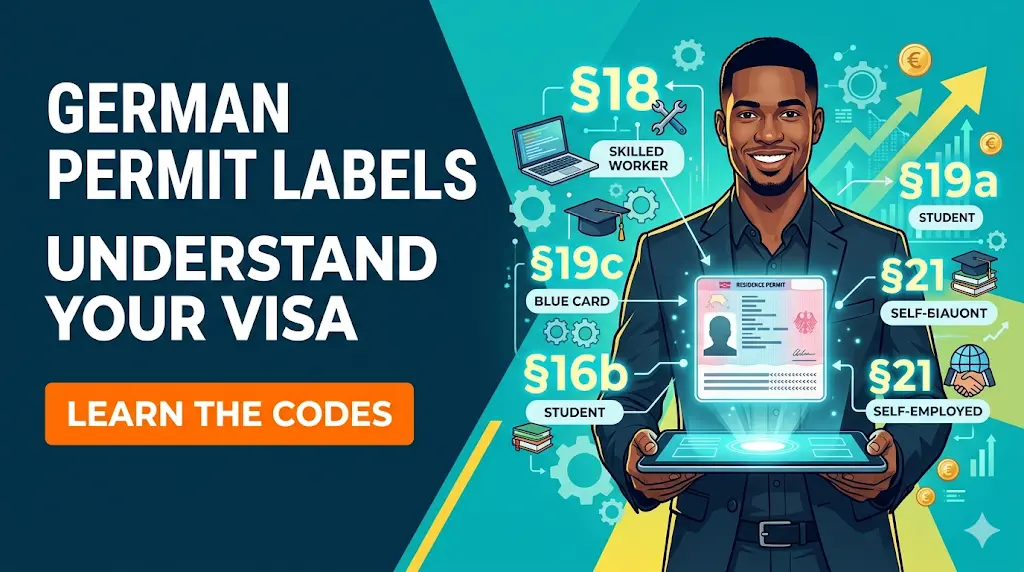
The modern German residence permit is called the Elektronischer Aufenthaltstitel. It is a standard, credit-card-sized plastic document embedded with an RFID chip containing your biometric data, fingerprints, and registered address. When you look at the front of the card, you will see your photo, your nationality, and the expiration date. However, the most critical piece of information is located under the heading “Art des Titels” (Type of Title) and the “Anmerkungen” (Remarks) section.
The “Art des Titels” will classify whether you hold a temporary residence permit or a permanent settlement permit. The “Anmerkungen” section usually contains a specific legal paragraph code, such as §18b or §19c, alongside a reference to an attached document. Many expats simply glance at the expiration date and throw the card in their wallet, completely ignoring the legal codes. This is a massive mistake. That specific paragraph dictates every single right you have in the country, from whether you can collect unemployment benefits to how quickly you can bring your spouse over.
If the immigration office updates your working conditions or you change your address after navigating German Bureaucracy 101: Understanding the Anmeldung, Schufa, and Tax ID, they frequently place a highly permanent, tamper-proof sticker on the back of the card to update your details. Never attempt to peel this sticker off, as doing so instantly invalidates the physical document.
The Importance of the Supplementary Sheet Zusatzblatt
The plastic card is actually only half of your residence permit. The immigration caseworker will almost always fold up a flimsy, green piece of paper and hand it to you alongside the plastic card. This document is called the Zusatzblatt (Supplementary Sheet).
Because it looks like a generic receipt, hundreds of expats accidentally throw it away or leave it buried in a drawer. You must carry this green sheet with your plastic card at all times when crossing borders or starting a new job. The plastic card tells the police you are allowed to be in Germany; the green sheet tells the government exactly how you are allowed to earn money. It contains the legally binding restrictions of your visa.
If your Zusatzblatt states “Beschäftigung nur gestattet als Softwareentwickler bei Firma X” (Employment only permitted as Software Developer at Company X), you are strictly tied to that specific employer. If you quit or are fired, your right to work evaporates immediately until you get a new green sheet. Conversely, if it says “Erwerbstätigkeit gestattet” (Economic activity permitted), you have unrestricted access to the German labor market and can change jobs freely. Understanding how to read this sheet is a foundational step outlined in Understanding the Different Types of German Visas and Residence Permits.
Why the Legal Sections Matter
The specific paragraph printed on your card refers directly to the German Residence Act (Aufenthaltsgesetz, or AufenthG). This massive federal legal framework dictates the entry, residence, and economic activity of all non-EU foreigners.
The section number is your legal identity. A person holding a Section 16b student permit has drastically different rights than a person holding a Section 18g EU Blue Card. Your section number dictates how many hours you are legally allowed to work, whether your future children will receive state child benefits, and exactly how many months you must wait before applying for permanent residency.
Misunderstanding your section can lead to devastating unintentional visa violations. If you hold a permit that strictly prohibits freelance work and you issue a single invoice for a side hustle, the immigration office can flag your file and legally revoke your residency. You must know your section inside and out.
The Core Work Permits under Section 18
For the vast majority of skilled international workers arriving in Germany, Section 18 is the gateway to the European economy. This section of the law underwent a massive overhaul to attract global talent, creating highly specific sub-categories based on your educational background.
Section 18a and 18b Qualified Professionals
The standard employment visas in Germany are split into two primary tracks. Section 18a is specifically designed for skilled workers possessing a recognized vocational training qualification. Section 18b is the equivalent permit for skilled workers holding a recognized academic university degree.
To qualify for either of these permits, your foreign qualifications must be officially recognized as comparable to a German degree or training program. The immigration office strictly enforces this rule. If your university diploma is in a foreign language, the caseworker will reject your application unless it is accompanied by a certified, legally sworn translation. Utilizing Lingoking is the most effective way to secure these certified translations rapidly. Because Lingoking utilizes court-sworn translators recognized by the German government, you guarantee your educational documents will pass the strict comparability checks without administrative delays.
Furthermore, you cannot obtain a Section 18a or 18b permit without providing proof of comprehensive health insurance. Travel insurance is explicitly banned for long-term work permits. To bypass the confusing local insurance brokers who refuse to speak English, veteran expats use Feather Insurance to secure statutory health coverage instantly. Feather Insurance provides you with the exact German-language confirmation PDF that the immigration office demands, ensuring your standard work permit application is approved on the spot.
Section 18g The EU Blue Card
The EU Blue Card is the absolute premier work permit in Europe, and it was recently restructured under Section 18g of the Residence Act. It is specifically reserved for highly qualified professionals earning a premium salary, granting them immense privileges over standard Section 18b holders.
As of 2026, to secure a standard EU Blue Card, your employment contract must guarantee a gross annual salary of at least 50,700 euros. However, if you work in a designated bottleneck profession like mathematics, IT, natural sciences, engineering, or human medicine, that salary threshold drops significantly to 45,934.20 euros. The German government aggressively lowered these thresholds to attract specialized talent, a massive shift detailed in How to Apply for the EU Blue Card in Germany.
The perks of holding a Section 18g permit are phenomenal. Blue Card holders can leave the country for up to twelve consecutive months without their permit expiring, compared to the standard six months for other visas. More importantly, Blue Card holders are placed on an accelerated track to permanent settlement, bypassing years of bureaucratic waiting.
Navigating Employer Ties and Flexibility
Regardless of whether you hold a standard Section 18b permit or a prestigious Section 18g Blue Card, almost all new expats face the dreaded employer tie. For the first twelve months of your employment in Germany, your residence permit is strictly bound to the company that sponsored you.
If you experience a toxic workplace and decide to resign, or if your company conducts unexpected layoffs, you cannot simply sign a contract with a new company and start working the next day. You must first secure a new job offer and then petition the immigration office for permission to change employers. They will issue you a new Zusatzblatt.
If you are fired and cannot find a job immediately, understanding your safety net is critical. Because you were paying into the statutory system, you must immediately report to the employment agency to claim your benefits, a survival tactic fully decoded in Understanding Arbeitslosengeld I vs II: Unemployment Benefits Explained. Once you successfully survive your first twelve months of employment, the employer tie is usually lifted, granting you unrestricted access to the German labor market.
Alternative Work and Freelance Permits Section 19 and 21
Not every successful expat arrives with a traditional university degree or a desire to work a standard corporate job. The German Residence Act contains specific provisions for self-taught specialists and independent entrepreneurs.
Section 19c Employment Based on Work Experience
Section 19c was dramatically expanded to address Germany’s severe shortage of specialized labor, particularly in the tech sector. This section allows individuals to secure a work permit based purely on their proven professional experience, even if they completely lack a formal university degree or vocational certificate.
This is a massive loophole for self-taught software developers and IT managers. To qualify, you generally need to prove that you have worked in your highly specialized field for at least three of the past seven years and meet a specific salary threshold. The burden of proof here is incredibly high. You must provide detailed reference letters from your previous foreign employers detailing your exact technical responsibilities. Submitting these letters in English or your native language will result in immediate rejection. Relying on Lingoking to provide legally certified translations of your highly technical work references ensures the German caseworker clearly understands the depth of your experience and approves your Section 19c permit.
Section 21 Freelance and Self Employment
If you want to be your own boss, you must apply for a permit under Section 21. Germany draws a very strict legal line between a freelancer (Freiberufler) working in a catalog profession like journalism, art, or consulting, and a commercial self-employed business owner (Gewerbetreibender) selling physical goods.
Securing a Section 21 permit is arguably the most difficult administrative hurdle in the country. The immigration office requires you to submit a massive portfolio, including a comprehensive business plan, local client letters of intent, detailed revenue projections, and proof of adequate financial reserves. You must prove that your business fulfills a specific regional economic need. Understanding the strict categorization of these independent professions is deeply analyzed in Freelancing in Germany: A Guide to the Freiberufler Visa.
One of the primary reasons freelancers are denied a Section 21 permit is a lack of acceptable health insurance. Because freelancers are not automatically enrolled in the statutory system by an employer, they must secure their own coverage. Traditional German private insurers frequently reject newly arrived freelancers because they lack a local credit history. Utilizing Feather Insurance is the ultimate workaround. Feather Insurance specializes in providing expats with fully compliant, freelance-friendly private health coverage, issuing the exact localized insurance certificates the immigration office demands to greenlight your Section 21 application.
The Job Seeker Visas under Section 20
If you want to move to Germany but do not yet have a job offer, the government offers the Opportunity Card (Chancenkarte) under Sections 20a and 20b. This is a points-based system that allows qualified individuals to live in Germany for up to a year specifically to search for employment.
To secure this visa, you must prove to the German consulate that you have enough liquid cash to survive without relying on the German welfare system. The government mandates that this money be placed in a highly regulated, frozen bank account known as a blocked account (Sperrkonto). Attempting to open a German blocked account from your home country using legacy banks is an exercise in utter futility.
Veteran expats completely bypass this nightmare by using Expatrio. Setting up your legally mandated blocked account through Expatrio is an entirely digital, streamlined process. You can secure the official blocked account confirmation document required by the embassy in a matter of days, completely in English, without ever stepping foot inside a German bank branch. Securing this financial proof instantly is the foundation of a successful relocation, a strategy thoroughly mapped out in Job Seeker Visa: Your Ticket to Finding Work in Germany.
Study Family and Permanent Residence Labels
Beyond pure employment, the German legal code accommodates international students, trailing spouses, and the eventual transition to permanent integration.
Section 16b Student Visas
Section 16b is the standard residence permit issued to international students attending a recognized German university. It is designed to facilitate education, but it places strict legal limits on how you survive financially.
A Section 16b permit legally restricts you to working exactly 140 full days or 280 half days per calendar year. If you exceed this limit by even a single hour, you are violating federal immigration law, and the immigration office can forcefully revoke your student visa and deport you. Students frequently rely on marginal part-time jobs to survive without triggering this limit, an economic balancing act explored in Part-Time Work and Taxes: How Mini-Jobs and Midijobs Affect Your Income.
Because students cannot work full-time, the government demands they prove they can afford their tuition and living expenses upfront. Just like the job seeker visa, Section 16b requires a massive blocked account. Expatrio remains the absolute industry standard for international students. By utilizing Expatrio, students can bundle their mandatory blocked account setup with their required statutory health insurance registration, generating all the required bureaucratic PDFs needed for their university enrollment and immigration appointment in one seamless digital dashboard.
Sections 28 to 32 Family Reunification
If you hold a valid German residence permit, your spouse and minor children have a legal right to join you under Sections 28 through 32 of the Residence Act.
The greatest hidden perk of the spousal reunification visa is that it usually inherits the best aspects of the primary permit holder’s status. If you are an EU Blue Card holder and your spouse arrives on a Section 30 reunification permit, their Zusatzblatt will almost universally state “Erwerbstätigkeit erlaubt.” This means your spouse has immediate, unrestricted access to the entire German labor market without needing sponsorship. Navigating the logistics of moving your entire household is a massive undertaking outlined in Bringing Your Family to Germany: The Family Reunification Visa.
However, the immigration office requires absolute, undeniable proof that your marriage is legally valid. Handing a foreign marriage certificate to a German bureaucrat without proper certification is a guaranteed rejection. You must obtain an apostille from your home country and then have the entire document translated by a sworn German professional. Using Lingoking ensures your marriage documents are translated to the exact legal specifications required by the local registry office and the immigration authority, keeping your family together without bureaucratic delays.
Section 9 The Holy Grail of Permanent Settlement
The ultimate goal for almost every expat is to trade their temporary plastic card for a Section 9 Niederlassungserlaubnis (Settlement Permit). This is the holy grail of German immigration.
A Section 9 permit grants you unlimited, permanent residency. You are completely freed from the dreaded employer tie, you never have to pay expensive visa renewal fees again, and you can start your own business without begging for a Section 21 freelance permit. Furthermore, permanent residents are granted full access to the German social welfare safety net, protecting them from deportation if they face severe, long-term unemployment or illness.
| Residence Permit Section | Primary Target Group | Labor Market Access | Pathway to Permanent Settlement (§9) |
| Section 16b | University Students | Strictly limited (140 full days/year) | Time spent studying counts partially |
| Section 18b | Skilled Academic Workers | Tied to employer initially | Standard (usually 48 to 60 months) |
| Section 18g | EU Blue Card Holders | Tied to employer initially | Accelerated (21 to 27 months) |
| Section 21 | Freelancers & Entrepreneurs | Strictly limited to approved business | Accelerated (36 months for success) |
| Section 30 | Spouses of Skilled Workers | Fully unrestricted | Tied to primary permit holder’s timeline |
Handling Bureaucracy and Upgrading Your Permit
Securing your first temporary residence permit is merely the beginning. Transitioning from a restricted worker to a permanent resident requires years of flawless bureaucratic management and pristine documentation.
Gathering the Right Documentation
You must never walk into an immigration office empty-handed. The German bureaucratic system operates on a culture of absolute paper compliance. If a document is missing from your folder, the caseworker will simply send you home and force you to re-enter a months-long waiting list.
When applying for or upgrading your permit, you must bring your passport, your biometric photos, your current employment contract, your last three months of salary slips, and the specific application form (Antrag auf Erteilung eines Aufenthaltstitels). If your current permit expires while you are waiting for a renewal appointment, the office will issue you a Fiktionsbescheinigung (Fiction Certificate). This vital green paper legally extends your current permit conditions until your appointment date, proving to your employer and the police that your stay remains perfectly legal.
Navigating the Auslaenderbehoerde Appointments
Securing an appointment at a major municipal immigration office in cities like Berlin, Munich, or Frankfurt is a nightmare. The online booking portals are perpetually full. Expats routinely set alarms for 6:00 AM just to refresh the webpage, hoping to secure a cancelled time slot.
When you finally arrive, you must confront the language barrier. German civil servants are legally bound to conduct official business in the German language to prevent legal liability in case of mistranslations. They are not required to speak English with you, and many outright refuse. If your German is not at a conversational B1 level, bringing a fluent friend or hiring a professional relocation consultant to speak on your behalf is a necessary survival tactic.
Ensuring Uninterrupted Health Coverage
When the time finally comes to apply for your Section 9 Niederlassungserlaubnis, the caseworker will conduct a rigorous audit of your entire history in Germany. One of the primary reasons expats are denied permanent settlement is gaps in their health insurance coverage.
To secure permanent residency, you must prove that you have been continuously and compliantly insured for years. If you bounced between sketchy travel insurances and temporary expat policies, the caseworker will reject your permanent residency application outright. By partnering with Feather Insurance from the very beginning of your expat journey, you ensure your coverage is always structurally compliant with federal mandates. Feather Insurance provides you with the undeniable, seamless PDF proof of coverage required to pass the strict Section 9 audit, paving the way for your ultimate transition to full German citizenship. Understanding the intense regulations surrounding these policies is detailed in Public vs Private Health Insurance in Germany: Which is Right for You?
References
Primary sources (official)
- Make it in Germany – EU Blue Card: The federal government’s official English-language portal outlining the exact new 2026 salary thresholds, application requirements, and accelerated permanent residency timelines for Section 18g. https://www.make-it-in-germany.com/en/visa-residence/types/eu-blue-card
- Gesetze im Internet – Aufenthaltsgesetz (AufenthG): The complete, translated legal text of the German Residence Act, detailing the exact statutory language governing Section 9 (Permanent Settlement) and the binding conditions of the Zusatzblatt. https://www.gesetze-im-internet.de/englisch_aufenthg/
Other helpful sources
- Federal Foreign Office – Working in Germany: Detailed visa application checklists for third-country nationals applying for standard employment under Sections 18a and 18b from outside the European Union. https://wellington.diplo.de/nz-en/service/2125798-2125798
- BAMF – Issuing Residence Permits: The Federal Office for Migration and Refugees provides comprehensive explanations regarding the transition from temporary humanitarian or work-based permits to permanent settlement status. https://www.bamf.de/EN/Themen/AsylFluechtlingsschutz/AblaufAsylverfahrens/Ausgang/Aufenthaltserlaubnis/aufenthaltserlaubnis-node.html
Disclaimer
The information provided in this article is for general informational and educational purposes only and does not constitute professional legal or immigration advice. German residency laws under the Aufenthaltsgesetz (AufenthG), specifically regarding salary thresholds for the EU Blue Card (Section 18g) and the financial requirements for blocked accounts, are subject to annual federal updates and strict interpretation by local immigration authorities (Ausländerbehörden). Violating the conditions printed on your supplementary sheet (Zusatzblatt), such as engaging in unauthorized freelance work or exceeding student working hours, can result in the immediate revocation of your residence title and subsequent deportation.