Part-Time Work and Taxes: How Mini-Jobs and Midijobs Affect Your Income
Taking a small side hustle to combat German inflation, only to realize your second job triggered a massive tax penalty, is a brutal expat trap. I once lost nearly half my part-time paycheck because I blindly fell into Tax Class 6. This guide decodes the 2026 rules for Mini-jobs and Midijobs, explaining exactly how they impact your income and visa.
Disclosure: This post may contain affiliate links. We may earn a commission at no extra cost to you if you make a purchase through these links. Read full disclosure.
The Minijob: Tax-Free Earnings up to €603
In Germany, a Minijob (officially known as a geringfügige Beschäftigung) is a form of marginal part-time employment specifically designed to be mostly tax-free and bureaucracy-light for the employee. Understanding its strict limits is the difference between keeping your extra cash and handing it directly to the state.
How the 2026 Limits Work
The German government directly links the Minijob earning threshold to the statutory minimum wage. Because the minimum wage increased to €13.90 per hour on January 1, 2026, the statutory Minijob earning limit simultaneously increased to €603 per month (or an annual total of €7,236). This mathematical calculation ensures that a minimum-wage worker can clock roughly 43 hours a month without exceeding the legal threshold.
The law does allow for slight flexibility. If you occasionally earn more than €603 in a single month—for example, because you had to cover a sick colleague’s shifts unexpectedly—you will not instantly lose your Minijob status. The government permits you to exceed the limit provided the overage is unforeseeable, occurs no more than twice per calendar year, and the specific month’s earnings do not exceed double the limit (€1,206). However, if you systematically and predictably exceed the €7,236 annual limit, your job automatically converts into a fully socially insured role, radically changing your net income.
Taxes and Social Security Exemptions
The massive appeal of a Minijob for expats is that you generally receive your gross salary as your absolute net salary. The employer pays a flat-rate tax and social security contribution on top of your wage, meaning your €603 hits your bank account completely intact without standard income tax deductions.
By default, you are automatically enrolled to pay a tiny 3.6 percent contribution to the statutory pension insurance (Rentenversicherungspflicht). For a €603 salary, this is roughly €21 a month. However, you have the legal right to submit a formal opt-out letter (Befreiungsantrag) to your employer to be exempted from this entirely. Whether you should opt out is highly dependent on whether you plan to stay in the country long enough to vest in the system, a dynamic mapped out deeply in Claiming German Pension as a Foreigner: Can Non-Citizens Receive State Pension?
The Second Job Trap and Tax Class 6
Here is the exact scenario that destroys expat budgets: You hold a full-time, standard employment contract (Hauptberuf), and you decide to take a €603 Minijob on the weekends to save extra cash. The good news is that your first Minijob remains entirely tax-free and does not negatively affect your main salary’s tax bracket.
However, if you take a second Minijob, the German tax authority (Finanzamt) steps in. Your second Minijob will be brutally thrown into Tax Class 6 (Steuerklasse 6). Tax Class 6 has absolutely zero basic tax-free allowances. Every single cent of that second side hustle is taxed at your highest personal progressive tax rate. You will essentially be sacrificing your weekends just to hand 40 to 50 percent of the earnings straight to the government. Before you sign multiple part-time contracts, it is vital to review your primary Tax Classes for Couples: How Marriage Affects Your Taxes in Germany or individual tax status to avoid this massive liquidity drain.
The Midijob (Übergangsbereich): Earning €603.01 to €2,000
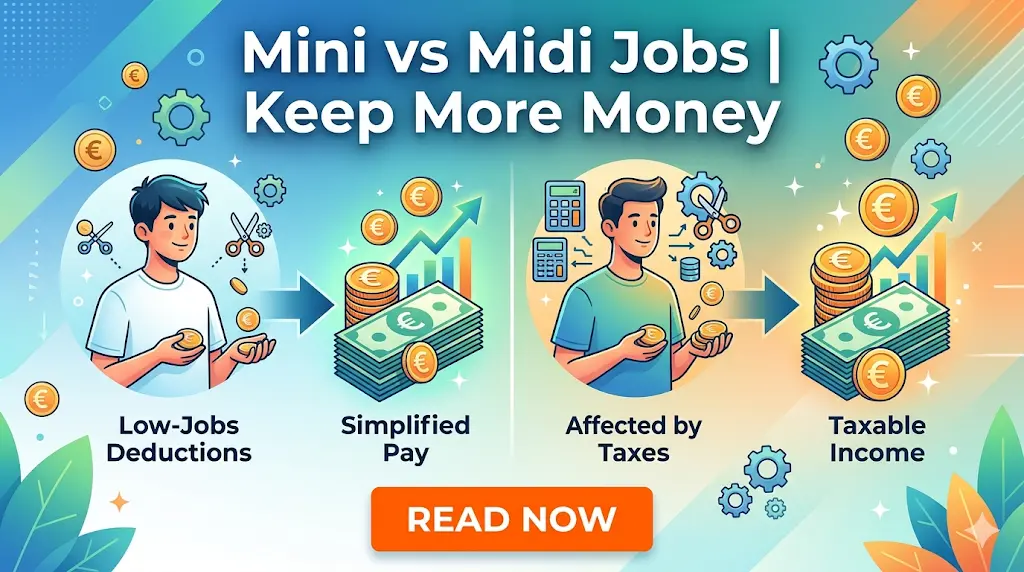
If you earn exactly €603.01, you cross the legal line from a Minijob into a Midijob. Officially known as the Übergangsbereich (transition zone), a Midijob covers monthly earnings scaling up to €2,000 in 2026. This zone is designed to prevent workers from being financially punished for taking on more hours.
The Sliding Zone of Social Contributions
In a standard full-time German job, you lose roughly 20 percent of your gross salary to social security contributions (covering health, pension, unemployment, and nursing care). If this full 20 percent hit you the exact moment you earned €604, your net pay would actually be lower than if you had simply stayed in a €603 Minijob.
To prevent this devastating “cliff effect,” the Midijob utilizes a sliding mathematical formula. At €603.01, your employee social security contributions start at essentially zero. As your income grows towards the €2,000 ceiling, the percentage you pay slowly scales up, only hitting the full, standard burden once you cross the €2,000 mark. The employer absorbs the heavier burden at the lower end of the scale.
Full Pension and Health Insurance Rights
Despite paying significantly reduced contributions at the lower end of the Midijob scale, the state grants you full social security rights. This is a phenomenal loophole and safety net for trailing expat spouses, freelancers needing stability, or part-time students.
If you earn €900 a month in a Midijob, you are fully enrolled in the statutory health insurance system (gesetzliche Krankenversicherung) under your own name, rather than relying on family insurance. More importantly, you accrue full pension points as if you were paying the full employer/employee split. You also gain the absolute legal right to unemployment benefits (Arbeitslosengeld I) if you work the job for at least 12 months, providing immense financial security.
Tax Implications for Midijobs
Unlike a Minijob, a Midijob is not inherently tax-free. It is fully subject to standard progressive income tax.
If this Midijob is your only source of income in Germany and you are in Tax Class 1, your €1,500/month salary will likely fall almost entirely under the basic annual tax-free allowance (Grundfreibetrag), meaning you still won’t pay actual income tax, though you will pay the sliding social security.
However, if the Midijob is a secondary income piled on top of a lucrative full-time job, it gets dumped straight into the dreaded Tax Class 6. The resulting tax withholdings will decimate your take-home pay initially. You will eventually balance this out and likely get a refund when you file your yearly return, a complex reconciliation process detailed in Understanding Your Tax Assessment (Steuerbescheid): After You File in Germany.
| Feature | Minijob (Geringfügige Beschäftigung) | Midijob (Übergangsbereich) |
| 2026 Monthly Limit | €0 to €603 | €603.01 to €2,000 |
| Employee Social Security | 0% (Pension opt-out available) | Sliding scale (starts low, scales up) |
| Health Insurance | NOT included (Must insure yourself) | Fully included in statutory system |
| Income Tax (Main Job) | Tax-free (Employer pays flat rate) | Standard taxation based on Tax Class |
| Tax Class if 2nd Job | Class 6 (Only for the second Minijob) | Class 6 (Brutally high withholding) |
Expat-Specific Hurdles: Visas and Banking
Understanding the tax math is only half the battle. As a foreigner, you must ensure that taking a part-time job does not inadvertently void your legal right to reside in the country or trigger a banking nightmare.
Visa Restrictions on Part-Time Work
Before you even apply for a Minijob or Midijob, you must ruthlessly check the stipulations printed on your physical residence permit or its supplementary green sheet (Zusatzblatt). German immigration law is unforgiving regarding unauthorized labor.
If you hold a tied work visa or an EU Blue Card, your residency is linked specifically to your primary employer. Taking any secondary employment—even a weekend Minijob at a café—usually requires explicit, prior written permission from the Ausländerbehörde (immigration office). If you are on a student visa, you are legally restricted to working 120 full days or 240 half days per calendar year. A Minijob consumes these days rapidly. Violating these visa terms by taking an unauthorized side hustle is strict grounds for deportation, an administrative reality decoded in Understanding the Different Types of German Visas and Residence Permits.
Managing Your Extra Income
Once you successfully secure the job and clear the legal hurdles, managing this new income stream effectively is essential. Do not let your €603 side hustle simply dissolve into your daily Cost of Living in Germany: Breakdown of Expenses (Rent, Food, Transport).
To protect and leverage this extra cash, veteran expats segregate it immediately. By routing your Minijob salary into an agile mobile account like N26, you can use their Spaces feature to automatically drag that €603 into a dedicated digital sub-account the exact moment it arrives. N26 keeps this money completely walled off from your main checking balance, allowing you to visually track your side-hustle growth without needing to decipher archaic terminology on your Understanding German Bank Statements: Fees and Transactions Explained.
If your primary goal is to send this part-time income back to your home country to support family or pay off foreign student loans, utilizing a traditional legacy bank will destroy your margins via hidden SWIFT fees and terrible exchange rates. Instead, funnel the money through Wise. By initiating the transfer with Wise, you secure the true mid-market exchange rate, ensuring your hard-earned euros cross the border fully intact. Mastering these highly efficient cross-border capital flows is a vital survival skill explored in Moving Money to Germany: Declaring Savings and Large Transfers and Cross-Border Banking: Managing Your Home Country Account While in Germany.
Finally, if you do not need the extra cash for immediate monthly survival, investing it is the smartest way to beat European inflation. You can transfer your Minijob earnings to a globally compliant brokerage like Interactive Brokers. Because Interactive Brokers charges incredibly low execution fees, you can easily dollar-cost average your €603 into globally diversified ETFs every single month without high overhead. Utilizing Interactive Brokers ensures your part-time hustle actually builds long-term, portable wealth that isn’t trapped in restrictive domestic German pension products, a wealth-building strategy deeply analyzed in Should You Invest in German or International Stocks? Diversifying as an Expat.
References
Primary sources (official)
- Minijob-Zentrale: The official federal authority managing all marginal part-time employment in Germany, providing the exact updated 2026 earning thresholds, employer registration portals, and pension opt-out forms. https://www.minijob-zentrale.de/
- Bundesministerium für Arbeit und Soziales (BMAS): The Federal Ministry of Labour and Social Affairs’ official legal breakdown of the Übergangsbereich (Midijob zone), detailing the sliding scale formula for social security contributions up to €2,000. https://www.bmas.de/DE/Arbeit/Arbeitsrecht/Teilzeit-und-Befristung/teilzeit-und-befristung.html
Other helpful sources
- Die Techniker (TK) – Mindestlohn, Minijobs und Midijobs 2026: A highly comprehensive guide from one of Germany’s largest public health insurers explaining exactly how the 2026 minimum wage increase to €13.90 legally forced the Minijob limit up to €603. https://www.tk.de/firmenkunden/service/fachthemen/ausland/mindestlohn-minijob-midijob-2026-auslaendische-beschaeftigte-2188270
- Betanet – Midijob 2026: An incredibly detailed advisory resource providing concrete mathematical fallbeispiele (case studies) on how holding multiple part-time jobs aggregates your income and pushes you over the Midijob limit. https://www.betanet.de/midijob.html
Disclaimer
The information provided in this article is for general informational and educational purposes only and does not constitute professional financial, tax, or legal immigration advice. German employment laws, specifically regarding the €603 Minijob limit and the €2,000 Midijob threshold, are strictly bound to the statutory minimum wage and are subject to change. Taking on secondary employment while holding a tied German residence permit or student visa without explicit approval from the Ausländerbehörde can result in severe legal consequences, including the revocation of your visa.