Moving Money to Germany: Declaring Savings and Large Transfers
Watching your entire life savings disappear into the international banking ether, only to realize your newly opened German bank account has been frozen for “suspicious activity,” is a paralyzing expat nightmare. I vividly remember staring at a locked screen after wiring my savings, convinced the authorities thought I was a criminal. This guide demystifies Germany’s strict anti-money laundering laws, reporting requirements, and the safest ways to transfer your assets.
Disclosure: This post may contain affiliate links. We may earn a commission at no extra cost to you if you make a purchase through these links. Read full disclosure.
The Bundesbank and the AWV Reporting Requirement
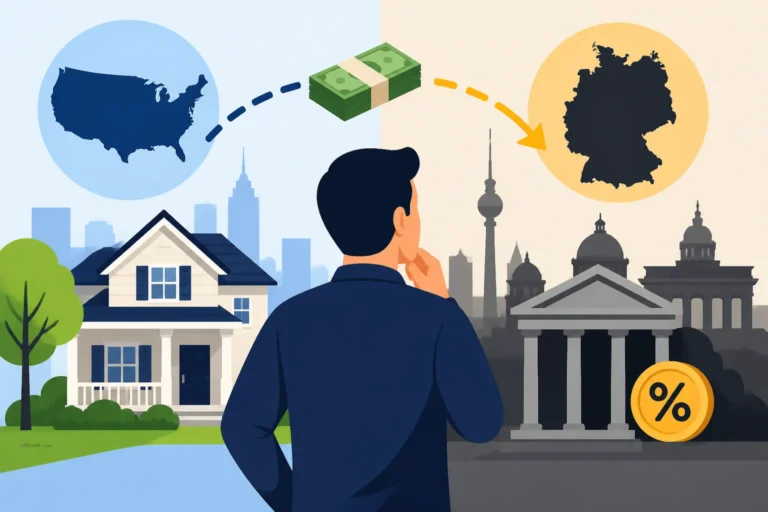
When you move your life to Germany, you inevitably have to move your money, too. Whether it is the proceeds from selling a house back home or a decade of accumulated savings, crossing the German border with large sums of cash triggers a massive, often invisible bureaucratic tripwire known as the AWV.
Understanding the 12500 Euro Threshold
Germany has incredibly strict monitoring systems for foreign trade and capital movement. The most important regulation you will encounter is the Außenwirtschaftsverordnung (AWV), or the Foreign Trade and Payments Ordinance. Under this law, any incoming or outgoing cross-border payment that exceeds 12,500 EUR (or the equivalent in a foreign currency) must be reported to the Deutsche Bundesbank (the German Central Bank).
The purpose of this reporting is not taxation. The Bundesbank merely uses this data for statistical purposes to track Germany’s balance of payments. However, failing to report an eligible transfer is considered an administrative offense (Ordnungswidrigkeit) and can result in severe fines of up to 30,000 EUR. The notification is not automatically done by your bank; the legal burden of reporting falls entirely on you, the recipient.
Expats often panic when they read this, assuming they will be taxed on the transfer. You must separate the concepts of reporting and taxing. Reporting a transfer to the Bundesbank does not mean the Finanzamt (tax office) is going to take a cut. It is purely a statistical declaration. If you are trying to understand the broader context of your local registrations, this administrative duty is just another facet of the surveillance state you encounter during German Bureaucracy 101: Understanding the Anmeldung, Schufa, and Tax ID.
The Crucial Expat Exception Moving Your Own Savings
Here is the saving grace that most generic online forums fail to mention, causing expats unnecessary sleepless nights: there are specific exemptions to the AWV reporting requirement, and the most prominent one applies to transferring your own savings.
If you are moving money from a foreign bank account that is in your name to a German bank account that is also in your name, this is legally considered an account transfer (Kontoübertrag). According to the Bundesbank’s specific guidelines, transferring your own assets between your own accounts does not have to be reported, regardless of whether the amount is 15,000 EUR or 500,000 EUR.
However, the moment a third party is involved, the exemption disappears. If your parents wire you 20,000 EUR as a gift to help you settle in, you must report it. If you sell a property back home and the buyer or the foreign escrow company wires the proceeds directly to your German account, you must report it. Only identical-name-to-identical-name transfers are exempt.
How to Execute the Bundesbank Report
If your transfer involves a third party and exceeds the 12,500 EUR threshold, reporting it is surprisingly analog. You do not fill out a massive online portal; instead, you must contact the Bundesbank directly.
By law, you must report the transaction by the seventh day of the month following the transfer. For example, if you receive a 50,000 EUR wire from a home sale on August 15th, you must report it to the Bundesbank by September 7th.
To do this, you call the Bundesbank’s toll-free hotline (0800 1234 111). When you call, you provide your basic details, and they will assign you a reporting number. You then fill out a specific form (usually Form Z4 for incoming payments) and submit it via email or through their basic online portal. The operators on the hotline are usually quite helpful, but dealing with federal phone lines is always intimidating. If you are struggling with the language barrier during these administrative tasks, using GermanPod101 to familiarize yourself with formal, bureaucratic vocabulary is a highly strategic move before picking up the phone.
The Logistics of Large International Transfers
Knowing the legal reporting limits is only half the battle. The actual mechanical process of moving tens of thousands of euros across borders can cost you an absolute fortune in hidden fees if you rely on traditional banking infrastructure.
The Hidden Costs of Traditional SWIFT Transfers
When you walk into your home-country bank and ask them to wire 50,000 USD to your new German account, they will initiate a SWIFT transfer. Traditional banks love SWIFT transfers because they are highly lucrative for the institutions involved, but they are a financial disaster for expats.
First, your home bank will charge an upfront wire fee. Then, the money passes through intermediary banks, each of which might siphon off a “correspondent fee.” Finally, when the money lands in Germany, your local bank might charge an incoming international wire fee.
But the true theft occurs in the exchange rate markup. Traditional banks rarely give you the real mid-market exchange rate (the one you see on Google). They usually pad the rate by 3% to 5%. On a transfer of 50,000 USD, a 4% markup means you are silently losing 2,000 USD just in the conversion spread. For expats meticulously calculating their budget using Cost of Living in Germany: Breakdown of Expenses Rent Food Transport, losing two months’ rent to hidden banking fees is a devastating blow.
Utilizing FinTech for the Mid Market Rate
To protect your savings, you must bypass traditional banks for the actual currency conversion. The modern expat strategy relies heavily on specialized financial technology companies that offer transparent pricing.
Using a service like Wise is fundamentally different from a SWIFT transfer. When you use Wise to send 50,000 USD to Germany, you do not actually send money across borders. You send your USD to Wise’s local US account. Wise then uses its own local German euro reserves to deposit the equivalent EUR into your German account. Because the money never actually crosses borders via the SWIFT network, you avoid intermediary fees entirely.
More importantly, you get the real mid-market exchange rate, paying only a small, transparent, upfront percentage fee. When moving life savings, locking in a guaranteed rate for 48 hours while you arrange the transfer provides immense peace of mind. It allows you to know exactly to the cent how much will land in your German account.
Setting Up a Receptive German Account
To receive your converted funds, you need a highly functional German bank account. Traditional German sparkassen (savings banks) are notorious for charging monthly maintenance fees, operating outdated online banking apps, and demanding in-person appointments in German to unblock accounts.
When you first arrive, opening a digital-first account is a massive relief. Opening an N26 account takes minutes from your smartphone and provides you with a full, legitimate German IBAN. Because N26 operates with modern digital infrastructure, receiving large inbound SEPA transfers (like the ones initiated by FinTech conversion services) is seamless.
However, you must be incredibly cautious. Digital banks use aggressive automated security algorithms. If you open a brand new account and suddenly blast 100,000 EUR into it on day two, the algorithm will panic and freeze your funds. You must properly verify your identity, warm up the account with smaller daily transactions, and be prepared to provide compliance documentation immediately. If you plan to rely on this money to secure a flat or navigate your visa requirements, as detailed in Navigating the Ausländerbehörde: Tips for Dealing with German Immigration Offices, having frozen funds will derail your entire immigration timeline.
| Transfer Method | Exchange Rate | Hidden Fees | Speed | Best Use Case |
| Traditional Bank (SWIFT) | Poor (3-5% markup) | High (Intermediary fees) | 3-5 business days | Only if legally required for specific escrow payouts |
| FinTech (e.g., Wise) | Excellent (Mid-market) | None (Transparent upfront fee) | 1-2 business days | Moving personal savings, paying rental deposits |
| Cash in Suitcase | N/A | Risk of civil forfeiture | Immediate | Amounts under 10,000 EUR only; highly discouraged |
Taxation on Transferred Savings and Foreign Assets
The most common panic-inducing question I hear from new arrivals is, “Will Germany tax the money I bring over?” The short answer is no, but the long answer involves understanding the difference between capital principal and capital yield.
The Principal Versus The Yield
Germany does not currently have a wealth tax (Vermögensteuer). The government does not tax the sheer existence of your money. If you saved 100,000 EUR over ten years while working in Canada, paid Canadian income tax on those earnings, and then moved the 100,000 EUR to Germany, that money is entirely yours. You do not owe the German Finanzamt a single cent just for transferring your principal savings across the border.
However, Germany heavily taxes capital yield. Once that 100,000 EUR lands in a German bank account, or remains in a foreign account while you live in Germany, any interest it generates, any dividends it pays out, or any capital gains it produces through investments are fully taxable under German law.
Germany levies a flat capital gains tax (Abgeltungssteuer) of 25%, plus a solidarity surcharge, bringing the effective rate to roughly 26.375%. If your savings sit in a high-yield savings account and generate 2,000 EUR in interest this year, you must pay tax on that interest, regardless of whether the account is in Munich or Toronto. This is a core pillar of unlimited tax liability, which is deeply explored in Taxing Worldwide Income: How Germany Taxes Foreign Income and Assets.
Managing Global Investment Portfolios
Many expats arrive in Germany with extensive stock portfolios, ETFs, or mutual funds held in foreign brokerage accounts. Leaving them there while living in Germany creates a massive compliance headache.
Foreign brokers do not automatically deduct German capital gains taxes or issue German-compliant tax certificates. This means every single year, you must manually calculate the EUR equivalent of every dividend received and every fractional share sold, using the historical exchange rate for the exact day the transaction occurred. It is an accounting nightmare that requires an expensive cross-border tax advisor.
To simplify this, many veteran expats consolidate their global investments. Using a globally compliant platform like Interactive Brokers is a highly popular strategy. Because Interactive Brokers operates internationally but caters to European residents, it provides robust, exportable tax reports that make filing your German Anlage KAP (capital income tax form) significantly less painful. It allows you to maintain access to global markets without accidentally committing tax evasion due to poor foreign reporting.
The Traps of Foreign Gifts and Inheritances
If the money you are transferring to Germany is not your own savings, but rather a gift or an inheritance from abroad, you are entering highly dangerous tax territory. Germany imposes strict Gift and Inheritance Taxes (Schenkungsteuer and Erbschaftsteuer).
If you are a German tax resident and your parents back in Australia wire you 500,000 EUR to help you buy an apartment in Berlin, the German state considers this a taxable event. The tax-free allowances depend entirely on your relationship with the donor. For a gift from a parent to a child, the tax-free allowance is a generous 400,000 EUR every ten years. Any amount above that is subject to a progressive tax rate.
If the gift comes from a friend, a sibling, or an unmarried partner, the tax-free allowance is a dismal 20,000 EUR. If your brother wires you 100,000 EUR from abroad, you will owe massive taxes on 80,000 EUR of it. You are legally required to notify your local Finanzamt within three months of receiving a reportable gift or inheritance. Ignoring this obligation is classified as tax evasion.
Navigating Anti Money Laundering AML Flags
You have reported the transfer to the Bundesbank, and you understand the tax implications. You execute the transfer. The money leaves your foreign account but does not appear in your German account. Instead, you receive a terse, automated email stating your account is under review. Welcome to the Geldwäschegesetz.
The Geldwaeschegesetz GwG Reality
The German Anti-Money Laundering Act (Geldwäschegesetz or GwG) mandates that all financial institutions rigorously monitor customer transactions. If a transaction deviates from your usual financial behavior, the bank’s automated compliance system will freeze the funds and temporarily lock your account until human compliance officers can investigate.
For expats, this is a daily reality. The algorithm does not know that you just arrived in the country and need to transfer 30,000 EUR for a rental deposit and a used car. It only sees a brand new account receiving a massive, uncharacteristic international wire. Digital banks like N26 and traditional giants like Deutsche Bank are equally ruthless with these automated freezes.
When your account is frozen, you cannot pay rent, you cannot buy groceries, and you cannot pay your mandatory health insurance premiums. If you default on your health insurance, the cascading legal consequences are severe, a reality you must prepare for by studying Health Insurance in Germany: Public vs Private. You must treat the AML algorithms with the utmost respect.
Preparing the Herkunftsnachweis Proof of Funds
To unfreeze your account or prevent it from freezing in the first place, you must provide a Herkunftsnachweis (Proof of Source of Funds). The bank is legally forbidden from releasing the money until they are satisfied that the funds are legitimate.
You cannot simply email the bank and say, “It’s my savings from working.” You must provide an impenetrable paper trail. If the money comes from salary savings, you should provide the last three years of your foreign tax returns and bank statements showing the accumulation of those funds. If the money comes from selling a house, you must provide the official, notarized sales contract and the escrow transfer receipt.
If these documents are in a foreign language (other than English, which is sometimes grudgingly accepted), the compliance department may demand sworn translations into German. Gathering, translating, and submitting this paperwork while your money is held hostage is an incredibly stressful experience that has brought many seasoned expats to tears.
Proactive Communication is Your Best Defense
The absolute best way to survive a large cross-border transfer is to be proactive. Do not wait for the algorithm to freeze your account.
Before you initiate a large transfer, contact your German bank’s customer service department. Inform them explicitly: “I am an expatriate relocating to Germany. On Tuesday, I will be receiving a transfer of 80,000 EUR from my own foreign account via Wise. This represents my accumulated salary savings. I have the proof of funds documentation ready. Where can I upload it proactively to prevent a security freeze?”
By opening a support ticket beforehand, you leave a paper trail that compliance officers can see when the algorithm inevitably flags the incoming volume. It demonstrates that you are a cooperative, legitimate resident aware of the GwG regulations. Surviving the German financial system requires shedding any expectation of banking privacy and embracing total, overwhelming transparency.
References
Primary sources official
- Deutsche Bundesbank – Foreign Trade and Payments Reporting: The official central bank guidelines, FAQs, and toll-free contact information regarding the AWV reporting requirement for transfers over 12,500 EUR. https://www.bundesbank.de/en/tasks/statistics/reporting-requirements/foreign-trade-and-payments-statistics/faqs
- BaFin – Federal Financial Supervisory Authority: The regulatory body’s official explanation of the German Anti-Money Laundering Act (GwG) and why banks are mandated to demand proof of funds. https://www.bafin.de/EN/Aufsicht/Geldwaeschepraevention/geldwaeschepraevention_node_en.html
Other helpful sources
- Make it in Germany – Taxes: The federal government’s official portal detailing unlimited tax liability, the absence of wealth tax, and basic capital gains rules for new residents. https://www.make-it-in-germany.com/en/living-in-germany/money-taxes/taxes
- Settle in Berlin – Moving Money to Germany: A highly practical expat guide explaining the mechanical steps of avoiding SWIFT fees and preparing a Herkunftsnachweis for compliance departments. https://www.settle-in-berlin.com/moving-money-to-germany/
Disclaimer
The information provided in this article is for general informational and educational purposes only and does not constitute professional financial, tax, or legal advice. German anti-money laundering laws (Geldwäschegesetz), central bank reporting requirements (AWV-Meldepflicht), and gift tax exemptions (Schenkungsteuer) are highly complex and strictly enforced. Penalties for failing to report foreign transfers or misrepresenting the source of funds can result in severe financial fines and frozen assets. While utilizing modern financial platforms like Wise, N26, and Interactive Brokers can significantly optimize your currency conversion and tax reporting, your legal obligations remain absolute.