Understanding Elster: Filing Your Taxes Online in Germany
Staring at a fully German tax portal that demands a paper password sent via physical mail to activate your digital account is a uniquely infuriating expat rite of passage. I almost missed my first filing deadline because I misunderstood this analog-digital paradox. This guide decodes the ELSTER registration maze, the essential forms you need, and how to successfully file your German taxes online without tearing your hair out.
Disclosure: This post may contain affiliate links. We may earn a commission at no extra cost to you if you make a purchase through these links. Read full disclosure.
The Paradox of ELSTER Registration
When you first hear about ELSTER (short for Elektronische Steuererklärung), you likely assume it operates like any modern government digital portal. You enter your email, create a password, and log in. In Germany, security and privacy laws are paramount, which means the onboarding process is deliberately slow and involves physical letters.
Requesting Your Activation Code
To even begin the ELSTER registration process, you must possess your permanent Tax Identification Number (Steueridentifikationsnummer or Steuer-ID). This is the unique 11-digit number you receive in the mail shortly after completing your initial city registration, a foundational administrative hurdle explained in German Bureaucracy 101 Understanding the Anmeldung Schufa and Tax ID.
Once you input your Steuer-ID and email address into the ELSTER website, the system splits the activation process into two parts. You will receive an email with an activation ID, but you cannot use it yet. You must wait for the German tax authority (Finanzamt) to physically mail an activation code to your registered home address. This letter can take anywhere from a few days to two full weeks to arrive. If you attempt to register on the day your taxes are due, you will automatically miss the deadline.
The Certificate File and Password
When the physical letter finally arrives, you must combine the code from the letter with the ID from the email to generate your certificate file. This is a small digital file ending in .pfx.
This .pfx file is your actual digital key to the tax portal. You must save this file on your computer’s hard drive and create a master password for it. Every single time you want to log into ELSTER in the future, you must manually upload this .pfx file and type in your password. Do not lose this file, and do not forget the password. If you do, there is no quick “forgot password” reset link. You will have to delete your account, re-register, and wait another two weeks for a new physical letter to arrive in your mailbox.
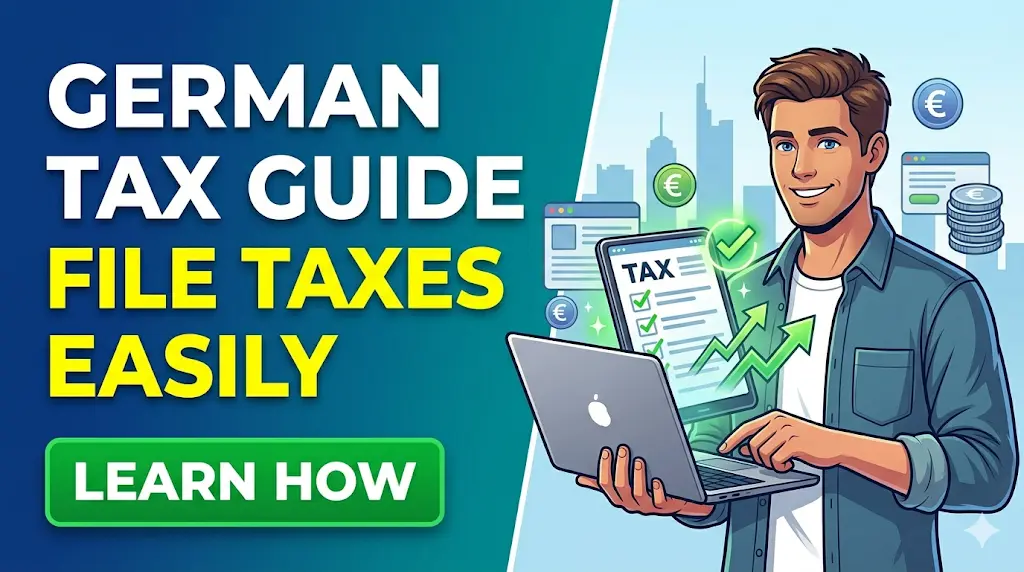
Decoding the Essential Tax Forms
The most shocking realization for expats logging into ELSTER for the first time is that it is not tax preparation software; it is merely a digital transmission tool. ELSTER does not ask you friendly, interview-style questions to find your maximum refund. It simply presents you with digital replicas of complex German tax forms.
The Core Forms Mantelbogen and Anlage N
Every single person filing a tax return must complete the Hauptvordruck (often called the Mantelbogen). This is the main form where you input your basic personal data, address, and bank account details for your refund.
If you are a standard employee working for a company in Germany, your most important form is the Anlage N (Income from employment). Here, you will systematically input the data from your annual income tax statement (Lohnsteuerbescheinigung), which your employer provides at the end of the year. This form is also where you declare your income-related expenses (Werbungskosten), such as commuting costs, work equipment, and home office allowances.
Tracking these deductible expenses throughout the year is critical to maximizing your refund. Using the categorized digital features inside your N26 app is a brilliant way to manage this. By actively tagging work-related purchases in your N26 checking account throughout the year, you avoid the miserable task of hunting down physical receipts in a shoebox come tax season.
Declaring Foreign Income and Investments
This is the section where the majority of international workers make critical errors. As a resident of Germany, you are subject to unlimited tax liability, meaning you must declare your global income. Understanding the exact parameters of this liability is a complex process decoded in Taxing Worldwide Income How Germany Taxes Foreign Income and Assets.
If you have foreign bank accounts that generated interest, or if you hold global investments, you must fill out the Anlage KAP (Income from capital assets). If you use a domestic German broker, they automatically deduct the 26.375 percent capital gains tax and send it to the Finanzamt. However, if you maintain your portfolio overseas, you must calculate and declare those gains manually.
This manual calculation is a mathematical nightmare unless you use a globally compliant platform. Veteran expats heavily favor keeping their investments with Interactive Brokers. Because Interactive Brokers generates highly detailed, localized European tax reports, you can essentially copy and paste the final numbers directly into your ELSTER Anlage KAP form. Using Interactive Brokers prevents you from spending weeks manually converting foreign stock dividends into Euros on specific historical dates, a vital strategy discussed in Should You Invest in German or International Stocks Diversifying as an Expat.
Managing Expat Finances and Cross Border Taxes
Successfully clicking “submit” on ELSTER is only half the battle. You must then wait for the tax office to process your return and issue your official tax assessment notice (Steuerbescheid). Understanding the complex calculations on this document is a crucial skill outlined in Understanding Your Tax Assessment Steuerbescheid After You File in Germany.
Receiving Your Refund Effectively
If you overpaid your taxes throughout the year, the Finanzamt will deposit your refund directly into the bank account you listed on the Hauptvordruck. The German tax office strongly prefers a standard SEPA account with a local IBAN.
Providing your N26 account details ensures the transfer processes seamlessly without cross-border delays. When the Finanzamt finally executes the refund, receiving that instant push notification on your N26 mobile app is one of the most satisfying moments of the expat financial year. Ensuring your domestic banking is optimized for these localized transactions is deeply explored in Mobile Banking Apps in Germany N26 Revolut and More.
Paying Tax Liabilities Without Hidden Fees
Conversely, if you had multiple income streams, received foreign rental income, or were placed in the wrong tax class, your ELSTER submission might result in a demand for back taxes.
If you are a new expat and your primary savings are still sitting in a bank account in your home country, transferring those funds to Germany to pay the Finanzamt can be disastrous. Traditional legacy banks will hit you with exorbitant international wire fees and apply a terrible exchange rate markup. To protect your capital, you must bypass the SWIFT network.
By utilizing Wise, you can move your home currency into Euros at the true mid-market exchange rate. You simply initiate the transfer through Wise, ensuring your money crosses the border without bleeding value to hidden markups, and route it directly to the tax office’s IBAN. Furthermore, if you are an international freelancer actively receiving foreign payments, accepting those funds via Wise ensures you have pristine, easily exportable financial records to attach to your ELSTER submission. Mastering these international flows is essential, a reality documented in Moving Money to Germany Declaring Savings and Large Transfers and Cross Border Banking Managing Your Home Country Account While in Germany.
Alternative Tax Tools for Non German Speakers
It is important to state clearly: ELSTER is available strictly in the German language. Due to legally binding terminology, the government refuses to offer an official English translation of the portal.
Third Party Tax Software Solutions
If your German is not at a professional financial level, navigating ELSTER directly is highly risky. Translating tax terms through an online dictionary frequently leads to catastrophic misunderstandings of what a specific deduction actually means.
Fortunately, Germany has a robust ecosystem of certified third-party tax applications, such as Taxfix, Wundertax, and SteuerGo. These platforms are authorized by the government to connect directly to the ELSTER API. They provide a highly intuitive, interview-style interface entirely in English. They ask you simple questions about your life (“Did you move for work?”, “Did you buy a new laptop?”), calculate your deductions automatically, and then transmit the data securely to ELSTER on your behalf. For the vast majority of standard employees, the 30 to 40 Euro fee these apps charge is worth every cent in preserved sanity.
When You Need a Steuerberater
Third-party apps are phenomenal for standard employment, but their algorithms break down quickly if your financial life is complex.
If you are a freelancer (Freiberufler), if you own a business, or if you have complex foreign real estate generating rental income, consumer tax apps will explicitly refuse to process your return. In these scenarios, attempting to use ELSTER alone is financial suicide. You must hire a certified German tax advisor (Steuerberater). While they are expensive, a good tax advisor will completely take over your ELSTER profile, optimize your cross-border deductions, and serve as a legal shield if the Finanzamt decides to audit your records. To keep your advisor’s billable hours low, ensure your records are pristine, a habit you can develop by reviewing Understanding German Bank Statements Fees and Transactions Explained.
| Filing Method | Cost | Language | Best Suited For |
| ELSTER (Direct) | Free | German Only | Fluent speakers with simple tax situations. |
| Third-Party Apps | €30 – €50 | English / Multiple | Standard employees seeking ease and translation. |
| Steuerberater | €300 – €1,500+ | English / Multiple | Freelancers, business owners, complex foreign assets. |
Filing taxes in a foreign country is never going to be an enjoyable experience, but understanding the rigid analog security of the ELSTER system is the first step toward mastering it. By preparing your .pfx certificate file weeks in advance, heavily utilizing modern financial platforms to track your deductible expenses and global capital gains, and knowing when to outsource the translation to third-party software, you can conquer the German tax season with your budget and your sanity fully intact.
References
Primary sources (official)
- ELSTER (Elektronische Steuererklärung): The official digital tax portal of the German federal and state tax administrations. Registration and certificate downloads must be completed directly through this domain. https://www.elster.de/eportal/start
- Bundeszentralamt für Steuern (BZSt): The Federal Central Tax Office’s official guidance on how the Tax Identification Number (Steueridentifikationsnummer) is issued and how it functions as your primary identifier for ELSTER. https://www.bzst.de/EN/Private_individuals/Tax_identification_number/tax_identification_number_node.html
Other helpful sources
- Make it in Germany – Taxes: The federal government’s official portal for international skilled workers, providing an English-language overview of the income tax system, filing deadlines, and the role of the Finanzamt. https://www.make-it-in-germany.com/en/living-in-germany/money-insurance/taxes
- Finanztip – ELSTER: Germany’s leading independent consumer advice portal offering step-by-step guides on navigating the ELSTER registration process and breakdowns of the Anlage N and Mantelbogen forms. https://www.finanztip.de/elster/
Disclaimer
The information provided in this article is for general informational and educational purposes only and does not constitute professional tax, financial, or legal advice. German tax laws regarding unlimited tax liability, statutory filing deadlines, and the mandatory declaration of worldwide income are strictly enforced by the Finanzamt. The ELSTER portal’s registration process requires physical mail delivery, and failing to register in time does not exempt you from strict statutory filing deadlines. While utilizing modern financial platforms like Wise, N26, and Interactive Brokers can significantly optimize your currency exchange rates, expense tracking, and generation of capital gains reports, your legal tax reporting liabilities remain your absolute responsibility.