The 13th Salary and Holiday Bonus: Are You Entitled to Extra Pay?
Hearing colleagues discuss their upcoming Christmas bonus while you quietly wonder if your contract includes one is incredibly isolating. I spent my first November in Munich terrified to ask HR if I was getting a 13th salary. This guide decodes German employment contracts to help you understand if you are legally entitled to holiday bonuses and how they are taxed.
Disclosure: This post may contain affiliate links. We may earn a commission at no extra cost to you if you make a purchase through these links. Read full disclosure.
Decoding the German Bonus Culture
When you relocate to Germany from the United States or the United Kingdom, your concept of a bonus is usually tied directly to annual performance metrics or corporate profit sharing. The German system approaches end-of-year compensation from a highly structured, almost institutionalized perspective.
The Difference Between a 13th Salary and Weihnachtsgeld
The most profound source of confusion for expats is the interchangeable use of the terms “13th salary” (13. Monatsgehalt) and “Christmas bonus” (Weihnachtsgeld). While they both result in a massive deposit hitting your bank account in November, they are fundamentally different legal concepts under German labor law.
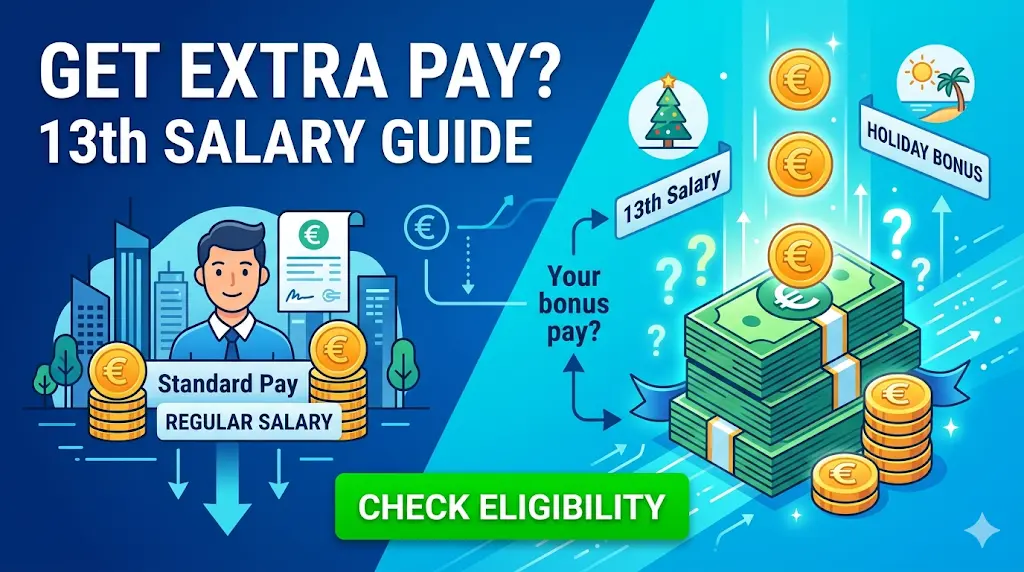
A 13th salary is legally classified as deferred compensation for work you have already performed. It is essentially your agreed-upon annual salary divided by thirteen instead of twelve, with the extra portion paid out at the end of the year. Because it is remuneration for actual labor, you have an absolute right to this money. If you quit your job in June, your employer is legally obligated to pay you a prorated amount (half) of your 13th salary when you leave.
Conversely, Weihnachtsgeld is classified as a special payment (Sonderzahlung) designed to reward your past loyalty to the company and incentivize your future retention. Because it is a loyalty reward rather than direct pay for labor, the rules are entirely different. If you resign from your position before the payout date—usually late November—you forfeit the entire bonus. There is generally no prorated payout for Weihnachtsgeld, leaving many departing expats furious when their final paycheck arrives without the extra thousands of euros they were expecting.
Urlaubsgeld and the Summer Bonus
While the end-of-the-year bonuses dominate the conversation, Germany also has a rich tradition of Urlaubsgeld (holiday pay or vacation bonus). This should not be confused with your standard paid time off. By law, your regular salary continues to be paid while you are on vacation. Urlaubsgeld is an additional cash bonus paid directly to you, usually in June or July, specifically intended to give you extra spending money for your summer travels.
Like the Christmas bonus, Urlaubsgeld is a voluntary special payment designed to reward loyalty. It is incredibly common in legacy German industries, manufacturing, and the public sector, but it is less frequently offered in modern tech startups or heavily internationalized corporate branches. If you are negotiating a new employment contract, failing to specifically ask about the inclusion of both Weihnachtsgeld and Urlaubsgeld means you could be leaving a massive amount of unstated compensation on the table, a costly mistake for anyone trying to navigate the high Cost of Living in Germany: Breakdown of Expenses Rent Food Transport.
Legal Entitlements and Contract Clauses
There is a widespread myth among expats that every worker in Germany is legally guaranteed a Christmas bonus. This is completely false. There is absolutely no statutory federal law mandating that an employer must pay you a 13th salary or a holiday bonus.
Collective Agreements and Company Custom
Your entitlement to extra pay depends entirely on the specific legal framework governing your employment. For roughly half of the German workforce, these bonuses are guaranteed by a collective bargaining agreement (Tarifvertrag). If your company is bound by a union contract—common in automotive, chemical, and public service sectors—your bonus is legally enshrined in that overarching agreement, and your employer cannot simply choose to withhold it.
If your contract is not governed by a Tarifvertrag, you must look at your individual employment contract. Even if your contract explicitly says nothing about a bonus, you might still be legally entitled to one under the principle of betriebliche Übung (company custom). Under German labor law, if an employer voluntarily pays a Christmas bonus to its employees for three consecutive years without explicitly stating that it is a one-off, voluntary payment, the bonus transforms into a permanent legal right.
To prevent this 3-year rule from taking effect, modern employers often attach a Freiwilligkeitsvorbehalt (voluntary reservation clause) to your payslip. This clause explicitly states that the bonus is a voluntary payment and does not constitute a legal claim for the future. Decoding the dense legal terminology of your contract is just as vital as understanding the paperwork involved in German Bureaucracy 101: Understanding the Anmeldung, Schufa, and Tax ID.
Repayment Clauses and Resignation
If you receive a massive Christmas bonus in November, celebrate, and then hand in your resignation in January, you might be in for a devastating shock. Many German employment contracts contain a Rückzahlungsklausel (repayment clause).
Because Weihnachtsgeld is a retention tool, employers want to ensure you actually stay with the company after taking the money. If your contract contains a valid repayment clause, leaving the company shortly after receiving the bonus triggers a legal obligation to pay it back in full.
German labor courts have established strict limits on these clauses to protect employees. If the bonus is less than 100 euros, it cannot be clawed back. If the bonus is between 100 euros and one full month’s salary, the employer can demand repayment if you leave the company before March 31st of the following year. If the bonus is greater than a full month’s salary, the binding period can stretch all the way to June 30th. It is critical to note that a 13th salary—because it is pay for work already done—can never be subjected to a repayment clause.
| Feature | 13. Monatsgehalt (13th Salary) | Weihnachtsgeld (Christmas Bonus) |
| Primary Purpose | Payment for work already performed | Reward for company loyalty and retention |
| Prorated on Resignation? | Yes, you receive a pro-rata share | Usually no, you forfeit the entire amount |
| Repayment Clause | Not legally permissible | Permissible (if clearly stated in contract) |
| Standard Payout Timing | Usually November or December | Usually late November |
The Tax Reality of German Special Payments
The joy of seeing an extra 4,000 euros added to your gross pay is usually obliterated the second you calculate the net payout. Expats frequently assume there has been a payroll error because the tax deductions on their bonus month are exponentially higher than usual.
Why Your Bonus Looks So Small on Payday
Under German tax law, a Christmas bonus or 13th salary is not taxed as regular monthly income. It is classified as Sonstige Bezüge (other remuneration). The German tax office (Finanzamt) taxes this lump sum by calculating your projected annual income tax without the bonus, and then calculating your projected annual income tax with the bonus.
Because Germany operates on a progressive tax system, this sudden injection of cash artificially spikes your annual tax bracket. The difference between the two annual tax calculations is then deducted entirely from your November paycheck. This aggressive calculation methodology means your bonus is effectively taxed at your absolute highest marginal rate. It is entirely common to lose 45 to 50 percent of your gross bonus to income tax alone.
Furthermore, if your regular monthly salary sits below the Beitragsbemessungsgrenze (the income ceiling for social security contributions), your bonus will also be hit with the standard 20 percent deduction for public health, nursing care, unemployment, and pension insurances. Understanding how these extra deductions impact your long-term retirement planning is a dynamic explored in Claiming German Pension as a Foreigner: Can Non-Citizens Receive State Pension?.
How to Read the Bonus on Your Payslip
When you receive your November Lohnabrechnung (payslip), the accounting will look incredibly chaotic. You must locate the gross bonus amount, which is usually listed under a distinct line item separate from your base pay.
Beneath the gross amounts, you will see a massive spike in the Lohnsteuer (wage tax) deduction line. Do not panic. While the immediate withholding is brutal, it is technically only a prepayment to the state. When you file your official tax return the following year, the Finanzamt will recalculate your exact tax liability based on your actual, finalized annual income. If they over-withheld taxes on your bonus in November, you will receive the difference back as a refund. Decoding the final mathematics of this process is heavily detailed in Understanding Your Tax Assessment Steuerbescheid: After You File in Germany. To ensure you can easily track the final net deposit when it hits your account, reviewing Understanding German Bank Statements: Fees and Transactions Explained is highly recommended.
Strategies for Managing Your Windfall
Once the heavily taxed net bonus finally lands in your account, your immediate priority should be protecting the capital from lifestyle creep. A sudden influx of euros can easily disappear into daily expenditures if you do not actively partition the funds.
Quarantining the Cash Locally
When you receive your standard salary and your bonus in a single, massive lump-sum deposit, relying on a modern banking platform is essential for financial clarity. Utilizing an agile account like N26 allows you to instantly visualize the deposit through real-time push notifications.
More importantly, you can use the N26 Spaces feature to immediately drag the bonus cash out of your primary checking balance. By digitally partitioning the extra money into a locked sub-account, you prevent it from inflating your daily grocery or leisure budget. This strict separation ensures your baseline financial discipline remains intact, a foundational survival mechanism covered deeply in Mobile Banking Apps in Germany: N26 Revolut and More.
Sending the Bonus Across Borders
Many expats rely on their end-of-year bonuses to clear financial obligations in their home countries or to send generous holiday gifts to their extended families. If you plan to repatriate a portion of your bonus, using a legacy German bank to execute an international wire transfer is a terrible mistake that will bleed your capital.
Traditional banks utilize the archaic SWIFT network, slicing off unpredictable intermediary fees and applying a terrible exchange rate markup to your hard-earned bonus. To protect your funds, you must intercept the exchange process. If your goal is to send money home, utilizing Wise ensures you completely bypass traditional bank SWIFT fees. Initiating the transfer through Wise locks in the true mid-market exchange rate, ensuring your foreign mortgage or student loan is paid efficiently without losing value to bank greed. Mastering these low-cost international transfers is a vital skill explored in Moving Money to Germany: Declaring Savings and Large Transfers and Cross Border Banking Managing Your Home Country Account While in Germany.
Investing for the Long Term
If you do not need the bonus for immediate travel or debt repayment, leaving thousands of euros sitting in a zero-interest checking account exposes your windfall to the silent erosion of European inflation. Your 13th salary should be treated as an aggressive wealth-building tool.
However, using local German brokerages often limits your geographic mobility, as they can force you to liquidate your portfolio if you ever decide to leave the country. Deploying the capital through Interactive Brokers allows you to invest in a globally diversified portfolio of ETFs with incredibly low execution fees. Because Interactive Brokers generates localized European tax reports, it keeps you perfectly compliant with the German tax authority while maintaining a portfolio that can easily cross borders. Protecting and compounding this surplus wealth safely is the ultimate hallmark of a financially integrated expat, a strategy comprehensively detailed in Should You Invest in German or International Stocks Diversifying as an Expat and Taxing Worldwide Income: How Germany Taxes Foreign Income and Assets.
References
Primary sources (official)
- Industrie- und Handelskammer (IHK) Nord Westfalen: The official Chamber of Commerce guidelines detailing the legal distinction between the 13th salary and Weihnachtsgeld, including the exact parameters of the betriebliche Übung (company custom) rule. https://www.ihk.de/nordwestfalen/recht/arbeitsrecht/weihnachtsgeld-3607482
- Deutscher Gewerkschaftsbund (DGB): The German Trade Union Confederation provides a comprehensive breakdown of employee rights regarding holiday bonuses, outlining the legal limits of repayment clauses (Rückzahlungsklauseln) upon resignation. https://www.dgb.de/service/ratgeber/weihnachtsgeld/
Other helpful sources
- Finanztip – Weihnachtsgeld & Steuern: Germany’s leading independent financial advice portal offering a deep mathematical explanation of the Sonstige Bezüge tax classification and why progressive tax brackets heavily reduce your net bonus payout. https://www.finanztip.de/weihnachtsgeld/
- Aivy HR Lexikon – Weihnachtsgeld: A practical legal summary aimed at human resources professionals, explaining how the voluntary reservation clause (Freiwilligkeitsvorbehalt) protects employers from permanent bonus claims. https://www.aivy.app/lexikon/weihnachtsgeld
Disclaimer
The information provided in this article is for general informational and educational purposes only and does not constitute professional financial, tax, or labor law advice. German employment laws regarding the 13th salary (13. Monatsgehalt) and Christmas bonuses (Weihnachtsgeld) are strictly governed by individual contracts, collective agreements (Tarifverträge), and the judicial principles of company custom (betriebliche Übung). Repayment clauses (Rückzahlungsklauseln) are highly complex and their validity depends entirely on the exact wording of your signed contract. Always consult a specialized German labor lawyer (Fachanwalt für Arbeitsrecht) before resigning if you are concerned about forfeiting or repaying a company bonus.