How to Read a German Rental Contract’s Financial Clauses (Deposit, Utilities)
Staring at a twenty-page German lease agreement filled with compound financial terms is absolutely terrifying when your housing is on the line. I once signed a contract completely misunderstanding my utility obligations, resulting in a devastating end-of-year bill that nearly wiped out my savings. This guide breaks down the financial clauses of a German rental contract so you can sign with confidence.
Disclosure: This post may contain affiliate links. We may earn a commission at no extra cost to you if you make a purchase through these links. Read full disclosure.
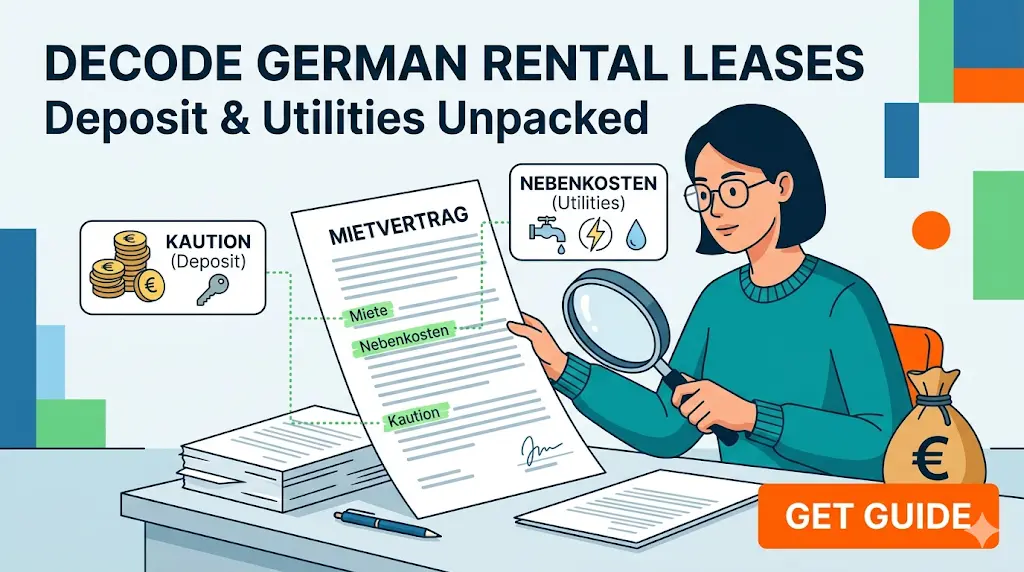
Kaltmiete vs Warmmiete and the Trap of Nebenkosten
When you browse German property portals, the large numbers displayed in bold are incredibly deceptive. If you come from a country where the advertised rent is simply the final amount you wire to the landlord every month, navigating the German pricing structure requires a fundamental mental shift.
Decoding the Cold Rent
The foundation of every German rental contract is the Kaltmiete (cold rent). This figure represents the absolute bare minimum cost of simply occupying the physical space. It covers the four walls, the ceiling, and the floor. It completely excludes the cost of making that space livable—meaning it does not include heating, hot water, cold water, trash collection, or building maintenance.
Many expats see a beautiful apartment listed in Munich or Berlin with a Kaltmiete of 1,200 euros and immediately base their entire monthly budget on that number. This is a dangerous financial illusion. The Kaltmiete is simply the baseline metric used to calculate your security deposit and legally allowable future rent increases. You will never actually write a monthly check for just the Kaltmiete. To safely calculate how much of your paycheck this apartment will consume, you must cross-reference your findings with a realistic Cost of Living in Germany: Breakdown of Expenses Rent Food Transport.
Warm Rent and the Annual Reconciliation Bill
The amount you actually transfer to your landlord every month is called the Warmmiete (warm rent). The warm rent is calculated by taking your Kaltmiete and adding your Nebenkosten (operating costs or utilities).
Here is the massive trap: the Nebenkosten amount listed in your contract is merely a Vorauszahlung (an advance payment or estimate). It is not a fixed, flat-rate fee. Every single month, you are paying an estimated amount into a pot based on what the landlord guesses your water and heating consumption will be, combined with fixed building costs like property tax (Grundsteuer), hallway cleaning, and the caretaker (Hausmeister).
At the end of the year, the landlord receives the actual utility bills for the building and performs the Nebenkostenabrechnung (annual utility reconciliation). If your actual consumption was higher than the estimated advance payments you made throughout the year, you will receive a massive back-payment demand. Due to the recent volatility in European energy prices, it is incredibly common for expats to receive reconciliation bills demanding 500 to 1,000 euros out of nowhere.
To survive these billing shocks, veteran expats actively quarantine funds. By opening your primary account with N26, you gain access to their Spaces feature, which allows you to create dedicated digital sub-accounts. You can instantly drag a small utility buffer into a locked Space every month, physically separating it from your daily checking balance. When the inevitable reconciliation bill arrives in December, you simply release the funds from your N26 sub-account and pay it without jeopardizing your grocery budget. Navigating the mechanics of these local utility mandates is deeply explored in How to Pay Rent and Bills in Germany: Banking Tips for Expats.
Navigating the Kaution Security Deposit
Moving into a new apartment requires a catastrophic amount of upfront liquid capital. The German security deposit (Kaution) is designed to heavily insulate the landlord against property damage or unpaid rent, but it places a massive burden on the tenant.
Legal Limits and Payment Structures
When reviewing the deposit clause in your contract, you must ensure the landlord is not exploiting your lack of local knowledge. According to Section 551 of the German Civil Code (BGB), a residential security deposit is legally capped at a maximum of three months of Kaltmiete. If your cold rent is 1,000 euros and your warm rent is 1,300 euros, the absolute maximum deposit the landlord can demand is 3,000 euros. If a landlord attempts to base the deposit calculation on the warm rent, they are breaking the law.
Furthermore, many landlords will aggressively pressure you to transfer the entire deposit in one lump sum before they hand over the keys. You are not legally required to do this. Section 551 of the BGB explicitly grants you the right to pay your Kaution in three equal monthly installments. The first installment is due at the start of the rental contract, and the remaining two are due alongside your next two rent payments. For an expat managing the intense financial drain of a transatlantic relocation, exercising this legal right to pay in installments can save you from immediate bankruptcy.
The contract should also state that the landlord will hold your deposit in a separate, insolvency-proof trust account (Treuhandkonto), distinct from their personal assets. If the landlord goes bankrupt, your deposit is legally protected from their creditors.
Transferring the Deposit Safely
If you agree to pay the deposit upfront, or if you need to rapidly prove your liquidity to a landlord to secure the lease, you will likely need to bring bulk savings from your home country into Germany.
This is where the legacy banking system will silently bleed you dry. If you instruct an American, British, or Australian bank to execute a standard SWIFT wire transfer of 4,000 euros to your German landlord, the intermediary banks will hit you with opaque network routing fees. Worse, they will apply a catastrophic exchange rate markup, quietly skimming hundreds of euros off your principal amount.
To protect your home equity, you must intercept the exchange process. Utilizing Wise allows you to convert your foreign currency into euros at the true mid-market exchange rate. You simply initiate the transfer through Wise, ensuring your money crosses the border without bleeding value to hidden bank markups. You can then route those fully converted euros safely into your localized German checking account or directly to the landlord’s trust account. Knowing how to execute these massive cross-border capital flows safely while remaining compliant with federal reporting laws is a foundational step detailed in Moving Money to Germany: Declaring Savings and Large Transfers.
Indexmiete and Staffelmiete Rent Increases Explained
German tenant law (Mietrecht) heavily regulates how and when a landlord can raise your rent. To bypass the bureaucratic headache of arguing over local comparative rent indexes (Mietspiegel), landlords increasingly insert automatic rent increase clauses directly into the contract. You must identify these before you sign.
Graduated Rent Clauses (Staffelmiete)
A Staffelmiete clause explicitly outlines pre-agreed, fixed monetary increases at specific dates in the future. For example, the contract might state your cold rent is 1,000 euros in year one, 1,050 euros in year two, and 1,100 euros in year three.
While this sounds intimidating, it actually provides phenomenal financial predictability. You know exactly what your housing costs will be years in advance, allowing you to plan your career and savings trajectory without any nasty surprises. Furthermore, while a Staffelmiete is active, the landlord is legally barred from increasing your rent for any other reason, such as building modernizations.
Inflation-Tied Rent Clauses (Indexmiete)
The Indexmiete is currently the most dangerous clause an expat can sign. If your contract contains an Indexmiete, it means your cold rent is permanently tethered to the German Consumer Price Index (VPI), which tracks inflation.
If inflation sits at a healthy 1.5 percent, your annual rent increases are negligible. However, during periods of massive macroeconomic instability—such as the recent European energy crises where inflation spiked to nearly 8 percent—an Indexmiete allows your landlord to legally hike your rent by that exact percentage every single year. Because your salary rarely scales perfectly with inflation, an Indexmiete can rapidly price you out of your own home.
| Rent Increase Type | Mechanism | Expat Risk Level | Predictability |
| Standard Contract | Regulated by local Mietspiegel (comparative index) | Moderate | Low (Landlord can demand sudden increases) |
| Staffelmiete | Fixed, pre-agreed monetary increments | Low | Extremely High |
| Indexmiete | Tied to the national inflation rate (VPI) | Very High | Extremely Low (Subject to macroeconomics) |
Setting Up Your Banking for Monthly Payments
Once you have decoded the financial clauses and safely secured the keys, you must orchestrate a flawless, automated monthly payment system. German landlords despise late rent, and administrative failures can quickly lead to eviction warnings.
The Mandatory SEPA Mandate
Your contract will stipulate that your monthly Warmmiete must arrive in the landlord’s account by the third working day of the month. To do this, you must set up a SEPA standing order (Dauerauftrag).
While European law technically mandates that a landlord must accept rent from any European IBAN (such as a French or Lithuanian account), the reality is that many old-school German landlords will reject foreign IBANs—a frustrating phenomenon known as IBAN discrimination. To avoid fighting your landlord over banking regulations during your first week, you must establish a localized financial footprint. By using N26, you secure a fully recognized, native German DE IBAN. This ensures your rent transfers process flawlessly and keeps you in your landlord’s good graces. Structuring your domestic operations to avoid these petty disputes is a critical survival skill mapped out in Mobile Banking Apps in Germany: N26 Revolut and More.
If you are currently paying off obligations in your home country—like a student loan or a foreign mortgage—while trying to meet these strict German rent deadlines, you must learn to balance your dual financial lives. Juggling these currencies efficiently is deeply explored in Cross Border Banking Managing Your Home Country Account While in Germany.
Managing Surplus Income After Rent
Once your Kaltmiete, utility buffers, and daily expenses are perfectly organized, you must decide what to do with the surplus income you generate. Leaving excess euros sitting in a standard checking account exposes your wealth to the very inflation that drives up an Indexmiete.
Veteran expats aggressively sweep their surplus capital out of the local banking system. By opening a globally compliant brokerage account with Interactive Brokers, you physically separate your long-term wealth from restrictive domestic German products. Because Interactive Brokers caters to a highly mobile international client base, you can deploy your localized savings into a diversified, low-fee ETF portfolio that can easily cross borders if your career takes you out of Germany. You are not forced to liquidate your assets and trigger a massive tax penalty simply because you decide to end your rental contract and leave the country. Protecting and compounding your surplus wealth while maintaining geographic freedom is the ultimate hallmark of a financially integrated expat, a strategy comprehensively detailed in Should You Invest in German or International Stocks Diversifying as an Expat.
References
Primary sources (official)
- Gesetze im Internet – Bürgerliches Gesetzbuch (BGB): The official legal text of the German Civil Code. Section 551 explicitly details the laws regarding the limitation and statutory installment payments of the rental security deposit (Mietsicherheit). https://www.gesetze-im-internet.de/bgb/__551.html
- Deutscher Mieterbund (DMB): The national German Tenants’ Association provides comprehensive, legally backed explanations on how the Nebenkostenabrechnung functions and what specific operating costs a landlord is legally allowed to pass on to the tenant. https://mieterbund.de/
Other helpful sources
- Make it in Germany – Housing & Registration: The federal government’s official portal outlining the everyday administrative realities of renting an apartment as an international worker, including overviews of cold and warm rent. https://www.make-it-in-germany.com/en/living-in-germany/housing-mobility/housing-registration
- Finanztip – Mietvertrag: A highly trusted, independent financial advice portal detailing the hidden traps in standard German lease agreements, specifically breaking down the financial dangers of the Indexmiete during high inflation. https://www.finanztip.de/mietvertrag/
Disclaimer
The information provided in this article is for general informational and educational purposes only and does not constitute professional financial or legal real estate advice. German tenancy law (Mietrecht) is highly regulated, and the specific validity of utility cost allocations (Nebenkosten), graduated rent clauses (Staffelmiete), and inflation-tied rent adjustments (Indexmiete) depends entirely on the exact wording of your individual contract. According to § 551 BGB, you have the statutory right to pay your security deposit (Kaution) in three monthly installments. While utilizing modern financial platforms like Wise, N26, and Interactive Brokers can significantly optimize your currency exchange rates, domestic rent automation, and global asset management, your legal obligation to fulfill the financial terms of your signed lease remains your absolute responsibility.