How to Pay Rent and Bills in Germany: Banking Tips for Expats
Setting up your internet only to find the provider refuses your foreign credit card is a uniquely maddening welcome to Germany. I spent my first two weeks desperately trying to pay my landlord with a US account before facing eviction threats. This guide explains how to secure a local account, automate your rent, and easily manage German utility bills.
Disclosure: This post may contain affiliate links. We may earn a commission at no extra cost to you if you make a purchase through these links. Read full disclosure.
The German Financial System Untangled
When you first arrive in Germany, you carry the financial habits of your home country with you. If you come from North America or the UK, you are likely accustomed to paying rent through online portals, writing physical checks, or setting up credit card auto-pays for your internet and electricity bills. In Germany, attempting to use any of these methods will result in immediate rejection.
Why Your Foreign Bank Account Will Not Work
The German economy is profoundly conservative when it comes to daily financial transactions. Credit cards are viewed with deep suspicion by landlords and utility providers because of the high merchant processing fees associated with them. Instead, the entire country operates on a unified, direct bank-to-bank transfer system known as the Single Euro Payments Area (SEPA).
If you try to wire your first month’s rent directly from your Bank of America or Barclays account to your German landlord, you will trigger a chaotic, expensive chain of events. Traditional international wire transfers route through the SWIFT network, which means intermediary banks will shave off unpredictable fees from your principal amount. If your rental contract stipulates exactly €1,200, and your landlord only receives €1,175 because of SWIFT deductions and terrible exchange rates, you are legally in arrears. Doing this repeatedly can give your landlord grounds for termination.
Furthermore, German utility companies—from internet providers like Telekom to local electricity grids like Vattenfall—will flat-out refuse to pull monthly payments from a non-European bank account. They require a SEPA-compliant system to automate their billing. Trying to navigate these rigid institutional rules without the proper setup is a massive source of the initial culture shock detailed in German Bureaucracy 101: Understanding the Anmeldung, Schufa, and Tax ID. You must surrender your home-country financial habits and adapt to the German way of banking immediately.
The Importance of a German IBAN
To survive in Germany, you need an International Bank Account Number (IBAN). Specifically, you need one that starts with “DE” (for Germany). While legally, under European law, any IBAN within the SEPA zone (such as a French or Spanish account) must be accepted by German companies, “IBAN discrimination” is still rampant. Many local landlords, gym owners, and older billing systems will reject a non-German IBAN simply because their legacy software cannot process it.
Getting a German IBAN historically presented expats with a brutal catch-22. To open an account at a traditional brick-and-mortar Sparkasse or Deutsche Bank, you need a registered address (Anmeldung). But to get a registered address, you need to sign a lease, and to sign a lease, you need a bank account.
This is why modern digital banks are an absolute lifeline for newly arrived expats. Opening an N26 account allows you to bypass this traditional paradox. Because N26 verifies your identity digitally and allows you to open a fully licensed German bank account using just your passport and a temporary shipping address, you can secure your “DE” IBAN within days of landing. Having this functional account ready to go is the only way to seamlessly process your rental deposits and prove your financial viability, a crucial step for expats navigating the strict financial requirements of Understanding the Different Types of German Visas and Residence Permits.
Mastering SEPA Transfers and Direct Debits
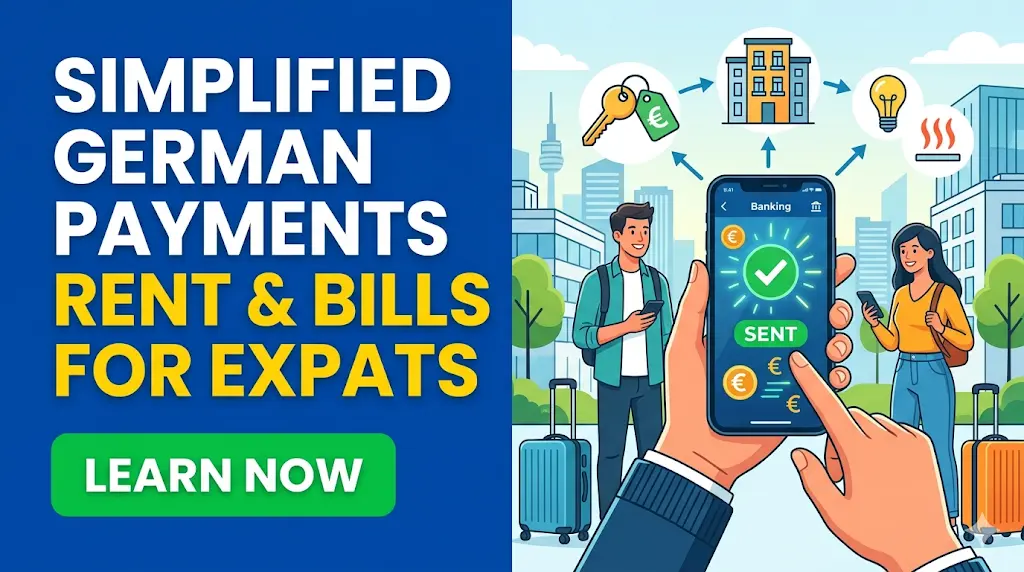
Once you have your German bank account secured, you must master the two foundational pillars of German bill paying: the Dauerauftrag and the SEPA-Lastschriftmandat. Mixing these two up will lead to bounced payments and aggressive late fees.
Setting Up a Dauerauftrag for Rent
In Germany, rent (Miete) is strictly paid via an active bank transfer (Überweisung). Your landlord will never automatically pull the money from your account; you are legally responsible for pushing the money to them. According to German tenancy law, your rent must land in your landlord’s bank account by the third working day (Werktag) of the month.
Because missing this deadline can damage your relationship with your landlord, you must automate the process. You do this by setting up a Dauerauftrag (Standing Order) within your banking app. You input your landlord’s IBAN, the exact rent amount, and select a recurring monthly date (usually the 1st of the month). The bank will automatically execute this transfer every single month until you tell it to stop.
When you set up the Dauerauftrag, the Verwendungszweck (reference line) is incredibly important. You cannot just leave it blank or write “Hello.” You must write “Miete” followed by your apartment number or your last name, exactly as stipulated in your lease. If you live in a massive building complex, the property management company relies entirely on this reference line to match your payment to your file. If you are a student sharing a flat and splitting costs, managing these precise transfers is a survival skill explored deeply in Housing for Students: Living in Dorms vs Off-Campus WG.
The Magic of SEPA Lastschrift for Bills
While rent is an active push, your recurring utility bills—such as electricity (Strom), internet (WLAN), mobile phone contracts, and the mandatory public broadcasting fee (Rundfunkbeitrag)—are managed via a passive pull. This is called a SEPA-Lastschriftmandat (SEPA Direct Debit Mandate).
When you sign up for an electricity provider, they will ask you to fill out a Lastschriftmandat. By providing your IBAN and signing this mandate (often done digitally with a simple checkbox), you give the company legal permission to withdraw their monthly fee directly from your checking account. You do not have to initiate the payment; they simply take what is owed on the due date.
This system is incredibly convenient, but it requires diligent cash flow management. If the utility company attempts to pull €80 for your electricity bill, and your account only has €70 in it, the direct debit will bounce. This is called a Rücklastschrift. Not only will your bank charge you a penalty fee for the bounced transaction, but the utility company will also hit you with a late payment fine (Mahngebühr). Utilizing the push notifications on your N26 app is a brilliant way to prevent this; you get an instant alert the moment a direct debit is initiated, giving you a real-time pulse on your liquidity.
| Feature | Dauerauftrag (Standing Order) | SEPA-Lastschrift (Direct Debit) |
| Who initiates the payment? | You (the sender) | The billing company (the receiver) |
| Primary Use Case | Paying Rent to a landlord | Electricity, Internet, Gym, Insurance |
| Amount Flexibility | Fixed amount every month | Variable amounts (based on usage) |
| Your Responsibility | Ensure it is set up before the due date | Ensure sufficient funds are in the account |
Avoiding Hidden Fees When Funding Your Account
Understanding how to pay the bills is useless if you do not know how to efficiently move your money into Germany to fund the account in the first place. For expats, the mechanics of cross-border transfers dictate whether you survive the expensive first month or bleed capital to hidden banking fees.
Moving Your Savings Across Borders
The most expensive hurdle you will face upon moving into a German apartment is the Kaution (security deposit). By law, German landlords can demand up to three months of “cold rent” (rent excluding utilities) upfront as a deposit. If your rent is €1,000, you suddenly need to produce €3,000 before they hand over the keys.
If your life savings are still sitting in a bank account in the US, UK, or Australia, you have a massive logistical problem. As mentioned earlier, initiating a traditional wire transfer for €3,000 will result in catastrophic exchange rate markups. Traditional banks hide a 3% to 5% margin in their currency conversion rates. On a €3,000 deposit, you could silently lose €150 just to move your own money.
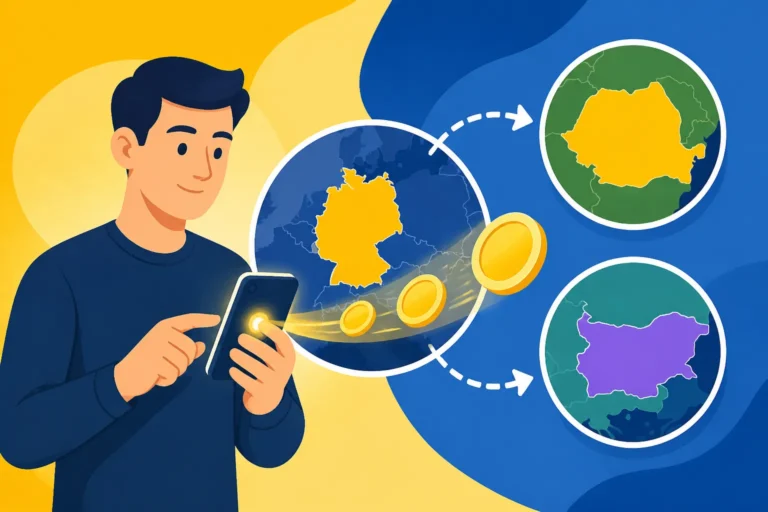
To bypass this financial trap, veteran expats rely entirely on financial technology platforms. By using Wise, you can move your home-country currency into Germany at the real mid-market exchange rate. You simply initiate a domestic transfer in your home country to Wise, and Wise deposits the equivalent euros directly into your German checking account for a tiny, transparent upfront fee. Because Wise executes these transfers rapidly, you can securely fund your Kaution and first month’s rent without the agonizing wait times and lost capital associated with traditional banks. For a deeper dive into managing large capital transfers legally, review Moving Money to Germany: Declaring Savings and Large Transfers.
Furthermore, if you still have lingering financial obligations back home—such as a student loan or a foreign mortgage—you can reverse the process. Funding these foreign debts directly from your German salary without incurring massive conversion fees requires a strategic setup, which is detailed in Cross-Border Banking: Managing Your Home Country Account While in Germany.
Consolidating and Investing Your Leftover Budget
Once you have successfully navigated the first few months, your financial life will settle into a predictable rhythm. Your salary will arrive in your N26 account, your rent will automatically depart via your Dauerauftrag, and your electricity and internet will be seamlessly pulled via Lastschrift.
At this point, you will hopefully have surplus capital at the end of the month. The worst thing you can do as an expat in Germany is leave this surplus cash stagnating in a standard checking account. German banks are notorious for offering near-zero interest rates on savings accounts while inflation slowly erodes your purchasing power, a reality you must factor into your long-term planning alongside the high local Cost of Living in Germany: Breakdown of Expenses Rent, Food, Transport.
Instead of letting your money depreciate, you should channel your surplus capital into the global markets. However, using domestic German brokers often traps you in a web of high trading fees and complex local tax wrappers that are inflexible if you decide to leave the country. A vastly superior strategy for expats is to open a globally compliant brokerage account. Moving your excess euros into a platform like Interactive Brokers allows you to invest in a highly diversified portfolio of global ETFs with incredibly low execution fees.
Because Interactive Brokers caters to a massive international client base, it provides the necessary European-compliant tax reports without tying your investments to a rigid, domestic German banking ecosystem. This allows you to aggressively build wealth while remaining fully compliant with local tax authorities, a complex balancing act explored deeply in Taxing Worldwide Income: How Germany Taxes Foreign Income and Assets. Mastering how you pay your bills is the foundational step; optimizing how you invest the remainder is how you truly thrive as an expat in Europe.
References
Primary sources (official)
- Deutsche Bundesbank – SEPA Direct Debit: The official central bank guidelines explaining the legal framework, return periods, and operational mechanics of the SEPA Core Direct Debit and B2B Direct Debit schemes in Germany. https://www.bundesbank.de/en/tasks/payment-systems/services/sepa/content/sepa-direct-debit-626654
- BaFin – Federal Financial Supervisory Authority: The regulatory body’s official explanation of instant credit transfers, banking compliance, and the rights of consumers regarding unauthorized SEPA payments. https://kontenvergleich.bafin.de/en/glossary/instant-credit-transfers
Other helpful sources
- Make it in Germany – Bank Account: The federal government’s official portal outlining the rights of expats to open basic payment accounts, the differences between Girocards and Credit Cards, and standard required documentation. https://www.make-it-in-germany.com/en/living-in-germany/money-insurance/bank-account
- LMU Munich – Opening a Bank Account: A highly practical university guide for international arrivals, detailing the specific differences between a Dauerauftrag (standing order) for rent and an Einzugsermächtigung (direct debit) for utilities. https://www.lmu.de/en/workspace-for-students/international-student-guide/opening-a-bank-account/
Disclaimer
The information provided in this article is for general informational and educational purposes only and does not constitute professional financial, tax, or legal advice. German banking regulations, the legal deadlines for rental payments under the German Civil Code (BGB), and the consumer protection rules governing SEPA direct debit reversals (Lastschriftrückgabe) are strictly enforced and subject to individual banking terms and conditions. Missing a rental payment deadline or bouncing a direct debit can result in severe financial penalties and potential legal eviction proceedings.