Mobile Phone Contracts vs Prepaid: Which is More Cost-Effective in Germany?
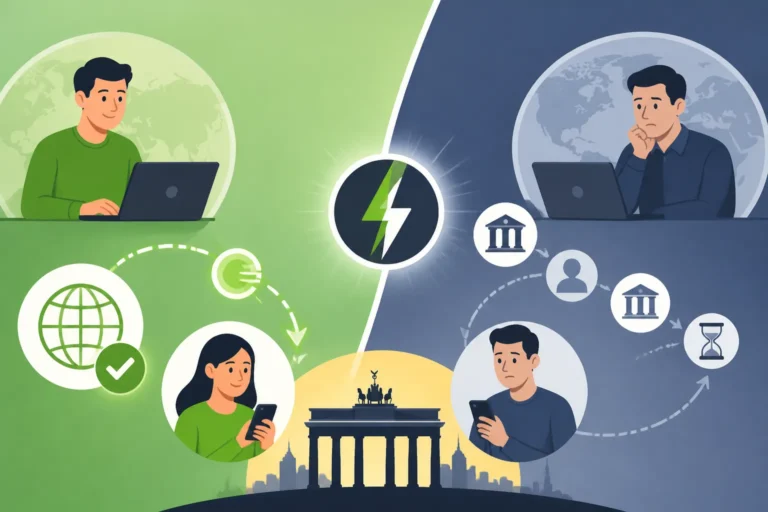
Your first week in Germany, you need a German number for the bank, your landlord and a dozen verification codes. Then you walk into a phone shop and get turned away because you have no SCHUFA history. This guide compares contracts and prepaid plans on real cost, flexibility and paperwork, and shows how your phone bill can matter at tax time.
Disclosure: This post may contain affiliate links. We may earn a commission at no extra cost to you if you make a purchase through these links. Read full disclosure.
Why the Contract vs Prepaid Question Feels So Loaded in Germany
In most countries, choosing a phone plan is a ten-minute decision. In Germany it can turn into a small administrative project. The choice between a Vertrag (contract) and Prepaid touches your credit history, your address registration, your bank account and sometimes your tax return. I learned this standing in a Saturn electronics store on Alexanderplatz with my passport in one hand and my rental agreement in the other. A very polite salesperson told me the system “would not accept” my application.
The frustration is real, and it is not your fault. The German mobile market is built around residents with a settled financial footprint: a registered address, a local IBAN and a credit file. Newcomers have none of these on day one. That is why the “which is cheaper” question is also a question of “which can I actually get right now”. For the full setup sequence, see Setting Up a Phone Plan in Germany: Prepaid vs Contract.
The SCHUFA Wall and the Newcomer Problem
A postpaid contract is a form of credit. The provider lets you use the network now and bills you later, and if the contract includes a handset, it is effectively financing the device. Before signing you up, German providers typically run a credit check through SCHUFA, the country’s main credit bureau. If you arrived last month, your SCHUFA file is either empty or very thin, and an empty file can lead to a rejection, a demand for a deposit, or an offer limited to a SIM-only plan without a phone.
I have seen this play out many times in expat circles. Priya, a software engineer who moved to Munich with a strong salary and an excellent credit record back home, was rejected for a flagship phone contract in her first fortnight. Three months later, after her salary had landed in a German account a few times and her address registration was established, the same provider approved her without a second glance. Nothing about her finances had changed except their visibility to the German system. To understand how that file builds over time, read The SCHUFA Credit Score in Germany: How It Works.
The practical lesson is that prepaid is often the default first step for newcomers, whatever the long-term cost comparison says. You can treat it as a bridge rather than a permanent decision.
Identity Checks, Video Ident, and Your First SIM
Even prepaid is not anonymous in Germany. Every SIM card has to be registered to a verified identity, and this catches many arrivals off guard. Supermarkets sell prepaid starter packs, but the SIM will not activate until you complete identity verification. This is usually done through a video call with an agent who checks your passport on camera, or in person at a shop or post office counter.
Video ident works with most passports, but it can be fiddly. Hotel Wi-Fi drops mid-call, the agent cannot read the security features under your desk lamp, or the system does not recognise a particular nationality’s document. Have a strong connection, good daylight and your passport ready. If one provider’s process will not accept your document, another’s often will, and an in-store activation is a reliable fallback.
If you have not completed your Anmeldung yet, read Connectivity Before Your Anmeldung: What You Can Buy Without a Registered Address before you buy anything. It will save you a wasted trip. Many people try to use a home number for the first months, but German banks and delivery services often insist on a local one, as explained in Why You Still Need a German Number: Banks, Deliveries, and Verification Codes.
Comparing the True Cost of Contracts and Prepaid Plans
The headline monthly price on a poster in a phone shop window tells you very little. To compare contracts and prepaid fairly, you need to look at the total cost over the whole period you are committed. That means one-off activation fees, the cost of any handset, what happens when the minimum term ends, and how flexible you will be if your life changes. Because tariffs change constantly, I will not quote figures here. Instead, I will show you how to read the offer so you can run the numbers yourself on each provider’s current price page.
The Hidden Price of a Subsidised Handset
The classic German contract bundles a new smartphone with a monthly tariff. You pay a small upfront amount for the phone, sometimes almost nothing, and a higher monthly fee for the duration of the minimum term. It feels painless. It is also where most people overpay without realising it.
Here is how to check. Take the monthly fee, multiply it by the number of months in the minimum term, and add the upfront handset payment and any connection fee. Then compare that total to two separate purchases: the same phone bought outright from a retailer, plus a SIM-only plan with a similar data allowance over the same period. Sometimes the bundle wins, especially during promotions. Often the separate route is noticeably cheaper, and it leaves you owning an unlocked phone with full freedom to change provider.
The second trap is what happens after the minimum term. In many bundled contracts, the monthly fee stays the same once the phone has been “paid off”, even though you are no longer financing anything. German contracts also do not quietly end on their own. You have to actively cancel (kündigen), in writing or through the provider’s portal, within the notice period stated in your contract. A colleague of mine in Hamburg kept paying a handset-inclusive rate for well over a year after his phone was effectively his, simply because nobody reminded him. Put your notice deadline in your calendar the day you sign.
How Prepaid Top-Ups and Plan Packages Actually Work
German prepaid has evolved far beyond the pay-per-minute cards of the past. Most prepaid offers now sell packages: a bundle of data, calls and texts that renews automatically for a fixed period, paid from your prepaid balance. You top up your balance by bank transfer, card, PayPal or vouchers bought at the supermarket checkout, and the package renews as long as there is enough credit.
Two details matter for cost. First, many prepaid packages renew on a fixed cycle that is shorter than a calendar month. That means more renewals per year than you might expect, so always convert the price to an annual figure before comparing it with a monthly contract. Second, if your balance runs short, the package may not renew, and you may be charged standard per-unit rates or lose data access until you top up. Setting up automatic top-ups avoids this, but make sure you understand the threshold that triggers them.
The great strength of prepaid is control. There is no credit check beyond identity verification, no long minimum term and no risk of a surprise bill. You can change package or provider when a better deal appears. Students, job seekers and anyone on a tight or uncertain budget tend to find this predictability worth more than any small price advantage a contract might offer.
Network Choice: The Big Three and the Discount Brands
Germany has three main network operators: Telekom, Vodafone and O2 (Telefónica). On top of them sits a large layer of discount brands that rent capacity on these networks. Examples include Congstar, which runs on Telekom’s network, and Aldi Talk, which runs on O2’s. Supermarket and online-only brands often offer prepaid and flexible contracts at lower prices than the network owners’ own brands, but they may have lower priority on the network, slower speeds or fewer extras.
Coverage matters more in Germany than many newcomers expect. City centres are generally fine on all networks. Rural areas, regional trains and some parts of the east and the uplands can be patchy depending on the operator. Before committing to anything long, ask colleagues and neighbours which network works in your building, your commute and your weekend hiking spots.
For budget-oriented comparisons, see Travel eSIM vs Aldi Talk and Congstar: Budget Options for Longer Germany Stays and Travel eSIM vs Telekom, Vodafone, and O2 Prepaid: Price Per GB in Germany. For the providers themselves, our overview of Internet and Mobile Providers in Germany is a good next stop.
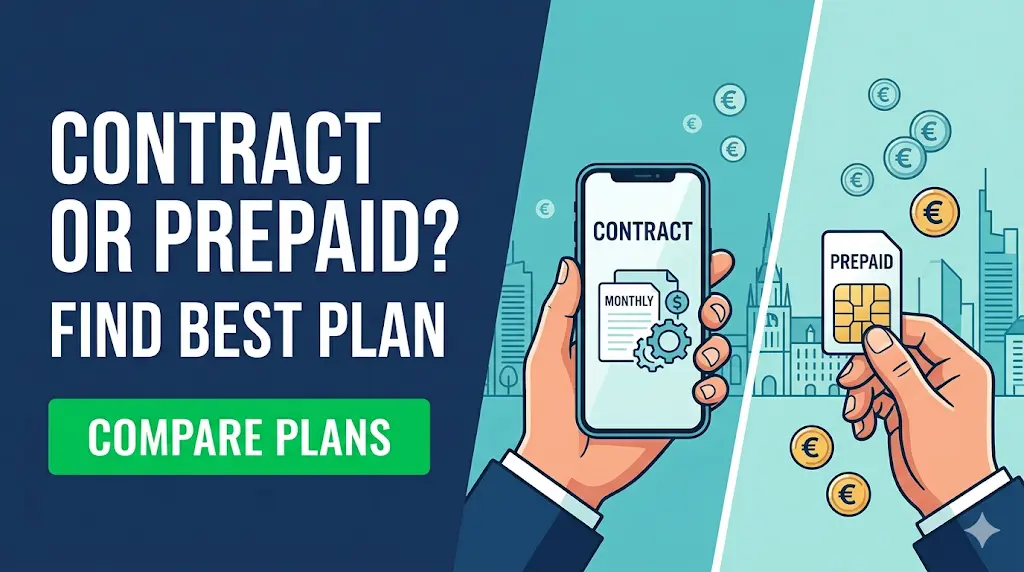
The table below summarises how the main options compare in practice.
| Factor | Postpaid Contract with Handset | SIM-Only Contract | Prepaid Package |
|---|---|---|---|
| Credit check | Usually required, newcomers often rejected | Usually required, easier to pass | Identity check only |
| Commitment | Fixed minimum term, active cancellation needed | Fixed term or flexible, depending on offer | None beyond the current package period |
| Upfront cost | Low device payment plus possible connection fee | Possible connection fee | Starter pack and initial top-up |
| Total cost over time | Often highest once device is factored in | Often competitive for heavy users | Often lowest for moderate users |
| Bill shock risk | Possible with extras and roaming outside the EU | Possible with extras | Very low, spending capped by balance |
| Paperwork for taxes | Monthly invoice provided | Monthly invoice provided | Top-up receipts, sometimes harder to collect |
| Best for | Settled residents who want financing | Settled residents who already own a phone | Newcomers, students, budget control |
Matching the Right Plan to Your Situation
There is no single “best” answer, because the right choice depends on where you are in your German journey. What makes sense for a student in Leipzig in their first semester is very different from what suits a two-income family in Frankfurt with three phones and a tablet. Here are the most common expat profiles and what tends to work for each.
The Newly Arrived Job Seeker or Student
If you have just landed and your residence status, address or income is still settling, prepaid is almost always the right first move. You get a German number quickly, you avoid the credit-check rejection, and you are not locked into anything if you end up moving cities for a job or switching universities.
Consider Mateo, who arrived in Cologne on a job-seeker permit. He bought a discount prepaid pack at a supermarket on his first evening, completed video ident from his short-term flat, and had a working number before his first Bürgeramt appointment. When he found a job three months later in Stuttgart, he simply kept the same number and topped up as usual. A contract signed in week one would have followed him around, and so would its minimum term.
For students, the decision is similar. Your data needs may be modest if you spend most days on university Wi-Fi, and a mid-sized prepaid package covers social media, maps and messaging comfortably. Tourists and short-stay visitors have slightly different needs, explained in German SIM Card for Tourists vs Residents: What’s the Difference?.
The Settled Employee on a Payroll
Once you have a regular salary landing in a German bank account and a few months of address history, the contract world opens up. This is the point to reassess. If you use a lot of data, stream music on your commute, or want a premium network with high priority, a SIM-only contract can offer a better price per gigabyte than prepaid. It also comes with a proper monthly invoice, which is useful for tax purposes, as we will see below.
My advice is to buy your phone outright, or keep your existing one, and choose a SIM-only contract rather than a handset bundle. You separate the two costs, you can see exactly what you are paying for connectivity, and you can switch providers when a better offer appears without worrying about a device still being financed. Pay the bill by direct debit so you never miss a payment, which also quietly supports your credit history. The mechanics are covered in How to Pay Bills in Germany: Banking Autopay, Direct Debit, and Transfers.
If you travel often, check how your plan treats roaming. Within the EU, domestic allowances can generally be used in other member states under fair-use rules, but non-EU destinations such as Switzerland, the UK and countries further afield may be charged very differently from one provider to the next. Read the roaming page of any provider before signing. For a deeper look at the home-SIM versus local-SIM question, see eSIM vs EU Roaming in Germany: What a Home SIM Actually Costs You.
The Freelancer and Heavy Data User
Freelancers often run their whole business from their phone: client calls, hotspotting a laptop in a café when the coworking Wi-Fi fails, two-factor authentication for every invoicing tool. For you, reliability and generous data usually matter more than squeezing out the lowest possible price. A contract on a strong network, or a large-allowance SIM-only plan, is typically the safer choice.
There is a second reason contracts suit freelancers: documentation. A clear monthly invoice made out in your name, showing the provider, the period and the amount, is exactly the kind of record a tax advisor wants to see. Prepaid top-up confirmations can work too, but they are scattered across emails, app screens and supermarket receipts, and gathering them at year end is tedious.
Many freelancers also run two SIMs, one for business and one personal, using a dual-SIM or eSIM-capable phone. This makes the business-use share of your phone costs much easier to justify, and it keeps clients from calling your personal number at nine on a Sunday evening.
Family Plans and Second SIMs
Families face a different calculation. Many network brands offer discounts when you add extra SIM cards to a main contract, and these “partner” or “family” add-ons can bring the per-person cost down considerably. The trade-off is that everything is tied to one contract holder, one credit check and one minimum term. If the main holder leaves Germany or the relationship changes, untangling the lines can be awkward.
For teenagers, prepaid is often the parents’ favourite. Spending is capped by the balance, there are no surprise bills from in-app purchases charged to the phone bill, and you can set up regular top-ups as a kind of mobile allowance. Mixed households often end up with a contract for the adults and prepaid for the children, which balances price and control well.
Whatever you choose, review the whole household’s connectivity spending once a year alongside your other recurring costs. Phone plans are one of those subscriptions that quietly creep upward. Our guide Netflix, Spotify, and Subscriptions: Managing Monthly Subscriptions on a German Budget has a simple method for doing this review.
Turning Your Phone Bill Into a Tax Win
This is the part almost nobody tells you in the phone shop. Your mobile phone costs can be relevant to your tax return, and the way you pay for connectivity, by contract with monthly invoices or by scattered prepaid top-ups, affects how easy it is to claim what you are entitled to. For Americans in Germany, who still have to file a US return every year, the picture has an extra layer. This is where getting professional help from a specialist such as Taxes for Expats pays for itself.
Why Invoices Matter More Than You Think
In Germany, employees can generally claim the work-related share of their phone and internet costs as income-related expenses (Werbungskosten) on their annual tax return, unless the employer already reimburses them. Self-employed people and freelancers can treat the business-use share as an operating expense. The rules on how much you can claim, and how you must prove it, depend on your situation, so this is not a blanket “deduct your whole bill” rule. What is consistent is that the tax office expects you to be able to show what you paid.
A contract makes this simple. Twelve monthly invoices in a folder or a cloud drive, each with your name, the provider and the amount, form a clean paper trail. With prepaid, you need to collect top-up confirmations and, ideally, package statements from the provider’s app or customer portal. Some prepaid providers make this easy, while others only show recent transactions, so download them regularly rather than trying to reconstruct a whole year in one go.
Here is a scenario I see every spring. Anna, a project manager in Düsseldorf, uses her personal phone constantly for work calls and client messages, with no employer reimbursement. She was on prepaid and threw away most of her supermarket top-up receipts. When she sat down to do her return, she could document only part of her spending. The following year she switched to a SIM-only contract, and the documentation took her two minutes. To learn which expense categories are typically claimed, read How to Claim Common Deductions on a German Tax Return.
Americans in Germany Have Two Returns to Think About
If you are a US citizen or green card holder living in Germany, you may file a German return as a resident, and you must file a US return as an American every year, wherever you live. That surprises many newcomers. The two systems do not mirror each other, and an expense that reduces your German tax bill will not necessarily be deductible on your US return in the same way. Whether your phone costs count depends on whether you are employed or self-employed, how your income is reported, and which credits or exclusions you use on the US side.
For self-employed Americans in Germany, the stakes are higher. Business expenses, including the business-use share of a phone contract, can affect both German income tax and the US self-employment calculation. Getting the documentation and the treatment consistent across both returns matters. Our article Self-Employed in Germany, American on Paper: SE Tax and the Double Filing Problem walks through why this is so easy to get wrong. The broader framework is explained in Filing US Taxes While Living in Germany: What Americans Abroad Need to Know.
The practical point for this article is that the choice between contract and prepaid feeds into your record-keeping. That record-keeping feeds into two returns, not one. Clean monthly invoices are a gift to whoever prepares your US filing.
How Taxes for Expats Fits Into the Picture
Taxes for Expats is a firm that specialises in preparing US tax returns for Americans living abroad, including those based in Germany. Instead of trying to work out alone how your German income, German taxes paid and work-related expenses translate onto US forms, you work with preparers who handle expat situations every day. For an American freelancer in Berlin claiming phone and internet costs, or an employee in Munich wondering whether anything on their German return affects their US filing, that specialist knowledge removes a lot of guesswork.
What I appreciate about using a specialist like Taxes for Expats is that the conversation starts with your real life: where you work, how you are paid, which accounts you hold, and what you are already claiming in Germany. You bring your documents, including those phone invoices, and the preparer slots each item into the right place on the US side. Pricing depends on the complexity of your return, so check the Taxes for Expats website for their current fees and service details before you book.
If you have spent an evening staring at US forms trying to figure out what a German Werbungskosten claim means for your American return, this is your sign to stop. Gather your records for the year, including your phone contract invoices or your prepaid top-up statements, and reach out to Taxes for Expats for your US filing. It is one less thing to fight with on your own in a country that already gives you plenty of paperwork.
A Practical Checklist Before You Sign or Top Up
Use this sequence whether you are buying your very first German SIM or reconsidering a contract you have had for years.
- Decide whether you can realistically pass a credit check right now. If you arrived recently or have no German income yet, start with prepaid and revisit the question later.
- Check coverage for your home address, workplace and commute by asking neighbours and colleagues which network works best there.
- Estimate your monthly data use from your current phone’s settings, then compare the price per gigabyte across prepaid packages and SIM-only contracts.
- For any contract, calculate the full cost over the minimum term, including connection fees and handset payments. Compare it with buying the phone outright plus a SIM-only plan.
- For any prepaid package, check the renewal cycle length and convert the price to an annual figure before comparing.
- Read the roaming terms for the countries you visit most, especially those outside the EU.
- Note your contract’s cancellation notice period in your calendar on the day you sign, and cancel actively if you do not want it to continue.
- If you plan to leave Germany during the term, ask the provider in writing what options they offer, and keep their written answer.
- Set up direct debit or automatic top-ups so you never miss a payment or lose your number.
- Save every invoice or top-up statement to a dedicated folder each month, ready for your German return and, if you are American, for your US return with Taxes for Expats.
For a broader walk-through of getting connected after arrival, including home internet, see Internet and Mobile Phone Plans in Germany: Getting Connected Fast and How to Get a German SIM Card and Mobile Plan.
In my experience, the most cost-effective path for most expats looks like this. Start on prepaid while your German financial life takes shape. Move to a SIM-only contract on a good network once you are settled and using lots of data. Keep the invoices filed from day one. Your phone plan is one of the smallest decisions you will make in Germany, but handled well, it saves you money every month and makes tax season noticeably easier. If you are an American abroad, let Taxes for Expats handle the US side, so the paperwork you have carefully kept actually works for you.
Disclaimer
This article is for general informational purposes only and does not constitute professional advice. Laws, prices and regulations vary by location and change over time. Consult a qualified professional for guidance on your specific situation.