Understanding the German Banking System: IBAN, SEPA, and More
Navigate the intricacies of the German banking system with our comprehensive expat guide. Discover how IBANs and SEPA transfers work, decode essential financial terminology, compare account types, and master daily transactions to manage your money abroad efficiently and securely.
Disclosure: This post may contain affiliate links. We may earn a commission at no extra cost to you if you make a purchase through these links. Read full disclosure.
The Core of German Banking Infrastructure
Decoding the IBAN and BIC
The International Bank Account Number, universally known as the IBAN, is the absolute foundation of modern banking across Europe. Before its implementation, moving money domestically and internationally involved a chaotic mix of routing numbers and localized account formats that frequently resulted in failed transactions. The IBAN standardizes this process, providing a universally recognizable format that uniquely identifies your specific bank account on a global scale. As an expat in Germany, your IBAN will become one of your most frequently used pieces of personal data, required for everything from receiving your monthly salary to setting up your internet contract.
In Germany, every IBAN consists of exactly 22 characters. It begins with the country code “DE” for Germany, followed by two calculated check digits that prevent typos from routing your money to the wrong destination. The next eight digits represent the Bankleitzahl (BLZ), which is the specific routing code for your bank and branch. Finally, the remaining ten digits constitute your personal account number (Kontonummer). If your actual account number is shorter than ten digits, the system pads it with leading zeros to maintain the strict 22-character length.
While the IBAN handles the identification of the specific account, you will occasionally encounter the BIC (Bank Identifier Code), also known as a SWIFT code. The BIC is an 8-to-11-character alphanumeric code that identifies the financial institution itself rather than the individual customer. Following widespread banking modernization, you no longer need to provide a BIC for domestic German transfers or cross-border Euro transfers within the SEPA zone; the IBAN alone is sufficient. However, if you are receiving funds from a non-European country, the sending bank will almost certainly require your German BIC to route the money correctly across the global SWIFT network.
The Role of the SEPA Network
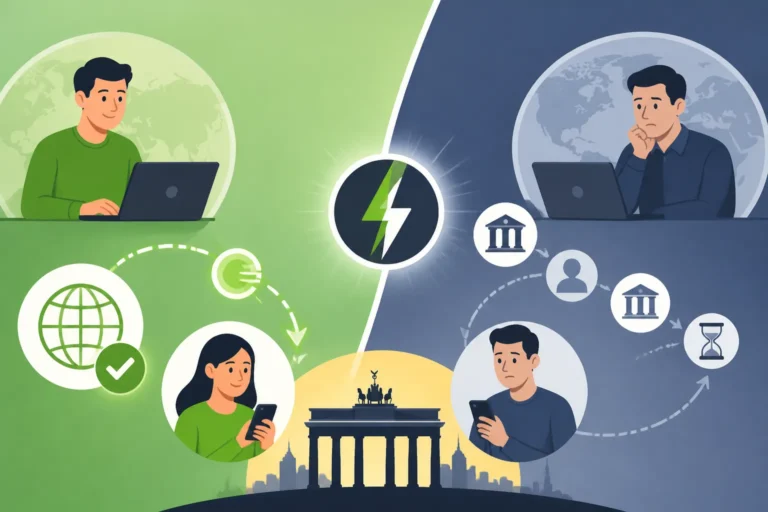
SEPA stands for the Single Euro Payments Area, an initiative driven by the European Union to harmonize electronic payments across Europe. The fundamental goal of SEPA is incredibly simple but economically profound: to make cross-border electronic payments within the Eurozone as fast, secure, and inexpensive as domestic payments. Before SEPA, transferring money from Berlin to Paris could take days and incur massive, opaque international banking fees. Today, thanks to this unified network, a transfer between these two cities operates under the exact same legal frameworks and low costs as a transfer between Berlin and Munich.
The SEPA network encompasses all EU member states, alongside several non-EU countries like Switzerland, Norway, Iceland, and the United Kingdom. For expats, this means that your German bank account is incredibly versatile. You can use your German IBAN to pay for a vacation rental in Spain, receive freelance income from a client in France, or pay a university tuition fee in the Netherlands without worrying about currency conversion fees or delayed clearing times. The entire system operates in Euros, establishing a frictionless financial continent.
SEPA primarily facilitates two types of transactions: the SEPA Credit Transfer (pushing money) and the SEPA Direct Debit (pulling money). Standard SEPA Credit Transfers are legally required to be credited to the recipient’s account by the end of the next business day. However, the banking industry is rapidly transitioning toward “SEPA Instant Credit Transfers” (Echtzeitüberweisung). For a small fee—or increasingly, for free at modern neobanks—you can execute an instant SEPA transfer that clears and settles in the recipient’s account within ten seconds, 24 hours a day, 365 days a year.
Traditional Banks vs Direct Banks
When establishing your financial base, you will face a critical choice between traditional “branch banks” (Filialbanken) and modern “direct banks” (Direktbanken or neobanks). Traditional institutions like Deutsche Bank, Commerzbank, and the massive, decentralized network of local Sparkassen and Volksbanken have dominated the German landscape for centuries. These banks offer profound security and comprehensive financial portfolios, making them ideal if you eventually plan to apply for a complex mortgage, secure a large business loan, or require face-to-face wealth management consultations. However, their physical infrastructure is expensive to maintain, meaning they frequently charge monthly account maintenance fees (Kontoführungsgebühren) and heavily rely on archaic, paper-based bureaucracy.
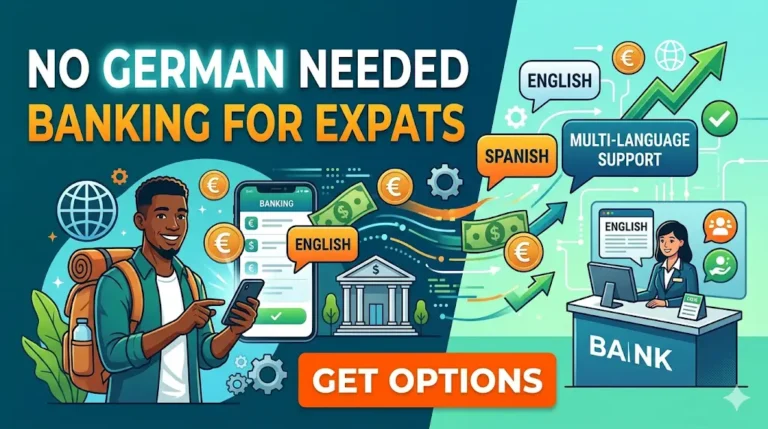
In stark contrast, direct banks and neobanks operate entirely without physical branches. Institutions like N26 have revolutionized the German market by building their entire business model around a smartphone app. For expats, these digital platforms are often a revelation. You can typically open an account using a digital VideoIdent process in minutes, avoiding the need to schedule an in-person appointment or present a physical registration certificate immediately. Furthermore, platforms like N26 offer their entire user interface, customer support, and legally binding terms and conditions in pristine English, a massive advantage for newcomers struggling with the dense legal vocabulary of the German language.
Choosing between the two depends entirely on your long-term goals and immediate needs. Highly mobile expats and younger professionals overwhelmingly favor the agility, zero-fee structures, and linguistic accessibility of digital neobanks. Conversely, families setting down permanent roots and anticipating complex financial needs often gravitate toward traditional branches, despite the associated costs. To explore specific recommendations and compare account fees deeply, reviewing our guide on Best Banks in Germany for Expats: Low Fees and English Support provides actionable insights to help you make this foundational choice.

Essential Banking Terms and Account Types
The Girokonto Current Account
The Girokonto is the absolute heartbeat of your financial existence in Germany. It is the standard current or checking account, serving as the central hub for all your incoming and outgoing daily capital. German employers mandate that you have a functional IBAN to deposit your monthly salary, and landlords explicitly require it for setting up automated rent collections. Without an active Girokonto, it is functionally impossible to participate in the modern German economy, secure a post-paid mobile phone contract, or even register for health insurance.
When opening a Girokonto, pay close attention to the fee structures. Many traditional banks advertise “free” accounts, but the fine print reveals that the fee waiver is strictly conditional upon a Mindestgeldeingang (a minimum monthly incoming transfer), which is typically set between €700 and €1,000. If your income drops below this threshold in a given month, you will be hit with an automatic maintenance fee. This is a critical factor for freelancers or students whose monthly incomes might fluctuate unpredictably.
Another vital feature of the Girokonto is the Dispositionskredit, frequently shortened to Dispo. This is an authorized overdraft facility attached directly to your checking account. If you authorize a payment that exceeds your available balance, the bank will automatically cover the shortfall up to your pre-approved Dispo limit, ensuring your rent or utility bills do not bounce. However, the interest rates charged on a Dispokredit are notoriously exorbitant, often ranging from 9% to 14% annually. Relying on an overdraft is an expensive habit, a dynamic we analyze comprehensively in Money Matters in Germany: Complete Financial Guide for Expats.
Tagesgeldkonto and Festgeldkonto Savings Options
Once your daily liquidity is secured within a Girokonto, protecting your surplus cash from inflation becomes the next priority. The primary vehicle for accessible savings in Germany is the Tagesgeldkonto (instant-access savings account). This account operates entirely separately from your daily checking account, meaning you cannot accidentally spend your savings with your debit card. It is the perfect repository for your emergency fund (Notgroschen), offering modest interest rates while allowing you to transfer the funds back to your Girokonto within 24 hours if a sudden financial crisis strikes.
For savings that you do not need immediate access to, banks offer the Festgeldkonto (fixed-term deposit account). When you place money into a Festgeldkonto, you agree to lock the capital away for a specific, predetermined period, which can range from three months to several years. In exchange for relinquishing your liquidity, the bank rewards you with a significantly higher, guaranteed interest rate. If you attempt to withdraw the funds before the agreed-upon term expires, you will face severe financial penalties and the total forfeiture of your accrued interest.
Regardless of whether you choose a Tagesgeldkonto or a Festgeldkonto, your capital is profoundly secure. German and broader European banking regulations mandate a strict Deposit Guarantee Scheme (Einlagensicherung). Under this law, your deposits are legally protected up to €100,000 per person, per banking institution. Even in the highly unlikely event of a catastrophic bank failure, the state guarantees that you will be fully reimbursed for your savings up to this threshold.
The Sperrkonto Blocked Account for Visas
For a specific subset of the international community—namely non-EU university students and job seekers—the Sperrkonto (blocked account) is a mandatory bureaucratic hurdle. German immigration law requires individuals arriving from outside the European Union on non-working visas to definitively prove they possess sufficient financial resources to sustain themselves for an entire year without relying on the German social welfare system. The Sperrkonto is the dedicated financial instrument used to satisfy this strict legal requirement.
When setting up a Sperrkonto, you must deposit a large, legally mandated lump sum upfront. This figure is tied directly to the federal BAföG student loan rate, which frequently adjusts to match inflation. Once the total sum is deposited, the German consulate will issue your visa. However, you cannot freely access that massive lump sum upon arrival. The account is “blocked” by the bank.
Instead, the Sperrkonto operates on a drip-feed mechanism. Every month, the bank automatically unblocks exactly one-twelfth of the total deposited sum, transferring that specific monthly allowance into your standard German Girokonto so you can pay your rent and buy groceries. Specialized financial providers have entirely digitized the Sperrkonto creation process, allowing expats to securely transfer their funds and receive official blocking confirmations while still residing in their home countries.
Day to Day Transactions and Payment Methods
Überweisung Bank Transfers
The Überweisung (bank transfer) is the most ubiquitous payment method in Germany for any transaction that cannot be handled with a physical card or cash. Whether you are paying a complex medical invoice, settling a bill from an independent tradesperson, or sending money to a friend for a shared dinner, you will execute an Überweisung. In the modern era, this is done almost exclusively via online banking portals or mobile apps by entering the recipient’s name, their IBAN, and the specific transfer amount.
Historically, this process was heavily reliant on the Überweisungsträger (paper transfer slip). These iconic orange and white paper slips were filled out by hand and dropped into physical mailboxes located inside bank branches. While the younger generation has abandoned them entirely, many older Germans and traditional municipal utilities still mail pre-filled Überweisungsträger alongside their invoices, allowing you to manually sign and submit them if you distrust digital banking.
The most critical component of any Überweisung is the Verwendungszweck (reason for payment or reference line). Unlike casual banking in some countries where you might just type “Thanks!”, the German Verwendungszweck is a highly structured administrative tool. When paying a corporate invoice or transferring your monthly rent to a landlord, you must input the exact invoice number, your customer ID, or the specific apartment reference code in this field.
Lastschrift Direct Debits
While the Überweisung requires you to actively push money to a recipient, the Lastschrift (direct debit) operates on the opposite principle: you authorize a company to actively pull money from your account. The legal foundation for this is the SEPA-Lastschriftmandat (SEPA direct debit mandate), a formal authorization form you must sign, either physically or digitally, granting a merchant permission to withdraw funds directly from your Girokonto.
The Lastschrift is the absolute gold standard for paying recurring bills where the monthly amount fluctuates. This includes electricity bills, post-paid mobile phone contracts, internet services, and annual insurance premiums. By setting up a Lastschrift, you ensure your bills are paid perfectly on time every single month, entirely eliminating the risk of forgetting a manual transfer and incurring severe late fees (Mahngebühren).
Consumer protection surrounding the Lastschrift is exceptionally strong under EU law. If a merchant pulls an incorrect amount from your account, you have the unconditional right to reverse an authorized SEPA direct debit within eight weeks of the transaction date. You simply click a button in your online banking app, and the funds are instantly returned to your account, no questions asked. Furthermore, if a merchant fraudulently pulls funds without a valid, signed mandate, this return window is massively extended to 13 months, providing profound financial security.
Dauerauftrag Standing Orders
If you have a recurring expense where the amount remains exactly the same every single month, you will utilize a Dauerauftrag (standing order). Unlike the Lastschrift, where the merchant pulls the funds, a Dauerauftrag is an automated Überweisung that you control entirely from your end. You instruct your bank to automatically send a fixed amount of money to a specific IBAN on a designated day of the month, indefinitely, until you manually cancel the instruction.
The most common and vital use case for a Dauerauftrag is paying your monthly cold rent (Kaltmiete) and estimated utility advance (Nebenkosten). Landlords heavily prefer that tenants set up a Dauerauftrag timed for the first or third business day of the month, ensuring rent arrives with mechanical precision without requiring the landlord to manage hundreds of active direct debit mandates.
It is also an incredibly powerful tool for automated wealth building. Financially savvy expats routinely set up a Dauerauftrag scheduled for the day immediately following their payday. This automated order instantly transfers a fixed percentage of their salary directly into their Tagesgeldkonto or their brokerage account before they ever have a chance to spend it. Managing, pausing, or altering a Dauerauftrag takes only seconds within modern banking applications, giving you total control over your recurring cash flows.
| Payment Method | Action Type | Best Used For | Reversibility |
| Überweisung | Push (You send) | One-off invoices, medical bills, sending to friends | Hard to reverse once executed |
| Lastschrift | Pull (Merchant takes) | Fluctuating bills (Electricity, phone contracts, gym) | Easily reversible within 8 weeks |
| Dauerauftrag | Push (Automated) | Fixed monthly expenses (Rent, automated savings) | Must be canceled before execution date |
Navigating Cards and Cash Culture
Girocard vs International Debit Cards
The distinction between domestic and international payment cards is a profound point of friction for many expats. The Girocard is Germany’s proprietary domestic debit network. Historically, the Girocard functioned purely within the borders of Germany. To allow citizens to use these cards while vacationing abroad, German banks traditionally “co-badged” them with international networks like Maestro (Mastercard) or V-Pay (Visa). This allowed the card to process as a Girocard at a local Berlin bakery, but as a Maestro card at an ATM in Rome.
However, the international financial landscape is shifting rapidly. Mastercard and Visa are aggressively phasing out their Maestro and V-Pay networks. Consequently, many German banks are transitioning away from the traditional co-badged Girocard. Instead, modern institutions, particularly neobanks, now issue standard Visa or Mastercard debit cards by default. These international debit cards pull funds directly from your checking account exactly like a Girocard, but they route the transaction through global networks.
While the Mastercard debit card is infinitely superior for online shopping, booking rental cars, and international travel, it presents a localized problem. Because Visa and Mastercard charge merchants significantly higher processing fees than the domestic Girocard network, countless small German retailers simply refuse to accept them. If a restaurant door explicitly says “Girocard” or “EC-Karte,” your international debit card will be declined. Therefore, if you opt for a modern bank that issues a Mastercard by default, you must explicitly ensure you have access to a supplementary Girocard to avoid being stranded at a local checkout counter.
Credit Cards and the Schufa Score
The German attitude toward consumer debt is famously conservative. True revolving credit cards (Echte Kreditkarten)—where you can carry a massive balance month-to-month while paying exorbitant interest rates—are relatively rare. When you apply for a credit card through a standard German bank, you will almost certainly be issued a “Charge Card.” With a charge card, you are granted a credit limit, but the entire balance of your monthly spending is automatically and mandatorily deducted from your linked Girokonto at the end of the billing cycle. You cannot choose to pay a minimum balance; you must clear the debt entirely every month.
Your ability to secure an overdraft facility, a credit card, or even a post-paid mobile phone contract is dictated entirely by your SCHUFA score. The SCHUFA is Germany’s dominant private credit bureau. It collects data on your bank accounts, loan histories, and any missed payments to calculate a “Basisscore” reflecting your financial reliability. A high SCHUFA score is vital; without it, landlords will outright reject your apartment applications.
As a newly arrived expat, your SCHUFA file is entirely blank. While a blank file isn’t inherently negative, traditional banks often view a lack of credit history as a risk, frequently denying initial requests for credit cards or overdrafts. You build a strong SCHUFA score passively by paying your bills perfectly on time, maintaining a stable Girokonto, and avoiding opening too many bank accounts simultaneously. The administrative sequencing of setting up these profiles is a delicate dance, which we explore alongside early bureaucratic steps in How to Get Health Insurance in Germany: Step-by-Step for Newcomers.
The Persisting Preference for Cash
There is a famous German idiom: “Bargeld lacht” (Cash laughs). Despite the global march toward a cashless society, Germany remains defiantly cash-centric. This preference is deeply rooted in a profound cultural desire for absolute privacy and an inherent suspicion of digital tracking. Many Germans firmly believe that their purchasing habits are nobody’s business but their own, and physical cash is the ultimate guarantor of anonymity. Furthermore, tangible cash is viewed as an excellent budgeting tool, making it physically obvious when funds are running low.
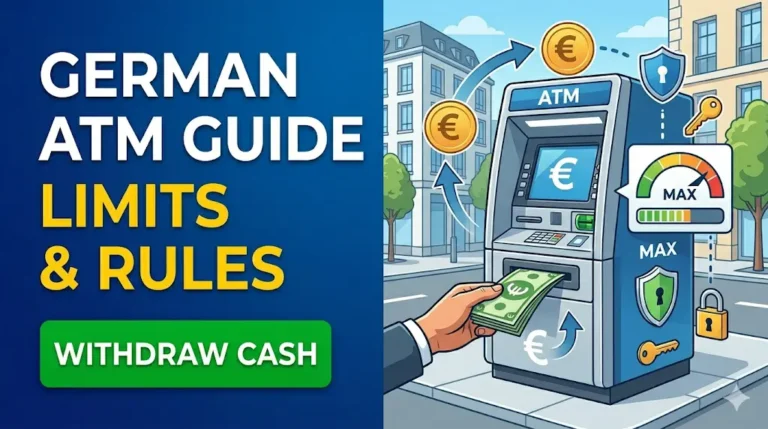
Consequently, accessing physical cash efficiently is a crucial daily requirement. When choosing a bank, you must thoroughly evaluate their ATM (Geldautomat) withdrawal policies. If you use an ATM outside of your bank’s designated network, you will be hit with brutal withdrawal fees ranging from €4 to €6 per transaction. Traditional banks rely on massive alliances; for example, Deutsche Bank, Commerzbank, and Postbank form the “Cash Group,” allowing their customers to use each other’s ATMs entirely for free. The localized Sparkasse network operates its own massive, exclusive fleet of machines.
Modern neobanks approach this differently. Because they lack physical infrastructure, they frequently offer a set number of free monthly withdrawals at any ATM that accepts Mastercard, regardless of the bank brand. After this limit is reached, they charge a flat fee. Learning to balance your reliance on cards while always carrying a €50 note for emergencies is a vital cultural adaptation.
Securing and Managing Your Finances Internationally
Handling Cross Border Transfers
While the SEPA network makes transferring Euros across Europe incredibly cheap and frictionless, it does absolutely nothing for expats who need to move money across global currency zones. If you are an American expat transferring savings from the US to fund an apartment deposit in Munich, or an Indian professional sending portions of your Euro salary back home to support family, relying on traditional German banks to execute these SWIFT transfers is a massive financial mistake.
Traditional high-street banks generate massive profits by hiding aggressive margins within their currency exchange rates, offering you a rate that is significantly worse than the actual market reality, and then attaching opaque, flat-fee processing charges on top. Over time, these hidden administrative taxes will systematically erode your wealth. To combat this, the modern expat community relies exclusively on specialized financial technology platforms.
Utilizing Wise is the absolute gold standard for cross-border money movement. When you send money via Wise, you receive the real, mid-market exchange rate—the exact rate you see on Google—while paying only a clear, minimal, upfront fee. Furthermore, their multi-currency account allows you to hold balances in dozens of different currencies simultaneously, giving you total, localized control over your global income streams without bleeding capital to unnecessary banking fees.
Digital Security and Data Protection
Germany enforces some of the strictest banking security and data protection protocols in the world. When utilizing online banking, simple password protection is legally insufficient. The European PSD2 directive mandates Two-Factor Authentication (2FA) for all financial platforms. In Germany, this is typically handled via a proprietary PushTAN app on your smartphone, or a physical PhotoTAN device that scans a colorful mosaic code on your computer screen to authorize transfers. While occasionally cumbersome, these systems make unauthorized access mathematically near-impossible.
However, the weakest link in your financial security is rarely the bank’s infrastructure; it is your own internet connection. Expats frequently live highly mobile lifestyles, managing their investments from coworking spaces, accessing banking apps via hotel Wi-Fi networks, or executing trades while sitting in airport transit lounges. Unsecured public Wi-Fi networks are prime hunting grounds for malicious actors utilizing “man-in-the-middle” attacks to silently intercept unencrypted data packets containing your banking credentials.
To eliminate this vulnerability, running a premium Virtual Private Network (VPN) is a mandatory cybersecurity measure. By activating NordVPN on your laptop and smartphone, you wrap all of your internet traffic in an impenetrable layer of military-grade encryption. Even if a local network is compromised, your financial data remains utterly invisible. Furthermore, NordVPN is a vital administrative tool; many home-country banks employ aggressive geoblocking, freezing accounts if they detect a login from a German IP address. By using the VPN to connect to a server in your home country, you bypass these security lockouts and maintain seamless access to your global wealth.
Expanding into Investments
Once you have mastered the daily mechanics of German banking, protecting your surplus capital from inflation requires entering the capital markets. Leaving vast sums of money in a checking account is a guaranteed way to lose purchasing power over time. To buy stocks, bonds, or ETFs in Germany, you must open a brokerage account, known as a Depot. While traditional branch banks offer Depots, their exorbitant custody fees and high trading commissions quickly devour your compound interest.
Savvy expats overwhelmingly prefer utilizing dedicated online brokers. However, investing in Germany introduces you to the Abgeltungsteuer—the flat 25% capital gains tax (plus the solidarity surcharge and church tax).
For expats who demand profound global market access and ultra-low fees, platforms like Interactive Brokers are incredibly powerful. Interactive Brokers allows you to trade across global exchanges from a single, unified interface, which is particularly vital for expats who may wish to purchase specific international assets that are restricted on domestic German platforms. It also offers immense portability; if you eventually leave Germany, an international brokerage account is infinitely easier to port across borders than a rigidly localized German Depot.
Conclusion
Understanding the mechanics of the German banking system is a transformative step in your expat journey, turning administrative anxiety into profound financial confidence. By grasping the structural importance of the IBAN and SEPA network, correctly utilizing Überweisungen and Lastschriften, and adapting to the cultural realities of the Girocard and cash preference, you seamlessly integrate into the daily rhythm of the German economy.
Secure your digital footprint with tools like NordVPN, optimize your international capital transfers with Wise, and future-proof your wealth through global platforms like Interactive Brokers. Armed with this knowledge and a solid checking account, you are fully equipped to navigate the bureaucratic complexities of Germany and build a stable, prosperous life abroad.
References
Primary sources (official)
- Deutsche Bundesbank: Official guidelines on the Single Euro Payments Area (SEPA), standard credit transfers, and direct debit mandates. https://www.bundesbank.de/en/tasks/payment-systems/services/sepa
- Federal Financial Supervisory Authority (BaFin): Consumer protection information regarding basic bank accounts and identity verification requirements. https://www.bafin.de/EN/Verbraucher/Bank/Produkte/Basiskonto/basiskonto_node_en.html
Other helpful sources
- Make it in Germany: The official government portal for qualified international professionals, offering practical guides on setting up a bank account and managing daily finances. https://www.make-it-in-germany.com/en/living-in-germany/money-insurance/bank-account
- Stiftung Warentest (Finanztest): Germany’s leading independent consumer testing organization, regularly comparing bank account fees, credit card conditions, and ATM network costs. https://www.test.de/
Disclaimer
The information provided in this article is for general informational and educational purposes only and does not constitute professional financial, tax, or legal advice. German banking regulations, SEPA payment processing times, ATM network fees, and SCHUFA scoring algorithms are highly complex and subject to continuous changes. Always carefully read the official terms and conditions (AGB) provided by the specific financial institution before opening an account, signing a direct debit mandate, or transferring funds. Consult with a certified financial advisor regarding your unique personal financial situation in Germany.