German Tax Scams: Recognizing Fake Letters from the Finanzamt
Opening your mailbox to a yellow envelope demanding immediate payment from the Finanzamt is enough to cause a localized panic attack. I once nearly wired two thousand euros to a fraudulent account because the fake tax letter looked terrifyingly authentic. This guide helps you identify fraudulent tax demands, secure your accounts, and handle actual German tax correspondence without fear.
Disclosure: This post may contain affiliate links. We may earn a commission at no extra cost to you if you make a purchase through these links. Read full disclosure.
The Anatomy of a Genuine Finanzamt Letter
Expats are uniquely vulnerable to bureaucratic scams. When you do not fully speak the language and are already terrified of the strict local tax authority, an official-looking letter demanding money triggers immediate, unquestioning compliance. To defend yourself against these predators, you must first understand how the actual Finanzamt operates and communicates.
How the Tax Office Actually Communicates
The German tax office is famously analog, operating almost entirely on physical paper. They communicate exclusively via physical mail sent directly to your officially registered home address. They will never send you an unsolicited SMS, WhatsApp message, or email demanding an immediate transfer. If your smartphone buzzes with a text message claiming to be the Finanzamt threatening a bank account freeze, you can confidently delete it.
Furthermore, genuine tax demands almost always follow a specific, highly regulated procedural timeline. You generally only receive a payment demand after you have actively submitted your annual tax return or if you are a registered freelancer who missed a scheduled quarterly prepayment. Random, out-of-the-blue letters demanding thousands of euros without prior assessment history are highly suspicious. Understanding this timeline and how official notices are generated is a crucial step covered in Understanding Your Tax Assessment (Steuerbescheid): After You File in Germany.
Decoding the Official Letterhead and Aktenzeichen
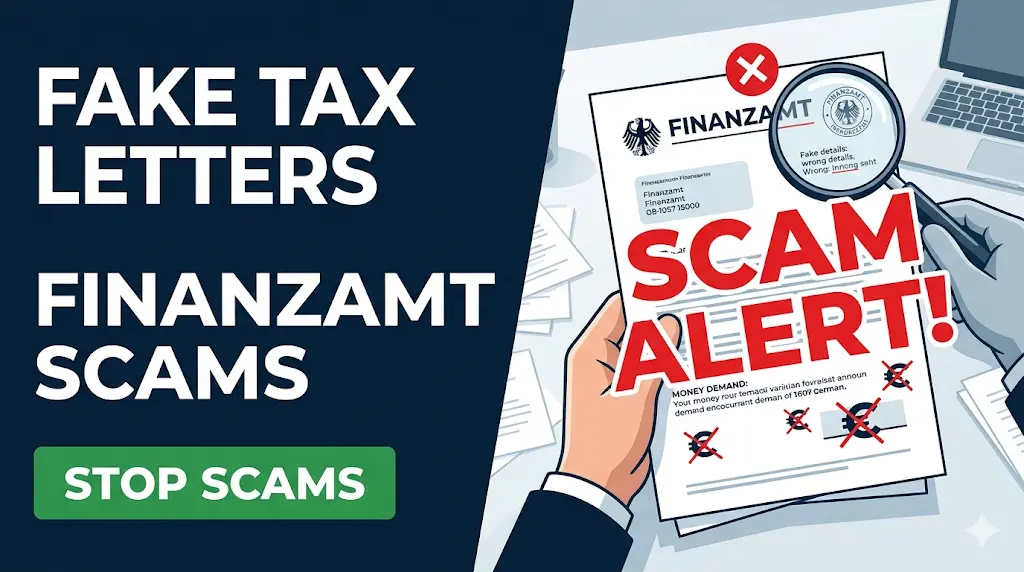
When you hold a physical letter, you must ruthlessly scrutinize the formatting. A genuine document will always prominently display your specific Steuernummer (Tax Number) or your Steueridentifikationsnummer (Tax ID) in the top right corner. Scammers often use generic greetings like “Sehr geehrter Steuerzahler” (Dear Taxpayer), guess your details based on stolen data, or list a completely fabricated reference number (Aktenzeichen).
Crucially, you must meticulously inspect the bank details provided for the payment. The Finanzamt only uses domestic accounts hosted by the German Bundesbank or regional state banks (Landesbanken). If the IBAN on the payment demand starts with anything other than “DE” (for Germany), such as “LT” for Lithuania, “ES” for Spain, or “GB” for Great Britain, it is an absolute, undeniable scam. The German government does not, and will not, collect your local taxes via foreign neo-banks or offshore corporate accounts.
Common Tax Scams Targeting Expats
Scammers utilize incredibly sophisticated tactics designed to exploit the specific fears and confusing administrative hurdles that international workers face daily. They know expats rely heavily on digital translation and fear deportation, making them highly lucrative targets.
The ELSTER Phishing Trap
One of the most rampant scams targeting expats involves fake emails mimicking the official ELSTER tax portal. These highly sophisticated emails usually feature stolen government logos and claim that your digital certificate has expired or that a massive tax refund failed to process due to incorrect banking details.
The email provides a convenient, urgent link urging you to log in immediately and update your data. If you click it, you are taken to a spoofed website designed to harvest your login credentials, your Steuer-ID, and your personal banking information. The official ELSTER portal never sends links asking for direct login updates in the body of an email. If you receive one of these warnings, open a fresh browser window and log into ELSTER independently. If you are struggling with the actual portal, reviewing Understanding Elster: Filing Your Taxes Online in Germany will show you how the genuine, paper-heavy activation process actually functions.
Aggressive Debt Collection Letters Inkasso
Another terrifying tactic is the fake Inkasso (debt collection) letter. Scammers send authentic-looking documents claiming you owe the Finanzamt money, and because you allegedly missed the deadline, the debt has been sold to a private debt collection agency.
These letters are designed to induce sheer panic. They threaten to send a bailiff (Gerichtsvollzieher) to your home, physically seize your assets, and register a severe negative mark on your Schufa if you do not pay within 48 hours. The fear of ruining a local credit score pushes many expats to pay blindly, an administrative vulnerability explored deeply in German Bureaucracy 101: Understanding the Anmeldung, Schufa, and Tax ID. It is vital to know that the Finanzamt has its own internal enforcement officers; they almost never sell standard tax debts to private, third-party Inkassobüros.
| Communication Feature | Genuine Finanzamt | Typical Scam / Fraud |
| Delivery Method | Physical mail (almost always) | Email, SMS, WhatsApp, or fake letters |
| Payment IBAN | Always domestic (DE) via Bundesbank | Often foreign (LT, GB, IE) or private banks |
| Tone and Urgency | Bureaucratic, offers a standard deadline | Highly aggressive, demands payment within 24/48 hours |
| Personalization | Uses exact Steuernummer and Aktenzeichen | Uses generic greetings or fabricated reference numbers |
Protecting Your Finances and Responding to Threats
If you receive a suspicious letter, or if you accidentally click a phishing link in a moment of panic, executing damage control immediately is your highest priority. You must lock down your liquidity and verify the claims independently.
Securing Your Bank Accounts
If a scammer acquires your IBAN through a fake tax portal or a spoofed form, they will attempt a fraudulent SEPA direct debit (Lastschrift). This is where having a modern, highly responsive banking setup becomes your absolute best defense.
Utilizing an agile account like N26 acts as a vital shield against these attacks. N26 gives you instant push notifications on your smartphone for every single transaction. If a fake debt collector tries to pull funds from your account, N26 alerts you the very second it happens. You are not left waiting for a monthly paper statement to realize you have been robbed.
Because N26 allows you to reverse unauthorized SEPA pulls instantly with just a few taps in the app, you retain absolute control over your liquidity. You can quickly block the fraudulent merchant and secure your funds before the scammers can extract the cash. Mastering this localized defense mechanism is a core concept found in Mobile Banking Apps in Germany: N26, Revolut, and More.
Verifying International Transfers and Investments
Some highly sophisticated scams target wealthy expats by claiming they owe taxes on foreign income or must repatriate funds to clear a phantom tax block. They will often fabricate numbers regarding your global stock portfolio to sound legitimate.
To combat this, keep your wealth locked down in a highly regulated, internationally compliant platform. By consolidating your assets in Interactive Brokers, you physically separate your wealth from localized German scams. Because Interactive Brokers automatically generates precise, localized European tax documents, you can immediately cross-reference their official reports against any suspicious claims made by a supposed tax collector. Using Interactive Brokers ensures you are never tricked by fake capital gains assessments, a strategy expanded upon in Taxing Worldwide Income: How Germany Taxes Foreign Income and Assets.
If you verify with your tax advisor that you do actually owe a legitimate tax bill to Germany, and your primary savings are still in your home country, never use the sketchy wire links provided in panic-inducing letters. Always initiate the transfer independently using Wise. Routing international tax payments through Wise provides a clear digital paper trail and guarantees the exact requested euro amount arrives securely at the verified Bundesbank IBAN. Using Wise ensures you do not bleed capital to terrible legacy bank exchange rates during a stressful tax season, a vital optimization step covered in Moving Money to Germany: Declaring Savings and Large Transfers. Furthermore, keeping your international operations cleanly separated prevents cross-border financial chaos, a topic decoded in Cross-Border Banking: Managing Your Home Country Account While in Germany.
What to Do If You Spot a Scam
If you suspect a letter is fake, do not call the phone number printed on the document. Scammers frequently set up fake call centers with professional-sounding German operators to trick you into confirming your identity over the phone.
Instead, open a browser, independently Google your local Finanzamt, call their official public number, and ask for the department dealing with your Steuernummer. They can instantly verify if the letter is genuine. If you have already lost money, immediately file a police report (Strafanzeige) and contact your bank’s fraud department. Being able to quickly export your transaction history to provide evidence to the police is essential, a skill highlighted in Understanding German Bank Statements: Fees and Transactions Explained. Never let the fear of a tax audit force you into making a blind financial transfer. For actual audit scenarios, rely on Tax Audits in Germany: What to Do If the Finanzamt Comes Knocking to prepare a legitimate, legal defense.
References
Primary sources (official)
- Bundesfinanzministerium (Federal Ministry of Finance): The official government portal detailing active warnings against phishing campaigns, fake SMS (Smishing), and fraudulent letters demanding fake crypto or inheritance taxes. https://www.bundesfinanzministerium.de/Content/DE/Standardartikel/Service/Kontakt/warnmeldungen.html
- Bundeszentralamt für Steuern (BZSt): The Federal Central Tax Office’s permanent warning page regarding fraudulent emails sent in the name of ELSTER attempting to harvest tax identification numbers. https://www.bzst.de/DE/Service/Phishing_Warnungen/phishing_warnungen_node.html
Other helpful sources
- Verbraucherzentrale (Consumer Advice Centre): A highly practical, frequently updated radar tracking current fake SMS campaigns, fraudulent debt collection (Inkasso) threats, and how to report them to the police. https://www.verbraucherzentrale.de/wissen/digitale-welt/mobilfunk-und-festnetz/fakesms-zu-onlinebanking-steuerbescheiden-und-gerichtsverfahren-67038
- Polizeiliche Kriminalprävention der Länder und des Bundes: The official police crime prevention portal offering concrete steps on how to file a Strafanzeige (criminal complaint) if you have fallen victim to a financial scam in Germany. https://www.polizei-beratung.de/themen-und-tipps/betrug/
Disclaimer
The information provided in this article is for general informational and educational purposes only and does not constitute professional tax, financial, or legal advice. Fraudulent schemes targeting expats are highly sophisticated and constantly evolving. The German tax authority (Finanzamt) will exclusively communicate official tax assessments (Steuerbescheid) and legally binding payment demands via physical mail, and payments are strictly routed to domestic Bundesbank or Landesbank IBANs.