Value-Added Tax (VAT) for Freelancers: When Do You Need to Register?
Staring at a paid invoice and realizing you forgot to charge 19% VAT—and now have to cover it out of your own pocket—is a sickening expat rite of passage. I once lost an entire week’s pay to the Finanzamt simply because I misunderstood the revenue limits. This guide breaks down German VAT registration, the small business exemption, and the complex rules of cross-border invoicing.
Disclosure: This post may contain affiliate links. We may earn a commission at no extra cost to you if you make a purchase through these links. Read full disclosure.
Decoding the German VAT System for Freelancers
Before you send your very first freelance invoice in Germany, you must fundamentally untangle how the German state views your money. Many expats assume that whatever hits their bank account belongs to them, but the German tax system operates on strict compartmentalization.
The Difference Between Income Tax and Umsatzsteuer
The most critical mental shift you must make as a new freelancer is separating your income tax (Einkommensteuer) from your value-added tax (Umsatzsteuer or Mehrwertsteuer). Income tax is a levy on your actual profit—the money you get to keep after business expenses. If you have been studying Quarterly Tax Prepayments (Vorauszahlungen) for Self-Employed People, you know that the state assesses this based on your personal earning capacity.
VAT, however, has absolutely nothing to do with your personal profit. VAT is a consumption tax paid by the end consumer. As a freelancer registered for VAT, you are essentially acting as an unpaid, mandatory tax collector for the German government. You tack on 19% (or the reduced 7% rate for specific creative and journalistic works) to your net invoice amount. The client pays you the total, and you simply hold that 19% in your account until it is time to hand it over to the Finanzamt (tax office).
Understanding this structural difference is what prevents you from accidentally spending money that belongs to the state. If you treat VAT as part of your revenue, your cash flow will instantly collapse when the quarterly tax deadlines arrive.
The Kleinunternehmerregelung Small Business Exemption
The German government recognizes that forcing a freelance tutor or a part-time graphic designer to act as a state tax collector creates an unreasonable administrative burden. To solve this, they created the Kleinunternehmerregelung (Small Business Exemption) under Section 19 of the Value Added Tax Act (UStG).
If you apply for this status, you do not charge VAT on your invoices, and you do not have to file monthly or quarterly VAT returns. You operate entirely in net figures. To qualify, your total gross revenue (not profit, but total incoming money) must not exceed 22,000 EUR in your first year of business, and must not be projected to exceed 50,000 EUR in the following year.
If you meet these criteria, you must explicitly state on every invoice: “Gemäß § 19 UStG wird keine Umsatzsteuer berechnet” (According to Section 19 UStG, no value-added tax is charged). This exemption is an absolute lifesaver for expats just starting out or those navigating German Bureaucracy 101: Understanding the Anmeldung, Schufa, and Tax ID, as it removes a massive layer of accounting complexity.
Why the Finanzamt Cares About Your B2B vs B2C Clients
While the small business exemption sounds perfect, choosing whether to use it depends entirely on who your clients are. The Finanzamt treats Business-to-Business (B2B) and Business-to-Consumer (B2C) transactions very differently within the VAT ecosystem.
If your clients are other VAT-registered businesses (B2B), adding 19% VAT to your invoice does not affect them financially. They pay you the 19%, and then they claim that exact 19% back from the Finanzamt as an input tax deduction (Vorsteuer). It is a neutral pass-through. Therefore, B2B clients do not care if you charge VAT or not.
However, if your clients are private individuals (B2C)—such as if you are a wedding photographer or a personal fitness trainer—adding 19% VAT directly increases the final price they pay out of pocket. Private consumers cannot claim VAT back. If you register for regular VAT, you instantly become 19% more expensive to your B2C clients compared to a competitor using the Kleinunternehmerregelung. This distinction dictates your entire pricing strategy.
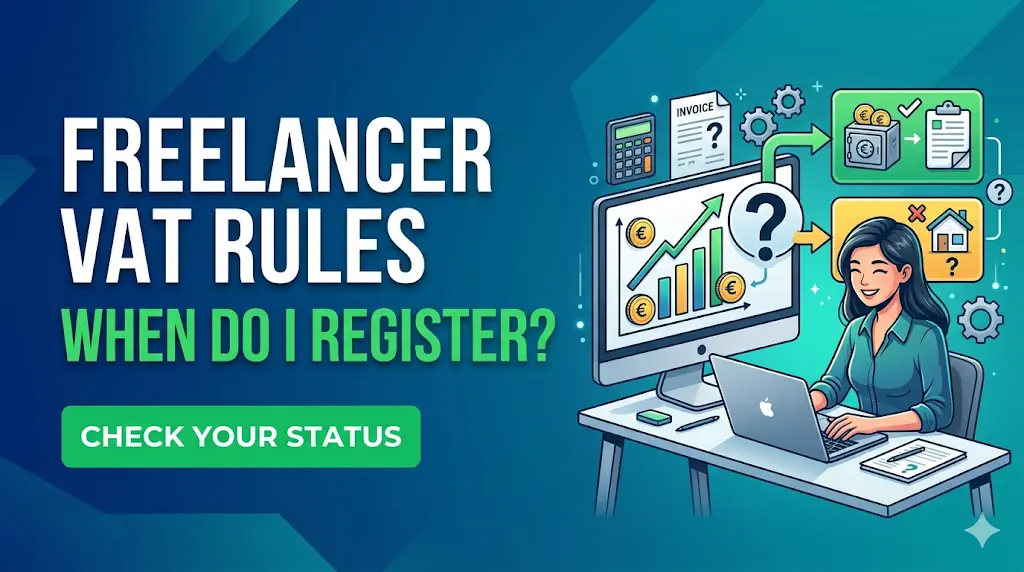
The Kleinunternehmer Exemption Pros Cons and Traps
Opting into the small business exemption seems like the obvious choice for new expats. However, it is laden with hidden financial traps and pro-rating mechanisms that routinely catch foreigners off guard.
Calculating the 22000 Euro Revenue Threshold
The 22,000 EUR limit is a hard ceiling, but it is deeply misunderstood. Firstly, it applies to your total gross revenue, not your profit after deducting your laptop or travel expenses. If you take in 22,500 EUR and have 5,000 EUR in expenses, you have still breached the limit because your incoming revenue exceeded the threshold.
The most vicious trap is the pro-rating rule. The 22,000 EUR limit applies to a full calendar year (January to December). If you start your freelance business in October, you only have three months left in the year. The Finanzamt mathematically pro-rates the limit: 22,000 EUR divided by 12 months equals roughly 1,833 EUR per month. For your three months of operation, your actual threshold is only 5,500 EUR.
If you launch in October, earn 8,000 EUR by December, and assume you are safe because you are under 22,000 EUR, you are wrong. You breached the pro-rated limit. The Finanzamt will forcefully transition you to regular VAT status on January 1st of the following year.
When Staying Small Costs You Money Input Tax Deduction
The single biggest drawback of the Kleinunternehmerregelung is the loss of the Vorsteuerabzug (input tax deduction).
When you buy goods or services for your business—such as a new €2,000 MacBook, a camera, or specialized software—you pay 19% VAT at the checkout counter. If you are a regular VAT-registered freelancer, you report this purchase on your VAT return, and the Finanzamt refunds you that 19% (roughly €319). You effectively buy business equipment at a massive discount.
If you are a Kleinunternehmer, you cannot claim that 19% back. You absorb the full retail cost. If your freelance business requires massive upfront capital investments in expensive gear, choosing the small business exemption will cost you thousands of euros in lost refunds, significantly impacting your overhead and Cost of Living in Germany: Breakdown of Expenses (Rent, Food, Transport). In these capital-heavy cases, voluntarily waiving the exemption and registering for regular VAT immediately is the smarter financial move.
The Psychological Trap of Sudden Price Increases
If you start as a Kleinunternehmer serving private B2C clients, you will inevitably hit the revenue ceiling as your business grows. When you cross the limit, you are legally obligated to switch to regular VAT taxation in the following calendar year.
This creates a massive psychological and financial shock. On January 1st, you suddenly have to add 19% to the invoices of all your existing private clients. For a private client, a €100 session just became €119 for the exact same service.
Most freelancers find that their private clients refuse to pay the sudden hike. To keep the clients, the freelancer is forced to swallow the 19% VAT out of their own profit margin, effectively taking a massive pay cut for being successful. If you plan to scale a B2C business rapidly, it is often better to start with regular VAT from day one, so your clients are accustomed to your true market price, avoiding the painful transition trap later.
Registering for VAT and Managing the Bureaucracy
If you decide to register for regular VAT, or if your revenue forces you into it, you are stepping into a highly regimented reporting rhythm. The German state does not tolerate late VAT payments.
The Fragebogen zur steuerlichen Erfassung Explained
Your journey into the VAT system begins the moment you register your freelance activity via ELSTER (the official online tax portal) by filling out the Fragebogen zur steuerlichen Erfassung (Questionnaire for Tax Registration).
In this multi-page digital document, you will estimate your first year’s revenue and profit. There is a specific checkbox where you must explicitly choose whether you want the Kleinunternehmerregelung or the Regelbesteuerung (regular VAT taxation).
More importantly, you must select your taxation method: Soll-Versteuerung or Ist-Versteuerung. This is critical. Soll-Versteuerung means you owe the 19% VAT to the Finanzamt the moment you send the invoice to your client, even if they haven’t paid you yet. Ist-Versteuerung (cash accounting) means you only owe the VAT after the client physically pays the invoice. As a freelancer, you must always apply for Ist-Versteuerung to protect your cash flow and avoid fronting tax money for late-paying clients. Ensuring this form is filled out correctly dictates how smoothly your life will proceed when you start navigating Understanding Your Tax Assessment (Steuerbescheid): After You File in Germany.
Securing Your Umsatzsteuer Identifikationsnummer USt IdNr
When you complete the registration, your local Finanzamt assigns you a standard tax number (Steuernummer). However, if you plan to do any business with clients or vendors outside of Germany but within the European Union, the Steuernummer is legally insufficient.
You must apply for an Umsatzsteuer-Identifikationsnummer (USt-IdNr), the specific European VAT ID. This is issued by the Federal Central Tax Office (Bundeszentralamt für Steuern or BZSt), not your local office. You can request it via a simple checkbox on your initial ELSTER questionnaire, or apply for it later via the BZSt website.
The USt-IdNr always starts with “DE” followed by nine digits. This number is your passport for cross-border European trade. You must print it on your official invoices, and you must display it in the Impressum (legal notice) of your professional website.
Filing the Advance VAT Return Umsatzsteuervoranmeldung
Once registered for regular VAT, you must file an Umsatzsteuervoranmeldung (Advance VAT Return) via ELSTER. For new businesses, the Finanzamt usually requires you to file this every single month. After a year or two, if your VAT liability is relatively low, they may allow you to drop down to a quarterly schedule.
The deadline is unforgiving. If you are on a monthly schedule, you must submit the return and wire the owed VAT to the tax office by the 10th day of the following month (e.g., October’s VAT is due November 10th).
You calculate the total VAT you collected from clients, subtract the input VAT you paid on your business purchases, and transfer the difference. If you miss this deadline, you trigger automatic late filing penalties (Verspätungszuschläge). Chronic lateness is one of the fastest ways to invite a deep investigation, a nightmare scenario mapped out in Tax Audits in Germany: What to Do If the Finanzamt Comes Knocking.
Cross Border Freelancing and Reverse Charge
The modern expat freelancer rarely serves a purely German client base. The moment your services cross an international border, the VAT rules mutate drastically, requiring highly specific invoicing protocols.
Invoicing Clients Outside of Germany but Within the EU
If you are a regular VAT-registered freelancer in Germany and you provide a B2B service (like coding or consulting) to a VAT-registered business in France, Spain, or Poland, you do not charge German 19% VAT.
Instead, you use the Reverse Charge Mechanism. Under European tax law, the tax liability shifts from you (the provider) to the client (the recipient). You issue an invoice with exactly 0% VAT. However, the invoice must contain your German USt-IdNr, your client’s foreign VAT ID, and the mandatory legal phrase: Steuerschuldnerschaft des Leistungsempfängers (Reverse Charge).
This mechanism removes the nightmare of registering for tax in every European country. However, you must report all these zero-VAT European transactions to the Federal Central Tax Office quarterly by filing a Zusammenfassende Meldung (Summary Statement). This allows European tax authorities to cross-reference transactions and combat tax evasion.
Handling Clients in the United States and Non EU Countries
If you are picking up contracts from companies in the US, the UK, or Canada, the rules shift again. For general B2B services, the place of performance is deemed to be where the client is located.
Because the client is outside the EU, the service is entirely outside the scope of European VAT law. The transaction is classified as nicht steuerbar (not taxable) in Germany. You issue an invoice in net figures with 0% VAT. You simply add a phrase like: “Not subject to German VAT according to § 3a Abs. 2 UStG (Reverse Charge / non-EU export).”
This is incredibly lucrative for expats navigating platforms for Working in Tech in Germany: Opportunities for IT Professionals, as you avoid adding a 19% markup to your North American clients, keeping you highly competitive globally. This income must still be reported for regular income tax purposes, a process deeply intertwined with Taxing Worldwide Income: How Germany Taxes Foreign Income and Assets.
Managing Multiple Currencies Without Losing Your Profit
The biggest hidden cost of non-EU freelancing is not taxes; it is currency conversion. If you invoice a client in the US for $5,000, and they wire it directly to your traditional German savings bank, the SWIFT network intermediary fees and the 3% to 4% bank exchange rate markup will silently cannibalize hundreds of dollars from your invoice.
To protect your margins, expats must use FinTech infrastructure. Using a service like Wise allows you to open local USD, GBP, and AUD receiving accounts. Your foreign client pays a local domestic transfer in their home currency, satisfying their accounting department. The funds land in your Wise account, where you can hold them, or convert them to EUR at the real mid-market exchange rate with a tiny, transparent fee. Furthermore, if your business scales and you need to pay overseas sub-contractors or buy foreign software tools in USD, utilizing the Wise multi-currency debit card ensures you avoid continuous double-conversion fees.
| Client Location & Type | Do You Charge German VAT? | Mandatory Invoice Action | Applicable Tax Rule |
| Germany (B2B & B2C) | Yes (19% or 7%) | Separate Net, VAT amount, and Gross | Standard German VAT |
| EU Country (B2B) | No (0%) | Include both VAT IDs, add “Reverse Charge” text | Reverse Charge Mechanism |
| EU Country (B2C) | Yes (German VAT)* | Charge German VAT as if they were local | Standard VAT (*Subject to OSS rules for digital goods) |
| Non-EU Country (B2B) | No (0%) | Add “Not subject to German VAT (§ 3a Abs. 2 UStG)” | Nicht steuerbar (Not taxable) |
Practical Banking and Investment Tips for VAT Payers
Surviving the monthly VAT cycle requires militant financial segregation. If you treat your business checking account like a personal piggy bank, you will inevitably spend the government’s money and face insolvency.
Keeping Your VAT Money Strictly Separated
The easiest way to fail as a freelancer is to look at your bank balance, see €11,900 after a big project, and assume you have €11,900 to spend. If you are registered for standard VAT, €1,900 of that balance belongs to the Finanzamt.
You must segregate your funds instantly. Many expats use modern digital business accounts like N26 to automate this discipline. N26 offers a “Spaces” feature that acts as integrated sub-accounts. The minute an invoice is paid, you should immediately drag the 19% VAT component into a dedicated “VAT Hold” Space. This physically removes the money from your available daily balance, preventing accidental spending.
When the 10th of the month rolls around, you transfer the exact amount owed back to the main balance to cover the ELSTER direct debit. Furthermore, utilizing N26 push notifications ensures you know exactly when the Finanzamt pulls the funds, giving you a transparent, real-time pulse on your tax liabilities without having to constantly log into clunky desktop banking portals. For those juggling gigs while studying, keeping this money separate is a core survival tactic discussed in English-Speaking Jobs in Germany: Finding Work When You Don’t Speak German.
Preparing for Annual Settlements and Future Growth
At the end of the year, you must file a final, comprehensive Umsatzsteuererklärung (Annual VAT Return). This document reconciles all your monthly or quarterly advance payments against your final, verified yearly revenue. If you made minor math errors throughout the year, this is the document your tax advisor uses to balance the books. Providing your accountant with clean, filterable CSV exports generated easily from N26 saves you immense billable hours.
Once your VAT is settled and your income tax prepayments are secured, you must look to the future. Storing your actual, post-tax net profit in a basic checking account means you are losing money to inflation. Expats who successfully scale their freelance businesses rely on globally compliant platforms like Interactive Brokers to invest their surplus capital.
By pushing your true profit out of your daily N26 business account and into a highly diversified portfolio on Interactive Brokers, you physically separate your long-term wealth from your daily operational risks. Interactive Brokers provides the localized European tax reporting you need, ensuring that as your wealth grows, your compliance remains flawless, an advanced strategy analyzed further in Moving Money to Germany: Declaring Savings and Large Transfers. Mastering VAT is a painful initiation, but once automated, it is the foundation of a highly lucrative expat business in Germany.
References
Primary sources official
- Bundesfinanzministerium – Kleinunternehmerregelung: The Federal Ministry of Finance’s official legal circular detailing the revenue limits, application of Section 19 UStG, and the pro-rating rules for the small business exemption. https://www.bundesfinanzministerium.de/Content/DE/Downloads/BMF_Schreiben/Steuerarten/Umsatzsteuer/Umsatzsteuer-Anwendungserlass/2025-03-18-sonderregelung-kleinunternehmer.html
- Bundeszentralamt für Steuern BZSt – USt-IdNr: The official portal explaining the purpose of the European VAT ID, how it differs from a standard tax number, and the online application process. https://www.bzst.de/DE/Unternehmen/Identifikationsnummern/Umsatzsteuer-Identifikationsnummer/Vergabe_USt_IdNr/vergabe_ust_idnr_node.html
Other helpful sources
- IHK – Reverse Charge Verfahren: The Chamber of Commerce’s detailed breakdown of how the Reverse Charge mechanism functions, including the exact legal phrasing required in various European languages for B2B invoices. https://www.ihk.de/ulm/hauptnavigation/mitgliedsunternehmen/beraten-informieren/recht-steuern/auskuenfte-zum-steuerrecht/umsatzsteuer-verbrauchssteuer/umsatzsteuer-international/dienstleistungen/rechnungshinweis-in-landessprachen-6712112
- Existenzgründungsportal (BMWi): The government-backed startup portal offering highly accessible explanations of VAT obligations, input tax deductions (Vorsteuerabzug), and ELSTER registration. https://www.existenzgruendungsportal.de/
Disclaimer
The information provided in this article is for general informational and educational purposes only and does not constitute professional tax, financial, or legal advice. German tax laws, specifically regarding the Value-Added Tax Act (Umsatzsteuergesetz – UStG), the strict application of the Reverse Charge mechanism for cross-border services, and the calculation of revenue limits for the Kleinunternehmerregelung, are highly complex and subject to continuous updates by the Finanzamt. Failing to charge, collect, or remit VAT on strict monthly deadlines can result in massive financial penalties and audits. While utilizing modern financial platforms like Wise, N26, and Interactive Brokers can significantly optimize your currency conversion, cash segregation, and post-tax investing, your legal tax liabilities remain your absolute responsibility.