Quarterly Tax Prepayments (Vorauszahlungen) for Self-Employed People
Opening an envelope from the Finanzamt demanding you pay next year’s taxes before you’ve even earned the money is a financially paralyzing expat milestone. I vividly remember my cash flow evaporating overnight when my first prepayments hit exactly alongside my retroactive tax bill. This guide decodes German quarterly tax prepayments to help self-employed expats survive this cash flow crisis.
Disclosure: This post may contain affiliate links. We may earn a commission at no extra cost to you if you make a purchase through these links. Read full disclosure.
The Brutal Shock of Your First Vorauszahlungen Assessment
Transitioning from a standard salaried employee to a freelancer in Germany is liberating until the bureaucracy catches up with you. The German tax system is incredibly unforgiving when it comes to independent income, and the single biggest cause of self-employed bankruptcy in the first three years is the misunderstanding of how the state collects its dues.
What Are Tax Prepayments and Why Do They Exist
To understand why you are suddenly being billed in advance, you have to understand the liquidity needs of the German state. When you are a standard employee, your employer automatically deducts Lohnsteuer (wage tax) from your paycheck every single month before the money ever hits your bank account. The state receives a continuous, predictable stream of revenue.
When you become self-employed, the state loses that automatic, monthly pipeline. You are receiving 100% of your gross income directly from your clients. To prevent freelancers from spending all their tax money and to ensure the state treasury remains funded throughout the year, the Finanzamt (tax office) institutes Vorauszahlungen (prepayments).
Essentially, the tax office looks at your previous earnings and estimates what you will owe for the current year. They then divide that estimated annual tax liability by four and mandate that you pay it in quarterly installments. It is a legally enforced estimation designed to mimic the monthly withholding that employees experience. Understanding this structural logic is the first step in surviving German Bureaucracy 101: Understanding the Anmeldung, Schufa, and Tax ID, as you must shift your mindset from “paying taxes once a year” to “paying taxes constantly.”
The Double Tax Year Trap for New Freelancers
The most devastating moment for any new expat freelancer is what locals grimly refer to as the Doppelschlag (the double hit). Because of the delayed nature of German tax filing, you do not pay taxes during your first year of freelancing. You enjoy all that gross income, assuming you are financially secure.
In year two, you finally submit your tax return for year one. The Finanzamt processes it and sends you your assessment. Suddenly, you owe a massive retroactive tax bill for the entirety of year one. But that is not all. Because you proved you are a profitable freelancer, the tax office instantly triggers your prepayments for year two.
You receive a single letter demanding the unpaid taxes for last year, plus the first two missed quarterly prepayments for the current year, all due within 30 days. I have seen talented expats forced to abandon their businesses because they failed to hoard cash for this exact moment. If you are approaching your first tax return, you must meticulously prepare your liquidity by reviewing Understanding Your Tax Assessment Steuerbescheid: After You File in Germany.
How the Finanzamt Calculates Your Quarterly Bill
The math behind the Vorauszahlungen is clinical and entirely backward-looking. The tax office generally uses your most recent Steuerbescheid (tax assessment) as the absolute baseline.
According to Section 37 of the German Income Tax Act (EStG), if your final tax liability from the previous year minus any withheld taxes (like capital gains tax or standard employee wage tax) leaves a remaining debt of at least 400 EUR for the year—and at least 100 EUR per quarter—the Finanzamt will automatically initiate prepayments.
If you had a phenomenal, high-earning year, the tax office assumes you will have an equally phenomenal year going forward. They simply take your high tax bill, divide it by four, and send you the prepayment schedule. They do not care if you lost your biggest client on January 1st. Until you explicitly tell them otherwise, the algorithm assumes your business is perpetually growing.
Managing Your Cash Flow Around the Quarterly Deadlines
Surviving as a freelancer in Germany is less about your creative talent and more about your treasury management. If you fail to respect the rhythm of the Finanzamt, the late fees will compound into a relentless debt spiral.
The Sacred Dates March June September December
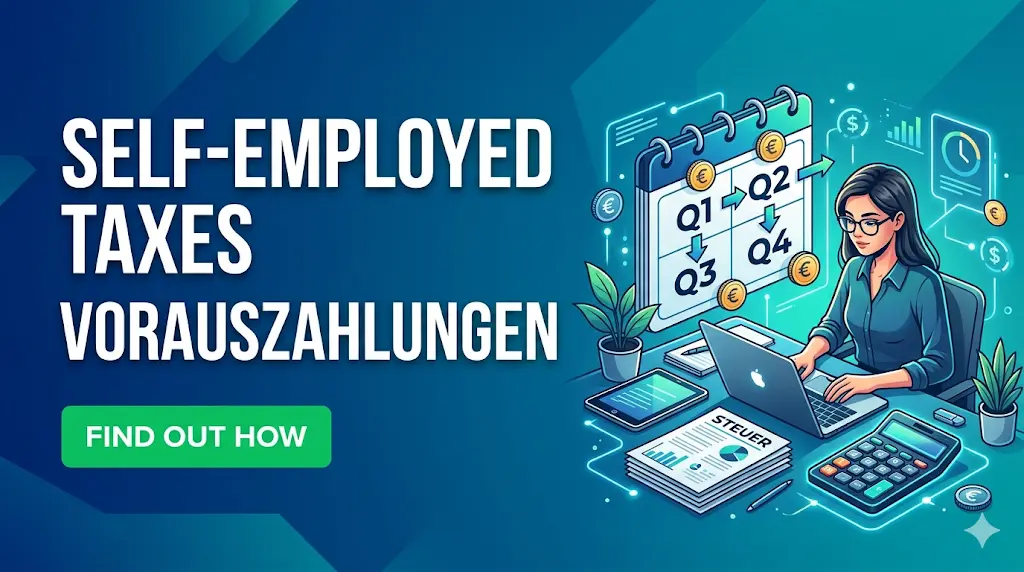
Income tax prepayments (Einkommensteuer-Vorauszahlungen) are due four times a year on exact, unyielding dates: March 10, June 10, September 10, and December 10.
These dates are sacred. The Finanzamt does not send you a friendly reminder invoice before each quarter. You receive the schedule once, and you are legally responsible for ensuring the money reaches the tax office’s bank account on or before those exact dates. If the 10th falls on a weekend, the deadline rolls over to the next business day.
If you miss a payment, the penalties are aggressive. The tax office charges a Säumniszuschlag (late payment penalty) of 1% of the rounded-down overdue amount for every single month it is late. If you owe 3,000 EUR for the quarter and forget to pay it for two months, you will bleed cash purely in punitive fees. Balancing these massive quarterly cash outflows requires you to deeply understand your overhead, which you should audit using Cost of Living in Germany: Breakdown of Expenses (Rent, Food, Transport).
Separating Your Funds to Avoid Accidental Spending
The only way to survive the quarterly tax drain is strict, uncompromising financial segregation. The gross money sitting in your checking account is a dangerous illusion; usually, 30% to 40% of it already belongs to the German government.
When I started freelancing, mixing my rent money with my tax money led to terrifying end-of-quarter panics. The solution is creating dedicated tax hoarding mechanisms. Opening a modern digital account like N26 is a massive advantage here. N26 offers a “Spaces” feature that acts as integrated sub-accounts. Every time a client pays an invoice, you should immediately transfer 35% of that gross payment directly into a dedicated “Tax Prepayment” Space within the N26 app.
You can then set up a SEPA Direct Debit Mandate (SEPA-Lastschriftmandat) with the Finanzamt. By giving the tax office permission to automatically pull the prepayments from your N26 main account on the 10th of the quarter, you completely eliminate the risk of forgetting a manual wire transfer. You just drag the funds out of your saving Space the day before the direct debit hits.
Navigating Cross Border Client Payments
For many expats, the complication deepens because their freelance clients are not in Germany. If you are an American or British expat doing remote consulting for home-country clients, you are being paid in foreign currencies.
If you receive a 5,000 USD payment into a traditional German bank account, the bank will quietly siphon off 3% to 4% of your hard-earned money in hidden currency conversion spreads. However, the Finanzamt still expects you to pay taxes on the true value of that invoice. You are paying taxes on money you lost to bank fees.
To plug this leak, savvy expats intercept international payments using platforms like Wise. You can provide your US clients with local US account details via Wise to receive the USD natively. You then convert the USD to EUR at the real mid-market rate and transfer it to your German account. By utilizing Wise, you retain the maximum amount of your gross revenue, ensuring you actually have the liquidity needed when the March or September tax deadlines inevitably arrive. If you are struggling with the logistics of international banking, you must review Moving Money to Germany: Declaring Savings and Large Transfers.
How to Adjust Your Prepayments When Income Drops
The standard prepayment schedule is based entirely on the past. But freelance income is volatile. If a global pandemic hits or you lose your main anchor client, being forced to pay taxes based on last year’s boom will bankrupt you. You have to fight back.
The Legal Right to Request a Reduction
Under Section 37, Paragraph 3 of the Income Tax Act, you have the absolute legal right to request an adjustment to your prepayments if you can demonstrate that your current year’s income will be significantly lower than the previous year. This process is called a Herabsetzungsantrag (Application for Reduction).
You do not have to wait until you are broke to file this. The moment you realize your revenue projections have plummeted, you should act. The tax office wants their money, but they do not want to force viable businesses into insolvency. If you overpay your prepayments, they eventually have to refund it to you next year anyway without paying you interest. Adjusting the prepayments aligns your cash flow with reality.
However, you cannot just send an emotional email saying, “I am making less money.” Germany is a paper-based society that demands evidence. You must prove the downward trend with hard, current financial data.
Drafting the Herabsetzungsantrag Reduction Application
To request the reduction, you must submit a formal message to your local Finanzamt. The most secure and immediate way to do this is through the official government tax portal, ELSTER. Within ELSTER, you can use the form titled Sonstige Nachricht an das Finanzamt (Other message to the tax office) or select the specific application for adapting prepayments.
In your application, you must provide a revised, realistic profit forecast for the current year. This usually requires attaching a current BWA (Betriebswirtschaftliche Auswertung or Business Evaluation) from your accounting software, or a meticulously detailed Excel spreadsheet showing your actual income and deductible expenses year-to-date.
You must also provide a brief, factual explanation (Begründung) for the drop in income. Phrases like “Loss of primary international client contract” or “Significant illness preventing project completion” are valid. The tax office will review your evidence, and if they find your new profit projection plausible, they will issue an updated Vorauszahlungsbescheid (Prepayment Notice) with lowered, or entirely cancelled, quarterly installments.
Using a Steuerberater vs DIY Negotiation
If your business is a simple, single-person consulting operation, filing a reduction request via ELSTER is a straightforward DIY task. However, if your business structure is complex, attempting to negotiate with the Finanzamt alone can backfire.
Many standard employees use a subsidized Lohnsteuerhilfeverein (Income Tax Assistance Association) for tax help. As a self-employed expat, you must know that these associations are legally prohibited from advising anyone with commercial or freelance income. You are entirely excluded from their services.
If your reduction request is denied, or if the tax office demands deeper accounting evidence that you do not understand, you must hire a Steuerberater (Certified Tax Advisor). A Steuerberater has the institutional weight to file the Herabsetzungsantrag on your behalf. When a licensed advisor signs off on a severely reduced profit projection, the tax office rarely disputes it. Knowing when to escalate your financial defense to a professional is the core lesson of surviving Tax Audits in Germany: What to Do If the Finanzamt Comes Knocking.
The Intersection of Prepayments and Global Income
Expats rarely have neat, purely domestic financial profiles. When your self-employed prepayments collide with global investments or foreign business income, the math becomes agonizingly complex.
Tax Treaty Credits and Foreign Business Income
If you are a tax resident in Germany, you are subject to unlimited tax liability on your worldwide income. If your self-employed business expands and you start generating taxable commercial income in a foreign country, your German prepayments will fluctuate based on double taxation treaties.
In some cases, Germany will apply the progression clause (Progressionsvorbehalt). They might not tax the foreign commercial income directly if it was already taxed abroad, but they will use it to push your German freelance income into a much higher tax bracket. Suddenly, the Finanzamt increases your quarterly prepayments on your local income because your foreign income raised your overall tax rate. Navigating this cross-border mathematical trap requires a deep understanding of Taxing Worldwide Income: How Germany Taxes Foreign Income and Assets.
Capital Gains Traps for Self Employed Expats
The most frustrating reason expats see their Vorauszahlungen violently increase has nothing to do with their actual freelance business. It involves their private investments.
If you hold a global portfolio on a foreign brokerage platform, Germany does not automatically withhold capital gains tax on your trades. You have to report it manually. If you had a phenomenal year in the stock market and cashed out a large position, you will report a massive spike in capital gains on your Anlage KAP.
The Finanzamt algorithm will see this massive tax liability from your capital gains and automatically assume you will generate that exact same stock market profit next year. They will drastically hike your quarterly prepayments to cover these presumed future capital gains.
You must immediately file an adjustment request explaining that the capital gains were a one-off liquidity event, not a recurring business income stream. To prove this easily, expats who consolidate their investments on platforms like Interactive Brokers have a massive advantage. Because Interactive Brokers generates localized, European-compliant tax reports, you can quickly export your transaction history to definitively prove to the tax clerk that the stock sale was a singular event, forcing them to lower your prepayments back to a reasonable baseline for your freelance work.
Managing Multiple Income Streams
The prepayment nightmare also impacts expats who are legally employed but picking up side-hustles. If you secure a standard English-speaking corporate role—a journey detailed in English-Speaking Jobs in Germany: Finding Work When You Don’t Speak German—your employer handles your main taxes.
However, if you also register a freelance side-business, your employer’s Lohnsteuer deductions will not cover the tax liability of your side-hustle. The Finanzamt will issue a Vorauszahlungsbescheid exclusively designed to capture the taxes for your freelance side-income. Even international students who pick up freelance tutoring (if their visa permits it, which is highly restricted and must be verified via Working Part-Time as a Student: Rules for Working on a Student Visa) can suddenly find themselves hit with quarterly tax bills that devour their modest side-income.
Coping with Trade Tax Gewerbesteuer Prepayments
If you thought income tax prepayments were the only hurdle, Germany has a secondary, entirely separate tax trap for certain types of self-employed expats: the Trade Tax (Gewerbesteuer).
Freiberufler vs Gewerbetreibender Distinctions
In Germany, self-employment is split into two fiercely protected legal categories: Freiberufler (liberal professionals) and Gewerbetreibender (commercial traders).
If you are a Freiberufler—typically an IT consultant, journalist, artist, doctor, or lawyer—you belong to the catalog professions. You do not register a trade business, and you are blissfully exempt from paying Trade Tax. Your prepayments only consist of standard income tax.
However, if you are an e-commerce seller, a digital marketing agency owner, or a drop-shipper, the state classifies you as a Gewerbetreibender. You must register with the local trade office (Gewerbeamt), and if your profit exceeds the tax-free allowance of 24,500 EUR, you are subjected to the dreaded Gewerbesteuer. This tax exists entirely separately from your income tax.
The IHK and Local Municipality Billing
The bureaucratic nightmare of the Trade Tax is that it is not assessed by your local Finanzamt. It is levied by the specific municipality (Gemeinde or Stadt) where your business is registered.
This means you will receive a second, entirely separate prepayment schedule from the city council. The quarterly deadlines for Trade Tax prepayments (Gewerbesteuer-Vorauszahlungen) operate on a completely different rhythm than income tax. They are due on February 15, May 15, August 15, and November 15.
If you are a Gewerbetreibender, you must manage two overlapping, staggered tax schedules. Every six weeks, a massive sum of money is due to a different level of the German government. If you are struggling to map out these staggered liquidity events, using the sub-account features in your N26 app to create distinct “Income Tax” and “Trade Tax” vaults is the only way to prevent accidental insolvency.
Offsetting Trade Tax Against Income Tax
The only silver lining to the Trade Tax burden is the relief mechanism known as the Gewerbesteueranrechnung. To prevent commercial traders from being taxed into oblivion, German law allows you to offset a significant portion of your paid Trade Tax against your overall Income Tax liability.
Because the multiplier used by the municipality (Hebesatz) varies wildly—being astronomically high in Munich but lower in suburban villages—the offset calculation is intensely complicated. You essentially receive a credit on your income tax return for the trade taxes you prepaid to the city.
| Feature | Income Tax Prepayments (ESt-Vorauszahlung) | Trade Tax Prepayments (GewSt-Vorauszahlung) |
| Who Pays It? | All profitable self-employed individuals | Only Gewerbetreibende (profits > 24,500 EUR) |
| Billing Authority | Local Tax Office (Finanzamt) | Local Municipality (Gemeinde / Stadt) |
| Quarterly Deadlines | Mar 10, Jun 10, Sep 10, Dec 10 | Feb 15, May 15, Aug 15, Nov 15 |
| Reduction Application | Submit via ELSTER to Finanzamt | Submit to the municipality based on a Finanzamt notice |
Surviving as a self-employed expat in Germany requires more than just professional talent; it requires mastery of the local treasury calendar. By predicting your Vorauszahlungen, leveraging digital banking for strict cash separation, and aggressively filing for reductions when revenue drops, you can conquer the administrative hostility and build a highly profitable, sustainable business in Europe’s largest economy.
References
Primary sources (official)
- Bundesministerium der Finanzen – Einkommensteuergesetz: The official federal legal text (EStG § 37) dictating the exact rules, dates, and 400 EUR minimum thresholds for income tax prepayments. https://www.gesetze-im-internet.de/estg/__37.html
- ELSTER – Das Online-Finanzamt: The official portal of the German tax administration used to submit electronic requests to adjust prepayments (Anpassung der Vorauszahlungen). https://www.elster.de/eportal/start
- Make it in Germany – Taxes for Self-Employed: The federal government’s portal outlining the differences between Freiberufler and Gewerbe, and how the respective prepayments are handled. https://www.make-it-in-germany.com/en/working-in-germany/setting-up-business/running/taxes
Other helpful sources
- Settle in Berlin – German Freelance Tax Guide: A highly detailed expat survival guide covering the mechanics of VAT, Income Tax, and navigating the dreaded Doppelschlag during your second year. https://www.settle-in-berlin.com/germany-freelance-tax-guide/
- IHK München – Gewerbesteuer Vorauszahlungen: The Chamber of Commerce’s breakdown of how municipalities calculate the Hebesatz and issue Trade Tax prepayment notices. https://www.ihk-muenchen.de/de/Recht/Steuerrecht/Gewerbesteuer/
Disclaimer
The information provided in this article is for general informational and educational purposes only and does not constitute professional tax, financial, or legal advice. German tax laws, specifically regarding income tax prepayments (Einkommensteuer-Vorauszahlungen), trade tax liability (Gewerbesteuer), and the strict statutory penalty framework (Säumniszuschläge) imposed by the Finanzamt, are highly complex and strictly enforced. Failing to make quarterly payments on the exact mandated dates will result in escalating financial penalties. While utilizing modern financial platforms like Wise, N26, and Interactive Brokers can significantly optimize your cross-border cash flow, tax segregation, and investment reporting, your legal tax liabilities remain your absolute responsibility.