Investing From Germany: Brokerage Accounts and ETFs
You land in Germany, your salary starts arriving, and the cash sits in a Girokonto earning very little. Then the questions start. Which broker accepts a newcomer? Why can’t you buy the ETF you held back home? What is the Vorabpauschale? This guide covers German brokerage accounts, ETF structures, tax withholding and the expat-specific traps, so you can invest without surprises.
Disclosure: This post may contain affiliate links. We may earn a commission at no extra cost to you if you make a purchase through these links. Read full disclosure.
Why Investing From Germany Feels So Different
Most of us arrive with habits from home. Americans know their 401(k) and Vanguard funds. Brits know their ISA. Australians know super. Germany has none of these as a direct equivalent. Germans also have a long cultural preference for savings accounts and life insurance policies, so friends and colleagues are often less useful guides than you would expect.
The Cultural Gap Around Saving and Investing
My first colleague in Frankfurt told me investing in the stock market was “basically gambling”. She kept her savings in a Sparbuch at the local Sparkasse. That attitude has shifted a lot, mostly because low-cost ETF savings plans became popular among younger Germans. Still, older bank advisers can steer you toward expensive in-house funds or insurance-wrapped products.
Treat any branch adviser who leads with a fund carrying an up-front charge, or with a pension insurance contract, with healthy suspicion. These products are not illegal or always bad. But for most expats who want broad market exposure, a self-directed brokerage account with ETFs is simpler and more transparent. You can see what you own, what it costs and how it is taxed.
What You Actually Need Before Opening an Account
German brokers are regulated and must verify who you are and where you pay tax. In practice, that means you need the following:
- A registered German address from your Anmeldung.
- Your tax identification number.
- A valid passport or residence permit for the video or in-person identity check.
- A German or SEPA bank account to fund the broker.
If you are still waiting on your Steuer-ID, some brokers let you start the application and add it later. Others block you until it arrives.
That timing problem catches many newcomers. In your first weeks, focus on registration, banking and building a cash cushion. For the cushion, see Rainy Day Fund: Saving an Emergency Fund in Germany (How Much and Where?). Once those basics are in place, the brokerage step is quick. For the full application walkthrough, see How to Open a Brokerage Account in Germany.
Choosing a Brokerage Account in Germany
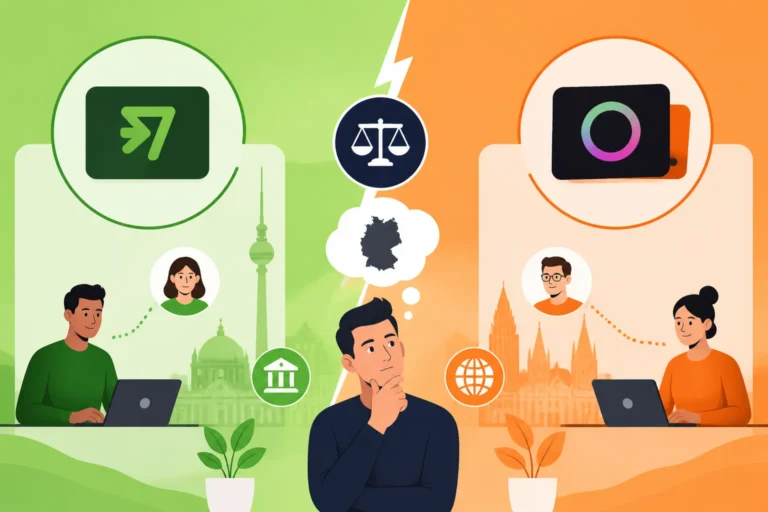
The German market splits into three broad camps:
- Neobrokers: app-first platforms such as Trade Republic and Scalable Capital.
- Direct banks: banks with an attached Depot, such as comdirect, ING and DKB.
- International brokers: platforms such as Interactive Brokers, which serve many countries from one platform.
Each camp makes sense for a different type of investor.
Neobrokers, Direct Banks and International Platforms Compared
Neobrokers built their reputation on low-cost trading and free or cheap ETF savings plans. Direct banks tend to offer a broader product range, more exchanges and the reassurance of a full banking licence with a long track record. International brokers give you global market access and multi-currency accounts. Their trade-off matters a lot in Germany: they usually do not withhold German tax for you.
Fee models change often, so check each provider’s own price page before you decide. What matters more is the shape of the costs. Ask yourself four questions:
- Is there a flat fee per trade or per savings plan execution?
- Does the provider charge a custody fee?
- Does it charge a currency conversion spread on non-euro assets?
- Does it earn money through payment for order flow, which can affect execution prices?
| Broker type | Typical examples | German tax withheld automatically | Best suited to |
|---|---|---|---|
| Neobroker | Trade Republic, Scalable Capital | Yes | Low-cost monthly ETF savings plans |
| Direct bank Depot | comdirect, ING, DKB | Yes | Investors who want bank and Depot together |
| Traditional branch bank | Sparkasse, Volksbank | Yes | Those who value in-person service |
| International broker | Interactive Brokers | Usually no | Experienced investors needing global access |
For a deeper look at individual platforms, see Best Online Brokerage Accounts for Expats in Germany: Investing Made Easy.
The Steuereinfach Question
“Steuereinfach” means tax-simple. It is the single biggest reason most expats should start with a German broker.
A German broker calculates the withholding tax on your dividends, sale gains and fund lump sums, then pays it straight to the Finanzamt. If you have submitted a Freistellungsauftrag, which is a tax exemption order, the broker first applies your annual saver’s allowance. In many cases you never need to declare your investments on your tax return at all.
With a foreign broker, nothing is withheld in Germany. You must report every dividend, sale and fund lump sum yourself on the Anlage KAP form. I learned this the hard way. In my second year, I spent a weekend reconstructing ETF prices from broker statements because my international platform had no German tax report.
If you do go this route, a guided tax tool such as Wundertax walks you through the investment income section in English. Even so, you still need clean records from the broker.
Linking Your Reference Account and Funding It
Every German Depot has a reference account, the Referenzkonto, where withdrawals land. Many expats use a simple online bank account for this. N26 is a common choice because it is quick to open with a German address and works in English.
Your salary arrives there, a standing order moves money to the broker’s cash account, and the savings plan buys ETFs automatically. Once you set this up, it runs without any effort.
The tricky part is money you bring from abroad. If you are moving savings from a US, UK or Indian account, your home bank’s international wire may hide a wide exchange-rate margin. Many expats convert through Wise first and then send euros by SEPA transfer to their German account.
Two steps help this go smoothly:
- Keep proof of where the funds came from.
- Expect your German bank to ask about large incoming transfers.
Understanding ETFs Available in Germany
Walk into any expat forum and you will see the same complaint: “Why can’t I buy VTI?” The answer comes down to EU consumer-protection rules and fund domicile. Once you understand it, choosing ETFs in Germany becomes much easier.
UCITS ETFs and Why US Funds Are Off Limits
Retail investors in the EU can generally only buy funds that publish a standardised key information document in an EU language. Most US-domiciled ETFs do not produce one. That is why European brokers block them.
Instead, you buy UCITS ETFs. Most are domiciled in Ireland or Luxembourg and track the same indices, such as the MSCI World, the FTSE All-World and the S&P 500. Big issuers like iShares, Vanguard, Xtrackers, Amundi and SPDR all list UCITS versions on Xetra, the main German exchange.
Picture Priya, a software engineer from Bangalore living in Munich. She holds an Indian mutual fund back home and wants global equity exposure in Germany. She simply searches her broker’s app for a UCITS ETF tracking a world index, checks the ISIN, which starts with IE or LU for Irish or Luxembourg funds, and sets up a monthly savings plan.
For Americans the picture is messier, and I cover it below. The broader question of how much home bias to keep is covered in Should You Invest in German or International Stocks? Diversifying as an Expat.
Accumulating Versus Distributing Funds
Every ETF either pays dividends out to you or reinvests them inside the fund:
- Distributing funds, marked “Dist” or “Ausschüttend”, pay cash to your account.
- Accumulating funds, marked “Acc” or “Thesaurierend”, reinvest automatically.
This is a legal and tax distinction in Germany, not just a matter of preference. It decides how and when you get taxed.
Distributing funds trigger tax on each payout, which your German broker handles at source. Accumulating funds feel tax-free while you hold them, but Germany does not let them defer tax entirely. Once a year, an accumulating fund held in a German Depot can trigger a notional taxable amount called the Vorabpauschale. It is calculated from an official base rate and the fund’s value. The broker pulls the tax from your cash account, so keep a small balance there.
| Feature | Accumulating ETF | Distributing ETF |
|---|---|---|
| Dividends | Reinvested inside the fund | Paid to your cash account |
| Ongoing German tax | Annual Vorabpauschale, if applicable | Tax on each distribution |
| Effort | Fully automatic compounding | You reinvest payouts manually |
| Useful for | Long-term accumulators | Those wanting regular income |
Taxes already paid through the Vorabpauschale are credited against your gain when you sell, so you are not taxed twice. For the mechanics and worked examples, see How Are ETF Gains Taxed in Germany (Vorabpauschale)?.
Partial Exemption and Fund Classification
German investment tax law grants a partial exemption, the Teilfreistellung, on income from qualifying equity funds. Mixed funds receive a smaller exemption, and bond funds generally receive none. Exactly how much is exempt depends on how much of the fund sits in equities and how the fund classifies itself.
Your German broker applies this automatically. With a foreign broker, you apply it yourself on your return.
In practice, a plain global equity UCITS ETF qualifies as an equity fund and receives favourable treatment. This is one reason German finance communities lean so heavily toward broad equity ETFs rather than complex structured products or actively managed bond funds.
How Investment Income Is Taxed in Germany
Germany taxes most private capital income at a flat withholding rate called the Abgeltungsteuer, separate from your salary tax bracket. The solidarity surcharge sits on top, and so does church tax if you are registered with a church.
The Flat Tax, Allowances and Your Exemption Order
Each resident has an annual saver’s allowance, the Sparerpauschbetrag. Married couples filing jointly get a combined amount. You claim it by giving each bank or broker a Freistellungsauftrag that tells them how much of your allowance to apply.
You can split the allowance across several providers. The total, however, must not exceed your entitlement. Many expats forget this step entirely and end up with tax withheld that they later have to reclaim through a return.
Church tax deserves a mention. If you ticked a religion during your Anmeldung, brokers receive that information and withhold church tax on your investment income too. Many newcomers only discover their registration status this way. If that applies to you, see Church Tax in Germany (Kirchensteuer): Who Pays and How to Opt Out. For the broader rules on sale gains, see Capital Gains Tax in Germany: What Investors Need to Know.
Losses, Loss Pots and Filing a Return
German brokers keep separate loss pots, the Verlustverrechnungstöpfe:
- Losses from selling individual shares can only offset gains from individual shares.
- Losses from ETFs and other investments go into a general pot.
If you hold accounts at several brokers, losses do not automatically cross between them. You can request a loss certificate, the Verlustbescheinigung, by the deadline your broker specifies and then offset the losses through your tax return.
Filing a return can also pay off when your personal income tax rate is lower than the flat rate. This is the Günstigerprüfung, a lower-rate check, and it is worth considering for students, part-time workers or a spouse with low income. You can also reclaim excess foreign withholding tax on dividends in some cases.
Special Situations for Expat Investors
The standard German playbook works well for most EU citizens and many other nationals. A few groups, though, face extra layers of complexity.
Americans and the PFIC Problem
US citizens are taxed by the IRS wherever they live. UCITS ETFs count as Passive Foreign Investment Companies under US rules, which means punitive taxation and heavy reporting on Form 8621. At the same time, EU rules block most US-domiciled ETFs. You end up squeezed from both sides.
Common workarounds include:
- Holding individual stocks.
- Keeping investments at a US broker that still allows a German address.
- Exercising options on US ETFs through certain international brokers.
- Focusing on US retirement accounts.
None of these is simple. An American client of a cross-border specialist such as Taxes for Expats will typically need both German and US reporting coordinated. Read German Investment Funds and PFIC Rules: The Trap Americans Fall Into and US-Domiciled ETFs From Germany: The MiFID II Problem for Americans before you buy anything.
Investing in a Foreign Currency and Leaving Germany Later
If you are paid partly in dollars or pounds, or plan to retire elsewhere, currency matters. A world ETF in euros still holds mostly dollar assets underneath. The trading currency is not the same as your economic exposure. For strategies to manage income in another currency, see How to Handle Currency Risk When Paid in Foreign Currency in Germany.
Leaving Germany raises its own issues. Some neobrokers restrict or close accounts once you deregister and move outside the EU. Your new country may also tax gains differently.
Before you deregister, check four things:
- Your broker’s policy on non-resident customers.
- Whether you can transfer holdings to another Depot without selling.
- How your new country treats existing gains.
- Whether your Freistellungsauftrag and reference account need updating.
Pensions, Crypto and Other Alternatives
ETFs are not the only option. Germany has state-subsidised retirement products with tax benefits but strict lock-ins, explained in Pension Options in Germany: Riester, Rürup, and the State Pension. Many expats find these less flexible than a plain Depot, especially if they may not retire in Germany.
Cryptocurrency follows a completely different rule set from the flat capital income tax. It is taxed as a private sale, with its own holding-period logic. If you hold coins alongside your ETFs, see Crypto and Taxes in Germany: How Gains Are Treated rather than assuming the same rules apply.
A Practical Setup Plan for Your First Year
Here is the sequence I would follow if I arrived in Germany again tomorrow:
- Complete your Anmeldung and wait for your Steuer-ID letter.
- Open a current account to serve as your reference account.
- Build a cash emergency fund before you invest anything.
- Choose a German broker that withholds tax automatically, unless you have a specific reason to go international.
- Submit a Freistellungsauftrag so your saver’s allowance is applied.
- Pick one or two broad UCITS equity ETFs and check the ISIN, domicile and whether they accumulate or distribute.
- Set up a monthly savings plan on a date just after payday.
- Keep a small cash buffer in the broker account for the annual Vorabpauschale.
- Download your annual tax certificate, the Jahressteuerbescheinigung, and file it with your records.
- Review once a year and resist the urge to tinker after every headline.
Common Mistakes to Avoid
The mistakes I see most often are:
- Forgetting the exemption order.
- Choosing a foreign broker for small savings and then drowning in tax paperwork.
- Buying dozens of overlapping ETFs.
- Panic-selling during a market drop.
- For Americans, buying UCITS funds without understanding the PFIC consequences.
Take your time with the first setup, and once it is running, check it about once a year rather than every week. The German system rewards boring consistency.
Disclaimer
This article is for general informational purposes only and does not constitute professional advice. Laws, prices and regulations vary by location and change over time. Consult a qualified professional for guidance on your specific situation.