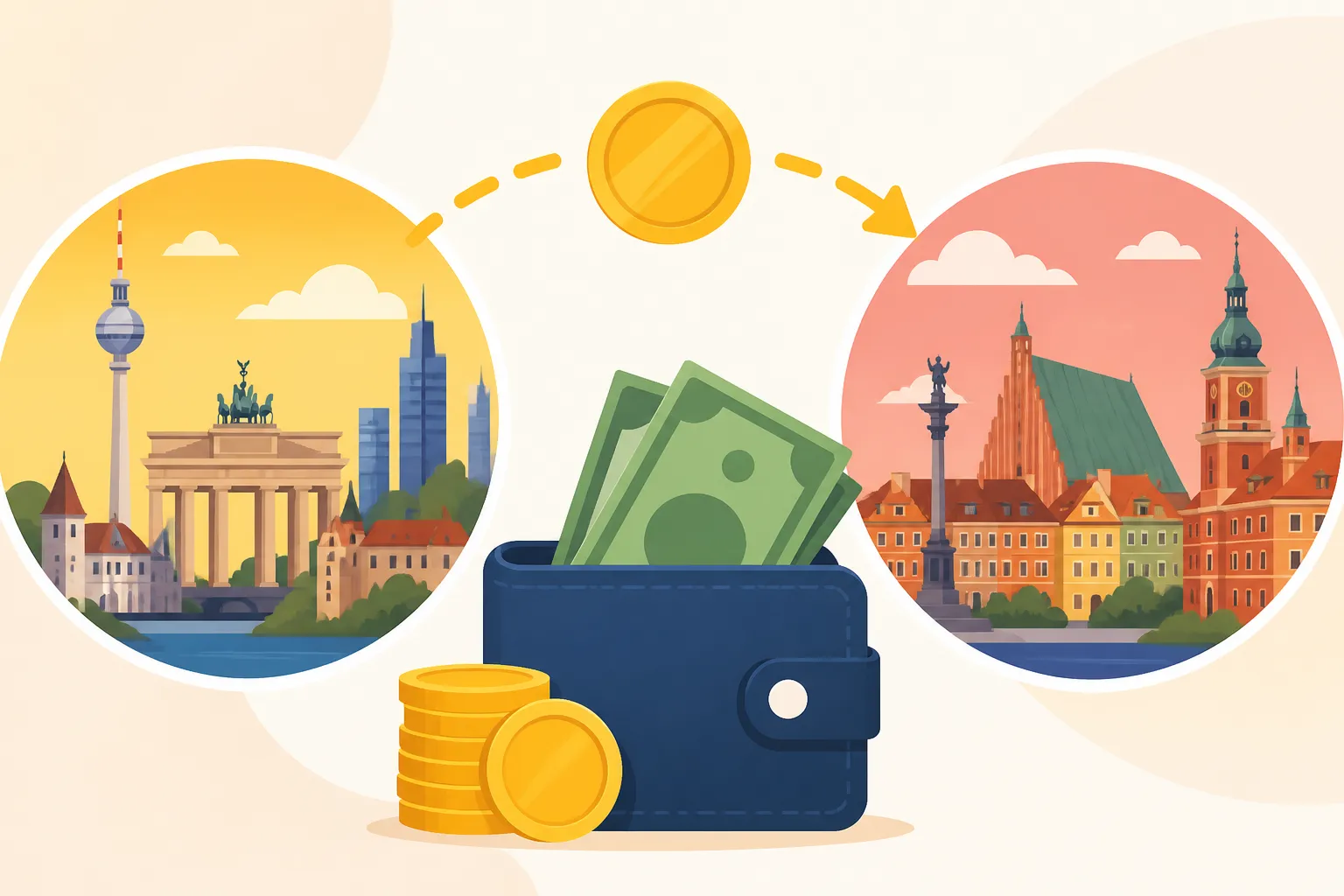
Sending Money From Germany to Poland: Zloty Transfer Costs Compared
Oh, the joys of managing money across borders, right? It's one of those silent struggles many of us expats face, especially when our loved ones or financial obligations are back in our home countries. If you're living in Germany and need to send money to Poland in Polish Zloty (PLN), you've probably already stumbled into the murky waters of hidden fees, bewildering exchange rates, and bank transfers that feel like they're traveling by horse and buggy. This guide is here to shed some light on the best, most cost-effective, and transparent ways to send your hard-earned euros to Poland, making sure your Zloty reaches its destination without unnecessary headaches or expenses.
Disclosure: This post may contain affiliate links. We may earn a commission at no extra cost to you if you make a purchase through these links. Read full disclosure.
The Expat's Dilemma: Why Sending Money to Poland Can Be Tricky
Moving to Germany brings a whole new set of financial realities. You're paid in euros, your expenses are in euros, but often, your heart (and your wallet's obligations) might still be in Poland, requiring you to convert those euros into Polish Zloty. It's not just about the numbers on a screen; it's about ensuring your family receives what they need, or that your investment back home is properly funded. And let's be honest, dealing with German bureaucracy and financial institutions can be an experience in itself, even without adding international transfers into the mix!
The Hidden Costs of Currency Exchange
You think you're sending €1,000, and you expect a certain amount to arrive in Zloty, but then… surprise! The recipient gets less than you calculated. This isn't just bad luck; it's usually the result of unfavorable exchange rates and undisclosed fees. Traditional banks, in particular, are notorious for marking up the exchange rate, meaning they give you a worse rate than the "real" one, pocketing the difference. This "spread" is rarely transparent and can quickly eat into your transfer amount. Imagine needing to send money for a specific bill or a family emergency; every single Zloty counts, and losing a significant chunk to hidden fees is incredibly frustrating and financially draining. It feels like you're being penalized simply for trying to support your family or manage your assets internationally.
Navigating Traditional Bank Transfers
For years, our default was always our trusty local bank. You'd waltz into a Sparkasse or Deutsche Bank, fill out a form, and hope for the best. And then you'd wait. And wait some more. SWIFT transfers, the system traditional banks use for international payments, are often slow and involve multiple intermediary banks, each of which can levy its own processing fees. This means the money might pass through several hands before reaching Poland, and each hand takes a little piece of the pie. It's a system built for a bygone era, not for the fast-paced, interconnected world we live in today. Not to mention, the exchange rate you get from a traditional bank is rarely the best available, further diminishing the value of your transfer. Trying to track these transfers or understand the final cost can feel like deciphering an ancient scroll, leaving you more confused than informed. And forget about knowing exactly when the money will arrive; it's more of a hopeful estimate than a concrete timeline.
Unpacking Transfer Costs: Fees, Rates, and Speed
When you're trying to send money from Germany to Poland, it's not enough to just look at a "transfer fee." That's only one piece of the puzzle. To truly understand how much your transfer will cost, you need to dissect the various components and consider the overall impact on the Zloty amount that actually lands in your recipient's account. This transparency is crucial for anyone managing their finances across borders, whether it's for regular family support or a one-off payment.
Understanding the Mid-Market Exchange Rate
This is the holy grail of exchange rates, the one you see on Google or Reuters. It's the midpoint between the buying and selling prices of two currencies on the global market. In an ideal world, you'd always get this rate. However, most banks and some money transfer services add a "markup" to this rate. This means they sell you the Zloty at a slightly higher price than they bought it, and that difference is pure profit for them. It might seem small on paper, a fraction of a percent, but on a larger transfer, it can quickly add up to significant euros that disappear before your money even leaves Germany. Always compare the rate offered by a provider to the mid-market rate. If there's a significant difference, you're paying a hidden fee. This is often where traditional banks really hit you, offering a seemingly low transfer fee but a terrible exchange rate.
The Various Types of Transfer Fees
Beyond the exchange rate, you'll encounter direct transfer fees, which come in a few flavors:
- Fixed Fees: Some providers charge a flat fee regardless of the amount you send. This can be great for larger transfers, as the fee becomes a smaller percentage of the total. However, for smaller amounts, a fixed fee can feel disproportionately high.
- Percentage-Based Fees: Other services charge a percentage of the amount you're sending. This is often more favorable for smaller transfers, as the fee scales down with the amount. But for very large transfers, a percentage-based fee can quickly become expensive.
- Intermediary Bank Fees: This is the sneaky one, primarily associated with SWIFT transfers through traditional banks. As mentioned, your money might pass through several banks, each taking a cut. These fees are unpredictable and often only revealed after the transfer has been completed, leaving both you and your recipient in the dark about the final cost until it's too late.
- Recipient Fees: In some cases, the recipient's bank might charge a fee for receiving an international transfer. While less common for transfers within the EU, it's something to be aware of, especially if your recipient uses a very small, local bank in Poland.
Balancing Speed and Cost in Your Transfers
It's a classic dilemma: do you want your money to arrive quickly, or do you want to pay the absolute lowest fee? Sometimes, you can have both, but often there's a trade-off.
- Fast Transfers: These typically come with a higher price tag. If you need money to arrive in Poland within hours, some services offer express options, but you'll usually pay a premium for the convenience. This might be necessary in an emergency, but for routine transfers, it might not be the most economical choice.
- Standard Transfers: Most online money transfer services offer standard transfers that take 1-3 business days. These are usually more affordable and strike a good balance between cost and speed for most expats. This is often the sweet spot for regular remittances, where you plan a few days ahead.
- Slow Transfers: Traditional bank transfers, especially those that rely solely on the SWIFT network, can sometimes take up to 5 business days, or even longer if there are issues or public holidays involved. While potentially cheaper on the surface (if you ignore the exchange rate markup and hidden fees), the lack of speed and transparency can make them a less attractive option for most.
When choosing a service, always consider how urgent the transfer is and whether the additional cost for speed is genuinely worth it for your specific situation. For many expats supporting family in Poland, a reliable service that offers a good rate and reasonable speed is paramount.
Your Best Bet for Zloty Transfers: Online Specialists like Wise
When it comes to getting your Euros into Zloty and across the border to Poland efficiently and affordably, I've seen countless expats, myself included, turn to online money transfer services. Among them, one name consistently comes out on top for its transparency, fair rates, and sheer convenience: Wise (formerly TransferWise). This service has truly revolutionized how we think about international money transfers, especially for regular remittances or larger sums where every cent counts.
Why Wise Stands Out for Germany-Poland Transfers
Let's cut to the chase: Wise is often the hero for transfers from Germany to Poland. Why? Because it directly tackles the biggest pain points for expats: hidden fees and poor exchange rates. Wise operates on a principle of radical transparency, showing you exactly what you'll pay and exactly what exchange rate you'll get before you commit to the transfer. This means no nasty surprises for you or your recipient in Poland.
Unlike traditional banks, Wise doesn't mark up the exchange rate. They use the real mid-market exchange rate, the one you'd see if you Googled it. Their fees are upfront, low, and clearly displayed, typically a small fixed fee plus a tiny percentage of the transferred amount. For transfers from Germany to Poland, this often means your recipient gets significantly more Zloty than they would through a conventional bank, even after accounting for Wise's fees. They achieve this by using a local transfer system: your euros go into Wise's German account, and then Wise pays out from their Polish account in Zloty. It's not an international transfer in the traditional sense, which is why it's faster and cheaper. This model bypasses the costly SWIFT network and its many intermediaries, ensuring your money travels smarter, not harder.
Step-by-Step with Wise: Making a Transfer
Making your first transfer with Wise is surprisingly straightforward, especially once you've done it once. Here's a quick rundown of what you can expect:
- Sign Up or Log In: If you're new, you'll need to create a free account on the Wise website or through their mobile app. It's a quick process, much less cumbersome than setting up a bank account in Germany.
- Choose Your Currencies and Amount: You'll specify that you're sending EUR from Germany and want to send PLN to Poland. Enter the amount you wish to send, and Wise will immediately show you the exact amount your recipient will receive in Zloty, along with a clear breakdown of the exchange rate and the small fee. This upfront transparency is truly invaluable.
- Enter Recipient Details: You'll need your recipient's full name, address, and their Polish bank account details (IBAN). Make sure these are accurate to avoid any delays.
- Fund Your Transfer: You have several options to send your euros to Wise from Germany. You can use a bank transfer (Überweisung), which is often the cheapest option but can take 1-2 business days. Alternatively, you can pay with your debit card for a faster transfer (sometimes instant, but with a slightly higher fee), or even credit card (highest fees, but instant). For those of us using online banking, initiating a transfer directly from your German bank account to Wise is super simple.
- Confirm and Track: Once you've paid, Wise will send you email updates (or app notifications) about the status of your transfer. You'll know when your money has left your account, when it's being processed, and when it's landed in your recipient's Polish bank account. Transfers to Poland usually arrive within hours, often within minutes, making it incredibly reliable. This transparency and speed are huge benefits, particularly when you're dealing with urgent payments or simply want peace of mind.
Beyond Transfers: Additional Wise Benefits for Expats
Wise isn't just about single transfers; it offers a suite of features that can greatly benefit expats living in Germany. For example, their multi-currency account allows you to hold, send, and receive money in over 50 currencies, including EUR and PLN, and get local bank details for 10 different countries. This means you could theoretically receive Zloty directly into your Wise account and then spend it using a Wise debit card, bypassing further currency conversions if you ever travel to Poland frequently.
This can be incredibly useful for those who travel between Germany and Poland regularly, or for freelancers who might receive payments in various currencies. You can manage your finances in multiple currencies without the need for multiple traditional bank accounts, which simplifies your financial life immensely. Having a local Polish bank account number through Wise's multi-currency account can be a game-changer for receiving payments or managing affairs in Poland without incurring additional fees. It's truly a tool built for the modern, internationally-minded individual, cutting through the red tape and costs that traditional banking often imposes. If you're looking for the best way to handle your money, considering your options for Opening a Bank Account in Germany: Step-by-Step for Newcomers and exploring innovative platforms like Wise is a smart move.
Other Digital and Traditional Options: A Comparative Look
While Wise might be my personal hero for cross-border transfers to Poland, it's always good to be aware of the other players in the game. You've got a range of options, from other innovative digital services to the age-old methods offered by traditional banks. Each comes with its own set of pros and cons, and what works best for one expat might not be the ideal solution for another. Understanding these alternatives will help you make the most informed decision, especially when comparing them with the clear advantages that services like Wise offer.
Exploring Alternative Online Providers
The digital landscape for money transfers has blossomed over the past decade, and many services have emerged to challenge the dominance of traditional banks. Here are a few notable ones that often facilitate transfers from Germany to Poland:
- Revolut: A popular digital banking alternative, Revolut offers competitive exchange rates and often fee-free transfers up to a certain limit each month, especially if you have one of their premium plans. It's excellent for everyday spending and smaller, frequent transfers. However, beyond the free limits or on weekends, their exchange rates can become less favorable, and they might add small fees. Many expats managing their Mobile Banking Apps in Germany: N26, Revolut, and More often have a Revolut account for its versatility.
- Xoom (a PayPal service): Xoom is known for its speed and convenience, especially if you or your recipient already use PayPal. It allows for bank deposits, cash pickup, and even home delivery in some cases. While fast, their exchange rates can sometimes be less competitive than Wise, and their fees might be slightly higher, depending on the amount and payment method.
- Western Union / MoneyGram: These are global giants known for cash pickup services, making them useful if your recipient doesn't have a bank account or needs cash immediately. They have extensive networks in both Germany and Poland. However, they are typically among the most expensive options due to higher fees and less favorable exchange rates compared to pure online bank-to-bank transfer services. The convenience comes at a significant cost, making them less ideal for regular, bank-to-bank transfers.
When evaluating these alternatives, it's crucial to always run a quick comparison for your specific transfer amount and destination. Most platforms have a clear calculator on their homepage that will show you the total cost and the amount received in Zloty. This allows you to directly compare apples to apples, or rather, Euros to Zloty, and see how much more your family in Poland would receive with a transparent service like Wise.
When Traditional Banks Might Still Be an Option (and their drawbacks)
Despite the rise of digital alternatives, many expats still consider their traditional German banks for international transfers. After all, you already have an account with them, and it feels familiar. Banks like Deutsche Bank, Commerzbank, or even your local Sparkasse do offer international transfer services.
The main "pro" of using your bank is familiarity and potentially feeling more secure, especially for very large, infrequent transfers where you might value the face-to-face interaction or perceived institutional stability. For example, if you're working through Understanding Your German Payslip: Gross vs Net Salary Explained and then sending some home, using your existing bank might seem like the simplest approach.
However, the drawbacks are significant and often outweigh the perceived benefits:
- Higher Fees: As we've discussed, traditional banks typically charge higher transfer fees. These can be fixed, percentage-based, or a combination, and sometimes even a separate fee for "SWIFT costs."
- Unfavorable Exchange Rates: This is the big one. Banks often use a marked-up exchange rate, which is essentially a hidden fee that significantly reduces the amount of Zloty your recipient receives. They profit from this spread, which is rarely disclosed upfront in a transparent manner.
- Slower Transfer Times: International bank transfers via the SWIFT network can take several business days to complete, sometimes even longer due to intermediary banks or processing delays. This can be frustrating if you need money to arrive quickly.
- Lack of Transparency: You might not get a clear, upfront breakdown of all costs and the exact Zloty amount your recipient will receive until after the transfer is initiated or even completed. This lack of predictability can be quite stressful.
For most day-to-day transfers to Poland, especially for expats who are regularly sending money, the combined costs of fees and unfavorable exchange rates from traditional banks make them a far less economical choice compared to digital specialists like Wise. It’s always worth investigating if Best Banks in Germany for Expats: Low Fees and English Support can offer better international transfer terms, but even then, they rarely beat the dedicated transfer services.
Let's do a quick comparison example (hypothetical, based on typical fee structures and exchange rate markups observed generally, actual rates and fees vary daily):
Hypothetical Transfer: Sending €1,000 from Germany to Poland (PLN)
| Provider Type | Exchange Rate Offered (EUR to PLN) | Total Transfer Fee (approx.) | Est. PLN Received (after fees & rate) | Transfer Speed | Transparency |
|---|---|---|---|---|---|
| Wise | Mid-market rate | €5 – €8 | ~4,300 PLN | Hours to 1 day | High (all costs upfront) |
| Traditional German Bank | Mid-market – 2-4% markup | €15 – €30 + intermediary fees | ~4,100 – 4,200 PLN | 2-5 business days | Low (hidden rate markup) |
| Revolut (Standard Plan) | Mid-market (Mon-Fri) / Markup (Wknds) | €0 – €10 (varies by plan/limit) | ~4,250 – 4,280 PLN | Instant to 1 day | High (shows fees) |
| Xoom | Mid-market – 1-3% markup | €5 – €15 | ~4,200 – 4,250 PLN | Minutes to 1 day | Medium (rate markup) |
| Western Union | Mid-market – 3-5% markup | €10 – €25 | ~4,000 – 4,100 PLN | Minutes (cash pickup) | Low (significant markup) |
Disclaimer: These figures are illustrative and can fluctuate based on current exchange rates, specific provider policies, transfer amounts, payment methods, and any promotional offers. Always check the live rates and fees on each provider's website before making a transfer.
As you can see, the differences can be quite substantial. Over time, these small differences in fees and exchange rates add up, making a significant impact on your overall financial outflow from Germany to Poland. This is why for me, and many other savvy expats, Wise truly stands out as the pragmatic and financially smart choice. When you're thinking about Transferring Money Internationally: Cheapest Ways to Send Money Abroad, Wise should always be at the top of your comparison list.
Practical Tips for Sending Money to Poland
Navigating international money transfers, even with the best services, can sometimes feel like a bit of a labyrinth. But with a few practical tips and a bit of foresight, you can make the process smoother, cheaper, and less stressful. It's all about being prepared and understanding the nuances of cross-border transactions, especially when you're moving your hard-earned euros into Polish Zloty. For instance, if you're managing Finances for International Students: Managing Money on a Student Budget, these tips become even more critical to conserve every cent.
Essential Information You'll Need
Before you even log into your chosen money transfer service, have these details ready. Accuracy here is paramount; a small typo can cause significant delays or even send your money to the wrong account, which is a headache nobody needs.
- Recipient's Full Name: Make sure it matches exactly what's on their bank account. No nicknames or abbreviations.
- Recipient's Address: This is often required for compliance purposes, even for bank-to-bank transfers.
- Recipient's IBAN (International Bank Account Number): This is the most crucial piece of information. For Poland, IBANs are typically 28 characters long and begin with "PL". Double-check every digit!
- Recipient's Bank Name: The full legal name of their bank in Poland.
- SWIFT/BIC Code (sometimes needed): While many modern services like Wise handle this in the background, some older systems or specific banks might still ask for the SWIFT/BIC code of the recipient's bank.
- Your Personal Details: Your full name, address, and potentially your German bank account details (for funding the transfer).
Always ask your recipient to send you their bank details in writing (email or message) rather than trying to jot them down over the phone. A quick copy-paste can prevent a world of hurt.
Keeping an Eye on Exchange Rates
Exchange rates between EUR and PLN are constantly fluctuating. While you can't predict the future, being mindful of the rates can help you maximize your transfer.
- Set up Rate Alerts: Many services, including Wise, allow you to set up email alerts. You'll get a notification when the EUR to PLN exchange rate hits a certain level you're happy with. This is a fantastic way to time your transfers, especially for non-urgent payments, ensuring you get more Zloty for your Euro.
- Avoid Weekend Transfers (if using certain services): Some providers, notably Revolut, apply a higher margin (less favorable rate) on currency exchanges over the weekend when interbank markets are closed. If you're using such a service, plan your transfers for a weekday to get the best rate. Wise generally maintains its mid-market rate even on weekends, which is another reason it's so popular.
- Check Live Rates: Before every transfer, quickly check the live mid-market rate on Google or a reliable financial news site. Then compare it to the rate offered by your chosen service. This quick check will immediately tell you if you're getting a fair deal.
Dealing with Larger Transfers and Regulations
If you're sending a substantial amount of money, there are a few extra considerations. German and Polish regulations, like those across the EU, are in place to prevent money laundering and terrorist financing.
- Verification: For larger transfers or even your first few transfers, services like Wise or traditional banks will require identity verification. This usually involves uploading a copy of your ID (passport or German residence permit) and sometimes proof of address. This is a standard procedure and usually only needs to be done once.
- Source of Funds: For very large transfers, you might be asked to provide proof of the source of funds. This could be a bank statement showing the money, a payslip, or a sale agreement. Don't be alarmed; it's part of compliance. This is especially relevant if you're looking into Understanding Your Tax Assessment (Steuerbescheid): After You File in Germany and how your finances are viewed.
- Transfer Limits: Most services have daily, weekly, or monthly transfer limits. If you need to send a very large sum, you might need to break it into multiple smaller transfers over a period, or contact customer support to discuss higher limits.
- Tax Implications: While sending money to family for personal use generally isn't taxed, always be aware of any potential gift tax thresholds in both Germany and Poland if the amount is extremely large. For most regular remittances, this isn't an issue, but it's something to keep in mind for significant financial gifts or inheritances. If you're managing finances as a Financial Planning for Mixed Nationality Couples: Managing Money & Taxes in Germany, these considerations are even more important.
By staying informed and being meticulous with details, sending money from Germany to Poland in Zloty can be a surprisingly smooth process. The key is to leverage modern, transparent services like Wise that are designed with the expat in mind, ensuring your money travels efficiently and cost-effectively, reaching its destination with maximum value.
Disclaimer
Please note that the information provided in this guide is for general informational purposes only and does not constitute financial, legal, or professional advice. Currency exchange rates, fees, and service availability are subject to change without notice. Always verify the latest information directly with the service providers mentioned and consider consulting a qualified financial advisor for personalized guidance based on your individual circumstances. While every effort has been made to ensure accuracy, we cannot guarantee that all information is up-to-date or error-free.