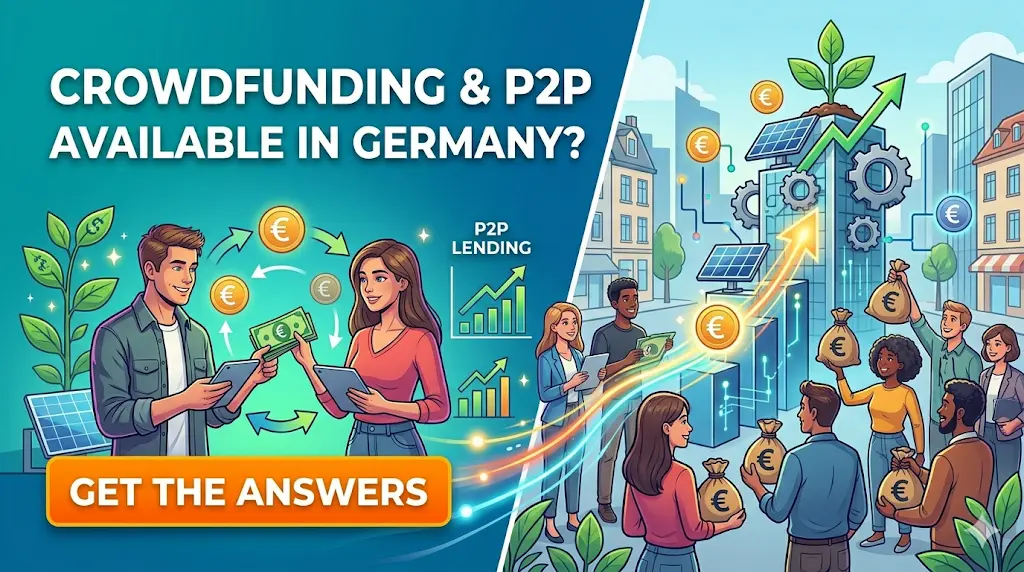
Peer-to-Peer Lending and Crowdfunding: Are They Available in Germany?
Trying to secure a small bank loan without a local credit history, or wanting to invest your spare euros outside of zero-interest savings accounts, leaves many expats feeling financially stranded. I spent my first year constantly rejected by traditional German banks for having a “thin” credit file. This guide breaks down the legalities, risks, and platforms for peer-to-peer lending and crowdfunding in Germany.
Disclosure: This post may contain affiliate links. We may earn a commission at no extra cost to you if you make a purchase through these links. Read full disclosure.
The Reality of Peer to Peer Lending in Germany
When expats arrive in Germany, they are often shocked by the incredibly rigid lending standards of the local banking sector. Peer-to-peer (P2P) lending, which connects private borrowers directly with private investors via an online platform, seems like the perfect alternative. However, the German market operates under strict regulations that fundamentally alter how these platforms work compared to the US or UK.
Borrowing as an Expat The Schufa Catch
If you need a small loan to cover the deposit on your new apartment or buy furniture, traditional banks will aggressively scrutinize your Schufa (the German credit score). As a newly arrived expat, your Schufa is virtually blank, leading to immediate algorithmic rejections.
Domestic P2P lending platforms, such as Auxmoney, offer a lifeline. Because private investors fund the loans, these platforms are willing to take on higher-risk borrowers, including freelancers and foreigners with thin credit files. However, you cannot entirely escape the system; you must still prove your identity, provide income statements, and possess a functional German bank account to receive the funds.
To even apply on these local platforms, you must provide a local IBAN. Getting a traditional bank account is notoriously difficult without a credit history, but bypassing legacy bank bureaucracy with N26 gives you the fast, SEPA-compliant German IBAN you need to interact with these platforms. Understanding how your credit score dictates your financial mobility is a foundational hurdle mapped out in German Bureaucracy 101: Understanding the Anmeldung, Schufa, and Tax ID.
Investing The BaFin Regulatory Shield
If you are on the other side of the equation and want to lend your money to earn interest, you will quickly notice that domestic German P2P platforms offer lower yields than their Eastern European counterparts. This is due to the heavy regulatory shield imposed by BaFin (the Federal Financial Supervisory Authority).
In Germany, any institution that accepts deposits and issues loans must hold a full banking license. Because tech startups running P2P platforms do not possess these licenses, they are legally forced to use a “fronting bank” model. The platform partners with a fully licensed, white-label bank (like Solarisbank or Sutor Bank) to legally originate the loan, which is then immediately sold to the private investors. This added layer of regulatory friction creates high administrative costs, which ultimately eat into your investment yield.
Because of these lower domestic yields, many expat investors in Germany turn to Baltic P2P platforms (like Mintos or Bondora) to chase higher returns. Managing your cash flow with N26 makes calculating your investment capacity much easier, allowing you to track exactly how much surplus liquidity you can afford to send to these foreign platforms every month. Having a clear overview of your domestic expenses ensures you never over-leverage yourself, a strategy explored in Mobile Banking Apps in Germany: N26, Revolut, and More.
Navigating German Crowdfunding Platforms
Beyond personal loans, Germany has a robust and highly regulated crowdfunding ecosystem. This sector allows retail investors to pool their money to finance massive projects that were historically reserved for institutional venture capitalists.
Real Estate Crowdfunding Mezzanine Capital
Buying property in major German cities like Munich or Berlin is prohibitively expensive, requiring massive upfront capital. Real estate crowdfunding platforms (such as Exporo or Bergfürst) democratize this asset class, allowing you to invest in commercial developments or apartment complexes with as little as 500 euros.
However, you must deeply understand the legal structure of these investments. In Germany, real estate crowdfunding is almost exclusively structured as Nachrangdarlehen (subordinated loans). This legal classification is incredibly dangerous: it means that if the real estate developer goes bankrupt, the primary banks get paid back first. You, the retail investor holding the subordinated loan, are literally the last person in line to be compensated. The risk of total capital loss is massive.
Before locking your savings into highly illiquid real estate projects, you must ensure your baseline localized budget is secure. Chasing a 6 percent yield on a property development is foolish if you are struggling to cover the notoriously high Cost of Living in Germany: Breakdown of Expenses (Rent, Food, Transport).
Startup and Equity Crowdfunding
If you have a higher risk tolerance, platforms like Seedmatch allow you to provide early-stage capital to German tech startups and innovative businesses. Unlike standard loans where you receive a fixed interest rate, equity crowdfunding ties your returns to the actual performance and valuation of the company.
If the startup succeeds and is eventually acquired, your payout can be substantial. However, the startup failure rate is extraordinarily high. These investments should be viewed as highly speculative venture capital rather than a stable retirement plan. Furthermore, tracking the obscure transaction codes when these platforms occasionally pay out small dividends or return your capital requires a meticulous understanding of your Understanding German Bank Statements: Fees and Transactions Explained.
Managing Your Money Across Border Platforms
The most lucrative P2P and crowdfunding platforms are often located outside of Germany. Interacting with these foreign platforms introduces significant currency and transfer risks that can quietly destroy your investment margins.
Bypassing Legacy Bank Transfer Fees
If your savings are still sitting in a home country bank account in US dollars, British pounds, or Australian dollars, sending a direct international wire to a European P2P platform is a massive mistake. Traditional banks will hit you with opaque SWIFT fees and apply a catastrophic exchange rate markup, instantly wiping out months of potential yield.
Using Wise to convert your capital to euros at the true mid-market exchange rate is absolutely essential before funding these platforms. Wise prevents traditional banks from skimming a 3 to 5 percent markup off your investment principal. Once converted, you can seamlessly route those euros directly into the crowdfunding platform’s escrow account. Later, if you decide to withdraw your capital and send it back home, routing your profits through Wise ensures your margins remain intact. Efficiently managing these large cross-border capital flows is a sophisticated skill detailed in Moving Money to Germany: Declaring Savings and Large Transfers and Cross-Border Banking: Managing Your Home Country Account While in Germany.
Balancing Risk with Regulated Brokerages
The golden rule of alternative finance is that P2P lending and crowdfunding should only represent a tiny, highly speculative fraction of your overall net worth. These assets are generally illiquid; if the market crashes, you cannot simply log in and sell your subordinated real estate loan.
For your core wealth, using a regulated platform like Interactive Brokers is far safer and more predictable. Unlike illiquid P2P loans, Interactive Brokers provides immediate liquidity and access to heavily regulated, globally diversified ETFs. By holding your primary retirement funds in broad market equities via Interactive Brokers, you build a resilient financial foundation. This stable core allows you to take calculated, high-yield risks with smaller amounts of capital in the P2P sector. Understanding how to properly balance these asset classes is critical, a concept deeply mapped out in Should You Invest in German or International Stocks? Diversifying as an Expat.
| Investment Type | Typical Yield | Liquidity | Primary Risk Factor | Legal Structure in Germany |
| P2P Consumer Lending | 5% – 11% | Moderate (Secondary markets exist) | Borrower default | Regulated Fronting Bank |
| Real Estate Crowdfunding | 4% – 7% | Very Low (Locked for years) | Developer bankruptcy | Nachrangdarlehen (Subordinated) |
| Startup Crowdfunding | Variable | Extremely Low | Total company failure | Profit-participating loans |
| Global ETFs (For Balance) | 7% – 9% (Historical) | Very High (Instant selling) | Market volatility | Standard Regulated Equities |
Tax Implications for Alternative Investments
Generating a high yield on a P2P platform feels fantastic until the German tax authority (Finanzamt) demands their cut. The taxation of alternative investments in Germany is mathematically straightforward but administratively burdensome.
The Capital Gains Tax Withholding
Profits generated from P2P lending and crowdfunding are classified as capital income. Therefore, they are subject to the standard German flat tax (Abgeltungsteuer).
The base tax rate is 25 percent, plus a 5.5 percent solidarity surcharge (Solidaritätszuschlag), bringing your effective tax rate to exactly 26.375 percent (plus church tax, if applicable). If you invest through a domestic German platform, the platform will automatically withhold this tax and send it directly to the Finanzamt before paying out your interest.
However, the German government grants every resident a tax-free allowance for capital income (Sparer-Pauschbetrag), which is currently 1,000 euros per year. To ensure the domestic platform does not automatically tax your first 1,000 euros of profit, you must actively submit an exemption order (Freistellungsauftrag) in your account settings. If you forget to do this, you will have to manually reclaim the overpaid taxes at the end of the year, an arduous process decoded in Understanding Your Tax Assessment (Steuerbescheid): After You File in Germany.
Declaring Foreign P2P Platforms
The administrative nightmare truly begins if you invest in foreign platforms, such as those based in Latvia, Estonia, or the UK. Foreign platforms do not report to the German Finanzamt, nor do they automatically withhold German taxes.
As a German tax resident, you are subject to unlimited tax liability, meaning you are legally required to declare every single cent of global interest you earn. You must manually calculate your foreign P2P profits and enter them into the Anlage KAP (Income from capital assets) form on your annual German tax return. Failing to report the 500 euros you made on a Baltic P2P platform is considered tax evasion.
Furthermore, if a foreign P2P loan defaults, writing off that loss against your other capital gains is a highly contested gray area in German tax law, often requiring the intervention of a certified tax advisor (Steuerberater). Understanding the strict global reporting requirements enforced by the German state is vital to keeping your financial life compliant, a reality thoroughly explored in Taxing Worldwide Income: How Germany Taxes Foreign Income and Assets.
References
Primary sources (official)
- Bundesanstalt für Finanzdienstleistungsaufsicht (BaFin): The Federal Financial Supervisory Authority’s official English-language guidelines on the regulation of crowdfunding platforms, the necessity of banking licenses, and the legal framework of subordinated loans. https://www.bafin.de/EN/Aufsicht/FinTech/Crowdfunding/crowdfunding_node_en.html
- Bundesministerium der Finanzen (BMF): The Federal Ministry of Finance’s official glossary and legal definition of the Abgeltungsteuer (final withholding tax) applied to capital yields and interest income. https://www.bundesfinanzministerium.de/Web/DE/Service/FAQ_Glossar/Glossar/Functions/glossar.html?lv2=176512&lv3=176532
Other helpful sources
- Finanztip – P2P Kredite: Germany’s leading independent consumer advice portal offering deep analysis on the risks of P2P platforms, tax declaration mechanics, and the ongoing legal rulings regarding the deductibility of defaulted loans. https://www.finanztip.de/p2p-kredite/
Disclaimer
The information provided in this article is for general informational and educational purposes only and does not constitute professional financial, tax, or legal advice. Peer-to-peer lending and crowdfunding involve a high degree of risk, including the potential for total capital loss, particularly when structured as subordinated loans (Nachrangdarlehen). These assets are generally illiquid and are not protected by statutory European deposit insurance schemes (Einlagensicherung). German tax laws regarding the declaration of foreign capital gains via the Anlage KAP are strictly enforced by the Finanzamt.