Opening a Bank Account in Germany: Step-by-Step for Newcomers
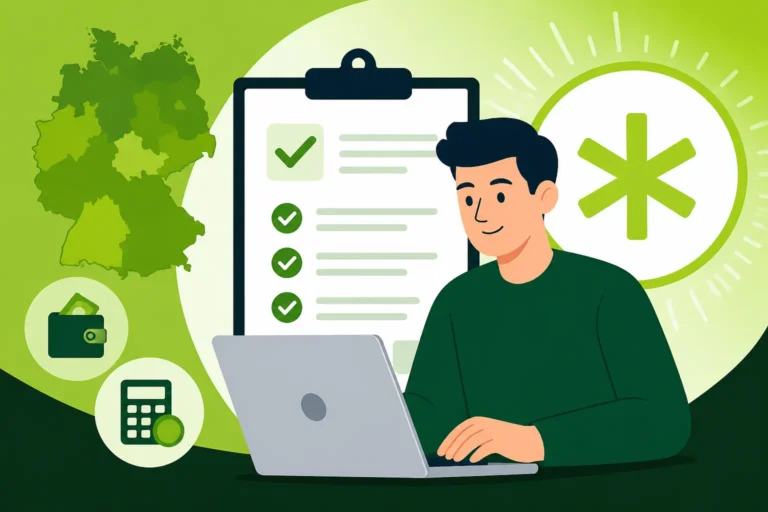
Navigating the German financial system can feel like learning a complex new language, but securing a local bank account is your foundational step to settling in. This comprehensive guide breaks down everything from choosing the right institution and gathering documentation to understanding local card cultures and minimizing fees as a newly arrived expat.
Disclosure: This post may contain affiliate links. We may earn a commission at no extra cost to you if you make a purchase through these links. Read full disclosure.
Understanding the German Banking System
Before you start filling out application forms, it is essential to understand how the German banking landscape is structured. The system is diverse, deeply rooted in regional traditions, and operates somewhat differently from the centralized banking models found in the US, UK, or other European nations. Grasping these foundational concepts will save you significant time and frustration.
Traditional versus Direct Banks
The German banking sector is broadly divided into traditional brick-and-mortar institutions and modern, digital-only direct banks. Traditional banks include private commercial giants like Deutsche Bank and Commerzbank, as well as the massive network of publicly owned savings banks known as Sparkassen, and cooperative banks like Volksbanken. These institutions offer physical branches, in-person advisory services, and extensive ATM networks. However, they are notorious for charging monthly account maintenance fees, sending excessive physical mail, and lacking comprehensive English-language support, which can be a major hurdle for newcomers.
In contrast, direct banks (Direktbanken) operate entirely online or via smartphone apps. These institutions have revolutionized the German market by offering accounts with low or zero monthly fees, streamlined digital applications, and highly intuitive user interfaces. For expats, the biggest draw is often the availability of full English customer service and app navigation. Digital banks like N26 have become the default starting point for many international arrivals because they remove the friction of making in-person appointments and translating dense German contracts.
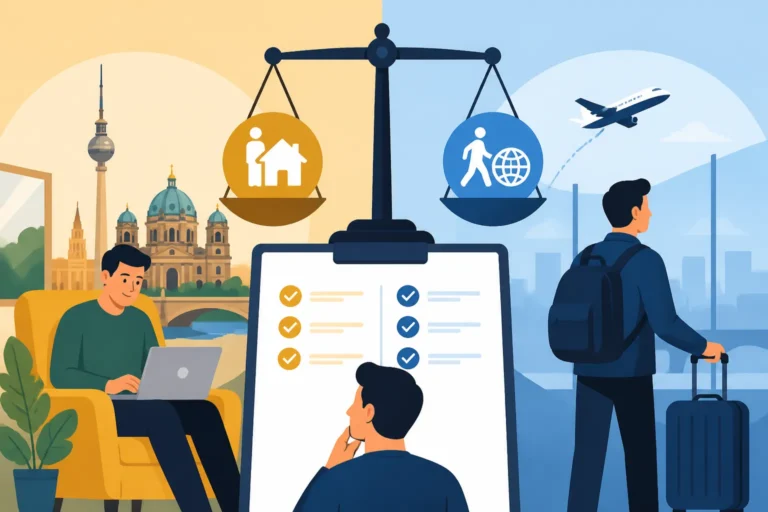
Choosing between the two depends heavily on your specific needs. If you require complex financial products, business loans, or simply prefer shaking hands with a bank manager, a traditional institution might be necessary down the line. But for everyday spending, receiving your salary, and paying rent, direct banks offer a vastly superior and more cost-effective user experience for the newly arrived foreigner.
Types of German Bank Accounts
When opening an account, you will encounter specific German terminology. The most essential account is the Girokonto, which translates to a current account or checking account. This is your primary financial hub. Your salary is deposited here, and you use it to set up direct debits (SEPA-Lastschriftmandat) for your rent, health insurance, electricity, and gym memberships. Without a Girokonto, daily life in Germany is practically impossible to manage.
Beyond the Girokonto, you might want to open a Tagesgeldkonto. This is an instant-access savings account. It typically offers a slightly higher interest rate than a Girokonto, but the money is not tied up; you can transfer it back to your checking account at any time. It is the perfect place to store your emergency fund or save up for your apartment deposit. Another option is the Festgeldkonto, a fixed-deposit account where you lock your money away for a specific term (e.g., one to five years) in exchange for a guaranteed, higher interest rate.
For non-EU students or job-seekers arriving on specific visas, a Sperrkonto (blocked account) is often a mandatory requirement. This is a special type of account where you deposit a legally required sum of money to prove you have the financial means to support yourself for a year. The account is “blocked,” meaning you can only withdraw a set maximum amount each month. It is crucial to set this up well before arriving, as it is a prerequisite for your residence permit.
The Girocard versus Debit and Credit Cards
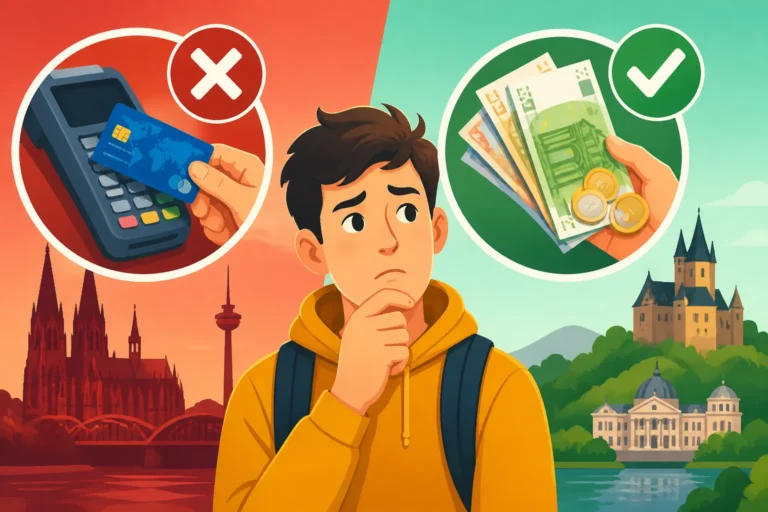
One of the biggest culture shocks for expats is the German card payment system. For decades, Germany ran on a proprietary debit card system known as the EC-Karte, now officially called the Girocard. This card is directly linked to your Girokonto. Even today, many small businesses, bakeries, local restaurants, and government offices (Bürgerämter) will only accept a Girocard or cash. They will actively reject standard Visa or Mastercard debit and credit cards because the merchant processing fees for Girocards are significantly lower.
However, the landscape is shifting. With the rise of direct banks and changes in consumer habits post-pandemic, standard Visa and Mastercard debit cards are becoming much more common. Institutions like N26 issue these globally recognized debit cards by default, which are perfect for online shopping, traveling abroad, and paying at major supermarket chains. But it is still highly advisable to maintain an account that issues a true Girocard, or you will eventually find yourself running to an ATM because a local vendor won’t accept your international card.
True credit cards (Kreditkarten), where you spend the bank’s money and receive a bill at the end of the month, are relatively rare in everyday German life. Germans are culturally debt-averse, and the banking system reflects this. If you do get a credit card from a German bank, it is usually a “charge card,” meaning the full balance is automatically deducted from your Girokonto at the end of every month, rather than allowing you to carry revolving debt and pay interest.
Prerequisites and Required Documents
German banking is heavily regulated, and strict anti-money laundering (AML) laws mean you cannot simply walk into a branch and walk out with an account in five minutes. Gathering the correct documentation beforehand is the most critical phase of the process, and missing a single piece of paper will result in delays.
The Importance of the Anmeldung
The single most significant hurdle for newcomers opening a bank account is the Anmeldung, or certificate of registration. By law, anyone moving into a residence in Germany must register their address at the local citizens’ office (Bürgeramt) within 14 days. You receive a stamped document called the Meldebescheinigung. Almost all traditional banks, and many direct banks, absolutely require this document as proof of your legal residence before they will open a Girokonto for you.
This creates a notorious expat catch-22: you need a bank account to transfer your deposit and pay rent to secure an apartment, but you need an apartment and the resulting Anmeldung to open a bank account. Navigating this requires strategic planning. Some direct banks, recognizing this dilemma, allow you to open a basic account using only your passport and a shipping address, provided you verify your identity. This allows you to get an IBAN immediately to show your landlord, giving you time to complete the official address registration later.
If you are struggling with this bureaucratic loop, it is often best to secure temporary accommodation (like an Airbnb or a furnished short-term rental) that allows you to officially register the address. Once you have that initial Meldebescheinigung, the doors to the entire German banking and bureaucratic system swing wide open. You can read more about mastering this process in our detailed guide to Registering your address in Germany.
Identity Verification Options
Once you initiate an application, you must legally verify your identity. If you apply at a traditional brick-and-mortar branch, you simply hand your passport to the bank clerk. However, if you are applying online with a direct bank, you will typically use one of two remote verification methods: PostIdent or VideoIdent. Understanding how these work is crucial for a smooth onboarding experience.
PostIdent requires you to print a specific coupon provided by the bank, take it along with your passport and Meldebescheinigung to any Deutsche Post branch, and have a postal worker verify your documents in person. The postal worker scans your ID, you sign a digital pad, and the post office securely transmits the verification to the bank. It is highly reliable but requires finding a post office during working hours and waiting in line.
VideoIdent is the faster, modern alternative. Through a secure video call via your smartphone or webcam, a trained agent will ask you to show your passport, tilt it to display the holographic security features, and confirm your personal details. This process takes about ten minutes and can be done from your living room. Modern banking apps like N26 integrate this seamlessly into their signup flow. However, be aware that VideoIdent relies on external verification companies, and their software sometimes struggles to recognize the security features of certain non-EU passports, which might force you to fall back on the physical PostIdent method.
Special Requirements for Non-EU Citizens
While EU citizens generally only need their national ID card and proof of address, non-EU expats face a slightly higher administrative burden. Your passport is mandatory, but you will also usually need to present a valid visa or German residence permit (Aufenthaltstitel). If your visa is still being processed and you only have a temporary entry visa, some traditional banks may be hesitant to grant you a fully functioning account with an overdraft facility, limiting you to a basic “Guthabenkonto” (credit-only account).
Additionally, all applicants must provide their tax identification number (Steueridentifikationsnummer or Steuer-ID). When you complete your initial Anmeldung, the Federal Central Tax Office automatically generates this unique 11-digit number and mails it to your registered address within a few weeks. Banks require this number to report your capital gains taxes to the government. If you haven’t received it yet, most banks allow you to open the account and supply the number within 90 days.
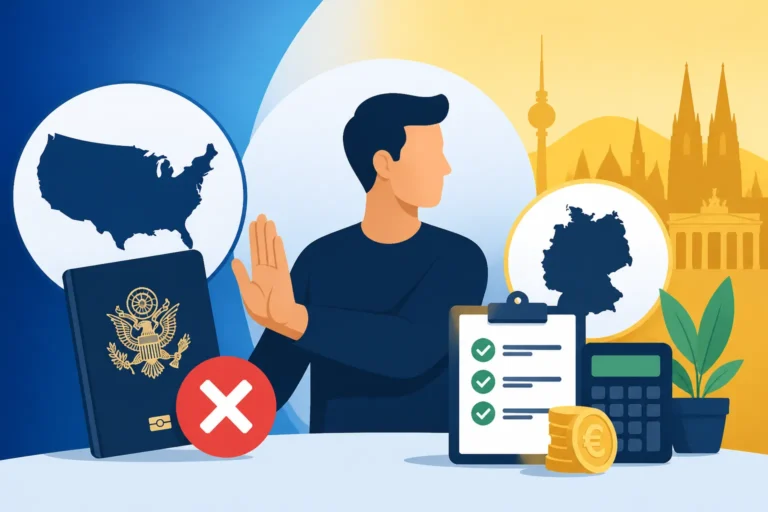
For US citizens, the process includes an extra layer of complexity due to the Foreign Account Tax Compliance Act (FATCA). You will be required to fill out additional forms declaring your US tax residency and providing your Social Security Number. Because FATCA imposes strict reporting requirements on foreign financial institutions, some smaller regional German banks simply refuse to open accounts for US citizens to avoid the administrative headache. As a US expat, you will have much better luck applying with large international banks or progressive digital platforms.
Step-by-Step Guide to Opening Your Account
With your documents prepared and your understanding of the landscape solidified, you can begin the actual process of securing your German bank account. Following a structured approach will ensure you choose the right product and get set up with minimal friction.
Choosing the Right Bank for Your Needs
Your first step is evaluating your lifestyle and financial requirements to select the best provider. If you are a digital nomad, a student, or a young professional who does most of their spending online, prioritize low fees and a great app interface. Mobile-first banks like N26 are highly recommended here; their lack of monthly maintenance fees and clear English interfaces alleviate much of the stress associated with moving to a new country.
If you prefer dealing in cash, you must pay close attention to ATM networks. Traditional banks belong to specific ATM consortiums. The Sparkasse network is the largest, meaning you will find their ATMs in every small village. The Cash Group (Commerzbank, Deutsche Bank, Postbank) is also massive. If you use an ATM outside your bank’s network, you will be hit with steep withdrawal fees, often up to 5 EUR per transaction. Digital banks often bypass this by offering a set number of free withdrawals per month at almost any ATM, which is a massive perk for flexible expats.
Finally, review the fine print regarding monthly fees (Kontoführungsgebühren). Many traditional banks advertise “free” accounts, but bury clauses in the terms and conditions stating the account is only free if a minimum monthly sum (usually 700 EUR to 3,000 EUR) is deposited, representing your salary. If your income fluctuates, or you are arriving without a job, these “free” accounts can quickly start costing you 5 to 10 EUR a month. Comparing these fee structures is vital for long-term budget management.
| Feature | Traditional Banks (e.g., Sparkasse) | Direct Banks (e.g., N26, DKB) |
| Monthly Fees | Usually 3€ – 10€ (unless minimum income met) | Often 0€ (with basic conditions) |
| English Support | Rare, highly dependent on local branch staff | Full English apps and customer service |
| Card Included | Girocard (EC-Karte) | Visa/Mastercard Debit (Girocard sometimes optional) |
| Account Opening | In-person appointment often required | 100% online via smartphone |
| ATM Network | Extensive proprietary networks (free within network) | Free withdrawals at almost any ATM (usually capped per month) |
Navigating the Application Process
If you choose a direct bank, the application process is executed entirely via their website or mobile app. You will be prompted to enter your personal details, email address, physical German address, and tax residency information. Ensure that your name matches your passport exactly; German bureaucracy is unforgiving of discrepancies, and a mismatched middle name can stall your application for weeks.
If you opt for a traditional bank, it is highly recommended to book an appointment (Termin) in advance, rather than just walking in. You can usually do this via their website. When you go to the branch, bring all your physical documents in a neat folder. It is also wise to prepare a few key phrases in German or bring a German-speaking friend, as you cannot guarantee the branch staff will be comfortable explaining complex financial terms in English.
During the application, you will be asked about your employment status and expected monthly income. This is standard procedure and helps the bank determine your eligibility for an overdraft facility (Dispokredit) and a credit card. If you are newly arrived and don’t yet have a credit history in Germany, it is perfectly normal for the bank to deny these credit lines initially. You can easily apply for them later once you have established a steady flow of income into the account.
Receiving Your Cards and PINs
German banking security protocols are deeply rooted in physical mail. Once your account is approved, you will not receive your card and PIN in a single package. To prevent theft, banks utilize a staggered mailing system. Over the course of a week to ten days, your mailbox will receive multiple separate envelopes.
First, you might receive a welcome letter containing your IBAN and account details. A few days later, an envelope containing your physical debit card or Girocard will arrive. A separate envelope, completely unbranded for security reasons, will follow a day or two later containing your four-digit card PIN. Finally, you may receive yet another letter containing your initial login credentials or photo-TAN activation graphics for online banking.
It is absolutely crucial that your name is clearly visible on your physical mailbox at your apartment building. In Germany, mail is delivered to names, not just apartment numbers. If the postal worker cannot find your surname on the letterbox, they will return the bank’s letters to the sender as “undeliverable.” This is a remarkably common issue for newly arrived expats staying in temporary housing and will severely delay your access to your funds. Make sure your name is taped to the box the day you move in.
Managing Your Money as an Expat
Opening the account is just the beginning. As an expat, your financial footprint often spans multiple borders, currencies, and regulatory environments. Setting up efficient systems for moving and growing your money is essential to avoid exorbitant hidden fees and maximize your financial health while living in Europe.
Handling International Transfers
Expats frequently need to move money across borders, whether bringing savings over to fund an apartment deposit, or sending portions of a German salary back home to pay a mortgage or student loans. If you use your standard German Girokonto to execute a SWIFT wire transfer to a non-Eurozone country, you will face two significant financial penalties. First, the bank will charge a high flat fee for processing the international wire. Second, and more insidiously, they will use an internal, highly marked-up exchange rate, keeping the difference as profit.
To protect your wealth from these institutional margins, expats must bypass traditional bank transfers. Utilizing dedicated international money transfer platforms is a non-negotiable strategy. Services like Wise are considered essential expat tools because they utilize the real mid-market exchange rate—the actual rate you see on Google—and charge a low, transparent upfront fee. This can literally save you hundreds of euros on a single large transfer, such as a rental deposit.
Furthermore, platforms like Wise allow you to set up multi-currency accounts, letting you hold Euros, US Dollars, British Pounds, and dozens of other currencies simultaneously. This provides immense flexibility, allowing you to convert money only when the exchange rates are favorable, rather than being forced to accept whatever rate your German bank dictates on the day you need to pay an overseas bill.
Navigating Fees and Hidden Costs
German bank accounts can harbor a variety of hidden fees that slowly erode your balance if you aren’t paying attention. The most common pitfall is the Dispokredit, or authorized overdraft facility. If your account drops below zero, the bank will cover your direct debits, but they will charge you a punitive interest rate, often between 9% and 14% annually. Because rent and utility bills are pulled automatically via direct debit in Germany, failing to monitor your balance can quickly push you into this expensive overdraft zone.
Foreign transaction fees (Fremdwährungsgebühren) are another hazard. If you travel outside the Eurozone (e.g., to Switzerland, the UK, or back to your home country) and use your standard German Girocard or debit card to buy a coffee, your bank will typically slap a 1.5% to 2% fee on the transaction. If you travel frequently, look for a bank account that explicitly offers zero foreign transaction fees, or use a dedicated travel card to avoid these cumulative micro-charges.
Finally, be cautious with paper banking. While the world has gone digital, some traditional German banks still charge you for physical services. Requesting a paper account statement mailed to your home, making a transfer manually with a teller at a branch, or even checking your balance at a physical terminal can sometimes incur small fees ranging from 0.50 EUR to 2.50 EUR. Always opt for digital statements and app-based transfers to keep your banking strictly free. For more tips on everyday budgeting, review our Cost of living in Germany guide.
Investing and Saving in Germany
Once you have established your daily banking routines and built a solid emergency fund, you should look toward long-term wealth building. Keeping large sums of cash in a Girokonto is a guaranteed way to lose purchasing power to inflation, as these accounts generate virtually zero interest. Germany has a strong culture of saving, but navigating the investment landscape requires specific platforms.
The most popular and tax-efficient way to invest in Germany is through ETF savings plans (ETF-Sparpläne). This automated system allows you to invest a set amount (e.g., 100 EUR) every month into broadly diversified index funds. Over time, this takes advantage of compound interest and euro-cost averaging. To do this, you need to open a securities account, known locally as a Depot. While your traditional bank will gladly open a Depot for you, their trading fees and management costs are usually astronomically high.
For expats who want to invest cost-effectively and maintain flexibility, dedicated online brokerages are the way forward. Utilizing a globally recognized platform like Interactive Brokers is an excellent strategy for highly mobile professionals. It offers incredibly low commission rates, access to global stock exchanges, and crucially, you can keep your account and your investments even if your career eventually takes you out of Germany to a new country. This avoids the massive administrative headache and potential tax triggers of having to liquidate and transfer a local German Depot when you move abroad.
Common Challenges for Newcomers
Even with a step-by-step guide, expats inevitably face systemic friction when interacting with German financial institutions. Being aware of these cultural and bureaucratic hurdles allows you to navigate them with patience and strategy, rather than frustration.
The Language Barrier in Banking
The single most pervasive challenge is the language barrier. German financial and legal terminology (Beamtendeutsch) is complex, highly formal, and heavily reliant on compound nouns that can baffle even advanced speakers. When you sign a contract for a bank account or a credit card, you are entering a legally binding agreement governed by stringent German consumer protection laws. If you sign a document you don’t fully understand, you may inadvertently agree to expensive premium account upgrades or costly insurance add-ons.
Traditional banks rarely provide their official terms and conditions (AGB) in English. Even if the teller speaks conversational English, they are legally bound to provide the official documentation in German. This is where direct, modern banks have a massive competitive advantage. Institutions that have built their platforms specifically for the international market offer their entire onboarding process, legal agreements, and day-to-day app interfaces in flawless English.
If you must use a traditional bank, never hesitate to ask to take the contract home before signing. Use translation software to carefully review the fee schedules and cancellation policies, or ask a trusted German-speaking colleague to review the documents with you. In the German legal system, “I didn’t understand the language” is rarely accepted as a valid excuse for breaking a contract.
Dealing with Schufa and Credit Scores
Your Schufa score is the German equivalent of a credit score, and it dictates much of your financial life. The Schufa Holding AG is a private credit bureau that tracks your financial reliability. When you try to rent an apartment, get a post-paid mobile phone contract, or apply for a loan, the vendor will check your Schufa score.
The paradox for newcomers is that when you first arrive, you have no Schufa record. You are essentially a ghost in the system. While a blank Schufa isn’t “bad,” it isn’t “good” either, meaning landlords and telecommunication companies might view you as a high-risk applicant. Opening your first German bank account is the very first step in establishing your Schufa profile.
Every Girokonto, credit card, and mobile phone contract you open is reported to the Schufa. To build a strong score quickly, ensure you never bounce a direct debit, pay all your bills strictly on time, and avoid opening too many bank accounts or applying for multiple credit cards in a short period, as numerous credit checks can temporarily depress your score.
Conclusion
Expats are naturally mobile. You will frequently find yourself managing your finances from airport lounges, hotel lobbies, and bustling Berlin cafes. While German banking apps are highly secure, utilizing public, unencrypted Wi-Fi networks exposes your sensitive financial data to interception by malicious actors. When managing your money, transferring large sums, or simply checking your balance in public spaces, relying on the local cafe’s network security is a dangerous gamble. To protect your digital financial footprint, utilizing a Virtual Private Network (VPN) is highly recommended.
By running your mobile connection through a premium service like NordVPN, you encrypt all data passing between your smartphone and your bank’s servers. This creates a secure tunnel that shields your passwords, account numbers, and personal details from anyone else sharing the public Wi-Fi network. It is a small, inexpensive step that provides immense peace of mind for the digitally active, highly mobile expat.
References
Primary sources (official)
- Federal Financial Supervisory Authority (BaFin): Official guidelines on identity verification requirements, including VideoIdent and PostIdent procedures for the 2026 fiscal year. https://www.bafin.de/EN/Verbraucher/Bank/Produkte/Basiskonto/basiskonto_node_en.html
- Federal Ministry of Justice (BMJ): Legal framework governing the “Payment Accounts Act” (Zahlungskontengesetz), which guarantees every resident the right to a basic bank account. https://www.gesetze-im-internet.de/zkg/index.html
Other helpful sources
- Make it in Germany: The official government portal for international professionals, offering a comprehensive step-by-step checklist for opening a bank account in Germany. https://www.make-it-in-germany.com/en/living-in-germany/money-insurance/bank-account
Disclaimer
The information provided in this article is for educational and informational purposes only and does not constitute financial, legal, or tax advice. While we strive to keep the information accurate and up-to-date, banking fees, regulations, and account requirements in Germany are subject to change. Always independently verify terms, conditions, and fee structures directly with the financial institution before opening an account or signing any contracts. We assume no liability for any financial decisions made based on the contents of this guide.