Claiming German Pension as a Foreigner: Can Non-Citizens Receive State Pension?
Seeing a massive chunk of your gross salary vanish into the German pension system every month, only to wonder if you will ever see a cent of it again, is deeply unsettling. I spent my first two years convinced my contributions were just a sunk, unrecoverable tax. This guide clarifies exactly how non-citizens can either claim a monthly retirement payout or secure a massive lump-sum refund.
Disclosure: This post may contain affiliate links. We may earn a commission at no extra cost to you if you make a purchase through these links. Read full disclosure.
Understanding the German State Pension System for Expats
When you receive your first German payslip, the deductions can be genuinely shocking. The largest of these deductions is usually the Rentenversicherung (RV), the statutory German pension insurance.
Currently, the mandatory contribution rate is set at 18.6 percent of your gross salary (up to a specific income ceiling). Fortunately, you do not pay this entire amount yourself. The burden is split equally between you and your employer, meaning 9.3 percent is deducted from your paycheck, and your employer matches that exact amount. While this system works perfectly for locals who will live in Munich or Berlin until they are eighty, it creates an incredibly confusing dynamic for highly mobile expats who only plan to stay for a few years.
The Five-Year Minimum Qualifying Period (Wartezeit)
To be legally entitled to a lifelong monthly pension payout when you reach the standard German retirement age (currently scaling up to 67 years old), you must hit the Wartezeit—the minimum qualifying period.
In Germany, the absolute minimum qualifying period is five years (exactly 60 months) of contributions. If you work in Germany for six years and then move to Singapore or back to the United States, your contributions are vested. You are permanently locked into the system, and when you turn 67, the Deutsche Rentenversicherung (DRV) will pay you a monthly pension based on those six years of work, regardless of where you live in the world. Tracking your progress toward this 60-month threshold begins the moment you register your address and receive your social security number, a foundational step mapped out in German Bureaucracy 101: Understanding the Anmeldung, Schufa, and Tax ID.
How Totalization Agreements Save Your Contributions
But what happens if you only work in Germany for three years and then leave? Do you lose that money because you failed to hit the 60-month mark?
This is where international law steps in to protect you. Germany has signed bilateral social security agreements (often called Totalization Agreements) with over 20 non-EU countries, including the United States, Australia, India, Canada, Brazil, and the UK. If you are a citizen of one of these treaty countries, you can combine the years you worked in your home country with the years you worked in Germany.
For example, if you worked in the US for ten years, and then worked in Germany for three years, the DRV recognizes your combined thirteen years of global labor. You instantly bypass the 5-year German minimum. When you retire, Germany will pay you a partial monthly pension specifically calculated for the three years you contributed to their system. Understanding how these international treaties intersect with your long-term wealth is just as critical as understanding the rules covered in Taxing Worldwide Income: How Germany Taxes Foreign Income and Assets.
Leaving Germany Early: The Pension Refund (Beitragsrückerstattung)
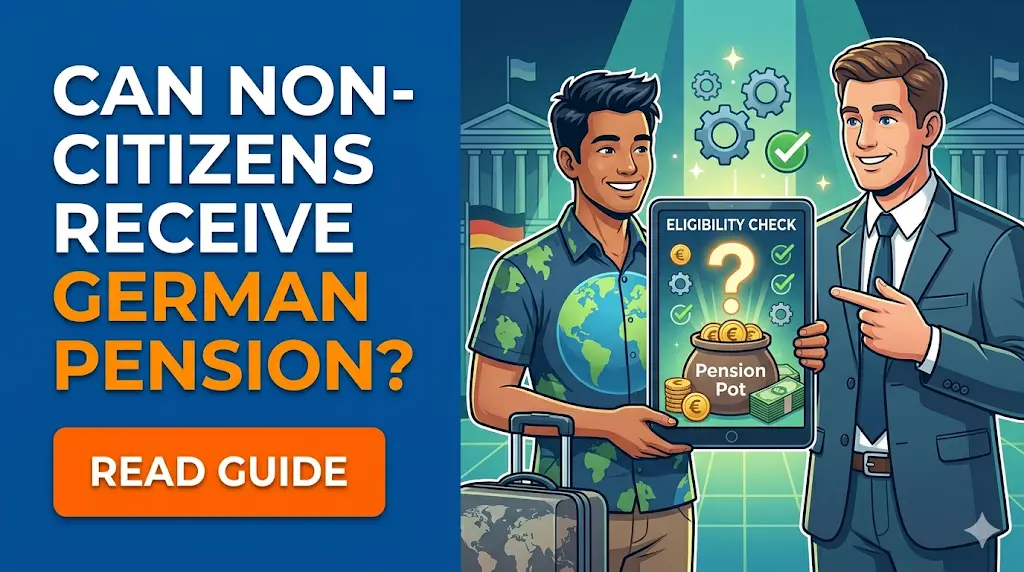
If you are a non-EU citizen and you leave Europe after working in Germany for a short period, you might not want a tiny monthly pension payout forty years from now. You might want your cash back today. This is called a Beitragsrückerstattung (pension contribution refund).
The Strict 24-Month Waiting Period
The German government does not make it easy to extract your capital. You cannot simply apply for a refund at the airport on your way out. To successfully claim your refund, you must meet incredibly strict criteria:
- You must be a non-EU citizen.
- You must reside outside the European Union.
- You must wait exactly 24 months from the date of your last German pension contribution.
For two full years, you cannot pay a single cent into the German pension system, nor can you be legally obligated to do so. This waiting period feels like the government is holding your money hostage, but it is a strict legal requirement. If you move back to Germany in month 23 and start working, the clock resets, and your refund is canceled. Securing the necessary deregistration paperwork before you leave is the only way to prove to the DRV exactly when your waiting period began, a process thoroughly detailed in What Happens to Your Bank Account When You Leave Germany? Closing Accounts Properly.
The Treaty Trap: When Refunds Are Denied
Here is the most devastating caveat that catches expats off guard: If you are from a country with a Totalization Agreement (like the US, India, or Australia) and you hit the 60-month contribution mark, you are legally barred from getting a refund. Because the treaty guarantees you a lifelong monthly pension when you hit 60 months, the DRV considers you fully vested and prohibits early withdrawals. You can only claim a cash refund if you contributed for 59 months or less. If you are at 58 months and considering a new job offer outside of Germany, staying for two more months will permanently lock tens of thousands of euros inside the European system until you are 67.
What You Actually Get Back
If you successfully apply for the refund (usually by submitting form V0901 to the DRV), you must prepare yourself for a brutal mathematical reality.
You only get your half of the contributions back. The 9.3 percent that was deducted from your gross salary will be refunded to you in a lump sum. The 9.3 percent that your employer matched is forfeited entirely to the German state. Furthermore, the DRV does not pay a single cent of interest on your money, even if it has been sitting in their coffers for four years. Despite this, receiving a lump sum of €15,000 or €20,000 is a massive capital injection that can dramatically alter your financial trajectory if handled correctly.
| Feature | Pension Refund (Beitragsrückerstattung) | Monthly State Pension (Altersrente) |
| Eligibility | Non-EU citizens who left Europe 24+ months ago. | Anyone with 60+ months of contributions (or combined via treaty). |
| What You Receive | A one-time lump sum of your employee contributions (9.3%). | A lifelong monthly payment starting at retirement age. |
| Employer Contributions | Forfeited entirely. | Retained and factored into your monthly payout. |
| Impact of Bilateral Treaties | Prohibits refund if you reach 60 months of contributions. | Allows you to combine years worked abroad with German years. |
Claiming Your Monthly Pension from Abroad
If you choose not to take the refund—or if you are legally barred from taking it because you hit the 60-month threshold—you will eventually need to claim your monthly pension.
When you approach retirement age, you must actively submit a pension application to the DRV; it does not start automatically. If you live abroad, you can initiate this through your local German embassy or consulate.
To ensure fraud does not occur, the DRV requires expats living outside of Germany to submit an annual Lebensbescheinigung (Life Certificate). This physical document must be signed and stamped by an official authority in your home country (like a notary, a bank manager, or a local police station) to prove you are still alive to receive your checks. Failing to return this document promptly will result in an immediate suspension of your monthly pension payout.
Managing Cross-Border Pension Logistics
Whether you are waiting 24 months to receive a massive €20,000 lump-sum refund, or you are a retiree receiving €400 a month in a foreign country, relying on traditional banking infrastructure to move this money across borders is a terrible financial strategy.
Navigating Exchange Rates and Banking Fees
If the DRV wires your lump-sum refund directly to your traditional bank account in the US or the UK, the transfer will be routed through the SWIFT network. Your home bank will apply a predatory “bank exchange rate,” silently shaving 3 to 5 percent off your principal amount. On a €20,000 refund, you could lose €1,000 purely to invisible conversion spreads. Deciphering these catastrophic fees is a frustrating reality explored in Understanding German Bank Statements: Fees and Transactions Explained.
To bypass the SWIFT network entirely, you can use Wise to receive the DRV refund natively in euros. You simply provide the DRV with your Wise Euro IBAN on the refund application. Wise allows you to receive the funds natively and then convert the lump sum to your home currency at the exact, transparent mid-market exchange rate. Years down the line, if you are receiving a monthly pension payout, having the DRV send it to your Wise account prevents your home bank from skimming a percentage off every single pension check.
If you plan to claim your refund 24 months after leaving, maintaining a functional Euro account in the interim is vital. Because N26 allows you to keep a digital checking account open without punishing you with absurd monthly maintenance fees while you wait out the 24 months abroad, it serves as the perfect landing pad for your eventual government payout. Tracking your daily budget and ensuring you have the right infrastructure to catch these payments is deeply analyzed in Cross-Border Banking: Managing Your Home Country Account While in Germany.
Bridging the Retirement Gap with Global Investments
The harsh reality of the German statutory pension is that, due to demographic collapse, it will not be enough to sustain a comfortable retirement. Whether you wait for the monthly payout or extract your capital via an early refund, you must actively manage your own wealth.
If you successfully endure the 24-month waiting period and receive a massive cash refund, the worst thing you can do is let it sit in a zero-interest savings account or blow it on a depreciating asset like a car. You must put that capital back to work. Once your refund arrives, sweeping it into Interactive Brokers allows you to buy globally diversified ETFs and equities with incredibly low execution fees.
Unlike traditional German banks that aggressively force you to close your Depot (brokerage account) the moment you deregister your address, Interactive Brokers travels with you. Because it caters to a highly mobile international client base, you can compound your retirement wealth across borders without triggering forced liquidation events. Understanding how to legally declare and invest these massive capital injections without triggering localized tax audits is a sophisticated strategy detailed in Moving Money to Germany: Declaring Savings and Large Transfers. Ultimately, treating your German pension not as a sunk cost, but as a carefully calculated component of your broader global portfolio, is the true hallmark of a financially integrated expat. For further insight on balancing these outcomes against your overall budget, review Cost of Living in Germany: Breakdown of Expenses (Rent, Food, Transport). To ensure your financial paperwork is perfectly aligned when dealing with state authorities, checking your final Understanding Your Tax Assessment (Steuerbescheid): After You File in Germany is always recommended.
References
Primary sources (official)
- Deutsche Rentenversicherung – International: The official English-language portal of the German pension authority explaining bilateral agreements, adding together global periods of insurance, and the rules surrounding international payouts. https://www.deutsche-rentenversicherung.de/DRV/EN/International/international_node.html
- German Missions in Australia – Pension Services: An excellent, plain-English breakdown by the German foreign office detailing exactly how to apply for the Beitragsrückerstattung (refund) from abroad and the mandatory Life Certificate (Lebensbescheinigung) process for retirees. https://australien.diplo.de/au-en/service/old-age-pension-1899664
Other helpful sources
- Pensionfriend – German Public Pension Refund: An in-depth financial advisory guide mapping out exactly which nationalities face the 60-month treaty trap and whether taking the cash refund mathematically outperforms waiting for the monthly payout. https://pensionfriend.de/en/refund-public-pension-germany.ap
- IamExpat – Germany Pension Refund Guide: A highly practical expat resource explaining the 24-month waiting rule, the exact 9.3% calculation of employee contributions, and the bureaucratic steps required to initiate the claim. https://www.iamexpat.de/expat-info/germany-news/germany-pension-refund-how-expats-can-claim-back-their-pension-contributions
Disclaimer
The information provided in this article is for general informational and educational purposes only and does not constitute professional financial, tax, or legal advice. German pension laws regarding the minimum qualifying period (Wartezeit), contribution refunds (Beitragsrückerstattung), and the application of bilateral Totalization Agreements are highly complex and strictly enforced by the Deutsche Rentenversicherung (DRV). If you surpass 60 months of contributions as a citizen of a treaty country, you are generally legally barred from receiving a lump-sum refund.