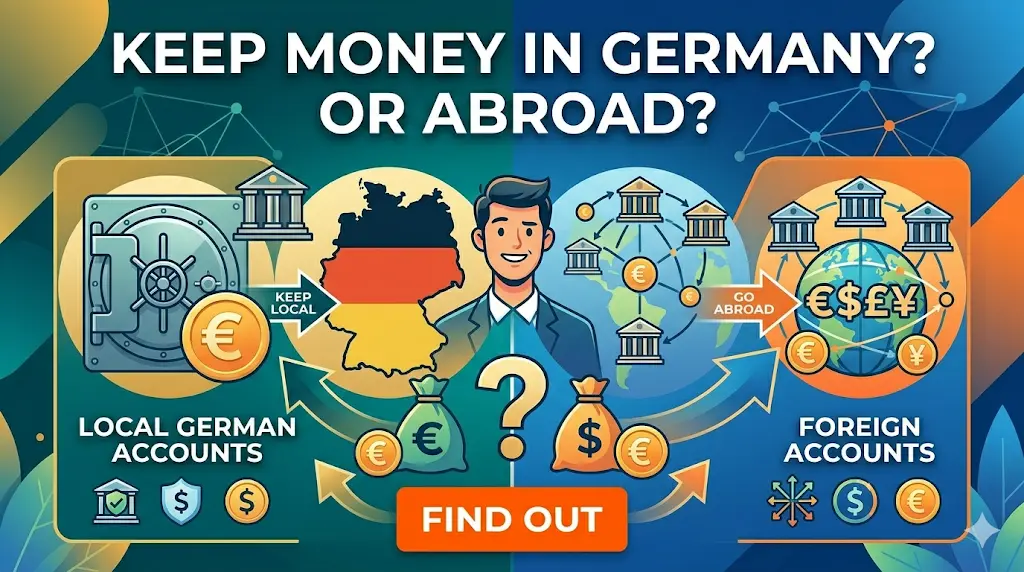
Should You Keep Your Money in Germany or Abroad? Pros and Cons of Local vs Foreign Accounts
Trying to pay my first Berlin apartment deposit from my US checking account resulted in a blocked international wire and a highly suspicious landlord threatening to cancel my lease. I spent months agonizing over whether to move my entire life savings into the rigid German banking system or leave it stranded abroad. This guide breaks down the pros, cons, and tax realities of splitting your wealth across borders.
Disclosure: This post may contain affiliate links. We may earn a commission at no extra cost to you if you make a purchase through these links. Read full disclosure.
The Local Necessity: Why You Cannot Avoid German Banking
Many expats arrive with premium, zero-fee travel credit cards from their home countries and assume they can completely bypass the notorious German banking bureaucracy. This illusion usually shatters the moment they try to sign a cell phone contract or register for internet.
The Tyranny of the SEPA Direct Debit (Lastschrift)
The German economy runs on the SEPA Direct Debit mandate (Lastschriftverfahren). Instead of you manually logging in and paying a bill every month, your landlord, your public health insurance provider, and your internet company will demand the right to automatically pull the funds directly from your checking account.
While European financial law dictates that utility companies and landlords must accept any valid European IBAN (a concept known as SEPA equality), the reality on the ground is starkly different. “IBAN discrimination” is rampant. Many local landlords, regional gyms, and outdated municipal utility providers use archaic software that simply rejects any IBAN that does not begin with “DE” (Germany). Attempting to navigate daily life without a native German IBAN is an exercise in utter frustration. Trying to fight a German property management company over European banking directives while your rent is overdue is a battle you will not win. Surviving these mandatory domestic setups is deeply explored in How to Pay Rent and Bills in Germany: Banking Tips for Expats.
The Schufa Catch-22 and Mobile Banking
To secure an apartment, you need a clean credit report from the local credit bureau, the Schufa. However, building a clean Schufa history requires you to have local financial contracts, like a registered bank account. If your entire financial life remains abroad, your Schufa is functionally blank, making you an undesirable candidate for landlords.
Traditional German banks (like the local Sparkasse) make opening an account nearly impossible for non-German speakers, demanding in-person appointments and mountains of paperwork. To bridge this gap without the analog headache, veteran expats open their primary daily account with N26. Because N26 provides a fully licensed, native German IBAN via an English-first smartphone app, you bypass the archaic branch appointments entirely. You instantly secure the local financial footprint necessary to build your credit profile, satisfying both your landlord and the Schufa algorithm. Integrating this localized digital tool is a crucial survival step outlined in Mobile Banking Apps in Germany: N26, Revolut, and More. Building this foundation correctly from day one helps you overcome the hurdles discussed in German Bureaucracy 101: Understanding the Anmeldung, Schufa, and Tax ID.
Keeping Money Abroad: Tax Reporting and Transfer Traps
Retaining your bank accounts in your home country is absolutely essential for managing student loans, foreign mortgages, or simply keeping a psychological safety net. However, the German state places massive regulatory obligations on residents who maintain wealth offshore.
Unlimited Tax Liability (Unbeschränkte Steuerpflicht)
The most dangerous assumption expats make is thinking that the German tax office (Finanzamt) has no jurisdiction over the savings accounts sitting in their home country.
Under Section 1 of the German Income Tax Act (EStG), if you live and work in Germany, you are subject to unlimited tax liability (unbeschränkte Steuerpflicht). This means you must declare your worldwide income. If you have a high-yield savings account in the UK, the US, or India generating interest, every single cent of that interest is fully taxable in Germany under the standard capital gains tax rate (Abgeltungsteuer).
Foreign banks do not automatically report or withhold this tax for the German government. The administrative burden of calculating your foreign interest, converting it to euros on the exact date of receipt, and manually declaring it on your annual tax return (Anlage KAP) falls entirely on your shoulders. Failing to report this offshore yield is considered tax evasion. You cannot hide your money by leaving it abroad. Understanding the strict global reporting requirements enforced by the German state is vital, a reality thoroughly explored in Taxing Worldwide Income: How Germany Taxes Foreign Income and Assets.
The AWV-Meldepflicht and Moving Capital Safely
When you eventually decide to move a large chunk of your foreign savings into Germany—perhaps for a real estate down payment or to buy a car—you face a dual threat: legacy bank fees and strict federal reporting laws.
If you wire a massive sum from a foreign traditional bank to your German checking account, the banks will use the archaic SWIFT network. They will apply a catastrophic exchange rate markup, quietly skimming thousands of euros off your principal amount before it ever reaches Germany. To protect your capital from this legalized theft, you must bypass legacy networks. Utilizing Wise allows you to convert your foreign currency into euros at the true mid-market exchange rate. You simply initiate the transfer through Wise, ensuring your money crosses the border without bleeding value to hidden bank markups.
However, escaping the bank fees does not exempt you from federal law. Under the German Foreign Trade and Payments Ordinance (Außenwirtschaftsverordnung), any cross-border transfer exceeding 12,500 euros must be officially reported to the Deutsche Bundesbank. This is known as the AWV-Meldepflicht. This is strictly for statistical purposes, not for taxation, but failing to call the Bundesbank hotline to report the incoming transfer can result in severe fines. Navigating these massive cross-border capital flows safely while remaining legally compliant is a foundational step detailed in Moving Money to Germany: Declaring Savings and Large Transfers.
Strategies for Long-Term Wealth and Investments
If you plan to stay in Germany for several years, you will eventually generate a surplus of euros from your local salary. Deciding where to invest this localized wealth is the final, most complex piece of the expat financial puzzle.
Why Domestic Brokers Fail Mobile Expats
The instinct for many new arrivals is to open a brokerage account with a popular domestic German app like Trade Republic or Scalable Capital to begin investing their euros. While these platforms handle the local capital gains tax withholdings automatically, they structurally fail highly mobile expats.
German domestic brokerages are legally designed strictly for German tax residents. If you get a promotion and your company relocates you from Frankfurt to Dubai, Singapore, or back to London, you must deregister your German address (Abmeldung). The moment you lose your German residency, these domestic platforms will frequently freeze your account and force you to liquidate your entire portfolio. Liquidating your assets triggers a massive, immediate capital gains tax event, effectively destroying years of compound interest simply because you crossed a border.
The Case for a Globally Compliant Brokerage
To build wealth that survives international relocation, you must decouple your long-term investments from rigid local banking laws. Veteran expats prioritize liquidity, compound growth, and geographic freedom above all else.
By opening your primary portfolio with Interactive Brokers, you insulate your future net worth from German domestic restrictions. Interactive Brokers operates across multiple international jurisdictions and caters specifically to a highly mobile demographic. You can invest your surplus euros into globally diversified ETFs with phenomenally low execution fees. If you leave Germany, your portfolio simply moves with you; you are not forced to liquidate.
Furthermore, Interactive Brokers generates localized European tax reports, keeping your investments perfectly legible and compliant with the Finanzamt while you are a resident, without locking you into the country permanently. Protecting your surplus wealth while navigating local residency laws is a sophisticated strategy detailed in Should You Invest in German or International Stocks? Diversifying as an Expat. Learning to orchestrate this efficient, low-cost capital flow across borders is a vital survival mechanism detailed in Cross-Border Banking: Managing Your Home Country Account While in Germany.
Structuring a Hybrid Financial Ecosystem
You do not have to choose strictly between local and foreign accounts; financial survival requires maintaining a strategic hybrid of both.
Balancing Local Liquidity with Global Reach
The optimal expat financial setup utilizes highly specialized tools for specific jobs rather than relying on one sluggish legacy bank to do everything poorly. You need a local hub for daily survival, a low-cost bridge for moving capital, and a borderless vault for your future wealth.
If you orchestrate this correctly, you will never pay a 3 percent foreign transaction fee on a streaming service again, nor will you fail to pay your rent on time. Furthermore, keeping these channels clearly separated ensures that when the time comes to file your annual taxes, your domestic income and your foreign capital gains are cleanly documented, preventing a nightmare scenario when you receive your Understanding Your Tax Assessment (Steuerbescheid): After You File in Germany.
Summary Comparison of Local vs Foreign Accounts
| Financial Goal | Optimal Strategy | Key Benefits | Major Pitfalls to Avoid |
| Paying Rent & German Bills | Local German Account (e.g., N26) | Solves IBAN discrimination; establishes Schufa history | Legacy German banks with high fees and no English support |
| Holding Emergency Funds | Foreign Account or Multi-currency wallet | Psychologically separate; protects home currency | Hiding interest from the Finanzamt (Unlimited Tax Liability) |
| Cross-Border Transfers | FX Specialist (e.g., Wise) | True mid-market exchange rate; bypasses SWIFT fees | Forgetting the €12,500 AWV-Meldepflicht Bundesbank report |
| Long-Term Investing | Global Brokerage (e.g., Interactive Brokers) | Avoids forced liquidation if you leave Germany | Using domestic brokers that lock you to a German address |
References
Primary sources (official)
- Deutsche Bundesbank – AWV-Meldepflicht: The official central bank guidelines detailing the mandatory reporting of all incoming and outgoing cross-border payments exceeding 12,500 euros for statistical purposes. https://www.bundesbank.de/en/service/reporting-systems/external-sector/electronic-submission/awv-meldepflicht-618452
- Bundeszentralamt für Steuern (BZSt): The Federal Central Tax Office’s official legal breakdown of unlimited tax liability (unbeschränkte Steuerpflicht) and how worldwide income is assessed for German residents. https://www.bzst.de/EN/Private_individuals/Tax_identification_number/tax_identification_number_node.html
Other helpful sources
- Make it in Germany – Bank Account: The federal government’s official portal outlining the rights of international workers regarding basic payment accounts, SEPA functionalities, and local registration. https://www.make-it-in-germany.com/en/living-in-germany/money-insurance/bank-account
- Freelancermap – AWV-Meldepflicht: A highly practical, plain-English breakdown of how to actually call the Bundesbank hotline, what information you must provide, and the severe financial penalties for failing to report foreign transfers. https://www.freelancermap.de/blog/awv-meldepflicht/
Disclaimer
The information provided in this article is for general informational and educational purposes only and does not constitute professional financial, tax, or legal advice. Under Section 1 of the German Income Tax Act (EStG), residents are subject to unlimited tax liability and must declare all worldwide income, including offshore interest and capital gains. Cross-border financial transfers exceeding 12,500 euros are strictly subject to the AWV-Meldepflicht reporting requirements established by the Deutsche Bundesbank. Always consult a certified, independent tax advisor (Steuerberater) regarding the declaration of complex foreign assets.